


|
The Bangkok to Chiang Mai sleeper is a classic Thai experience
|
|
Click for interactive train route map...
|
|
 |
|
|
|
The best way to get around
Thailand has one of the best metre-gauge rail systems in the world and the best way to get around & see the country is by train. It's comfortable, safe, cheap, environmentally friendly and unlike flying it's a genuine Thai experience. Ride the train from Bangkok to Chiang Mai or take train+ferry or train+bus from Bangkok to Ko Samui, Phuket or Krabi. You can travel Bangkok-Vientiane, Bangkok-Cambodia or Bangkok-Penang-Kuala Lumpur-Singapore by train, too. The 1,200-mile journey from Bangkok to Singapore takes 48 hours & costs only $80/£55. This page has schedules & fares for key train routes in Thailand and explains how to buy tickets.
Bangkok Krung Thep Aphiwat Central station now open! The new Krung Thep Aphiwat Central Station (KTW) opened on 19 January 2023 and all long-distance trains now start/terminate there instead of Bangkok's original Hualamphong station.
 How to buy
train tickets online
How to buy
train tickets online
How to buy
tickets at the station
Bangkok's new Krung Thep
Aphiwat Central station
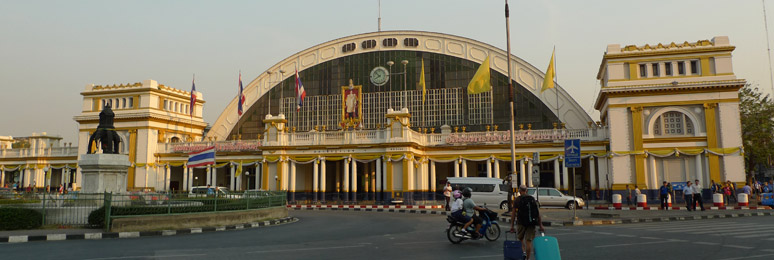
Bangkok's original Hualamphong station
Luggage, left luggage, taking bikes & motorbikes
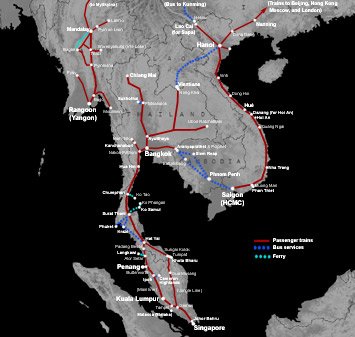
Map of train
routes in Southeast Asia
Times & fares for popular routes
Bangkok
to Nong Khai for Laos
Bangkok to Aranyaprathet & Cambodian border
Bangkok
to Kanchanaburi, River Kwai & Nam Tok
Bangkok to Samut Songkhram
- the Market train
Bangkok to Hua Hin, Surat
Thani, Hat Yai & S.Kolok
Bus & ferry links
Bangkok to
Koh Tao
by train+ferry
Bangkok
to Ko Samui, Ko Phangan by train+ferry
Bangkok to
Phuket
by train+bus
Bangkok to the Phi Phi islands
Bangkok to Sukhothai by train+bus
Bangkok to Chiang Rai by train+bus
Ko Samui - Phuket by ferry+bus
Singapore, Kuala Lumpur
& Penang to
Ko Samui
Singapore, Kuala Lumpur & Penang to Phuket
Singapore, Kuala Lumpur &
Penang to Krabi
International trains & buses
Bangkok to Penang, KL & Singapore by train
Bangkok to Singapore by Eastern & Oriental
Express
Bangkok to
Siem Reap, Phnom Penh & Cambodia
Bangkok to Vientiane & Laos by train
Bangkok to
Moulmein, Yangon & Burma
Bangkok to Saigon & Vietnam
by train & bus
Saigon to Hanoi &
Hanoi to
Beijing by train
Train travel in Singapore & Malaysia
Europe to Thailand by
Trans-Siberian Railway
Other useful information
Useful country information:
visas, time zone...
Suggested hotels in Bangkok & Chiang Mai
Travel insurance, mobile data,
VPN & other tips
Useful country information
General train travel information
How to check train times & fares
-
Check train times at the official State Railways of Thailand website, www.railway.co.th. Click Enter website to enter the English version and click Timetables. Or use the booking systems explained here.
I also highly recommend Richard Burrow's Thai Train Guide, www.thaitrainguide.com.
It helps to know the line names: Northern Line = Bangkok to Chiang Mai. Southern Line = Bangkok to Hua Hin, Surat Thani & Hat Yai and the line to Kanchanaburi & River Kwai. Northeastern line = Bangkok to Udon Thani. Eastern line = Bangkok to the Cambodian border.
Map of the Thai train network
-
See an interactive route map showing trains & connecting buses & ferries across Southeast Asia.
Are the trains on time?
-
Check real-time train running information online (including on your phone when in Thailand) at ttsview.railway.co.th.
Buses
-
You'll need to use buses where there are no trains, for example Phuket to Koh Samui. There are many bus operators in Thailand, check times & you can buy tickets for bus, train & ferry routes throughout Thailand using 12Go.Asia or www.baolau.com.
Bangkok Airport rail link
-
Suvarnabhumi airport: A modern rail link between Suvarnabhumi airport and central Bangkok opened in 2010, see www.srtet.co.th or www.bangkokairporttrain.com. Fast trains run about every 15 minutes 06:00-24:00 from Suvarnabhumi Airport to the City Air terminal at Makkasan (22 minutes, 35 baht) and Phaya Thai Skytrain station in the city centre (26 minutes, 45 baht). There is interchange with the MRT (metro) at Phetchaburi station and with the Skytrain at Phaya Thai station. It does not directly serve Bangkok's main Hualamphong station.
-
Don Muang airport: State Railways of Thailand trains between Bangkok and Ayutthaya, Chiang Mai & Nong Khai (for Vientiane in Laos) call at Don Muang station, right next to the old Bangkok Airport, about 50 minutes (22 km) from central Bangkok. However, most long-haul flights were transferred from the original Dong Muang Bangkok Airport to the new Bangkok Suvarnabhumi Airport in 2006.
How to buy train tickets online
Do you need to buy in advance?
-
No, if all you want is a local ticket such as Bangkok to Kanchanaburi, Ayutthaya, Hua Hin or Aranyaprathet as these are only sold at the station on the day. They cannot sell out!
-
No, even for longer distance trains if you want to stay flexible and are prepared to risk the specific train or class you want being fully-booked. There are often places available even on the day or a few days before, at least outside peak periods, as long as you're prepared to take an alternative train, class or date if your first choice is full.
However, sleepers on the best trains often sell out weeks ahead, especially at the Thai holiday periods such as New Year (30 December to 3 January) & Songkran (Thai New Year, usually 11-16 April). To be sure of a place, book ahead if you can.
1st class sleepers usually sell out very quickly as there's only one 1st class sleeping-car on the few trains which have them. The trains with the newest Chinese-built sleeping-cars are the most popular, especially on the Bangkok-Chiang Mai route, those should be booked as far ahead as possible.
-
Yes, always book ahead if you want to be sure of a ticket in a specific class on a specific train & date for a long distance journey as Bangkok to Chiang Mai. Booking in advance is essential at peak periods. To buy tickets online, read the section below.
-
To buy tickets all the way to Penang, Kuala Lumpur & Singapore, see the Bangkok to Singapore page.
When does booking open?
-
Booking horizons changed again in mid-2024:
-
Booking for most long distance journeys such as Bangkok to Chiang Mai opens up to 6 months ahead.
-
Booking for trips of between 25% & 59% of a long-distance train's journey opens 30 days ahead.
-
Booking for trips of less than 25% of a long-distance train's journey only opens 1 day ahead.
 Tickets can be collected in Bangkok, Chiang Mai or Surat Thani, or for an extra fee sent by registered post to addresses worldwide. |
Option 1, buy online at 12Go.Asia
-
You can order Thai train tickets online from reliable agency 12go.asia.
-
When to book
You must book at least 3 days ahead. Their system shows current seat & berth availability, although they don't offer real-time online booking, their staff procure the ticket for you manually.
12go.asia will take bookings months ahead but remember they can only buy your tickets when State Railways of Thailand open reservations.
-
Ticket delivery
If 12go.asia can source your tickets from SRT's online system, this produces an e-ticket which they can email you and you can board the train with it.
However, only a % of places are allocated to SRT's online system. When these sell out 12go use the regular SRT booking system and hard-copy tickets then need to be collected. You can choose to collect from one of several possible collection points, at least 60 minutes before your train leaves:
(1) Bangkok: 12go.asia's collection counter is in Metro Mall, a shopping centre at MRT Chatuchak station, which is two stops from Bang Sue station on the MRT Blue Line. Open 09:00-20:00 every day. There's no added fee for collecting here.
(2) Chiang Mai: You can collect tickets from the 24h Bossotel hotel reception across the road from Chiang Mai station, 70 baht fee, or from the station baggage room for 150 baht fee.
(3) Surat Thani: You can collect tickets from the station parcels office, open 24h.
(4) Don Muang airport: You can collect here if heading north, open 09:00-20:30.
(5) Nong Khai: You can collect from the station baggage office, for a 150 baht fee.
(6) Ayutthaya: You can collect from the parcels office.
(7) Bang Sue: You can collect from the parcels office for 100 baht fee, open daily 08:00-17:00. Bang Sue junction station is adjacent to the new Krung Thep Aphiwat Central station.
Alternatively, you can choose to have tickets sent by express post to an address in Thailand (although they won't send to Thai islands after many lost tickets). This option costs an extra 100 baht ($3).
-
Payment & booking fee
12go.asia charge the regular Thai Railways fare plus a reasonable 250 baht ($7.50) booking fee and a small PayPal payment fee (3.4% + 11 baht). The price they show for each train includes the 250 baht fee but not the PayPal fee. You pay securely via PayPal, either using a credit card or your own PayPal account, or you can choose their Visa or MasterCard payment channel provided by Omise which is a bit cheaper. There's no additional delivery fee if you collect tickets in Bangkok or Chiang Mai, and just a small ($4) fee for collection at Surat Thani.
-
Which trains & routes can 12go.asia sell?
Most State Railways of Thailand routes, trains & classes are loaded on the 12go.asia system, but not every class on every route between every station, so bear that in mind. It won't sell tickets for local trains such as Bangkok to Kanchanaburi, Hua Hin or Aranyaprathet as you need to buy these on the day at the station. But the most popular longer-distance trains, routes & classes are bookable online. They can even sell the combined train+bus/ferry tickets from Bangkok to Phuket, Krabi, Koh Samui, Koh Phangan & Koh Tao (although only in the outward direction in the case of Phuket & Krabi), and they can book the International Express between Bangkok and Butterworth in either direction. 12go.asia can also book buses & ferries around Thailand, and now it can also book Malaysian KTM trains too.
-
Tip: If you want one whole 1st class 2-berth compartment for two people, buy two 1st class tickets, selecting one upper and one lower berth, they will then book you together in one compartment. Make sure you select the option to book 2nd class if 1st class sleepers are full, see my advice on this here!
-
Feedback is always appreciated. So far, seat61 correspondents report good & helpful service.
Option 2, buy at www.baolau.com
-
Reliable Asian train & bus ticketing agency www.baolau.com also sells Thai train tickets through a direct connection to State Railways of Thailand's own online sales system. A big plus is that www.baolau.com allows you to select an exact seat choice from a numbered seating plan.
-
You print your own ticket, so ticket delivery is simplified, just be aware that only a certain percentage of all the berths or seats on each train is made available through SRT's online system. That means that trains or classes may be shown as sold out when in fact some seats or berths remain available, so it's worth checking 12go.asia as they can access all the seats and berths.
Option 3, order from a Thai travel agency
-
Alternatively, you can arrange Thai train tickets with various Thai travel agencies including www.travelconnecxion.com. They can have tickets waiting for you at your hotel in Bangkok for a small fee. Remember that you can't book before reservations open.
Option 4, buy from State Railways of Thailand
-
State Railways of Thailand has its own online booking system. It's had a chequered history, but the current system can be found at www.dticket.railway.co.th. It's slow to open, but it has an English version and it will accept most overseas credit cards, so you can use it to book tickets if you like.
-
For Bangkok, you should enter Krung Thep Aphiwat Central as your origin or destination rather than plain Bangkok if your train starts/terminates there (as most long-distance trains now do). Trains with the latest Chinese-built sleepers are shown as Special Express CNR.
-
If you have any problems using SRT's D-ticket system, or if it won't accept your credit card, use www.baolau.com or 12go.asia instead. These are quicker and easier to use, being designed for western visitors.
How to buy tickets at the station
It's easy to buy tickets at the station when you get to Thailand, but remember to take your passport, as it may now be required to buy a ticket. All long-distance express trains require a reservation. Reservations are computerised, and the booking office at any main station can reserve seats or berths for any journey in Thailand. Your ticket will have the train time and your seat or berth number printed on it. 3rd class local trains such as Bangkok-Ayutthaya or Bangkok-Kanchanaburi don't require a reservation, you just turn up, buy a ticket from the ticket office and hop on.
Buying tickets at Hualamphong
Even though all long-distance trains now leave from the new Krung Thep Aphiwat Central (KTW) station 11 km out of town, you can still buy tickets at the more centrally-located Hualamphong station, worth a visit in its own right.
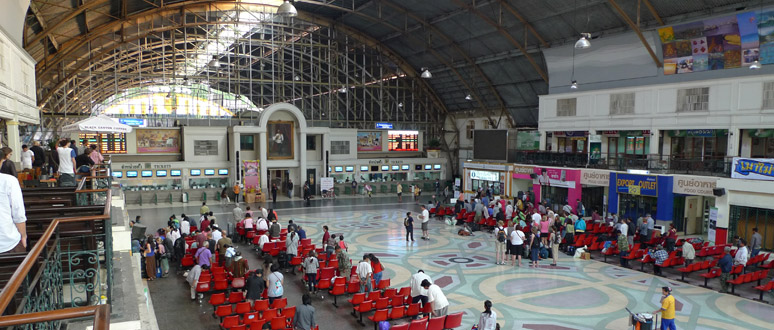
The main ticket office are on the concourse and well organised. TV screens above each window show what tickets each window sells.
Ticket scalping by agencies? I've had at least one report that trains to Chiang Mai were 'full' when the traveller asked at the official booking office for a train in two days' time, but they were later directed to a travel agency on one of the upper levels inside Hualamphong station who sold them first class sleeper tickets on the train they wanted for an extra 700 baht each. Agencies sometimes buy up blocks of tickets to re-sell, a practice known as scalping. SRT should stop this, but in the meantime, if you find a train full it's worth asking a travel agency inside the station, if you're willing to pay the extra! Feedback appreciated.
Busy periods
New Year (30 December to 3 January) & Songkran (Thai New Year, usually 11-16 April). Normally there's no problem buying tickets when you get to Thailand, if you are flexible as to the exact day, train and class, although obviously if it's mission-critical that you travel on a particular train in a particular class on a particular date, you should pre-book online. However, there are a few holiday periods when booking ahead is strongly recommended under all circumstances. The two biggest are New Year (30 December to 3 January) and Songkran (Thai New Year, usually 11-16 April). If you want to travel at these periods you should definitely pre-book, preferably on the very day booking opens.
Buy by phone on 1690
When in Thailand you can call State Railways of Thailand by dialling 1690 - there now seems to be no phone number accessible from outside Thailand. It's reported that they are very helpful and are comfortable speaking English. You'll need to give your name, passport number and contact number. They'll give you a 10-digit reference number to collect your ticket at the ticket office, so have pen & paper handy. However, you must book by phone at least 5 days before travel and you have to pick up and pay for the tickets at the station within 24 hours. Feedback appreciated.
Which station in Bangkok? See map
-
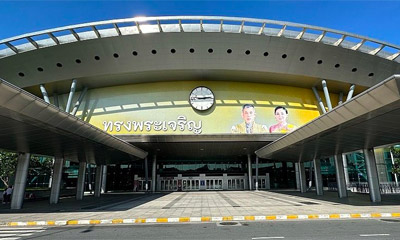
Krung Thep Aphiwat Central station: Since 19 January 2023, all long distance trains leave from the impressive new Krung Thep Aphiwat Central station, some 7 km north of Bangkok Hualamphong. Normally abbreviated to KTW, this modern out-of-town airport terminal for trains can be reached from downtown Bangkok by metro or local train. More about KTW and how to reach it.
-
Bangkok Hualamphong station: This is Bangkok's original station opened in 1916, located in the city centre. Even after 19 January, some 13 local trains will continue to leave Hualamphong station. This includes some local trains to Ayutthaya, the two daily trains to the Cambodian border at Ban Klong Luk, the trains to Pattaya and the weekend excursion train to the Bridge on the River Kwai and Nam Tok waterfall.
-
Thonburi station: The two daily local trains to Kanchanaburi, the Bridge on the River Kwai & Nam Tok use the much smaller Thonburi station on the far bank of the river, also known as Bangkok Noi. Map of Bangkok showing Hualamphong station & Thonburi (Noi) station. Thonburi station is a 9-minute 750m walk from Bang Khun Non station on the MRT metro blue line, see walking map. Thonburi station was formerly known as Bangkok Noi, it was the original terminus for trains to Hat Yai & Malaysia until the Rama VI Bridge opened in 1926, allowing express trains into Bangkok Hualamphong.
-
Wong Wian Yai station: This is the station for local trains to Samut Sakhon, better known as the Mae Khlong Market Train.
Krung Thep Aphiwat Central station (KTW)
The new Krung Thep Aphiwat Central station opened on 19 January 2023 and all long-distance expresses now use it instead of Hualamphong. Officially abbreviated as KTW, this vast new transport hub is located alongside Bang Sue junction station on the old line, 7 km north of Hualamphong station, see location map. Krung Thep simply means Bangkok in Thai.
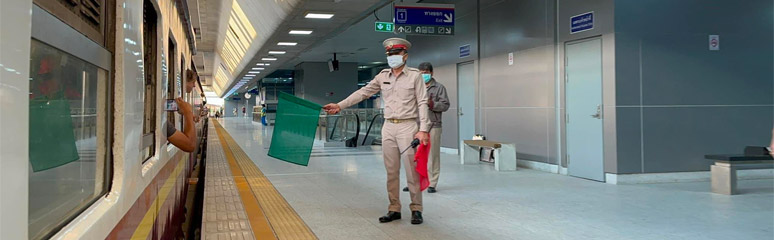
Overview & platforms: The street entrance is at ground level (Level 1), use entrance gate 4 for State Railways of Thailand long-distance trains. The trains leave from the 1st floor (Level 2), follow signs to Long distance trains. Access to the platforms is only allowed when the train becomes ready for boarding, around 20 minutes before departure. You'll need to listen for announcements, the departure screens show scheduled departures, but not platform numbers.
Northern & Northeastern line trains to Chiang Mai & Nong Khai leave from platforms 1 & 2 and arrive on platforms 5 & 6. Southern line trains to Hua Hin, Surat Thani, Hat Yai & Padang Besar leave from platforms 7 & 8 and arrive on platforms 11 & 12. The trains exit the station on a new section of elevated railway with views over the city.
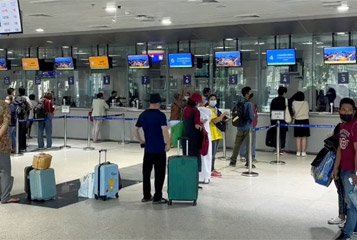
Ticket office: The station has plenty of ticket counters for State Railways of Thailand ticket sales. You can still buy tickets at the more centrally-located Hualamphong station if you find that more convenient.
Luggage lockers: There are left luggage lockers near the ticket office, operated using a touch screen with English language facility. You can pay per hour or per 24 hours, reckon on around 230 baht per 24h.
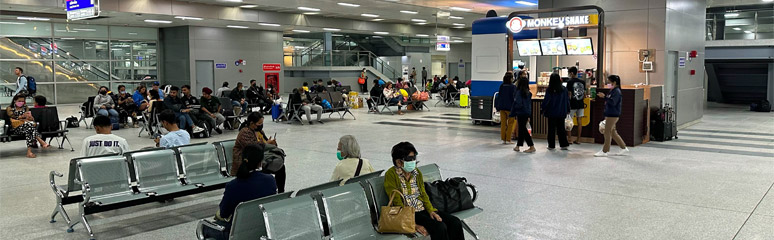
Food & drink: There are various food outlets, including burger outlets.
Toilets & showers: There are toilets which are free to use, with baby-changing facilities. There are also several showers which are also free to use, but you need to ask the toilet attendant to unlock one for you, you'll also need your own soap & towel.
Metro (MRT): The red line & blue line metro (MRT) platforms are in the basement.
How to reach KTW
By free shuttle bus: This ran for a year but has now been discontinued. Local bus 49 links KTW with Hualamphong every 15-20 minutes 05:00-21:00, taking between 30 & 60 minutes. The cheapest but slowest option.
By metro (MRT): Metro trains run from Hualamphong & various other downtown MRT station to Bang Sue MRT station. From Hualamphong, take the Blue Line to Tha Phra and change onto another Blue Line train to Bang Sue. Trains run every few minutes, metro journey time 31 minutes, so around 50 minutes in total including walking and waiting. Fare 43 baht. The metro accept contactless MasterCard & Visa cards, just touch in and out at the ticket gates with a contactless card.
For Bangkok metro information see metro.bemplc.co.th
By local train from Hualamphong: You may still want to experience a departure (or arrival) in Bangkok's classic central Hualamphong station. Some 13 trains per day will still run the 7 km from Hualamphong to Bang Sue junction station on the original line, even after KTW opens. The line takes you over many busy level crossings (a key reason the long-distance trains were moved out to KTW) and through the station serving Bangkok's royal palace.
Check train times from Bangkok to Bang Sue Junction at www.railway.co.th/Station/StationList. Fare 2 baht, buy at the station on the day, no reservation necessary.
Bang Sue junction station is across the road from the new KTW station. On arrival at Bang Sue, walk towards the rear of the train and over the crossing at the southern end of the platform, cross the road on the nearby pedestrian crossing and you're there. Just don't cut it fine if catching a long-distance train, these local trains can be delayed.
By taxi: From downtown Bangkok it takes about 25 minutes and costs around 130 baht. Ask to be dropped at Gate 4, which is the main entrance for the long distance ticket office, waiting area and food court. Taxi fare calulator: www.worldtaximeter.com/bangkok.
Bangkok Hualamphong station
Bangkok Hualamphong is Bangkok's original central station, opened in 1916 in downtown Bangkok. It still handles local trains to Ayutthaya, the trains to Aranyaprathet and Ban Klong Luk on the Cambodian border, and the weekend excursion train to Kanchanaburi, Bridge on the River Kwai and Nam Tok waterfall. There are regular (roughly hourly) departures to Ban Sue junction station, adjacent to the new Krung Thep Aphiwat Central station.
Train information counter: In the photo above, it's on the far right-hand side of the concourse, with the white lightbox visible above it. They can give you a simple pocket timetable in English for any of the main Thai rail lines.
Tickets for travel today: To buy tickets for immediate travel, go to any of the ticket windows to the left of the King's picture in the concourse photo below. In theory, the TV screens above each window say for which trains that window is selling tickets, but most screens merely say 'All trains'.
Left luggage office: This is now permanently closed.
Food & drink: There are several food outlets and a cafe on the station, but much fewer than there were now the new KTW station has opened. To buy supplies of drinks and snacks for the journey, there's a 'Tiffy Mart' in the far left-hand corner of the concourse towards the taxi rank.
Taxis: The taxi rank is on the left-hand side of the station. In the photo above, you'd head towards the King's picture then turn left. Expect a taxi to any city centre hotel to cost around 50 baht (£1 or $1.50). Taxi fare calculator for Bangkok.
Toilets: The toilets are beyond the information counter in the far right-hand corner of the concourse. They are of a reasonable standard, now free.
Luggage on Thai trains
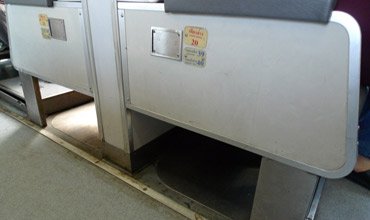
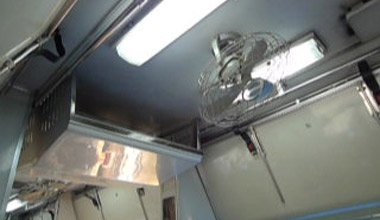
Luggage arrangements are really simple. You take your own luggage onto the train with you, and put it on any suitable luggage rack next to your seat or berth or inside your 1st class sleeper compartment. It will be quite safe, although some travellers take a bike lock with them to padlock it to the rack at night, just for peace of mind. You can put your daypack with camera, passport, and so on, in the berth alongside you at night. A very large suitcase would simply go on the floor alongside your seat.
Luggage limits: Officially, every passenger is allowed one big suitcase and one smaller item although this is not rigorously enforced. Your bags won't be weighed, but in principle baggage limits are a generous 60 Kg (110 lbs) for 1st class passengers, 40 Kg (88 lbs) for 2nd class passengers and 30 Kg (66 lbs) for 3rd class passengers.
Excess baggage: Large items in excess of the allowance such as golf clubs or additional suitcases can be carried in the baggage car if you buy a cargo ticket. You follow exactly the same procedure as for taking a bike, see the paragraph below.
Left luggage at stations
There are left luggage offices at Bangkok Hualamphong station (see above), Chiang Mai, Surat Thani, Ayutthaya and most other major Thai stations where you can leave your luggage for a small fee whilst you explore the town. The new Krung Thep Aphiwat station has left luggage lockers, see above.
Taking a bicycle or motorbike
You can take a bicycle or motorbike on most Thai trains for a small fee. The new Krung Thep Aphiwat Central station handles bicycles, but not motorbikes.
You can't take bikes on the diesel railcar (DRC) trains, or the Chinese-built (CNR) sleeper trains which have no baggage car, or the sleeper to/from Padang Besar in Malaysia which also has no baggage car. Nor on the on the Bangkok airport rail link. But other Thai express trains usually have a baggage car.
First, buy your passenger ticket, either in advance or at the station on the day. You cannot pre-book your bike, even if you pre-book your passenger ticket.
On the day of travel, go to the station with your passenger ticket, find the cargo desk and buy a cargo ticket for your bike. The cargo desk will be a chair, a desk and a set of scales on or near the platform, the location varies and some smaller stations don't have a cargo desk. A cargo ticket costs around 90 to 130 baht (£2.00-£2.70 or $3-$5) for a bike, but can be up to 1230 baht for a motorbike. It's a flat fee based on where the train is going, not on where you're going, so on a train going from Bangkok to Hat Yai, the cargo price is the same to Hua Hin as to Hat Yai. Part of the cargo ticket will be attached to your bike, the other part to your passenger ticket. If you arrive immediately before the train departs or if there isn't a cargo desk at that station, you may be told to pay on the train.
When the train is ready for boarding, you take you bike to the baggage car for loading. It's a good idea to provide something to secure your bike, a couple of luggage elastics or even just some plastic string picked up from one of the vendors on the platform, don't rely on this being provided. Ask if you can secure your bike to the inside of the baggage car yourself, which they usually allow, as otherwise they may just lean it against other cargo and it could be damaged when the train is in motion. Some 3rd class trains don't have a baggage car, so on these you'll have to manhandle your bike into a passenger carriage and stash it in the corridor next to one of the washrooms. Now take your seat in the train. At your destination, go to the baggage car, show your cargo ticket and collect your bike. There is nothing further to pay when you arrive.
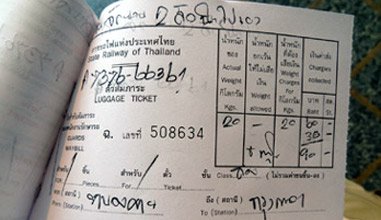
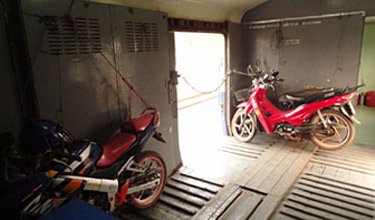
Traveller David Mitchell reports on taking a bike on a train in Thailand: "I can confirm that it is indeed possible to take bicycles on Thai trains, or at least the Bangkok to Chiang Mai route, though I’m sure it is similar for the others. You have to send the bike as cargo and it travels in the cargo/guards van. The procedure is to buy your ticket, then locate the cargo office where they will fill out a cargo ticket. They will attach part of the cargo ticket to the bike and part to your passenger ticket – the cost for a bike was 90 baht each way. You then have to drop off the bike in the cargo car yourself before taking your seat. At your destination you go to the cargo car and collect the bike – you will have to show your ticket & cargo ticket before they will release it. The cargo car sometimes gets full so it is worth turning up early to make sure that there is enough space in it to accommodate your bike."
Traveller Saibal Chatterjee took a bike from Thailand to Singapore by train: "In April 2012 I set out to ride my bike from Chang Mai to Singapore. I managed to bike as far as Surat Thani but then fell sick due to heat & exhaustion. So I carried on my journey towards Singapore by train. I took the overnight Thai Railways train to Hat Yai with my bike safe in the luggage compartment. From Hat Yai I took the Malaysian Railway train to Padang Besar and on to Kuala Lumpur (same train). I was allowed to take my bike on the Malaysian Railway train (at no extra charge). Initially I parked the bike between the space between the two toilets but the train conductor asked me to put it in the lockable luggage space on the other side of the compartment. I arrived at Kuala Lumpur station no problems. At Kuala Lumpur station I had to talk with the station manager to be able to take my bike on the train to Singapore. After a bit of sweet talk he allowed me to take my bike on the day (chair car) train to Singapore only if I bought a first class ticket (no extra charge for bike). I boarded the train and placed my bike between the last and the second last chairs. Later the ticket checker asked me to place the bike in the generator car so that it did not cause problems for other passengers. I did place my bike in the generator car and chained it with the door handle and reached Singapore without problems.
What are Thai trains like?
Which class?
Thai trains have 3 classes, 1st, 2nd & 3rd. 1st class only exists as modern air-conditioned sleeping-cars on overnight trains. 2nd class comes in seat and sleeper versions, in air-conditioned and non-air-con varieties, and is very comfortable especially on sleeper trains and the air-conditioned express railcars. Indeed, many experienced travellers including me actually prefer a cosy & sociable 2nd class sleeper to a 1st class one. Even 3rd class is surprisingly clean and acceptable by European standards, and local trains are an enjoyable way to make shorter trips. The photos below will help you decide class to use. The sitting and sleeper areas of all trains are non-smoking.
Quick links: 1st class sleepers 2nd class sleepers Restaurant cars 2nd class express railcars (DRC) 2nd class seats 3rd class seats
Alcohol ban since 2014: The sale & consumption of alcohol has unfortunately been banned on SRT stations since July 2014, a knee-jerk reaction to a specific incident. You can no longer buy beer from a vendor or in the restaurant car (unless it's alcohol-free!). So far most reports suggest that the ban is not being enforced for passengers who bring their own. If you keep your beer out of sight in your baggage there usually seems little problem drinking it in the privacy of your own sleeper, although one traveller experienced a bag search and his cans of beer were confiscated. Feedback appreciated.
1st class sleepers
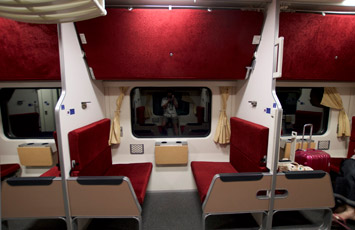
1st class sleeping-cars are air-conditioned with 9 lockable 2-berth compartments with washbasin opening off a side-corridor. Clean sheets, blankets, soap & towels are provided. There's a western-style toilet at the end of the corridor and even a shower, with hot water in the new Chinese-built cars but luke warm water in the older cars.
Berths are sold individually, one ticket buys one bed. Solo travellers will share with another passenger of the same gender unless they pay the sole occupancy rate or buy two tickets. The berths convert to a sofa for evening & morning use. If there are 3 or 4 of you, you can book two adjacent 2-berth sleepers with an inter-connecting door (berths 1 & 2 connect with berths 3 & 4, berths 5 & 6 connect with 7 & 8, and so on).
On key routes such as Bangkok-Chiang Mai, Bangkok-Nong Khai or Bangkok-Surat Thani-Hat Yai, a steward from the restaurant car may come round and take your food & drink order, offering you a set menu with several choices, around 200 baht for dinner and 120 baht for breakfast. The meal will be delivered to your sleeper and if that suits you that's great, but it can be more fun and more social to go along to the restaurant car, where you'll get a wider choice - just be warned that as the attendants get commission, they have been known to deny that there's a restaurant car on the train when there is and you're free to go there if you want!
The Man in Seat 61 says: "There's usually just one 1st class sleeping-car per train, so book early as the 1st class car gets fully-booked soon after booking opens. If there are two of you, select one upper berth & one lower berth when booking online to get a whole compartment to yourselves. First-time visitors often obsess about 1st class, but like many experienced travellers I actually prefer the more sociable open-plan 2nd class sleepers to rattling round on my own in a 1st class compartment. The 2nd class bunks have curtains for privacy at night and are fine even for families with children. Don't feel you have to go 1st class, you really don't!"
High-quality 1st class sleepers on trains 9, 10, 23, 24, 25, 26, 31, 32
High-quality 1st class sleeping-cars built in China entered service in 2016 between Bangkok & Chiang Mai (trains 9 & 10), Bangkok & Ubon Ratchathani (trains 23 & 24), Bangkok & Nong Khai (trains 25 & 26) and Bangkok & Hat Yai (trains 31 & 32). Their layout is similar to the older type, nine 2-berth compartments with washbasin opening off a side corridor. They have TV information screens and power sockets for laptops & mobiles. There are toilets and a hot shower at the end of the corridor. A slightly higher fare is charged for travel in these new cars. See the video here or this article here.
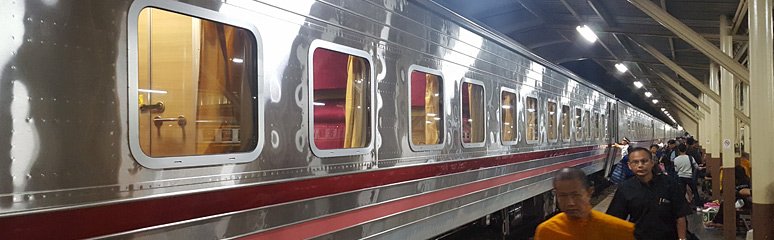
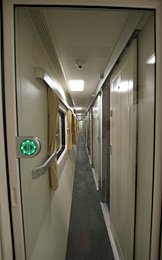
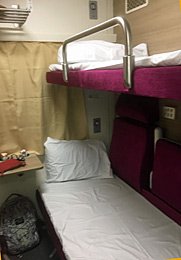
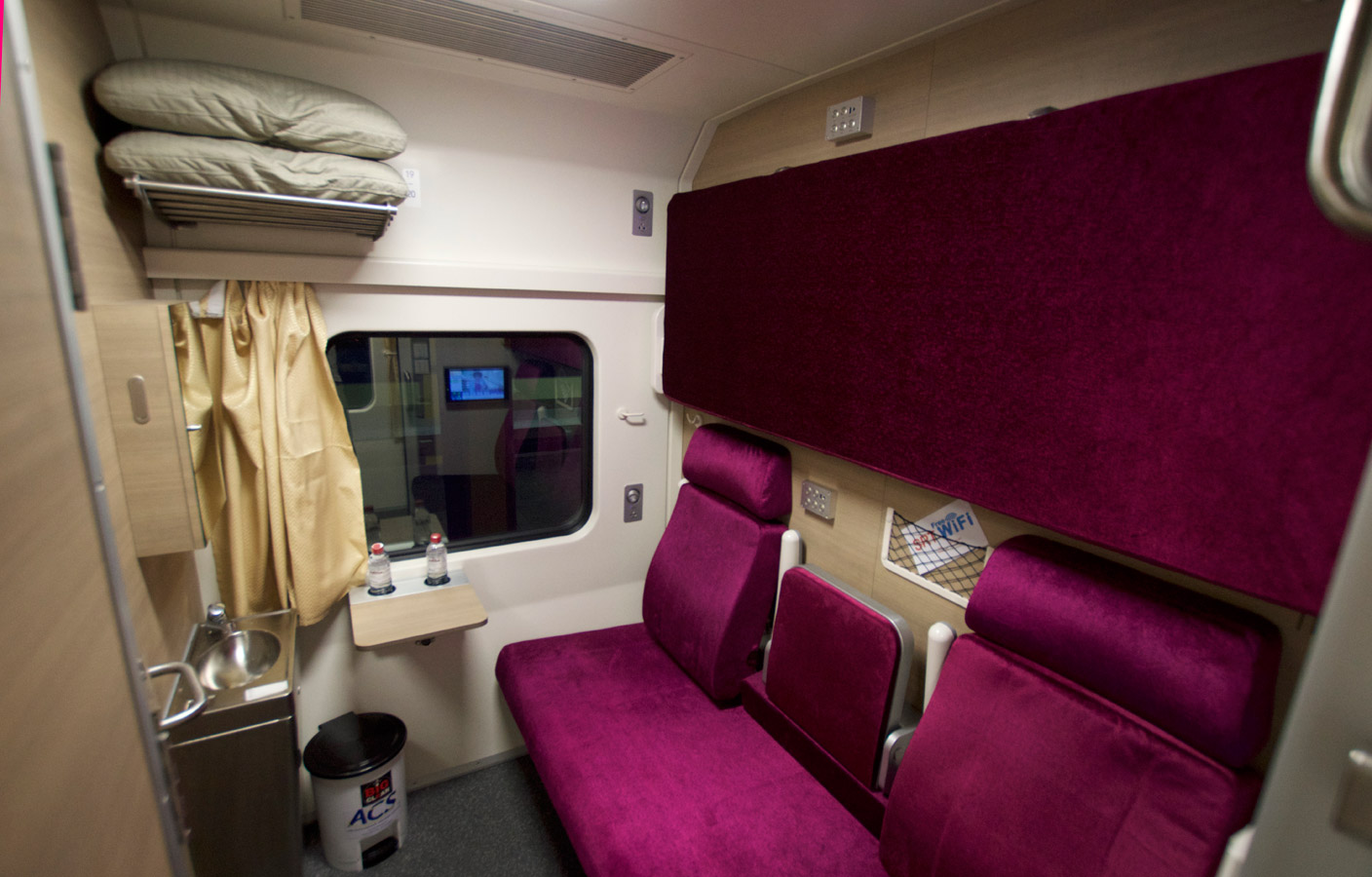
1st class sleepers other trains
If your train has a 1st class sleeper, it will be of this regular Thai type, unless it one of the trains which have been equipped with new Chinese-built sleepers (trains 9, 10, 23, 24, 25, 26, 31, 32), or trains 51 & 52 which use a second-hand Japanese sleeping-car as shown in the next section. These cars have nine lockable 2-berth compartments opening off a side corridor. There are toilets are at the end of the corridor, along with a cold but still very welcome shower.
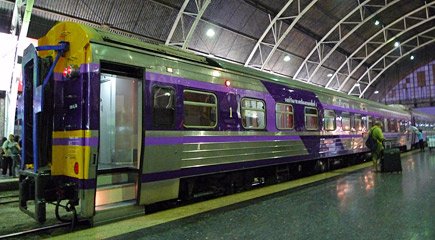
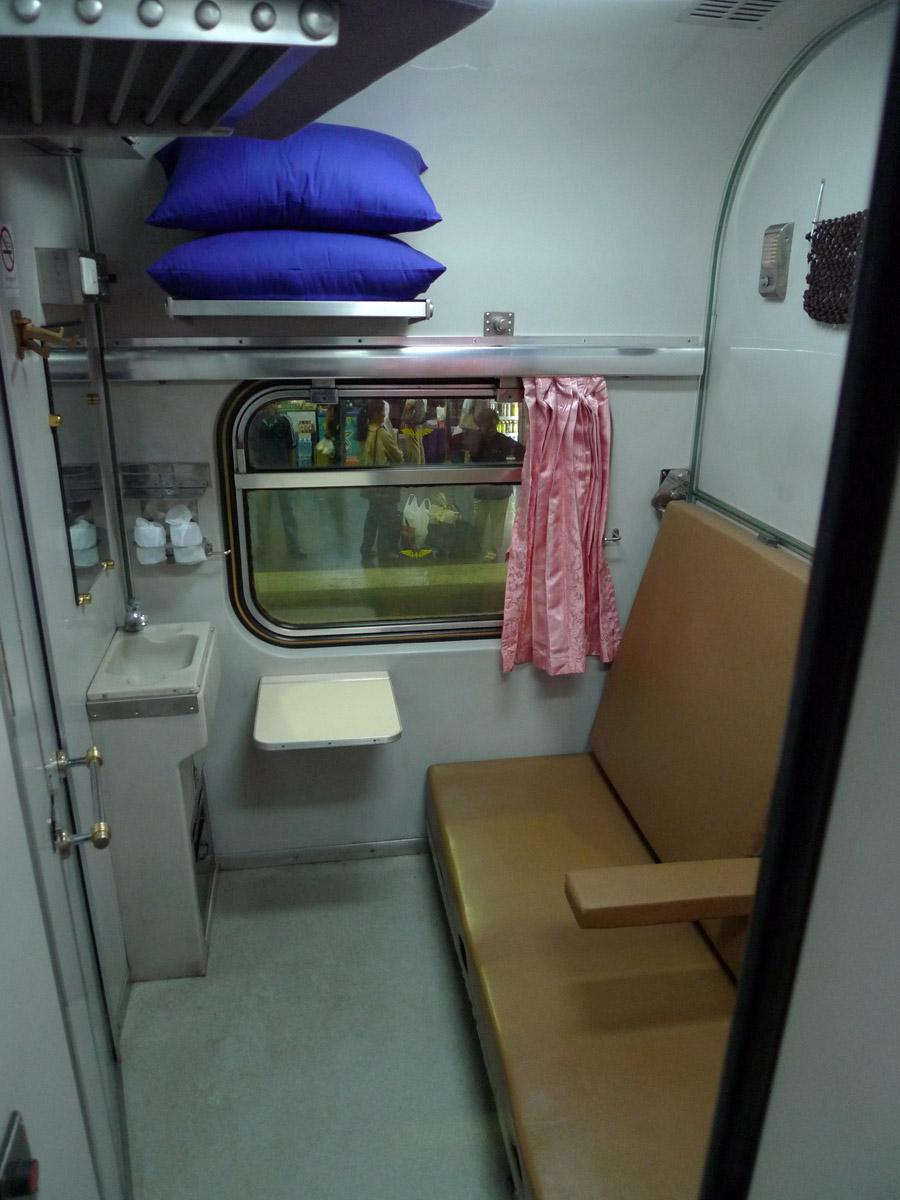
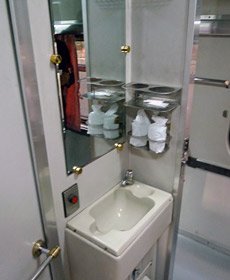
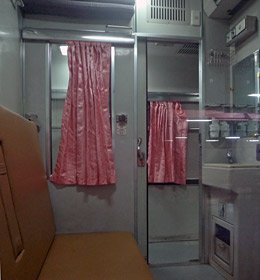
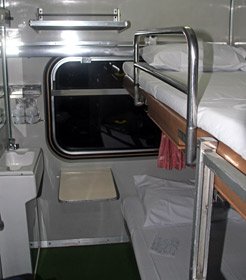
Japanese 1st class sleeper on trains 51, 52.
Train 51/52 between Bangkok & Chiang Mai is an exception. It has an ex-Japanese 1st class sleeper, which uniquely for Thailand has single-berth compartments, see the photos below. There are no 2-berth compartments on this train, but pairs of adjacent single-berth compartments have a connecting door, so berth 1 can be connected to berth 2, berth 3 to berth 4, and so on. Incidentally, until 10 November 2016, these cars were used on train 13/14, but from 11 November 2016 they are reassigned to train 51/52.
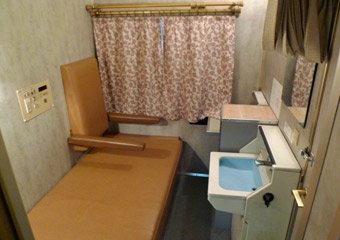
2nd class sleepers
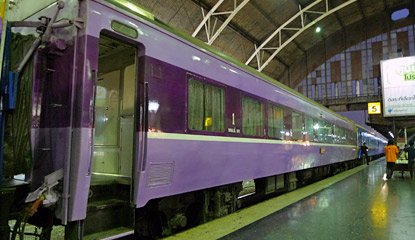
Most western visitors use 2nd class sleepers, which are comfortable, safe and fun. Berths are arranged open plan either side of a central aisle. During the evening and morning part of the journey, there are cosy face-to-face pairs of seats on each side of the aisle, see the photos below. At night, the attendant makes up the sleeping berths by pulling together each pair of seats to form a lower berth, and folding an upper berth out from the wall. He then arranges a mattress, pillow and fresh clean bedding on each berth, and hooks up the curtains on each bunk for privacy - see him do this in the video below!
Luggage goes on the overhead racks or under the seats, or on the floor next to your seats. Some people bring a bike lock to chain it up for peace of mind, but you'd normally take daypacks with any valuables into the berth with you.
2nd class sleepers come in air-conditioned and non-air-conditioned varieties, the air-con ones are cleaner and more modern, but the non-a/c ones have windows which open, better for taking photographs of the scenery. The fare for an upper berth is a fraction cheaper, but the upper bunks are narrower. Security is not a problem, it's a great way to travel which saves time even compared to flying, and saves a hotel bill too.
Upper berths are fine for anyone up to 6' 2" tall, if you're taller than that you should choose a lower berth as these are significantly wider, allowing tall people to sleep comfortably on the diagonal. On key routes such as Bangkok-Chiang Mai, Bangkok-Nong Khai or Bangkok-Surat Thani-Hat Yai, a steward from the restaurant car may take your food or drink order, offering a set menu with several choices, around 200 baht for dinner and 120 baht for breakfast, delivered to your seat. If that suits you, great, but it can be more fun to go along to the restaurant car, where you have a wider choice - just be warned that as the attendants get commission, they've been known to deny that there's a restaurant car!
The Man in Seat 61 says: "The 2nd class sleepers are the best choice for most western travellers, I actually prefer them to the first class variety, especially if I'm solo - and I'm not the only one who does! The air-conditioned sleepers are more comfortable and usually cleaner, non-air-con ones are getting rare now, but they have windows which open, better for viewing the countryside and taking photographs on the daylight parts of the trip."
High-quality 2nd class sleepers on trains 9, 10, 23, 24, 25, 26, 31, 32
New high-quality Chinese-built sleepers entered service in 2016 between Bangkok & Chiang Mai (trains 9 & 10), Bangkok & Ubon Ratchathani (trains 23 & 24), Bangkok & Nong Khai (trains 25 & 26) and Bangkok & Hat Yai (trains 31 & 32), see the video here. These modern sleepers are popular, so if you want one you should book as far ahead as possible, especially on the Bangkok-Chiang Mai route.
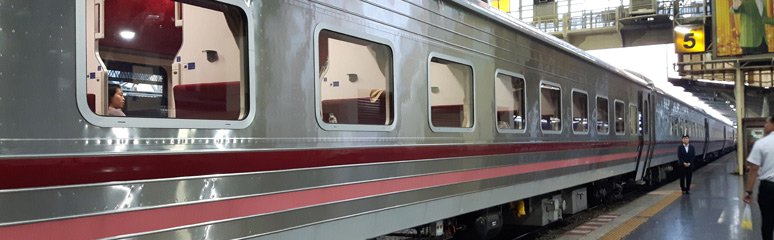
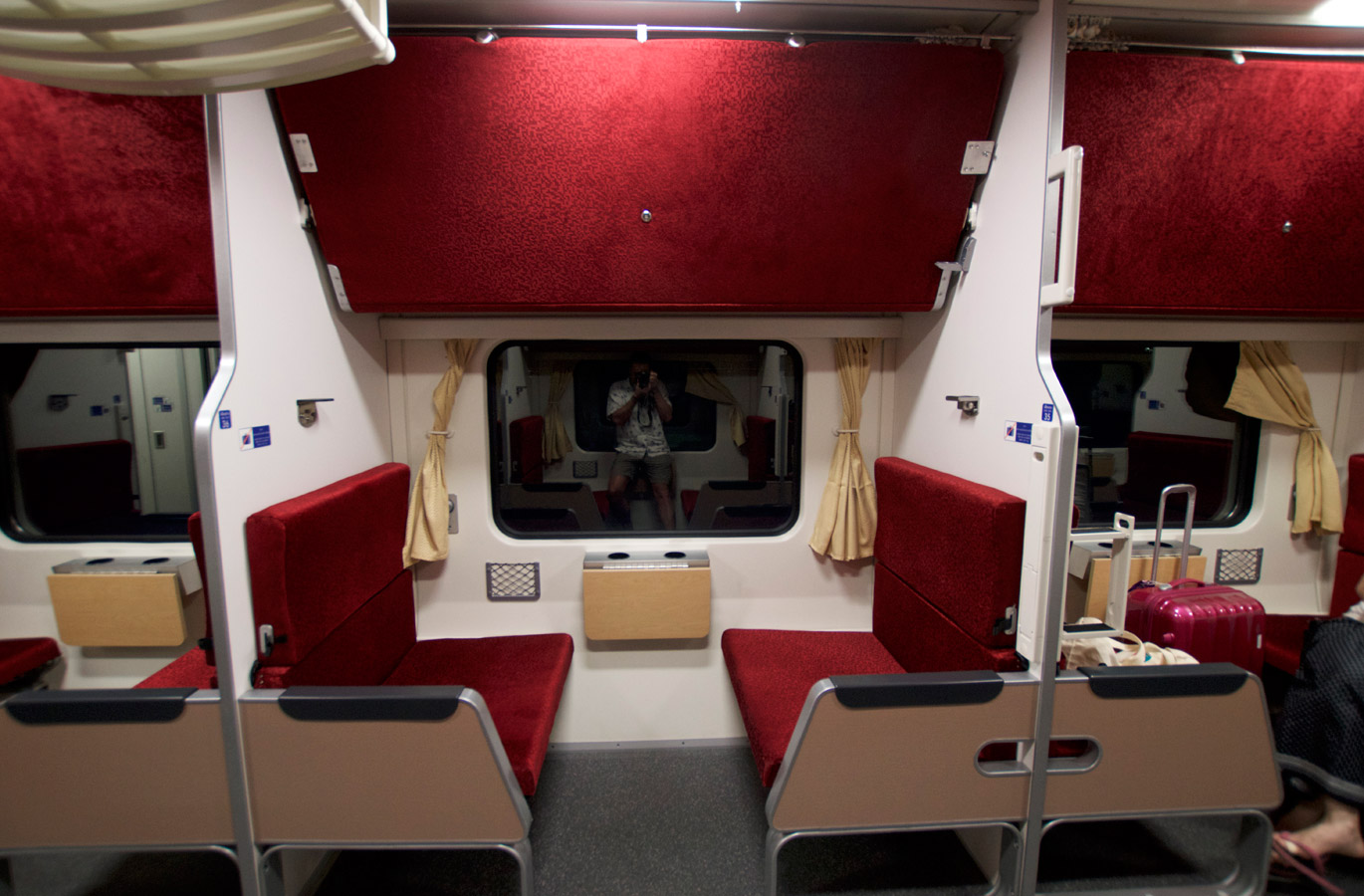
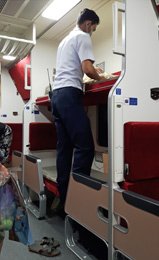
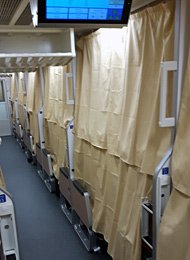
Modern air-con 2nd class sleepers
These modern air-conditioned sleepers now operate on trains 13/14 between Bangkok & Chiang Mai and trains 45/46, amongst others. There is a washing area with two sinks and western & squat toilets at the end of the coach. Soap & toilet paper are provided. At night, upper & lower berths fold out, each with curtains for privacy.
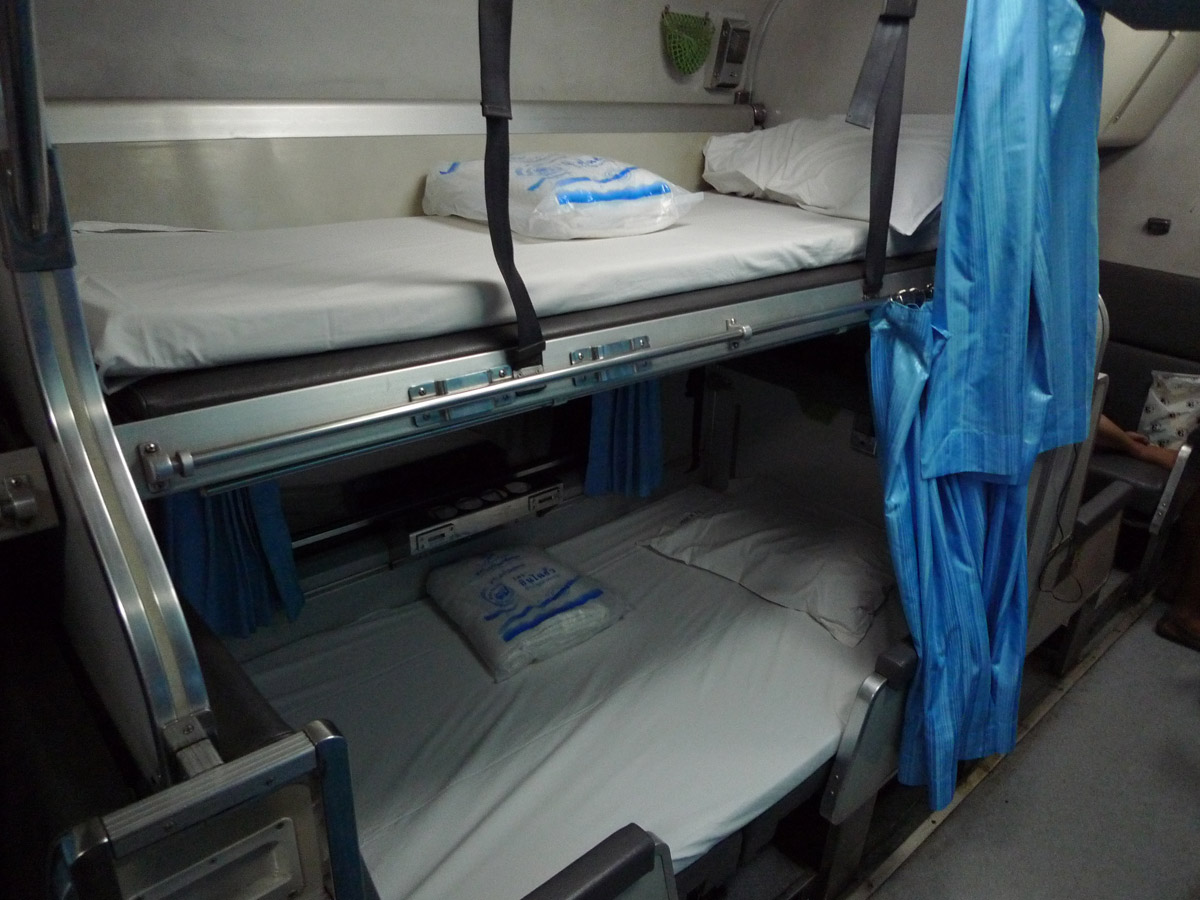
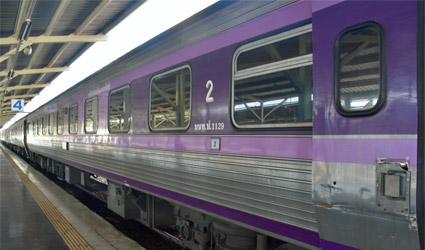
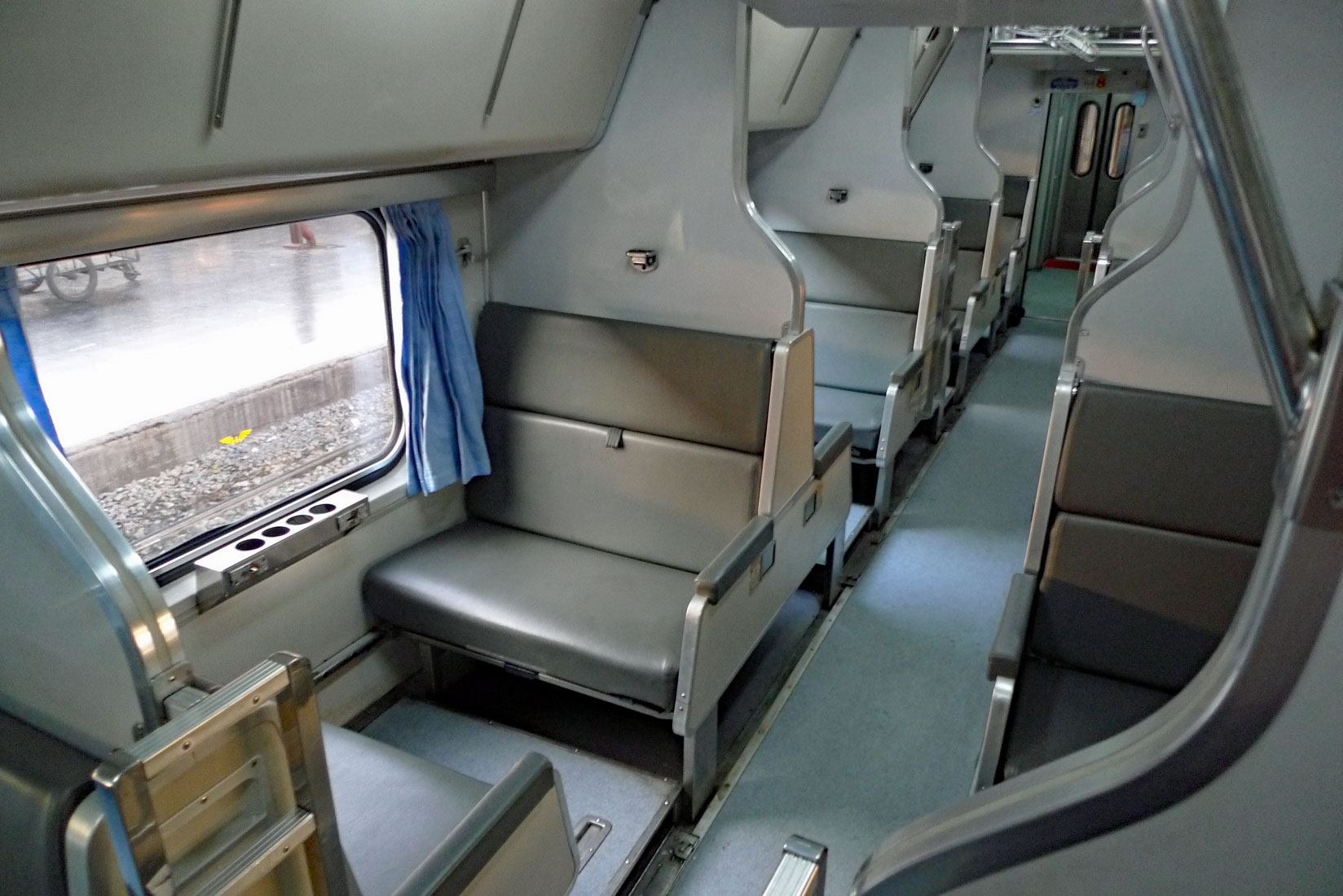
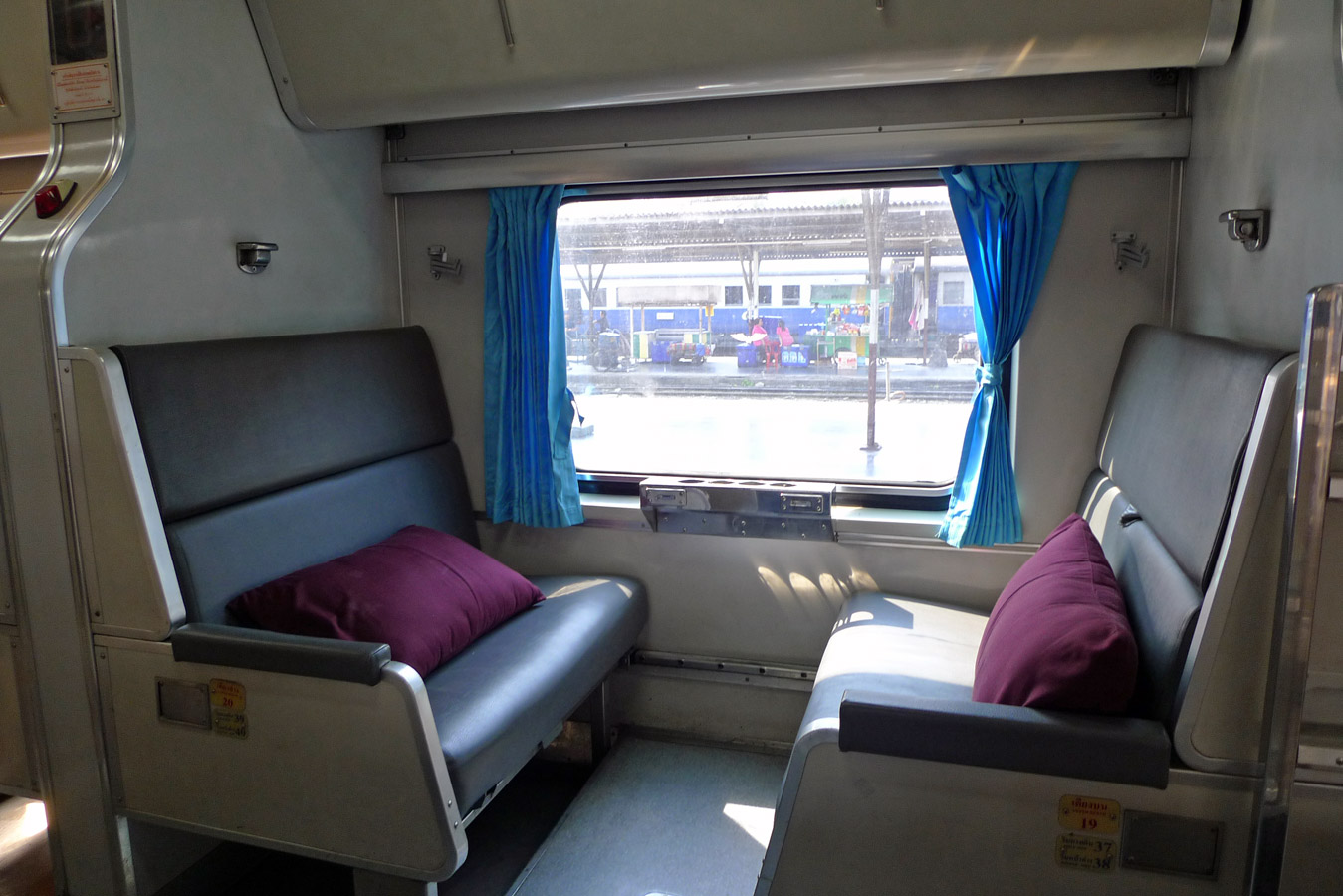
Watch the video: Making up the beds
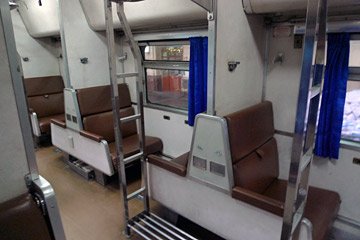
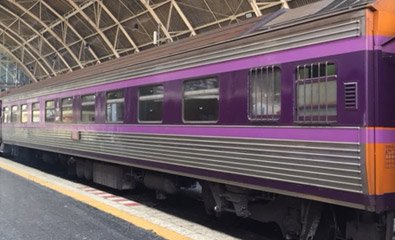
Older air-con sleepers
These older air-conditioned sleepers operate on train 69/70 between Bangkok & Nong Khai, and on many other overnight express trains in Thailand. You may also find them between Bangkok and Padang Besar. The layout is the same as the newer types shown above.
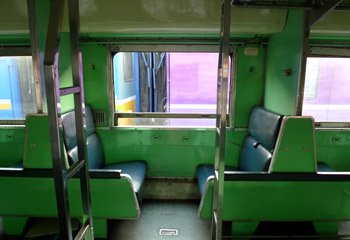
Non-air-con 2nd class sleepers
These are older and a bit grubbier, but the fare is a fraction cheaper and some people prefer the ability to open a window, for example to take photographs. There are fans on the ceiling, and window shutters to keep out the sun as well as glass panes. Not sure about that green, though.
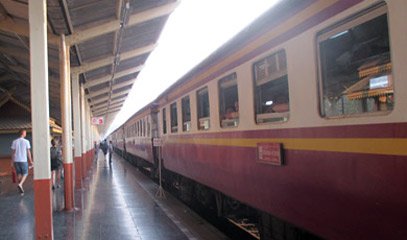
Restaurant cars
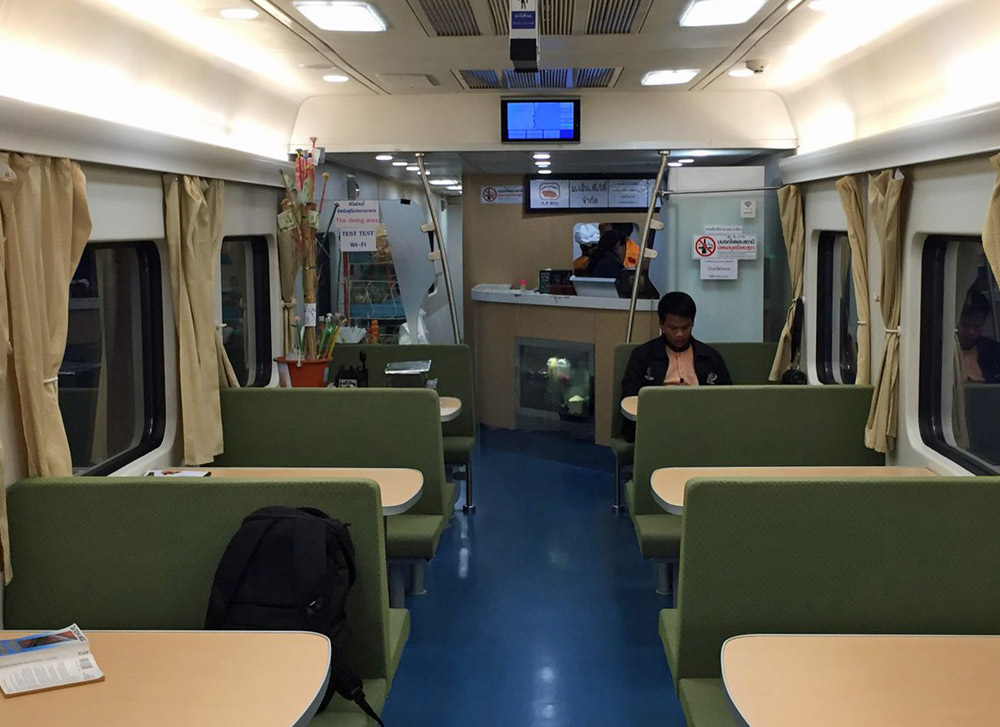
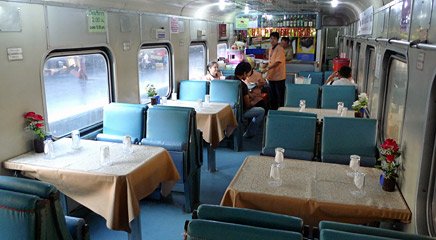
All the most important trains have a restaurant car, including trains 9, 10, 13, 14 Bangkok-Chiang Mai, trains 35 & 36 Bangkok-Hat Yai, trains 84 & 85 Bangkok-Surat Thani, trains 69 & 70 Bangkok-Nong Khai. Some restaurant cars are air-conditioned like the one shown below, including those on all the Chinese-built sleeper trains. Others are non-air-con, with opening windows such as the restaurant car on Bangkok-Chiang Mai sleeper train 13/14.
The food is remarkably cheap and good, a set meal costs around 150-200 baht (£3-£4 or $5-$6) and you choose from a leaflet with pictures & English captions. Beer is unfortunately no longer available since 2014.
A restaurant car attendant usually walks through the train with a menu card showing pictures & English captions. They will take meal orders and serve you at you seat if you prefer. You may find this more convenient, but its more fun & sociable to go to the restaurant car.
One traveller reports "We particularly enjoyed the restaurant car, the food was better than expected and they switched on the disco lights and 70's bogie music after the sun went down!"
Food & drink vendors: On almost all Thai trains, even 3rd class ones, you'll find vendors selling fruit & soft drinks. Obviously, you can bring your own food and drink if you like, bought at the station or nearby supermarket.
Alcohol: Sipping a beer on a Thai train has always been one of the pleasures of train travel, but sale and consumption of alcohol has been banned from July 2014 as a knee-jerk reaction to a specific incident. Restaurant cars therefore no longer sell beer, other than the alcohol-free variety.
2nd class seats
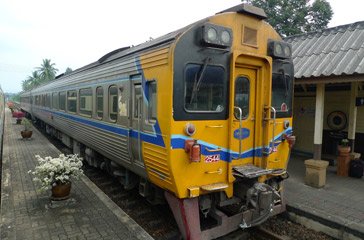
Special Express DRC (Diesel Rail Car)
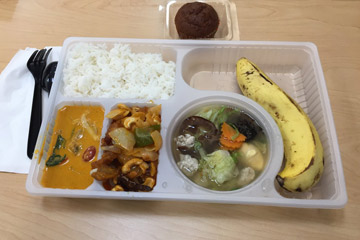
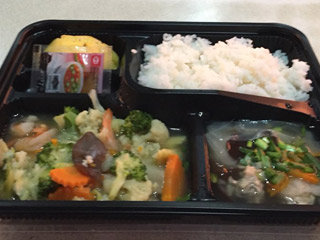
The air-conditioned express diesel railcars (DRC) are an excellent option for daytime travel on routes such as Bangkok to Chiang Mai and Bangkok to Hua Hin, Chumphon & Surat Thani. These air-conditioned trains were built by Daewoo in the mid 1990s and have comfortable 2nd class reclining seats, half of the seats in a car facing forwards and the other half backwards. There used to be a hostess service of a light meal, coffee & soft drinks included in the fare, however the end of SRT's supplier contract in 2024 means you have to buy food & drink until a new contractor can be found. The pre-packed rice-based lunch isn't hugely substantial, so feel free to take some other supplies with you if you're hungry. Relax and enjoy the journey as the scenery rolls by.
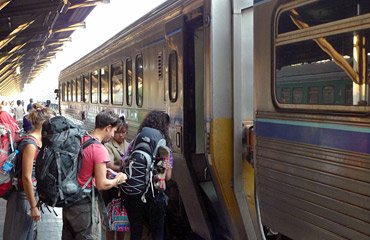
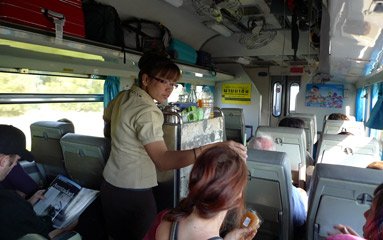
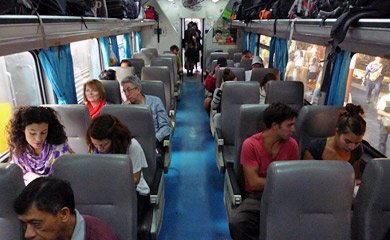
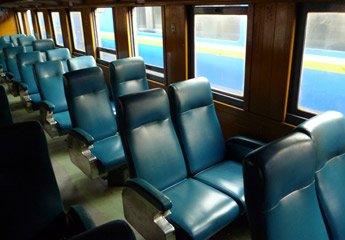
2nd class seats on express trains
A pleasant and comfortable way to travel for long-distance daytime journeys, although slower than the express railcars. There are both air-conditioned and non-air-con varieties. The advantage of the non-air-con coaches is the open windows and unrestricted views, a breeze wafting in as the train clickety-clacks through the Thai countryside. Each pair of seats can be rotated, seats are normally turned to face forwards. Photos courtesy of Graeme Thorley.
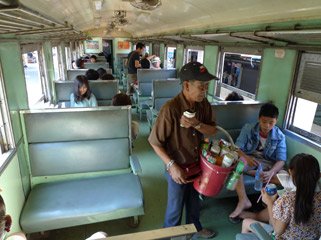
3rd class seats
In spite of its name, 3rd class is a perfectly good option for short trips such as Bangkok to Kanchanaburi or Ayutthaya, as it's generally clean, not usually crowded outside the commuter peaks, unbelievably cheap, and sitting next to an open window as the train clickety-clacks through the countryside is a very pleasant experience. Although, 2nd class would be better for long trips such as Bangkok to Nong Khai or Chiang Mai. 3rd class usually has padded seats, but some older carriages have wooden seats. It's normally non-air-con, but air-con 3rd class exists on a few long distance routes.
Bangkok to Chiang Mai
 |
|
|
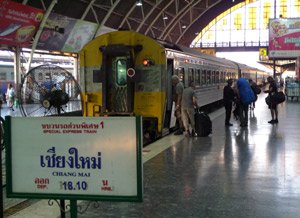
All aboard for Chiang Mai! A Special Express to Chiang Mai at Bangkok.
|
Thailand's most popular train route! Travelling from Bangkok to Chiang Mai by sleeper is effectively faster than flying, less stressful, much more fun, better for the environment and it saves you a hotel bill too. Think you don't see much from a night train? The scenery on the last part of the trip up into the mountains to Chiang Mai is particularly good, and even on the sleeper, watching the sunrise from the train in the morning is wonderful. The new Chinese-built high-quality sleepers on trains 9 & 10 are excellent, and of course, the sleeper train itself is the scenery, a genuine Thai experience with a chance to meet people.
* Train 9/10 is the best train to take as it uses new high-quality Chinese-built sleeping-cars & restaurant car.
** Train 13/14 is the next-best sleeper train using the next most modern cars, northbound it passes the best scenery near Chiang Mai in daylight. It also has a non-air-conditioned restaurant car with opening windows, ideal for photography.
*** Train 7/8 is the best daytime option, the air-conditioned express railcar.
Train classes:
1 = 1st class sleepers. S = 2nd class sleepers (air-conditioned). s = 2nd class sleepers (non-air-con). 2 = 2nd class seats. R = Restaurant car.
3 = 3rd class seats. DRC = Diesel Railcar express with 2nd class air-con seats, but no sleepers so not recommended for overnight journeys).
How to buy tickets What are Thai trains like? Map of train routes in SE Asia Luggage & bikes Suggested hotels in Chiang Mai & Bangkok
Fares are in Thai baht. £1 = 42 Baht. €1 = 36 Baht. $1 = 31 Baht.
Children aged 0 to 3 and less than 100cm in height travel free, children aged 4 to 11 and under 150cm travel at reduced fare, children 12 years old and upwards (or over 150cm high) pay full fare.

Bangkok to Nong Khai for Laos
|
|
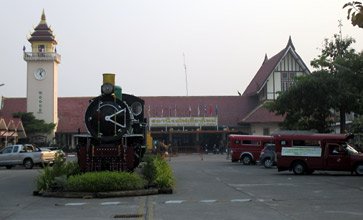
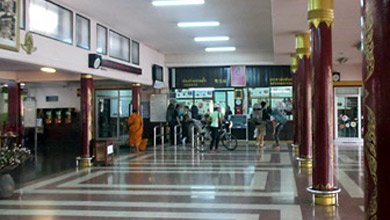
Here are trains between Bangkok & Nong Khai, near the border with Laos. If you're travelling into Laos, see the Laos page for information on the new Bangkok-Vientiane train service & on local transport across the Friendship Bridge between Nong Khai & Vientiane.
Train classes:
1 = 1st class sleepers. S = 2nd class sleepers (air-con). s = 2nd class sleepers (non-air-con). 2 = 2nd class seats. 3 = 3rd class seats. R = Restaurant car. DRC = Diesel Railcar express with 2nd class air-conditioned seats (no sleepers).
* Recommended daytime train, air-con express diesel railcar.
** Recommended train, high-quality sleeper train with modern Chinese-built sleeping-cars.
Train 133/134 runs to/from Vientiane, see the Laos page for Bangkok-Vientiane.
How to buy train tickets online Buying tickets at the station What are Thai trains like? Map of train routes in SE Asia Luggage & bikes Hotels in Thailand
Fares are in Thai baht. £1 = 42 Baht. €1 = 36 Baht. $1 = 31 Baht.
Children aged 0 to 3 and less than 100cm in height travel free, children aged 4 to 11 and under 150cm travel at reduced fare, children 12 years old and upwards (or over 150cm high) pay full fare.
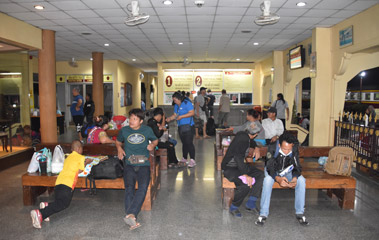
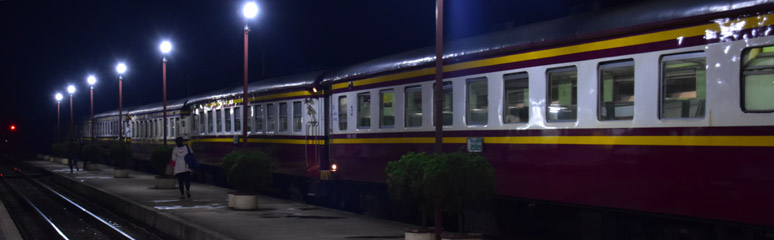
Bangkok to Ubon Ratchathani
Train classes:
1 = 1st class sleepers. S = 2nd class air-con sleepers. s = 2nd class sleepers (non-air-con). 2 = 2nd class seats.
3 = 3rd class seats. R = Restaurant car. DRC = Diesel Railcar express with 2nd class air-conditioned seats (no sleepers).
* Recommended train for daytime travel, air-con express diesel railcar. Train 71/71 is an older railcar which also has 3rd class non-a/c seats.
** Recommended overnight train, train 23/24 uses new high-quality Chinese-built 1st & 2nd class air-con sleepers, introduced November 2016.
How to buy train tickets online Buying tickets at the station What are Thai trains like? Map of train routes in SE Asia Luggage & bikes Hotels in Thailand
Fares are in Thai baht. £1 = 42 Baht. €1 = 36 Baht. $1 = 31 Baht.
Children aged 0 to 3 and less than 100cm in height travel free, children aged 4 to 11 and under 150cm travel at reduced fare, children 12 years old and upwards (or over 150cm high) pay full fare.
Traveller Ian Craven from Sydney reports: I recently travelled on the State Railways of Thailand on the Bangkok-Ubon run. We took daytime train 21, the express diesel rail car, in 2nd class air conditioned seats. We easily bought tickets the day before from a Bangkok travel agent for a very reasonable commission, about 50 baht. The train consisted of only three cars, and predictably we were the only farang on board. Train left just 5 minutes late, at 0550, and took at least an hour to get out of the suburbs of Bangkok, with the country eventually giving way to rice paddies as far as the eye can see; the train then climbs through some low hilly country with mainly teak plantations and orchards, and eventually gives way to a vast plain, again with rice predominate, along with sugar and banana’s, and all kinds of towns and villages, large and small. The seating was very comfortable, the air con just right (not too cold which is often the case), and the service impeccable. Despite a rather gruff visage, the conductor was in fact a very amiable fat controller, turned out in an immaculately pressed uniform. The train even features a 'trolley dolly', who serves breakfast (croissant & sweet bun), water, orange juice, tea and coffee (why is railway coffee uniformly bad everywhere in the world?!) and lunch (like an airline pack featuring a small chicken curry and rice, and some kind of putrid fish that even the locals were poking at with disdain!). All this comes included in the price of the ticket. Train arrived in Ubon dead on time at 1410, despite some unscheduled stops along the way to let off passengers. While it is certainly not one of the great train journeys of the world, it is not overly long and provides some excellent views of Thai rural life, and is a cheap, efficient and very effective way to get to the southern Lao PDR frontier. I would highly recommend it to anyone. The international bus from Ubon-Pakse runs twice daily, about 3 hours, 200 baht.
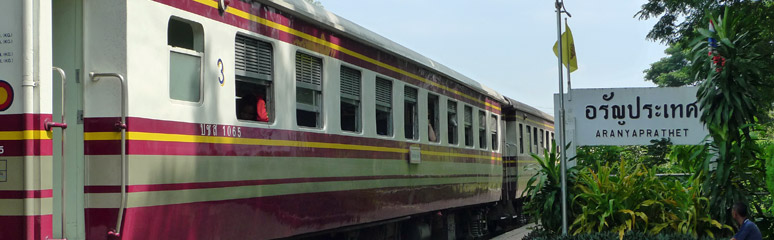
Bangkok to the Cambodian border
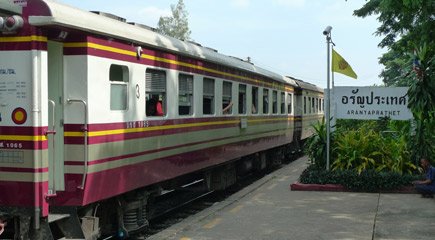
Ban Klong Luk is located at the Cambodian border, just metres from the border post. Trains only used to run as far as Aranyaprathet, 255 km from Bangkok and 6 km from the Cambodian border, but were extended to Ban Klong Luk in July 2019, just 200m from the Thai border post. You can now walk through the Thai & Cambodian border posts into Poiphet on the Cambodian side from where buses run to Siem Reap & Phnom Penh. See the Cambodia page for information about the journey from Bangkok to Siem Reap (for the Angkor Wat temples) & Phnom Penh, and about onwards bus transport to Saigon in Vietnam. Trains 275-280 have 3rd class seats, but Thai 3rd class is clean and comfortable, a very pleasant way to travel with vendors selling food & soft drinks. Train 279/280 is a diesel railcar. Train 275/276 is a locomotive & coaches. These trains continue to use Bangkok Hualamphong station.
Update 2026: Check latest security situation between Thailand & Cambodia before travelling to Aranyaprathet. Trains may no longer being going that far.
Children aged 0 to 3 and less than 100cm in height travel free, children aged 4 to 11 and under 150cm travel at half fare, children 12 years old and upwards (or over 150cm high) pay full fare.
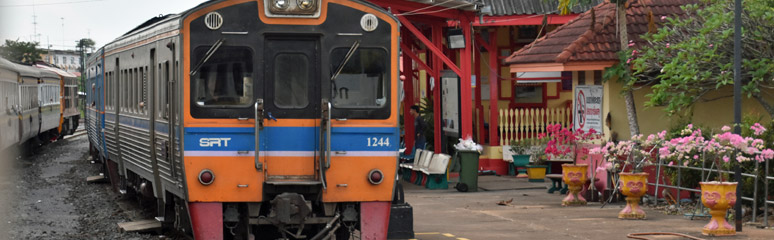
Bangkok to Kanchanaburi
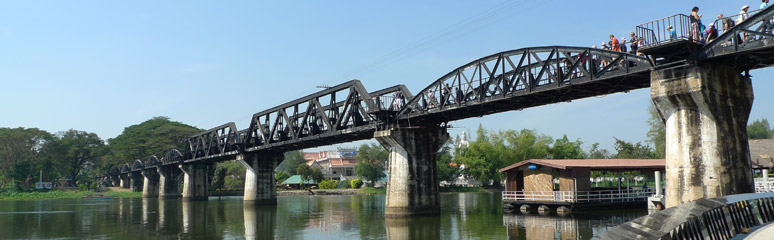
The best way to reach Kanchanaburi & the Bridge on the River Kwai is by train, using the infamous Death Railway itself, for just 100 baht (£2 or $3), see the Bridge on the River Kwai page for details.
There is also a special railcar (2nd & 3rd class air-conditioned) for tourists at weekends, leaving Hualamphong station at 06:30 for Kanchanaburi at 09:25, Nam Tok 11:30, returning from Nam Tok at 14:40 and Kan'buri at 16:55 arriving Bangkok 19:30. Special fares apply, reservation required, see the Bridge on the River Kwai page for details.
Bangkok to Sukhothai
Sukhothai has no rail station, but you can take a comfortable train from Bangkok to Phitsanulok on the Bangkok-Chiang Mai main line, which is about 59 km from Sukhothai by bus. This train/bus combo avoids a nightmare 7 hours on a bus from Bangkok. The 08:30 or 11:50 DRC express railcars from Bangkok would be a good choice to reach Phitsanulok, see here for train times. On arrival by train at Phitsanulok, simply ask one of the tuk-tuk taxis waiting outside the station to take you to the nearby bus station.
Buses leave Phitsanulok for Sukhothai frequently between 07:00 and 19:00, fare around 40 baht or so, journey time 1 hour.
One-time capital of the Sukhothai Kingdom, the UNESCO-designated ruins are 12 km outside Sukhothai town, easily reached by local transport.
Bangkok to Chiang Rai
To reach Chiang Rai, first take a train from Bangkok to Chiang Mai, see above for train times.
Ordinary (non-air-con) buses leave Chiang Mai Arcade bus station every hour or two from 06:00 to 17:30, journey time 3 hours 50 minutes, fare around 60 baht.
Air-conditioned buses also leave from Chiang Mai Arcade bus station every hour or so from 07:00 to 17:00, journey time 3 hours 10 minutes, fare 102 baht.
 |
|
|
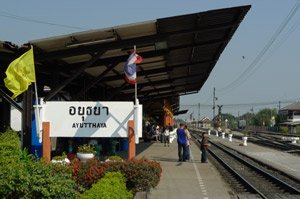
Ayutthaya station, 1h45 from Bangkok. |
Bangkok to Ayutthaya
Ayutthaya is the UNESCO-listed ancient capital of Siam, with impressive ruins and temples. It's a great day trip from Bangkok, or you can stop off on your way between Bangkok & Chiang Mai. The start of the UNESCO-listed area is some 3.5 km from Ayutthaya station, a 44-minute walk or short hop by tuk-tuk, see map.
Option 1, by local train
There are a range of local trains from the conveniently-located Bangkok Hualamphong station to Ayutthaya with basic but clean 3rd class seats, taking a leisurely 1h45 for the 71 km (44 miles). No reservation is necessary, just turn up, buy a ticket at the station and hop on. 3rd class isn't crowded outside peak times, as a day tripper from Bangkok you'll be going in the opposite direction from commuter crowds in any case. It's a pleasant way to get there, sitting next to an open window with a cool breeze blowing in, as the train clickety-clacks along.
To check these train times, go to See www.railway.co.th and look for Timetables.
Children aged 0 to 3 and less than 100cm in height travel free, children aged 4 to 11 and under 150cm travel at half fare, children 12 years old and upwards (or over 150cm high) pay full fare.
Option 2, by express train
You can also travel between Bangkok & Ayutthaya by express train. These are faster (typically 1 hour), more comfortable and you get a reserved seat. On the downside, all express trains now leave from the less-convenient Krung Thep Aphiwat Central station 7 km north of Hualamphong, and tickets need to be pre-booked.
Book online at www.baolau.com with instant confirmation, You print your own ticket and can board the train with the printout.
You must book at least the day before. On the day of travel, tickets aren't sold online, only at stations.
Booking for most trains opens 30 days ahead, but there are a few long-distance express trains (including express air-con railcar SP7 on its way to Chiang Mai) for which short-hop tickets such as Bangkok to Ayutthaya are only sold the day before, to avoid short-hop passengers using up long-distance places.
Using www.baolau.com you'll see that each train number is preceded by RP (rapid), EX (express) or SP (special express). The Bangkok-Ayutthaya fare on a rapid (RP) train is 20 baht in non-a/c 3rd class, 61 baht in non-a/c 2nd class.
Fares for EX & SP trains are significantly higher because they carry an express surcharge and they may have air-con cars or sleepers with higher fares. A non-a/c 2nd class seat on a rapid (RP) train is a good choice if the timings suit you, the cars have opening windows making it a pleasant option.
Incidentally, if you're returning from Ayutthaya to Bangkok in the afternoon, the long gap in 3rd class local trains between lunchtime and early evening may make a seat on an express train look a good option - and it might well be! Just remember that whilst the 18:48 local train might be more or less on time, a late afternoon express train coming from way up country could be an hour late by the time it reaches Ayutthaya. Not a reason not to book it, but bear that in mind when deciding between the 18:48 3rd class local train or the 16:37 Rapid - though I reckon the 16:37 rapid still usually gets to Bangkok first!
Stopping off on the way to Chiang Mai
All trains between Bangkok and Chiang Mai, Nong Khai & Ubon Ratchathai stop at Ayutthaya. It's easiest to use the 3rd class local trains for the Bangkok-Ayutthaya section rather than booking a seat on an express, the local trains are cheaper, more frequent and no reservation is necessary. Then see the Chiang Mai or Nong Khai timetable above for express train times Ayutthaya-Chiang Mai or Ayutthaya-Nong Khai. Ayutthaya has a left luggage office (on the platform, marked 'Cloak Room') where you can stash your bags for a 10 baht fee between trains.
Bangkok to Samut Songkhram
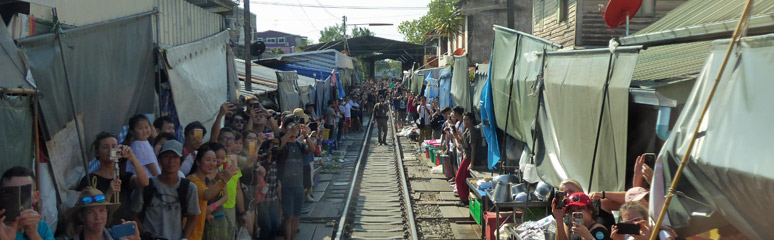
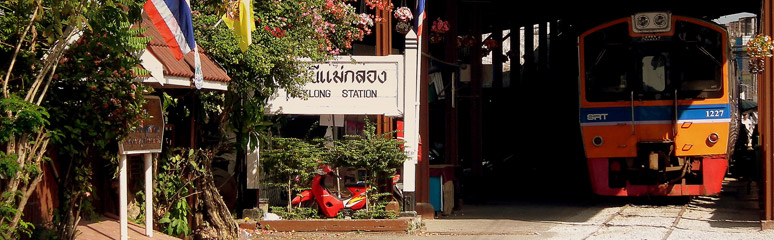
The Market Train: You may have heard of a little train near Bangkok that runs right through the middle of a market. This is the Bangkok - Mahachai - Mae Khlong Line, which runs within inches of the market stalls approaching its terminus at Samut Songkhram, some 70 km (45 miles) from Bangkok and known locally as Mae Khlong after the river on which it is situated. In fact, it's not one rail line but two, separated by a ferry across the Tha Chin river in the middle. These two lines are part of the State Railways of Thailand, but were originally built in 1905 as private lines and they are not physically linked to the rest of the network. A trip to Mae Khlong makes an interesting trip from Bangkok if you've a day spare. Watch this video to see the train pass through a busy market, when the train passes the market traders replace their canopies and you'd never know a train track was there.
Bangkok ► Mae Khlong Market
-
Step1, first take a little silver diesel railcar from Bangkok's Wong Wian Yai station to Samut Sakhon, known locally as Mahachai.
Bangkok's Wong Wian Yai station is located on the west side of the Bangkok river, a 20 minute walk from the BTS Skytrain station at Wangwan Yai, see map of Bangkok showing stations.
Trains run from Bangkok Wong Wian Yai to Mahachai roughly every hour from 05:30 until 20:10, journey time around 59 minutes, usually 3rd class only, fare 10 baht, distance 31.2 km (19 miles).
Most trains are non-air-conditioned with opening windows (better for photography), but you'll also find some 2nd class air-con cars on the 07:00 & 10:40 departures from Bangkok, plus a couple of later trains, with fare 25 baht.
-
Step 2, you then cross the Tha Chin river by ferry to Ban Laem, 3 baht. The ferry takes just a few minutes.
-
Step 3, on the other side, four trains a day run from Ban Laem to Mae Khlong (Samut Songkhram), departing 07:30, 10:10, 13:30, 16:40, journey time 1 hour, fare 10 baht, distance 33.6 km.
Mae Khlong Market ► Bangkok
-
Step 1, trains leave Mae Khlong (Samut Songkhram) at 06:20, 09:00, 11:30, 15:30 taking 1 hour to Ban Laem, 10 baht.
-
Step 2, cross the river by ferry from Ban Laem to Samut Sakhon (Mahachai), 3 baht, the crossing takes just a few minutes.
-
Step 3, trains return from Samut Sakhon (Mahachai) to Bangkok every hour from 04:30 to 19:00, journey time 59 minutes, fare 10 baht.
For more information, photos and a video, see www.nomadicnotes.comk. The trip makes an interesting excursion from Bangkok.
Bangkok to Southern Thailand
There are plenty of good air-conditioned trains from Bangkok to Hua Hin, Chumphon, Surat Thani & Hat Yai, with connections by ferry or bus to popular beaches and islands such as Phuket, Krabi or Ko Samui.
You can also travel to Malaysia & Singapore this way, by train from Bangkok to Penang, Kuala Lumpur and Singapore, see the Bangkok to Malaysia & Singapore page. This takes you along the west coast main line route.
Alternatively, you can take a train to Sungai Kolok on the eastern end of the frontier with Malaysia. You can walk across the frontier and get a bus a few miles on to Kota Bharu. The railway station for Kota Bharu is Wakaf Bahru (3 miles or so from Kota Bharu), from where there are daily trains to Singapore and Kuala Lumpur via the scenic Jungle Line, see the Malaysia page. This route forms an interesting alternative to the usual mainline route via Padang Besar, although you need to be aware of the security concerns around Sungai Kolok at the eastern end of the Thai/Malay border.
Bus/ferry connections to: Phuket Krabi Ko Samui & Ko Phangan Ko Tao
Times shown for Padang Besar & Butterworth are Malaysian time, one hour ahead of Thai time. Be warned, State Railways of Thailand show Padang Besar as Thai time!
To/from Butterworth, you change trains at Padang Besar, which is why the Butterworth time is in italics/brackets.
Train classes:
1 = 1st class sleepers. S = 2nd class sleepers (air-conditioned). s = 2nd class sleepers (non-air-con).
2 = 2nd class seats. 3 = 3rd class seats. R = Restaurant car.
DRC = Diesel Railcar express with 2nd class air-conditioned seats, but no sleepers so not recommended for overnight journeys.
* Recommended trains - express railcar by day, air-con sleepers by night. Train 31/32 uses high-quality Chinese-built sleeping-cars.
** Useful 3rd class train between Bangkok Hualamphong & Hua Hin. No reservation needed, cannot sell out, buy a ticket on the day and hop on!
How to buy train tickets online Buying tickets at the station What are Thai trains like? Map of train routes in SE Asia Luggage & bikes Hotels in Thailand
Fares are in Thai baht. £1 = 42 Baht. €1 = 36 Baht. $1 = 31 Baht.
Children aged 0 to 3 and less than 100cm in height travel free, children aged 4 to 11 and under 150cm travel at reduced fare, children 12 years old and upwards (or over 150cm high) pay full fare.
Security warnings in Southern Thailand: You may be aware of the security warnings for southern Thailand. These primarily apply to the eastern end of the Malaysia-Thailand border around Yala & Sungai Kolok, where there is a risk of being in the wrong place at the wrong time if you were to hang around. Bombs have gone off outside bars and police stations in Yala and Sungai Kolok, and the eastern Sungai Kolok-Yala-Hat Yai rail line has been affected on a number of occasions, so use this route with extreme care if at all. However, the Bangkok-Hat Yai-Penang-Kuala Lumpur-Singapore main line passes through the border at the western end which isn't as badly affected. Although I must make it clear that I'm no security expert, there are unlikely to be any problems simply passing through a small part of the less-affected area non-stop on board a train via the Singapore-KL-Penang-Hat Yai-Bangkok main rail line via Padang Besar. Although travellers should always take advice and be aware of the current situation. I certainly don't claim to provide current security advice!
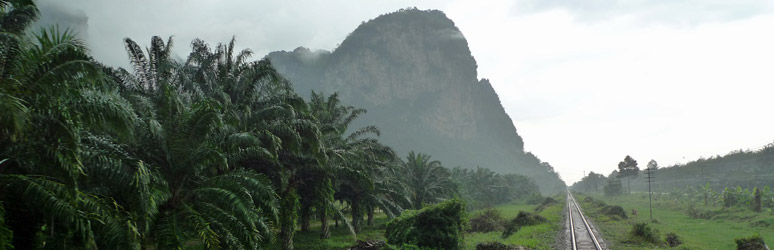
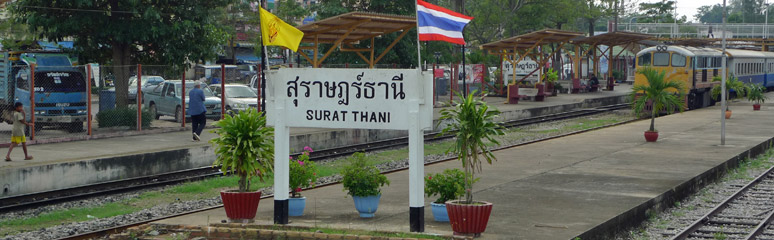
Bangkok to Ko Tao
Option 1, via Lomprayah Ferry
Book a comfy train from Bangkok to Chumphon, stay overnight - Chumphon station is in the town centre. Next day, a Lomprayah minivan leaves from outside the station for the 26 km drive to the Lomprayah pier for the Lomprayah's fast catamaran to Ko Tao.
Train classes:
1 = 1st class sleepers. S = 2nd class sleepers (air-conditioned). s = 2nd class sleepers (non-air-con). 2 = 2nd class seats. 3 = 3rd class seats.
R = Restaurant car. DRC = Diesel Railcar express with 2nd class air-conditioned seats.
The train can run an hour or two late, these schedules allow for that. The minivan+ferry is run by www.lomprayah.com.
How much does it cost?
-
Bangkok to Chumphon by sleeper train costs 1,230 in an air-con 1st class sleeper or 729 in an air-conditioned 2nd class sleeper.
-
Chumphon station to Ko Tao by minivan+ferry costs 900 baht one-way.
How to buy tickets
-
Book the train between Bangkok & Chumphon online at www.baolau.com or 12go.asia.
-
Then book the minivan+ferry between Chumphon & Ko Tao at 12go.asia. When the results appear, scroll down to the Ferries and Vans section and look for one that goes to/from Chumphon Train Station.
Option 2, via Surat Thani
The train-ferry connections actually work just as well via Surat Thani & Ko Samui, though it's a long way round. See the section below.
Bangkok to Ko Samui & Ko Phangan
It's easy to travel from Bangkok to Ko Samui, Ko Phangan or Ko Tao, using a train to Surat Thani then a combined minivan+ferry service operated by Lomprayah. It's the safe, comfortable & environmentally-friendly way to travel, much better than cramped buses or short-haul flights. The overnight sleeper option takes no more time out of your holiday than flying and is a lot more fun, and far more of an experience. Simply take a train from Bangkok to Surat Thani. On arrival at Surat Thani railway station (located at Phun Phin, 14 km from Surat Thani town centre), shuttle buses meet the train and take you to the Don Sak ferry terminal 60 km east of Surat Thani. You then take the fast ferry from Don Sak to Ko Samui, Ko Phangan & Ko Tao. Here is the recommended timetable.
Option 1, via Lomprayah Ferry
Train classes:
1 = 1st class sleepers. S = 2nd class sleepers (air-conditioned). s = 2nd class sleepers (non-air-con). 2 = 2nd class seats. 3 = 3rd class seats.
R = Restaurant car. DRC = Diesel Railcar express with 2nd class air-conditioned seats.
The train can run an hour or two late, these schedules allow for that. Have breakfast in Surat Thani! The minivan+ferry is run by www.lomprayah.com.
How much does it cost?
-
Bangkok to Surat Thani by sleeper train costs 1,332 in an air-con 1st class sleeper or 804 in an air-conditioned 2nd class sleeper.
-
Surat Thani station to Ko Samui by minivan+ferry costs 750 baht one-way, roughly £19, €22 or $24.
How to buy tickets
-
Book the train between Bangkok & Surat Thani online at www.baolau.com or 12go.asia.
-
Then book the minivan+ferry between Surat Thani Train Station & Ko Samui, Ko Phangan or Ko Tao at 12go.asia
Option 2, via Seatrans Ferry
Train classes:
1 = 1st class sleepers. S = 2nd class sleepers (air-conditioned). s = 2nd class sleepers (non-air-con). 2 = 2nd class seats. 3 = 3rd class seats.
R = Restaurant car. DRC = Diesel Railcar express with 2nd class air-conditioned seats.
The train can run an hour or two late, these schedules allow for that. Have breakfast in Surat Thani! The minivan+ferry is run by www.seatranferry.com.
How much does it cost?
-
Bangkok to Surat Thani by sleeper train costs 1,332 in an air-con 1st class sleeper or 804 in an air-conditioned 2nd class sleeper.
-
Surat Thani station to Ko Samui by minivan+ferry costs 420 baht one-way, roughly £10, €11 or $12.
How to buy tickets
-
Book the train between Bangkok & Surat Thani online at www.baolau.com or 12go.asia.
-
Then book the minivan+ferry between Surat Thani Train Station & Ko Samui at 12go.asia.
Bangkok to Phuket
Taking train+bus from Bangkok to Phuket is the comfortable & environmentally-friendly way to go, avoiding a gruelling 14-16 hour overnight bus journey in a cramped bus seat or an unnecessary short-haul flight. You simply take the comfy overnight sleeper train from Bangkok to Surat Thani, and next morning hop on an air-conditioned bus from Surat Thani to Phuket taking around 4h30.
Bangkok ► Phuket
-
Step 1, travel from Bangkok to Surat Thani by air-conditioned sleeper train.
Book any train you like, for example train 85 leaving Bangkok KTW at 19:50, arriving Surat Thani 06:23, with comfortable 1st & 2nd class air-conditioned sleepers, see the train timetable above.
-
Step 2, travel from Surat Thani to Phuket by an air-conditioned minivan.
On arrival in Surat Thani, walk out of the station, turn left and look for the Phantip Travel office across the road, see map showing office.
They will arrange for you to be picked up from the station and taken to their main office in Surat Thani Town some 14 km away.
A Phantip Travel minivan leaves from outside their Surat Thani Town office every hour from 09:00 to 17:00, journey time 4h30. It arrives at Phuket bus terminal 1, but they may be able to arrange drop-off at major hotels, feedback appreciated. The Phantip Travel website is www.phantiptravel.com.
Phuket ► Bangkok
-
Step 1, travel from Phuket to Surat Thani by an air-conditioned minivan.
A Phantip Travel minivan leaves from Phuket bus terminal 1 every hour from 07:00 to 15:00, journey time 4h30.
The minivan arrives at the main Phantip office in Surat Thani town, they should be able to arrange the transfer from Surat Thani town to Surat Thani station, about 14 km, or take a local taxi or tuk-tuk.
Allow plenty of time to catch your train, for example I'd leave Phuket on the 11:00 or 12:00 minivan departure to connect with train 86, or the 13:00 or 14:00 minivan departure to connect with train 84. The Phantip Travel website is www.phantiptravel.com.
-
Step 2, travel from Surat Thani to Bangkok by air-conditioned sleeper train.
Book any train that suits you, for example train 86 leaving Surat Thani at 19:31, arriving Bangkok KTW 06:10, or train 84 leaving Surat Thani at 20:23, arriving Bangkok KTW 07:05, both have comfortable 1st & 2nd class air-conditioned sleepers, see the train timetable above.
How much does it cost?
-
Bangkok to Surat Thani by sleeper train costs 1,332 in an air-con 1st class sleeper or 804 in an air-conditioned 2nd class sleeper.
-
Surat Thani to Phuket by minivan costs 300 baht one-way, roughly £8, €9 or $10.
Large luggage, station pick-up and hotel drop-off may cost extra.
How to buy tickets
-
Book the train between Bangkok & Surat Thani online at www.baolau.com or 12go.asia.
The train should be pre-booked as trains can get full.
-
Southbound from Bangkok to Phuket, you can just turn up and arrange transport at the Phantip Travel office on the day.
Or you could pre-book a minivan from Surat Thani Town to Phuket at 12go.asia, allowing at least 3-4 hours between train and bus in case of delay, but if the train arrives on time you're then left kicking your heels until your booked bus departure unless there is space on an earlier one.
-
Northbound from Phuket to Bangkok, pre-book the minivan from Phuket to Surat Thani Town at 12go.asia.
Bangkok to Krabi
Krabi hasn't got a railway station, but it's easy to get there using a comfortable train to Surat Thani then an air-conditioned bus for the last leg. Using the overnight sleeper train from Bangkok, the train+bus to Krabi takes no more time out of your holiday than flying, but is a lot more interesting, cheaper, and far more environmentally friendly. You're likely to find a number of buses to Krabi waiting at Surat Thani station after the arrival of your train.
Bangkok ► Krabi
-
Step 1, travel from Bangkok to Surat Thani by air-conditioned sleeper train.
Book any train you like, for example train 85 leaving Bangkok KTW at 19:50, arriving Surat Thani 06:23, with comfortable 1st & 2nd class air-conditioned sleepers, see the train timetable above.
-
Step 2, travel from Surat Thani to Krabi by an air-conditioned minivan.
On arrival in Surat Thani, walk out of the station, turn left and look for the Phantip Travel office across the road, see map showing office.
They will arrange for you to be picked up from the station and taken to their main office in Surat Thani Town some 14 km away.
A Phantip Travel minivan leaves from outside their Surat Thani Town office at 09:00, 10:30, 12:00, 13:30, 15:00 & 16:30, journey time 3 hours.
It arrives at Krabi bus terminal, but they may be able to arrange drop-off at major hotels, feedback appreciated. The Phantip Travel website is www.phantiptravel.com.
Krabi ► Bangkok
-
Step 1, travel from Krabi to Surat Thani by an air-conditioned minivan.
A Phantip Travel minivan leaves from Krabi bus terminal at 09:00, 10:30, 12:00, 13:30, 15:00, 16:30 journey time 3 hours.
The minivan arrives at the main Phantip office in Surat Thani town, they should be able to arrange the transfer from Surat Thani town to Surat Thani station, about 14 km, or take a local taxi or tuk-tuk.
Allow plenty of time to catch your train, for example I'd leave Krabi on the 12:00 or 13:30 minivan departure to connect with train 86, or the 13:30 or 15:00 minivan departure to connect with train 84. The Phantip Travel website is www.phantiptravel.com.
-
Step 2, travel from Surat Thani to Bangkok by air-conditioned sleeper train.
Book any train that suits you, for example train 86 leaving Surat Thani at 19:31, arriving Bangkok KTW 06:10, or train 84 leaving Surat Thani at 20:23, arriving Bangkok KTW 07:05, both have comfortable 1st & 2nd class air-conditioned sleepers, see the train timetable above.
How much does it cost?
-
Bangkok to Surat Thani by sleeper train costs 1,332 in an air-con 1st class sleeper or 804 in an air-conditioned 2nd class sleeper.
-
Surat Thani to Krabi by minivan costs 290 baht one-way, roughly £8, €9 or $10.
Large luggage, station pick-up and hotel drop-off may cost extra.
How to buy tickets
-
Book the train between Bangkok & Surat Thani online at www.baolau.com or 12go.asia.
The train should be pre-booked as trains can get full.
-
Southbound from Bangkok to Krabi, you can just turn up and arrange transport at the Phantip Travel office on the day.
Or you could pre-book a minivan from Surat Thani Town to Krabi at 12go.asia, allowing at least 3-4 hours between train and bus in case of delay, but if the train arrives on time you're then left kicking your heels until your booked bus departure unless there is space on an earlier one.
-
Northbound from Krabi to Bangkok, pre-book the minivan from Krabi to Surat Thani Town at 12go.asia.
Bangkok to Phi Phi islands
The Phi Phi islands can be reached by ferry from either Phuket or Krabi.
-
Phuket to Phi Phi by speedboat takes an hour. Several companies operate the route, including the Andaman Wavemaster (www.andamanwavemaster.com), Satun Pakbara Speedboat Club (www.spcthailand.com) & Bundhaya Speed Boat (www.bundhayaspeedboat.com).
You can check times, fares & buy tickets for all of these operators at 12go.asia.
-
Phuket to Phi Phi by regular boat takes 2 hours with a morning & afternoon sailing by Phi Phi Cruisers (www.phiphi-cruisers.com). You can check times, fares & buy tickets at 12go.asia.
Bangkok to Pattaya
A train line links Bangkok with the popular resort of Pattaya. A 3rd class train runs every day, comfortable enough, cheap, no reservation is necessary, just turn up, buy a ticket and hop on, see the 3rd class photos here. At weekends State Railways of Thailand run an air-conditioned Special Express diesel railcar, with 2nd class reserved seats. Both trains are a good and pleasant way to reach Pattaya, and they continue to use Bangkok's original Hualamphong station. You can check these times at www.baolau.com.
Train 283/284 = local train, 3rd class only, no reservation needed, you sit where you like.
Trains SP887/888 = special express diesel railcar, 2nd class air-conditioned seats, all reserved.
How much does it cost?
-
On train 283/284, 3rd class = 31 baht.
-
On train SP 997/998, 2nd class air-con reserved seat = 170 baht.
-
Children aged 0 to 3 and less than 100cm in height travel free, children aged 4 to 11 and under 150cm travel at reduced fare, children 12 years old and upwards (or over 150cm high) pay full fare. £1 = 42 Baht. €1 = 36 Baht. $1 = 31 Baht.
How to buy tickets
-
Tickets for Special Express 887 /888 can be booked online in advance at www.baolau.com.
-
Tickets for ordinary train 283/284 are only sold at the station an hour or less before departure, they cannot be bought in advance.
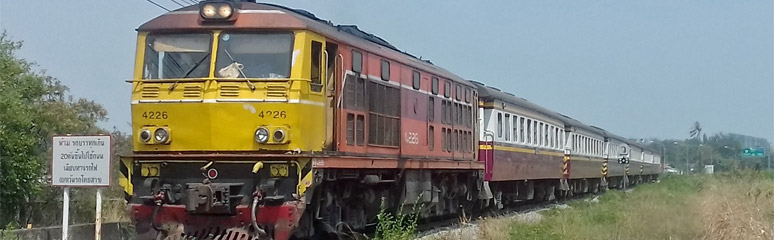
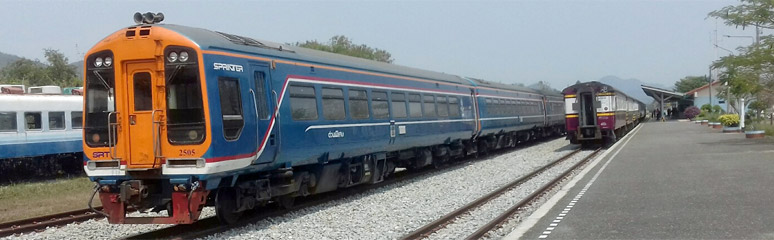
Bangkok - Kuala Lumpur - Singapore
-
It's easy, safe and comfortable to travel from Bangkok to Malaysia & Singapore by train, over 1,200 miles for around £50 or $80 one-way, including sleepers, a real bargain. It's the environmentally sound way to travel, too. Trains run daily, and if done all in one go, the complete journey from Bangkok to Singapore takes two nights, though you can stop off wherever you like for as long as you like. I'd suggest stopping off at least in Penang and Kuala Lumpur. Map of train routes in Southeast Asia.
-
Bangkok to Singapore by luxury train: See the Eastern & Oriental Express page.
Bangkok to Phnom Penh, Saigon
-
It's easy to travel between Bangkok, Siem Reap, Phnom Penh, & Saigon (Ho Chi Minh City) by train & bus, see the Train travel in Cambodia page.
Bangkok to Yangon & Burma
-
It's possible to travel overland between Bangkok, Moulmein & Yangon in Burma (Myanmar) by train & bus, see the Train travel in Burma page.
Singapore, KL & Penang to Ko Samui
Singapore & Malaysia ► Ko Samui
-
Step 1, travel from Singapore, Kuala Lumpur or Butterworth (Penang) to Surat Thani by train, see the Malaysia page for a timetable & fares.
-
You'll need to stay overnight and take a ferry next morning. Surat Thani station is located at Phun Phin, 14 km from Surat Thani town.
-
Step 2, minivans run from Surat Thani station to the Don Sak ferry terminal 60 km outside Surat Thani to connect with ferries hour to Ko Samui, crossing time 1½ hours. You can book integrated minivan+ferry tickets between Surat Thani Train Station & Ko Samui via Lomprayah catamarans or Seatran conventional ferries at 12go.asia
Ko Samui ► Malaysia & Singapore
-
Step 1, take an afternoon or evening ferry & from Ko Samui to Surat Thani, see the ferry timetable below. You can book integrated ferry+minivan tickets from Ko Samui to Surat Thani Train Station via Lomprayah catamarans or Seatran conventional ferries at 12go.asia.
-
Stay overnight in Surat Thani.
-
Step 2, travel from Surat Thani to Butterworth (Penang), Kuala Lumpur & Singapore by comfortable train, see the Malaysia page for full details of times & fares.
Ko Samui - Phuket
-
Several operators offer integrated ferry+bus options between the two holiday centres, Ko Samui & Phuket.
-
Journey time is between 6h15 & 7h30, fares from $18, book at 12go.asia.
Singapore, KL & Penang to Phuket
Singapore & Malaysia ► Phuket
-
Step 1, travel from Singapore, Kuala Lumpur or Butterworth (Penang) to Hat Yai by train, see the Malaysia page for a timetable & fares. On arrival at the railway station, take a tuk-tuk to the bus terminal. For example, as you can see on the timetable:
The 07:28 from Butterworth (Penang), change at Padang Besar, will get you to Hat Yai at 09:50.
The 09:30 from Kuala Lumpur Sentral, 13:38 from Butterworth (Penang), change at Padang Besar, will get you to Hat Yai at 15:35.
-
Step 2, travel from Hat Yai to Phuket by minibus or air-conditioned bus, you can check bus times and buy tickets for various bus operators using 12Go.Asia. Minibuses take 6 hours, fare around 350 baht. 1st class air-con buses take 7½ hours, fare around 344 baht.
For example, buses run by Sritrang Tour leave Hat Yai bus station at 05:45, 07:45, 08:45, 09:30, 10:05, fare around 344 Baht (£7). Minibuses leave Hat Yai for Phuket regularly, and are probably the best bet for a connection off the trains. You'll find plenty of people trying to sell you minibus tickets at the station when you get off the train.
-
Traveller David Maddox reports: "There are many people trying to sell you the minibus tickets to Phuket when you get off the train at Hat Yai. We went to two places. One pressured us into its shop and was asking for 650 Baht per person. If you walk out of the train station in Hat Yai and turn left and walk down past several restaurants and in one of the last buildings is a tour company that only charges 400 Baht (£8 or $13) per person and our bus was only locals. The minibus left from outside the agency, right near the station."
Phuket ► Malaysia & Singapore
-
Step 1, travel from Phuket to Hat Yai by bus or minibus, you can check bus times and buy tickets online for various bus operators using 12Go.Asia. Minibuses run regularly and take 6 hours, fare around 350 baht. 1st class air-con buses take 7½ hours, fare around 344 baht.
For example, 1st class air-conditioned buses run by Sritrang Tour leave Phuket for Hat Yai at 07:30, 08:30, 09:30, 11:30, 12:30, 19:30 & 21:30 (check bus times locally). On arrival at the bus terminal in Hat Yai, take a tuk-tuk to the railway station.
-
Step 2, travel from Hat Yai to Butterworth (Penang), Kuala Lumpur & Singapore by comfortable train, see the Malaysia page for full details of times & fares. For example, as you can see on the timetable:
The 07:30 from Hat Yai, change at Padang Besar, will get you to Butterworth (Penang) at 12:30, change there for Kuala Lumpur arriving 18:47.
The 13:05 from Hat Yai, change at Padang Besar, will get you to Butterworth (Penang) at 17:58 and Kuala Lumpur Sentral at 21:50.
Singapore, KL & Penang to Krabi
Singapore & Malaysia ► Krabi
-
Travel by train from Singapore, Kuala Lumpur, or Penang to Hat Yai, see train times & info Singapore-Malaysia-Surat Thani.
-
Then take a bus or minibus from Hat Yai to Krabi. Minibuses leave Hat Yai for Krabi regularly, journey time 4 hours, fare around 300 baht. You'll find plenty of people trying to sell you minibus tickets at the station when you get off the train, no need to pre-book.
Krabi ► Malaysia & Singapore
-
Minibuses run regularly from Krabi to Hat Yai, journey time 4 hours, fare around 300 baht. No need to pre-book, arrange locally.
-
Then travel by train from Hat Yai to Butterworth (Penang), KL or Singapore, see train times & info Singapore-Malaysia-Surat Thani.
London to Thailand by Trans-Siberian Railway
If you have the time (we're talking a minimum of 3 weeks one-way), you can travel from London to Bangkok overland, see the route map here. The links below cover travel in either direction, eastbound from London to Bangkok or westbound from Bangkok to London.
-
Step 1, London to Moscow by train. There are daily departures via Brussels, Berlin & Warsaw. Trains to Russia are suspended due to Covid-19 and now sanctions. Spend at least 1 night in Moscow.
-
Step 2, Moscow to Beijing by Trans-Siberian Railway. Two direct trains every week all year round, 6 nights. Fares from around £500 one-way with a bed in a 4-bed sleeper. Spend at least 1 night in Beijing. Trains to China are suspended due to Covid-19.
-
Step 3, Beijing to Hanoi by train. There are two direct trains a week, 2 nights, about $320 or £220 one-way in soft sleeper. Alternatively, there are daily trains with a change in Nanning. Spend at least 1 night in Hanoi.
-
Step 4, Hanoi to Saigon by train. There are several comfortable air-conditioned trains every day over the Reunification Railway taking 2 nights. Why not stop off to see Hue or Hoi An? About $90 or £50 one-way in soft sleeper.
-
Step 5, Saigon-Phnom Penh by bus. There are lots of buses every day, journey time 6 hours, $12. Spend at least 1 night in Phnom Penh.
-
Step 6, Phnom Penh to Poiphet by bus or train, train to Bangkok. Takes a day.
How to arrange this trip
-
There aren't any travel agencies who can arrange the whole trip, so you will need to plan it out and arrange each stage of the journey yourself. It's an exercise in project management! Unless time is absolutely no object, you should book the key sections in advance through various travel agencies.
-
Book London-Moscow as shown on the London to Russia page.
-
Book Moscow-Beijing & Beijing-Hanoi through a local Russian agency such as Real Russia, as shown on the Trans-Siberian page & Vietnam page.
-
Tickets for other parts of the trip, for example, Hanoi-Saigon-Phnom Penh-Bangkok can all be bought locally, as you go along. You'll need to pre-arrange visas for Belarus, Russia, possibly Mongolia, China & Vietnam, and in many ways complying with the various visa requirements (which sometimes require confirmed onward tickets to be held) is actually the biggest challenge, not buying the tickets, so check this out carefully using the relevant embassy websites.
-
Where do you start? First, read through the seat61 pages linked above. Then sketch out your itinerary using a simple spreadsheet like this, deciding where and for how long you want to stop off. Next, check out the visa situation for each country. Finally, follow the advice on each seat61 page to buy tickets for each train journey that you want to pre-book.
Some inspiration
You won't be the first to travel between Europe and Southeast Asia overland this way, far from it. Check out this excellent blog from Tom Woods, "Woodlands to Woking", woodlandstowoking.wordpress.com, and Matthew Woodward's equally excellent blog from Edinburgh to Singapore www.matthew-woodward.com/edinburgh-to-singapore.
Guidebooks
Take a good guidebook, a sound investment even in the age of free info on the internet. Easily the best guidebooks for the independent traveller are the Lonely Planets and Rough Guides, they'll zero you in on the most important sights, with stacks of practical information plus historical and cultural background. You won't regret buying either of these guides.
 Buy
at
Amazon.co.uk
or
Amazon.com
Buy
at
Amazon.co.uk
or
Amazon.com


Hotels in Thailand
Hotels in Bangkok
The Shanghai Mansion is close to Hualamphong station, with excellent reviews. Also try the Centre Point Sillom (great reviews, river views), the Chillax Resort (swimming pool, great reviews in spite of the name!), Inn a Day (rave reviews, close to palace & river, balconies to all rooms), Shangri-La Hotel (on the river, pool, rave reviews). Other hotels in Bangkok
Hotels in Chiang Mai
The Sila Boutique B&B gets rave reviews, has free WiFi and is inside old city. Or try La Pillow (great reviews, free WiFi, inside the old city), Villa Thapae (free WiFi, swimming pool, all rooms with balcony, rave reviews), Tamarind Village (spa, pool, poolside restaurant, tour desk, free WiFi, inside the old city and great reviews), De Naga Hotel (inside the old city, free WiFi, swimming pool, spa, great reviews), Rachamankha Hotel (pool, spa, free WiFi, great reviews). Other hotels in Chiang Mai
Bangkok's classic hotel: Mandarin Oriental Hotel
Known by locals (and taxi drivers) by its original name, plain Oriental Hotel, the Mandarin Oriental is Bangkok's oldest and grandest hotel. Located on the banks of the Chao Phraya River, its outdoor restaurant tables line the riverbank, where they do a great evening buffet. Most of the rooms are now housed in two huge modern tower blocks, but hidden behind palm trees in the courtyard is the diminutive original block, today restored to within an inch of its life and housing just a few of the more expensive suites.
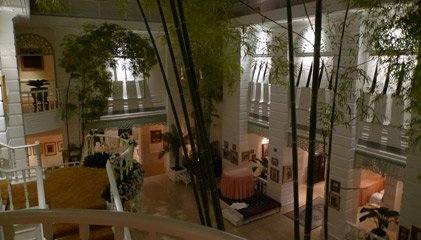
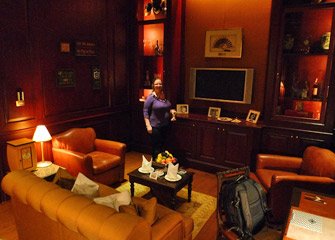

Backpacker hostels
www.hostelworld.com: If you're on a tight budget, don't forget about backpacker hostels. Hostelworld offers online booking of cheap private rooms or dorm beds in backpacker hostels in Paris and most other European cities at rock-bottom prices.
Flights to Bangkok
Overland travel by train & bus around Southeast Asia is an essential part of the experience, so once there, don't cheat and fly, stay on the ground! But a long-haul flight might be unavoidable to reach Thailand in the first place.
1) Check flight prices at www.opodo.com
2) Use Skyscanner to compare flight prices & routes worldwide across 600 airlines...

3) Lounge passes
Make the airport experience a little more bearable with a VIP lounge pass, it's not as expensive as you think, see www.loungepass.com
Travel insurance & other tips
|
|
|
|
|


Always take out travel insurance
Never travel overseas without travel insurance from a reliable insurer, with at least £1m or preferably £5m medical cover. It should also cover cancellation and loss of cash and belongings, up to a sensible limit. An annual multi-trip policy is usually cheaper than several single-trip policies even for just 2 or 3 trips a year, I have an annual policy with Staysure.co.uk myself. Here are some suggested insurers. I get a small commission if you buy through these links.
 www.staysure.co.uk
offers enhanced Covid-19 protection & gets 4.7 out of 5 on
Trustpilot.
www.staysure.co.uk
offers enhanced Covid-19 protection & gets 4.7 out of 5 on
Trustpilot.
www.columbusdirect.com
is also a well-know brand.
 www.staysure.com/ie if you live in Ireland.
 If you live in the USA try
Travel Guard USA.
If you live in the USA try
Travel Guard USA.
|
|

Get an eSIM with mobile data package
Don't rely on WiFi, download an eSIM with a European mobile data package and stay connected. Most newer mobile phones can download a virtual SIM including iPhone 11 & later, see device compatibility list. There's no need to buy a physical SIM card! Maya.net is a reliable eSIM data retailer with a 4.5 out of 5 Trustpilot rating and a range of packages including unlimited data.
|
|

Get a VPN for safe browsing. Why you need a VPN
When you're travelling you often use free WiFi in public places which may not be secure. A VPN encrypts your connection so it's always secure, even on unsecured WiFi. It also means you can select the geographic location of the IP address you browse with, to get around geoblocking which a surprising number of websites apply. See VPNs & why you need one explained. ExpressVPN is a best buy with a 4.7 out of 5 Trustpilot ranking which I use myself - I've signed up as an ExpressVPN affiliate, and if you go with expressvpn.com using the links on this page, you should see a special deal, 3 months free with an annual subscription. I get a small commission to help support this site.
|
|


Get a Curve card for foreign travel
Most banks give you a poor exchange rate, then add a foreign transaction fee on top. A Curve MasterCard means no foreign transaction fees and gives you the mid-market exchange rate, at least up to a certain limit, £500 per month at time of writing. The money you spend on your Curve card goes straight onto one of your existing debit or credit cards.
How it works: 1. Download the Curve app for iPhone or Android. 2. Enter your details & they'll send you a Curve MasterCard - they send to the UK and most European addresses. 3. Link your existing credit & debit cards to the app, you can link up to two cards with the free version of Curve, I link my normal debit card and my normal credit card. 4. Now use the Curve MasterCard to buy things online or in person or take cash from ATMs, exactly like a normal MasterCard. Curve does the currency conversion and puts the balance in your own currency onto whichever debit or credit card is currently selected in the Curve app. You can even change your mind about which card it goes onto, within 14 days of the transaction.
I have a Curve Blue card myself, it means I can buy a coffee on a foreign station on a card without being stung by fees and lousy exchange rates, just by tapping the Curve card on their card reader. The money goes through Curve to my normal debit card and is taken directly from my account (in fact I have the Curve card set up as payment card on Apple Pay on my iPhone, so can double-click my phone, let it do Face ID then tap the reader with the phone - even easier than digging a card out). I get a little commission if you sign up to Curve, but I recommend it here because I think it's great. See details, download the app and get a Curve card, they'll give you £5 cashback through that link.
|
|

Carry an Anker powerbank
Tickets, reservations, vaccination records and Interrail or Eurail passes are often held digitally on your mobile phone, so it's vital to keep it charged. I always carry an Anker powerbank which can recharge my phone several times over if I can't get to a power outlet. Buy from Amazon.co.uk or from buy from Amazon.com.
Touring cities? Use hill walking shoes!
One of the best things I've done is swap my normal shoes for hill-walking shoes, in my case from Scarpa. They're intended for hiking across the Pennines not wandering around Bangkok, but the support and cushioning for hiking works equally well when you're on your feet all day exploring foreign cities. My feet used to give out first and limit my day, now the rest of me gives up before they do!