


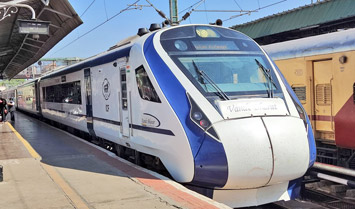
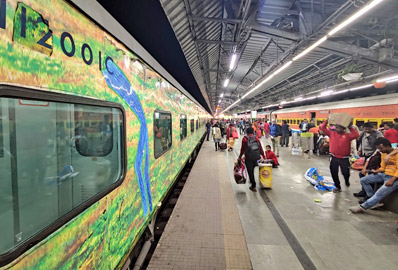
A 130 km/h Vande Bharat Express, as used between New Delhi & Varanasi. Courtesy of Nonstop Eurotrip.
Buy from 12go.asia without the hassle. See advice & full details on buying Indian train tickets |
|

Around India by train
The best way to see India is at ground level using the incredible Indian railway system, not from 35,000 feet. Experience the bustle of Indian railway stations and a comfortable journey on an Indian express train with the tea seller's cry of Chai, chai, garam chai wafting down the aisle. Forget media images of crowded local trains with people sitting on the roof. In an AC Chair Car or AC1 or AC2 sleeper on an express it’s safe, civilised, inexpensive & comfortable with all seats & berths reserved. Even journeys such as Mumbai to Delhi or Delhi to Jaisalmer can be made time-effectively by overnight sleeper, centre to centre, saving a hotel bill. Easily book Indian train tickets at 12go.asia.
 How to check train times
& fares
How to check train times
& fares
Which station in Delhi, Mumbai,
Kolkata, Agra?
Classes explained: AC1, AC2, AC3, EC, CC...
Types of train: Mail, Express, Rajdhani,
Shatabdi...
Quotas: General, Foreign Tourist, Tatkal
How to buy tickets at the station
Tips for
train travel in India: Luggage, food, security
Illustrated guide to the
11 classes on Indian trains
A recommended 2-week itinerary around northern India
The easy way: Organised tours of India by
train
IndRail
passes - discontinued in 2017
Tourist cruise trains & the Palace on Wheels
International trains, buses & ferries from India
Overland travel
between Europe & India
Travel insurance, mobile data, VPN &
other tips
Useful country information
Train routes & maps
-
India's passenger rail network is the third biggest in the world after Russia and China, with 63,000 km of rail routes and 6,800 stations. In terms of passenger kilometres, it's the biggest in the world. Indian Railways are the world's biggest employer, with over 1.5 million staff.
The trains in India go almost everywhere, and it's generally safe to assume that you can travel between any two Indian cities or major towns by train, the length and breadth of the country.
-
Most of India's rail network is broad gauge with rails 5' 6" apart, wider than standard gauge (4' 8½") used in Europe, allowing Indian trains to be wider than European trains. Parts of the country such as Rajasthan used to be served by an extensive metre-gauge network, but most metre-gauge routes have now been converted to broad gauge. A few hill railway such as Kalka-Simla and New Jalpaiguri to Darjeeling use narrow gauge, either 2' or 2' 6".
-
For an Indian railways route map see surveyofindia.gov.in/files/Railway map_Eng_C.jpg (please let me know if this stops working).
Also try www.mapsofindia.com/maps/india/india-railway-map.htm, or indiarailinfo.com/atlas.
Trains at a Glance |
How to check train times & fares
-
It can be easiest to check train times & fares for key routes at 12go.asia, this also sells tickets, hassle-free.
-
For train times & fares for any route, use www.indianrail.gov.in.
This is one of the various official Indian Railways websites, an amazing site but a little bewildering, not helped by there being another official site, www.indianrailways.gov.in. It's a good training course for your travels in India!
To check train times, look for Reserved Train Between Stations at the top of their home page.
To check fares, first find a train and note the train number, then click Fare enquiry at the top of their home page.
To check availability over various dates, first find a train and note the train number, then click Seat availability at the top of their home page.
-
Or download an app for your phone. There are many apps to choose from, the official IRCTC apps seem unavailable outside India so try these 3rd-party apps for checking Indian train times on the go. They're ad-heavy, but they work, I find Ixigo the best.
Indian Rail IRCTC for iPhone or Indian Rail IRCTC for Android.
-
Trains at a Glance
You can buy the famous Trains at a Glance timetable booklet for 100 rupees at any station bookstall, it shows times in printed form for most major stations on all the main routes. Very useful and a great souvenir!
Or download it for a small fee from www.irctctourism.com/gallery/tag.html.
Or download for free at indianrailways.gov.in/railwayboard/view_section.jsp?lang=0&id=0,1,304,366,537 Important: If it says Error 404 Page Not Found, simply set your VPN to India and it will work. This is why people need a VPN!
Tips for checking Indian train times
-
Booking systems only show direct trains
www.indianrail.gov.in only shows direct trains. For popular tourist routes this isn't a problem as there's usually a direct train, but there are several key exceptions such as Simla or Darjeeling where you need a mainline train followed by a narrow-gauge toy train:
Delhi to Simla: First search from New Delhi (station code NDLS) to Kalka (KLK) then search for a connecting train from Kalka to Simla (SML).
Kolkata to Darjeeling: First search from Kolkata Sealdah (SDAH) to New Jalpaiguri (NJP) then New Jalpaiguri to Darjeeling (DJ).
-
How many nights? If the system shows a train running overnight, look closely to see it isn't two or more nights. Mumbai to Kolkata or Delhi to Chennai is about 36 hours, so typically two nights. On the other hand, travelling on a fast train, Mumbai to Delhi or Kolkata to Delhi takes just one night.
-
Classes, train types & availability: To understand the class codes, 1A, 2A, CC and so on, see the explanation here. To understand the train types, Shatabdi, Rajdhani and so on, see the train types section. And to understand the difference between AVL (Available), RAC (Reservation Against Cancellation) & WL (Waitlisted) places and how this amazing system works, see the explanation here.
Which station in which city?
-
in Delhi, the main central station is New Delhi (station code NDLS), so start by checking trains from NDLS. Delhi Junction (station code DLI), also known as Old Delhi is in the middle of old Delhi near the red Fort. H.Nizamudin (NZM) & Sarai Rohilla (DEE) are secondary stations further from the city centre and best reached by taxi. See map of Delhi showing stations.
-
In Mumbai (Bombay), the most important (and impressive) station is the magnificent former Victoria Terminus in the city centre, now officially called Chhatrapati Shivaji Maharaj Terminus, station code CSMT. So start by looking for trains from CSMT. If you don't see any suitable trains, try Mumbai Central (MMCT) which is also (as the name suggests) pretty central and the station for fast sleeper trains to New Delhi. Finally try Dadar (DDR) or Lokmanya Tilak Terminus LTT), both of which are a little way out of the centre. See map of Mumbai showing stations.
-
In Kolkata (Calcutta), the main station is across the river in Howrah, known as Howrah Junction or just Howrah, station code HWH. Trains from Kolkata to New Jalpaiguri (for the toy train to Darjeeling) use Kolkata Sealdah station, often just shown as Sealdah, station code SDAH. See map of Kolkata showing stations.
-
In Agra, the main station for fast trains is Agra Cantonment, abbreviated as Agra Cantt, station code AGC, this is an autorickshaw or taxi ride from the Taj Mahal, although Agra Fort (AF) is nearer the old town centre and (obviously) the fort. See map of Agra showing stations & sights.
-
Goa is a region, not a specific town. The main stations are Madgaon (MAO) and Vasco da Gama (VSG), use these when checking trains.
-
Kashmir originally had no rail connection, but a line to Srinagar and beyond has now been completed. The line heads through tough terrain, and features the highest railway bridge in the world. Srinagar's station code is SINA (not to be confused with another smaller Srinagar in Rajasthan with station code SNAR).
-
Khajuraho (a much-visited temple complex) now has a station, station code KURJ. There's a daily overnight train called the Kurukshetra-Khajuraho Express leaving New Delhi station at 18:20, picking up at Agra Cantonment around 21:35 and arriving in Khajuraho at 08:00 next morning. It returns from Khajuraho at 18:35 arriving New Delhi at 08:45.
Example train times
Example fares from Delhi
£1 = 105 Rupees, €1 = 90 Rupees, $1 = 82 Rupees.
Shatabdi Express = Premier daytime train, special fare payable, meals included.
Rajdhani Express = Premier overnight train, special fare payable, meals included.
Child fares on Indian trains since 2016: Children aged 0 to 4 inclusive travel free. Children aged 5 to 11 inclusive travel at half fare if they do not take up a reserved seat or berth, but since April 2016 they must pay the adult fare if they travel with their own reserved seat or berth. I do not recommend that any child aged 5 to 11 travels without their own seat or berth in AC1, AC2, AC3, AC Chair car or Sleeper Class, so this effectively means you must pay the adult fare for children aged 5 and over. Children aged 12 and over pay the adult fare in all cases.
Classes explained
-
There are 11 classes on Indian Railways, I explain each class in detail here. But here's a quick summary:
AC first class, shown as AC1 or 1A, consists of berths in air-conditioned 2 berth & 4 berth compartments, bedding provided.
AC 2-tier, shown as AC2 or 2A, upper & lower berths in air-conditioned open-plan carriages, bedding provided.
AC 3-tier, shown as AC3 or 3A, upper, middle & lower berths in air-conditioned open-plan carriages, bedding provided.
AC 3-tier economy shown as 3E, a variation of AC 3-tier with an extra berth in each bay of berths on the longitudinal side of the aisle.
Executive Anubhuti chair car shown as EA, only available on a few Shatabdi Express trains, similar to Executive Chair class but with extra amenities such as seat-back TVs.
Executive Chair car shown as EC, comparable to European 1st class with seats 2+2 across the car width in air-con open-plan carriages.
Chair Car, shown as CC, comparable to European 2nd class with seats 2+3 across the car width in air-conditioned open-plan carriages.
Sleeper class, shown as SL, upper, middle & lower berths in open-plan carriages, the way the masses travel, no A/C, no bedding.
1st class, shown as F or FC with 2 & 4 berth compartments, although this has been almost entirely phased out in favour of AC2.
2nd class reserved seats, shown as 2S, basic open-plan wooden or plastic seats.
2nd class unreserved seats, shown as GN for general seating. Basic open-plan wooden or plastic seats.
-
Only a selection of these classes will be available on a given train. For example, a typical long-distance Mail or Express train might have one AC1 car, one AC2 car, one AC3 car then maybe 10 Sleeper class cars. A premier daytime express might have one or two cars of AC Executive Chair class (EC) and many cars of AC Chair class (CC).
-
For a detailed explanation of each class with photos, see my guide to Indian train classes.
Which class to choose?
-
For overnight journeys most visitors choose AC2, the class typically used by middle class Indian families. AC3 is a good alternative if AC2 is sold out, it's similar to AC2 but with an extra two bunks in each bay so is more crowded.
More affluent visitors splurge on AC1, twice the price of AC2 and only available on the better trains. It's typically used by army officers and bank managers.
At the other extreme, some adventurous backpackers choose the very basic Sleeper class (SL), the way the masses travel. It's often grubby with no air-con and no bedding (bring your own), and I wouldn't suggest it for first-timers unless on a rock-bottom budget. But the windows open, it has vast amounts of local colour and it's an authentic Indian experience if nothing else.
-
For daytime journeys AC chair car (CC) is an excellent choice where available. By all means use AC executive chair class (EC) if you don't mind the cost. If there's no CC or EC, you can make daytime journeys in AC1, AC2 or AC3 as the berths are folded away during the day to form seats.
Non-air-con 2nd class reserved seating (2S) is fine for shorter hops or even journeys such as New Delhi-Amritsar. The seats on the better trains are padded rather than wooden and the windows open for better views of the landscape. But unreserved 2nd class (GN) is a scrum, avoid!
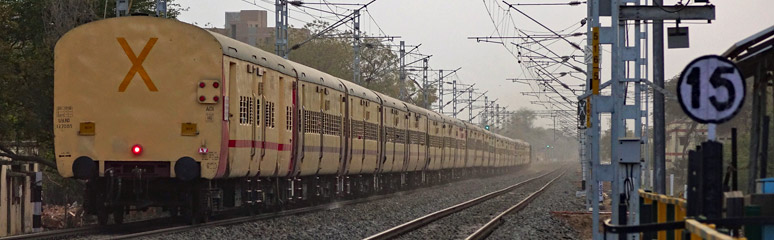
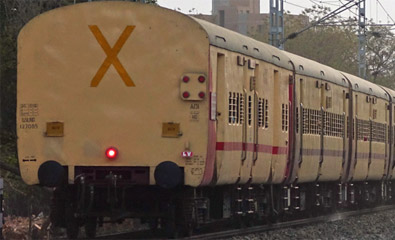
Above, a typical long-distance express or mail train with older carriages (not a premier Rajdhani or Duronto express). You can just make out 3 cars in the centre of the train with different windows, these are the AC cars, perhaps one AC1, one AC2 & one AC3. The rest of the train is Sleeper class. Courtesy of Albert Höchst.
Types of train
-
Local or Passenger trains
These are the slowest, calling at every station. You wouldn't normally use these for longer-distance travel, only for local journeys.
-
Mail & Express train
Most trains are classified Mail or Express, there's little difference between the two. You'll sometimes see an express or mail train described as Superfast, which means it has a faster schedule with a higher running speed, but not necessarily better facilities.
In addition to Mail & Express, India has a number of premier train brands indicating both higher speed and high-quality, more modern carriages with better on-board facilities, for example refreshments included in the fare:
-
Rajdhani express trains
These are excellent extra-fast all-air-conditioned sleeper trains linking Delhi with regional capitals such as Mumbai, Kolkata, and so on, Rajdhani is Hindi for capital. Rajdhani Express trains use German-designed LHB (Linke Hofmann Busch) coaches, see this link for photos, with AC1, AC2 & AC3. Meals are included in the fare, served at your seat. They're the best trains to take, the Delhi to Mumbai and Delhi to Kolkata Rajdhani Expresses leave early evening and arrive in the morning, a time-effective overnight trip that beats flying, hands-down.
-
Shatabdi Express trains
These are excellent fast air-conditioned daytime trains running at up to 140 km/h (87 mph) on routes such as Delhi-Agra, Delhi-Jaipur and Delhi-Kalka with AC Executive Chair class (EC) & AC Chair class (CC). Refreshments are included in the fare. Shatabdi is Hindi for century, as the first such expresses were introduced in 1988 to mark the centenary of Jawaharlal Nehru’s birth. Again, these are the best trains to take, comparable with European trains, also composed of German-designed LHB coaches.
-
Tejas Express trains
Fast all-air-conditioned expresses, similar to the Shatabdi Expresses. They run on several routes including Delhi-Lucknow and Delhi to Karmali in Goa. They have AC Executive Chair class & AC Chair class. They run at up to 130 km/h (80 mph).
-
Vande Bharat Express trains
India's most modern trains. New streamlined 16-car electric units with 14 cars of AC Chair class and 2 cars of AC Executive chair class, capable of 160 km/h and used in service at up to 130 km/h (80 mph). You'll find them on just a handful of routes including Delhi to Varanasi & Howrah (Kolkata) to New Jalpaiguri (the railhead for Darjeeling) and they're being extended to others. Like the Shatabdi Expresses, refreshments are included in the fare. See en.wikipedia.org/wiki/Vande_Bharat_Express & video of Varanasi-Delhi Vande Bharat Express.
-
Duronto Expresses
Another recommended train category, Duronto means rebel. These are very fast long-distance trains linking major city pairs often non-stop, often faster than the equivalent Rajdhani. Routes include Mumbai-Kolkata, Delhi-Kolkata, Delhi-Lucknow, Mumbai-Jaipur, although not always running every day. Duronto Expresses have AC1, AC2 and AC3 sleepers, although the carriages may not be as well-appointed as the premier Rajdhani Express on the same route. A few Duronto Expresses now also convey non-AC cars.
Which train to choose?
-
You'll see a bewildering array of named expresses when you run an enquiry between two Indian cities. Don't just pick one at random!
-
Tip 1, look for a high-quality train type and the fastest journey time: For long-distance and/or overnight journeys, look for a Rajdhani or Duronto express. For daytime journeys, look for a Shatabdi Express, Tejas Express or Vande Bharat Express. These are all higher quality than the average Indian train. Look at the journey time: As a general rule, the faster trains tend to have better quality rolling stock.
-
Tip 2, avoid making short journeys on long-distance trains: It's not always easy to work out where a train has come from when booking online, but for a short hop such as Agra to Delhi, you ideally want a train that starts its journey only a few hours south of Agra. You don't want a train that starts its journey 1,200 miles away and which might be 5 hours late by the time it reaches Agra, 27 hours into its journey!
-
Tip 3, for daytime journeys, look for a train with EC or CC. These are arguably more comfortable than travelling in AC1/2/3 on a sleeper train in seats mode and as you don't normally find EC or CC on very long distance trains, a train with these classes is normally a good choice for a shorter trip, see tip 2 above!
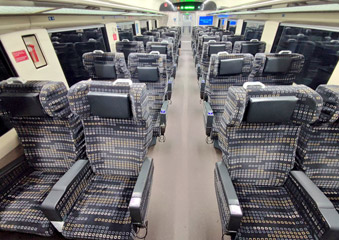
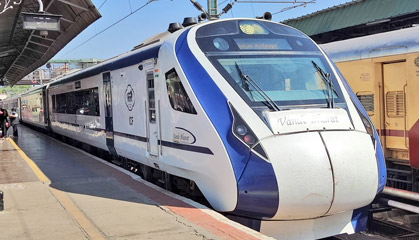
Executive Chair (EC) class on a Vande Bharat Express. These are India's most modern trains, capable of 160 km/h (100 mph) & used at up to 130 km/h (80 mph). See en.wikipedia.org/wiki/Vande_Bharat_Express. Photos courtesy of Nonstop Eurotrip, see video of Varanasi-Delhi Vande Bharat Express.
AVL, CNF, RAC & Waitlist
-
You need a reservation to travel on Indian long-distance trains, you can't just turn up and hop on. Reservations are fully computerised using the world's largest computer reservation system. Trains get fully-booked weeks in advance, so buy tickets as far ahead as possible.
When do bookings open?
-
Bookings for most Indian long-distance trains currently open 60 days before departure.
The Advance Reservation Period (ARP) was 60 days until 2008 when it was experimentally extended to 90 days, then extended to 120 days in 2012, reduced to 60 days in 2013 to make ticket scalping by agencies harder, restored to 120 days in April 2015 but reduced again to 60 days from November 2024 'to reduce the % of cancellations and no-shows and improve ticket availability'.
Some short-distance inter-city trains open for bookings less than this, for example Delhi-Kalka & Kalka-Simla may open only 30 days or in some cases just 15 days ahead.
The remarkable Indian Railways system
-
Indian Railways have a unique system with 4 possible statuses for seats/berths/bookings:
AVL = Available, these are seats or berths that are unsold and available for booking.
CNF = Confirmed. When you book an available seat or berth, your PNR status (Personal Name Record) becomes CNF, confirmed. You're safely booked on the train with a specific seat or berth.
RAC = Reservation Against Cancellation. When all the seats or berths on a train in a given class have been sold, a certain number of tickets in that class are sold as RAC, Reservation Against Cancellation.
WL = Waitlist. When all the RAC places have been sold, you can buy Waitlist (WL) tickets.
-
If you go to www.indianrail.gov.in & click Seat availability you can see how many seats remain available in each class on a given train.
For example, today is 26 January, let's say I want to go from Delhi to Kolkata on the best train, the overnight Howrah Rajdhani in AC 2-tier. Tomorrow's train is fully-booked in AC2 and shown as NOT AVAILABLE. I can buy Waitlisted tickets for this train on 28 and 29 January. I can buy RAC tickets on any day between 30 January & 5 February and if I buy those I can definitely board the train and travel with (in practice) maybe a 90% chance of ending up with a berth to myself. The first day on which AC 2-tier is shown as AVL so I can buy a ticket and instantly get a confirmed berth is 6 February. The Foreign Tourist quota would help me here, there are 7 or 8 FT quota places shown as AVL every day from 27 January onwards, but I'll explain that in the quotas section.
Reservation Against Cancellation (RAC)
-
With an RAC ticket, you can board the train and travel. Whatever happens, you're safely booked on that train. So if you're offered an RAC ticket you should take it, even though you won't have a specific seat or berth number at this stage.
-
In the vast majority of cases, one of the confirmed passengers will cancel or unsold tickets will be left in one of the more obscure quotas on departure day and you'll be promoted from RAC to CNF with a confirmed seat or berth on the train.
Your name will then be shown against a specific seat or berth number on the reservation list pinned on the notice board at the boarding station on the day of travel when the train is charted, or you can check your PNR (Personal Name Record) status online. A waitlisted passenger will be promoted from WL to RAC in your place.
-
In the unlikely event that nobody cancels, you'll be given a place to sit (but not a berth) in a carriage of the class you've booked. For example, two RAC passengers might be given seats on a bunk that would normally be for one person. In most cases, at least one of the confirmed passengers will fail to show up for the train and the on-board staff will allocate their berth to the passenger holding ticket RAC1. The passenger holding ticket RAC2 will then be left with a berth to themselves, solving two RAC passengers' problems! In the worst case scenario, if there were no no-shows the RAC passengers would have to sit up all night or take turns using the berth to snooze, but in practice this seldom happens. Like I said, if an RAC place is available, you should take it.
-
A downside of buying RAC tickets as a couple, family or small group is that you might be split up, because you get the places freed up when people cancel or which are left when tickets remain unsold in special quotas. But there's usually only one or two AC2 or AC3 cars on a given train, so in those classes you probably won't be far apart.
-
Incidentally, RAC tickets exist in AC2, AC3 & SL, but not in AC1, EC, CC or FC. In AC1, EC, CC & FC, passengers are always CNF or WL.
Waitlist (WL)
-
With a WL ticket you cannot travel, unless you are promoted to RAC or CNF before departure.
-
Each WL ticket has two numbers at any given moment in time, for example WL10/WL3.
The first number is the ticket's original Waitlist number. In this example, WL10 means you bought the Number 10 Waitlist ticket allocated to this train, 10th in the queue when the train opened for booking. This number won't change, even if you are promoted to a confirmed place (CNF), your ticket will always be WL10 and shown as such on the reservation list.
The second number is your current position in the queue, this number will reduce as people cancel. On websites & apps that show only one WL number rather than two, this is the number it shows. In this example WL10/WL3 means that 7 people have already cancelled and you are now 3rd in line for promotion to RAC. If 3 more people cancel, you'll be promoted to RAC and can travel.
-
If more people cancel you may even be promoted to CNF with a confirmed seat or berth. With a low-numbered WL ticket you've a good chance of this happening. For example, one traveller reports having Waitlisted places between WL1 and WL10 on numerous trips, and always successfully got promoted to CNF with a confirmed place on the train, usually in the 24 hours before departure as that's when all the movement takes place from tickets in unsold quotas being used to reduce the number of WL & RAC passengers.
-
Keep checking your PNR status online. Even if you're only promoted to RAC, you can at least travel. If the train is charted and you're still only Waitlisted, then you can't travel and your fare will automatically be refunded, less a minor clerkage fee.
How likely is a given WL ticket to be confirmed?
-
There are several websites that claim to predict how likely it is that a given WL ticket will be confirmed and allow you on the train, based on historical data. Try entering your PNR into www.railyatri.in/pnr-status.
The Vikalp scheme (ATAS)
-
There's yet another process to help Waitlisted passengers. When you buy a WL ticket, you may be asked if you want to opt in to the Vikalp scheme, also known as Alternate Train Accommodation Scheme or ATAS. Vikalp is Hindi for option.
-
If you tick the Vikalp box, you're offered a selection of possible alternative trains and you can choose which of these you'd be willing to take if you can't get a berth on the train you've booked. Then, if you are still Waitlisted (WL) when your original train is charted (so you can't travel on it), and if space is available in the same class on one of your chosen alternative trains, you'll be given a confirmed (CNF) berth on that instead.
An alternative train is one between the same or similar origin & destination leaving between 30 minutes & 72 hours after your original choice of train. For example, a train leaving from Old Delhi or Delhi H.Nizamudin might be considered alternatives to a train from New Delhi.
-
If there are several of you on one PNR, either all of you will be given places on an alternative train or none of you will, so don't worry, you won't be split up. However, once you opt in to Vikalp, you can't opt out again. And if you are transferred to a CNF place on an alternative train and decide you don't want it, you can cancel but only in line with the terms & conditions of a CNF place, which means a partial refund less the CNF cancellation fees (as an unsuccessful Waitlisted passenger on your original train you'd normally have been refunded almost all of your money).
Charting
-
Charting is the process of drawing up the final passenger list for each carriage of a given train, allocating names to berths. The list is posted on the reservations notice board at stations or you can check your PNR status online.
During this process, any unsold tickets in quotas such as handicapped, military or parliamentary are released, freeing up places so RAC passengers can be moved up to Confirmed (CNF) and WL passengers to RAC or CNF. So if you have a WL ticket and haven't already been promoted to RAC or CNF as passengers cancel, this is when you discover whether or not you're on the train.
It's also at this point that specific berth numbers are allocated to AC1 sleeper passengers, which is why you can't choose between an AC1 2-berth coupé and an AC1 4-berth compartment when you book.
-
Charting for trains leaving their origin station between 12:00 & 23:00 takes place around 4 hours before departure from that station.
Charting for trains leaving their origin between 23:00 & 12:00 takes place 19:00-21:00 Monday-Saturday or 13:00-15:00 Sundays & holidays.
How to check your current status
-
You can confirm your current PNR (Personal Name Record) status as WL, RAC or CNF at www.indianrail.gov.in/enquiry/PNR/PnrEnquiry.html or using one of the apps suggested above, by entering the PNR number shown on your ticket.
-
Remember that things can change even on the day of departure, most movement happens shortly before departure, when the train is charted.
Quotas
-
When you buy a ticket, it comes from a specific quota. A quota is simply an allocation of tickets for a particular type of traveller such as senior, handicapped, military or government, on each train in each class. By default, tickets come from the General quota.
General (GN) quota
-
The vast majority of tickets for a given train are held in the General quota (GN). Tickets from the GN quota are available to anyone of any age, sex or nationality, Indian or non-Indian.
-
As a visitor, you should normally book tickets from the General quota, unless it's sold out and you need the Foreign Tourist or Tatkal quotas.
Remote Location (RL) & Pooled (PQ) quotas
-
A long-distance train may have more than one quota of the general type: In addition to the main General quota for passengers making the whole journey (or at least the majority of it), there may be smaller allocations of tickets for passengers joining at each major intermediate stop, called a Remote Location (RL) quota. There may also be a residual allocation of tickets for passengers making various shorter journeys between intermediate stations, known as the Pooled (PQ) quota. This arrangement controls the number of tickets sold for short hops on longer-distance trains, as every time a seat or berth is sold for a short hop it prevents that seat or berth being sold for the whole journey. Tickets from the RL or Pooled quotas are also available to anyone of any age, sex or nationality, Indian or non-Indian.
-
Occasionally, you might find tickets from a certain main station unavailable, because that station's Remote Location quota has sold out. But if you run an enquiry from the next station down the line, perhaps even another stop within the same city, tickets may still be available, because they come from the Pooled quota or (if the stop is closer to the train's origin) the train's General quota.
Handicapped, senior & ladies quotas
-
There are specific quotas for handicapped people, staff on duty, members of parliament and the military, for example.
The Senior quota is only for Indian seniors so don't use this if you're not Indian.
The Ladies quota only exists in Sleeper class & AC3, it gets you berths in one small bay reserved for women, it's hardly worth bothering with.
The Lower Berth quota is for anyone with mobility issues who can't use the ladder to the upper berths, so absolutely needs a lower.
There are two quotas that may be of use to travellers, the Foreign Tourist (FT) and Taktal quotas.
-
When a train is charted and the final reservation list is compiled, any unsold seats or berths in these quotas will be freed up used to reduce the RAC/Waitlist, promoting RAC passengers to CNF and WL passengers to RAC and (once all RAC passengers are confirmed) CNF.
Foreign Tourist (FT) quota
-
Many important trains have a small Foreign Tourist (FT) quota of seats or berths available only to foreign tourists. The purpose of the FT quota is to allow foreign tourists to book trains at short notice notice when the General quota is fully-booked.
-
It's not a foolproof way to travel around India without pre-booking: There's an FT quota on only 200 trains a day out of some 9,000 trains, and the quota might be just 2 places, seldom more than 12, in one or two specific classes, typically AC1 & AC2 or CC. So even using the FT quota, you may have to wait a day or so before there is a berth available to your chosen destination in your chosen class.
For example, today is 25 January, the earliest date for which AC2 tickets available from the General quota on the Delhi-Varanasi Swatantrtwa Express is 11 February. But if I look at the Foreign Tourist quota, although there are no tickets today, there are two tickets available in AC2 tomorrow, and on each of the following few days.
-
If you buy an FT quota ticket at a ticket office or tourist reservation centre, you must pay in US Dollars, pounds sterling, or rupees backed by an exchange certificate proving they've come from a bank or bureau de change in exchange for foreign currency. Rupees backed by an ATM receipt and foreign bank card are usually sufficient. You can now book tickets from the Foreign Tourist quota when booking online.
-
Let's be clear, as a foreign tourist, you don't have to book from the FT quota. Anyone of any nationality can book from the General quota whenever it's available. And FT tickets are a little more expensive than tickets from the General quota, too.
Indeed, if there are still seats available in the General quota when you book, you shouldn't use the FT quota. Because later on when the train is fully-booked, some other overseas visitors may urgently need those precious few FT places, desperate to get a train back to Delhi for their flight home. If you used up all the FT places weeks ahead when you didn't need to, those travellers may be stranded!
Tatkal (TQ & PT) quotas
-
To allow travel at short notice on trains that are often fully-booked weeks ahead, Indian Railways introduced Tatkal.
Tatkal is Hindi for immediate. A number of tickets on key trains are held back and released at 10:00 one day before departure (originally 72 hours before departure, reduced to 2 days back in 2009 and just 1 day in 2011). They're sold with a Tatkal fee of 10% of the fare in 2nd class or 30% in all other classes.
There are in fact two Tatkal quotas, regular Tatkal (TQ quota) with fixed fares, and Premium Tatkal (PT quota) with variable fares that increase with demand. Tatkal places can also be booked online. If there are seats available in the Foreign Tourist quota then the Tatkal quota may be irrelevant for you, if not, the Tatkal system can be useful.
-
From 1 July 2025, only users who have authenticated their IRCTC account with their Aadhaar number (a number Indian citizens have) can buy Tatkal tickets, which effectively rules out foreign visitors.
How to buy tickets online
-
Indian trains get fully-booked weeks in advance as demand usually exceeds supply. So if you have a fixed itinerary and limited time you should buy tickets in advance before you get to India.
-
I recommend ticketing agency 12go.asia as option 1 for good reason: It's hassle-free, even though it only sells the principal trains on the most popular routes. It only sells confirmed tickets, it doesn't sell RAC or WL places. It readily accepts non-Indian credit cards.
-
But for complete access to all routes, trains, ticket types & quotas including Waitlisted & RAC, you must face the challenge of registering with the official Indian Railways booking website irctc.co.in, which is option 2. I provide instructions below. Be warned, the process may drive you nuts. Some people give up, others manage it in the end, but once registered you can book anything.
Option 1, buy at 12go.asia, recommended
|
|
|
|
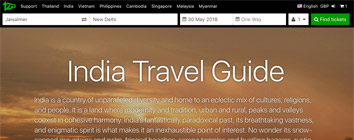
12go.asia for Indian train tickets: The painless option, accepts overseas credit cards, with no need to register at irctc.co.in. |
|
|
|
-
Ticketing agency 12go.asia is the quickest & easiest way to buy tickets for the main trains and routes used by tourists, it makes booking trains as easy as flights.
You can check prices & availability, pay with an international credit card and get the same e-ticket you'd have got from irctc.co.in, but without the frustration of having to register with irctc.co.in.
12go.asia charge a fee and mark-up, but as Indian train tickets are cheap this is no big deal. Given the time & effort you save I suggest using 12go.asia if it sells the journey you want.
-
Booking opens 60 days ahead, although some short-distance inter-city trains have a 30 or 15 day booking horizon. You can't buy tickets before reservations open. Indian trains get fully booked weeks ahead, so book as far ahead as you can.
Indian trains have 10 different classes of accommodation, read the guide to Indian classes.
-
How it works
12go.asia's system shows fares & availability in real time from IRCTC's system. You select your train & class. Tickets are then manually secured by 12go staff using IRCTC's business-to-business booking system.
You can see prices & pay in Indian Rupees, USD, GBP, Euros & other currencies.
You'll be emailed an e-ticket, the same IRCTC e-ticket you'd get from irctc.co.in. You can print it out or show it on your phone.
-
Limitations
12go.asia sells tickets for all the major routes of interest to visitors, but not between every possible station. For that you need irctc.co.in.
Option 2, buy at www.irctc.co.in
 |
|
|
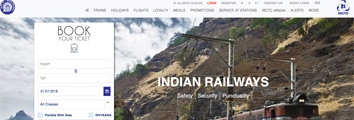
irctc.co.in for Indian train tickets: Now accepts overseas cards. |
-
You can buy train tickets from Indian Railways at the IRCTC website www.irctc.co.in.
-
Registering to use www.irctc.co.in is a time-consuming and frustrating process, but once registered you'll have access to all routes, trains, classes & ticket types.
-
Irctc.co.in has accepted overseas (non-Indian) credit cards since 2016, although it occasionally has periods when international cards don't seem to work. You must select the payment option which mentions International cards powered by PayU at the payment stage.
How to register for an IRCTC account
-
First you need to register. Only one person needs to register for an account. He or she can then buy tickets for themselves and their family or travelling companions, for a maximum 12 train journeys in any given month, each journey including up to 12 passengers.
-
Go to www.irctc.co.in and click REGISTER top right.
Enter the details to create an account.
Choose a username, some trial and error may be needed.
Enter your mobile phone number - your home country's international dialling code goes in the box marked ISD. This box says '91' until you have changed India to your own country in the box above. The ISD for the UK is '44'. Then enter your mobile phone number without any leading '0'.
Pin code means postcode. It won't accept UK-style postcodes, so enter 123456. Under Post Office, just enter your city & phone number again.
When finished, click Register.
-
Now you need to activate. Check your emails, as you will have been sent an email IRCTC' s Online Rail Ticket Reservation User Registration Confirmation. Click on the link in Please Click Here to login in your account. Or just go to www.irctc.co.in.
You'll see the usual irctc login form. Enter your chosen user ID and password to log in.
-
When you log in, you'll be asked to pay a small fee to have the necessary SMS OTP (= One Time Password, a 6-digit verification code) sent to your phone. For a non-Indian mobile the fee is Rs 122, about $1.50.
-
After paying, you'll see two fields, one asking you to verify your mobile number, the other asking to verify your email address.
Start with your mobile number. When you receive the text message on your phone, enter the 6-digit verification code in the mobile phone field and this will verify your mobile.
-
Now verify your email address. Click to have the Email OTP sent to your email address (you can also edit your chosen email address here, but if you entered the right one in the first place this shouldn't be necessary). Check your emails to find the email headed Your email id Verification activation OTP code and enter the 6-digit verification code to verify your email address.
-
You are now registered and you can book Indian train tickets at www.irctc.co.in. Feedback is always appreciated!
-
If the SMS text doesn't arrive
This is the first major problem many people have. I received the SMS OTP on my UK mobile phone no problem, and it works for many others. But I regularly get emails from people saying no text arrives and I have no idea why it doesn't work for everyone.
Solution? One correspondent says a text finally arrived after a week of trying repeatedly to get an SMS sent. So persevere!
Solution? One report suggests that they cannot process 'profile updation' 09:30-11:30 Indian time, so avoid requesting SMS texts in these two hours. 11:30-17:30 Indian times seems to be the best time to register.
You may need to contact irctc support. Or give up and use 12go.asia.
-
Payment problems paying the SMS verification fee
They charge a fee for sending the OTP to a non-Indian mobile. A few people have had credit card acceptance problems in paying this fee, but others find paying the fee works fine. Again, I don't know why, it could be problems with your own bank.
-
Phone number country code changes
Some people report that when they log back in their mobile number has reverted to an Indian '91' country code which they can't edit. Again, I did not experience this so don't know why. But others seem to have no problem.
-
Try a different browser
One correspondent kept getting error messages when registering with correct data, this was solved when she tried a different browser. It likes some browsers better than others.
-
'Email already in use' error message
I'm getting a lot of feedback about this error message when trying to verify your email address at the moment! Solution: On the verification screen, edit your email account to another account, if necessary setting up a new temporary email just for this purpose (e.g. gmail). Use that to verify the account. Once logged in and verified you can change your details to your usual email address if you want.
If you still have problems, are you sure you can't book your tickets with 12go.asia? I did warn you that would be easier!
How to buy tickets at www.irctc.co.in
-
Reservations for long distance trains open 60 days before departure
The Advance Reservation Period (ARP) was extended from 90 to 120 days in 2012, reduced again to 60 days in 2013, restored to 120 days in 2015 and cut back again to 60 days from 1 November 2024. They'll probably change it again. Some short-distance inter-city trains open for bookings less than this. To state the obvious, you can't buy tickets before reservations open.
-
Period of operation
The online booking service closes for maintenance 23:30-00:30 Indian time, which is 18:00-19:00 GMT. The system can sometimes be overloaded with visitors, so if you have any problems or if it rejects your credit card, try again later. This may be why some people breeze through it and love it, while others struggle. It gets significantly less busy after about 18:00 Indian time (13:00 GMT).
-
12 ticket limit
You can book a maximum of 12 train journeys per calendar month using this website, each involving up to 12 passengers. Bear that in mind if you plan to book a lot of trips.
-
Available, RAC or Waitlist places
When you click to see availability on a particular train, you will see places shown as AVL, RAC or WL, see the explanation of Reservation Against Cancellation & Waitlisting.
AVL = Available, this means there are tickets available for confirmed seats or berths on that train.
RAC = Reservation Against Cancellation, this means that the train is theoretically full, but Reservation Against Cancellation tickets are available for that train which allow you to board and be allocated a berth by the conductor. So if you only see RAC tickets available, my advice is to go ahead and book, you'll still be able to travel on that train.
WL = Waitlist, this means that all AVL & RAC tickets have been sold, and you can only buy a Waitlisted ticket. You cannot travel with a Waitlist ticket, but you may well be promoted to RAC or even a confirmed place (CNF) when other travellers cancel. If your Waitlist ticket is not promoted to RAC or CNF (thus allowing you to travel), the fare will be refunded. You'll need to decide for yourself whether to buy a Waitlist ticket and check your PNR status (Personal Name Record) online to see if you've been promoted to an RAC or CNF as departure approaches, or find an alternative train with AVL or RAC tickets available.
-
Which quota to use?
Use tickets from the General quota or if booking within 24 hours of departure, the Tatkal quota. Don't use up valuable Foreign Tourist quota places unless the General (GN) or Tatkal quotas have sold out. But only Indian nationals qualify for the Senior quota! More about quotas.
-
Ticket delivery
Tickets cannot be sent overseas or picked up at the station, but there are 'e-ticket' and 'i-ticket' options.
-
The e-ticket option
This is the recommended option, available for most trains. You book online and print your booking reference, then show it to the conductor on the train with your passport. It's easy, and avoids any problems with ticket delivery. A small charge is made for e-tickets, currently RS 25, about 35p. If you lose the printout you can still travel as long as you have your passport as ID, but there's an RS 50 fine if you cannot produce the printout or show the reservation confirmation on a laptop or phone screen.
-
The i-ticket option
You only need to use the i-ticket option if for some reason the e-ticket option isn't available for the train you want. i-tickets (i = internet) are sent by courier to any Indian address you specify (for example, the hotel where you will be staying) in Delhi, Mumbai, Kolkata, Chennai and other specified Indian cities. If you ask for them to be delivered to your hotel, the courier will need to see a letter authorising delivery if you are not there to sign for the tickets, so you will have to arrange this with the hotel. An email or fax to the hotel authorising them to take delivery is sufficient. To see which postcodes in which cities are covered by the courier service, select 'PIN codes covered' from the www.irctc.co.in home page. You'll need the full address and postcode (called a PIN code in India) for your hotel.
-
If you're booking an AC1 ticket, don't worry that your ticket doesn't show any car or berth number even though it's Confirmed (CNF). The reservation lists for AC1 are compiled and specific berths are allocated 2-4 hours before departure and posted on the platform notice board and online. This is also why you can't choose a 2-berth coupé or 4-berth compartment in AC1.
-
Payment options: Select the right payment gateway!
This is another problem that comes up regularly. It offers you several options to pay by Visa, MasterCard or Amex, offering a wide choice of Indian banks to process your payment.
Overseas visitors should select Multiple Payment Service. Then either:
Credit & Debit cards /Net Banking/Wallets/UPI / International cards (powered by PayU) or
Credit & Debit cards / Net Banking / UPI (Powered by Razorpay) or
International /Domestic Credit/Debit cards (Powered by Plural)
Tip: If you don't see International cards, try clicking My profile then Preferred Bank List list, scroll down & select international cards.
-
Credit card problems?
Cards sometimes fail not because there's a problem with the website's payment system, but because your own bank is blocking what it sees as a strange foreign transaction. Check with your bank and if necessary unblock irctc.co.in, then try again.
-
Tip: Download the IRCTC app for your phone. Download the IRCTC Rail Connect app for iPhone (if it's available in your region, it may not be) or IRCTC Rail Connect app for Android onto your phone. You'll probably find you can't buy tickets with overseas credit cards using the app, but tickets bought online at the IRCTC website will show up in the app and can be shown to the conductor. You can check train times, and see the current status of your booking if you are waitlisted or RAC. Feedback appreciated. I recommend some other apps that are available outside India in the travel tips section.
Option 3, Cleartrip.com, Makemytrip.com, Ixigo.com
-
www.cleartrip.com & www.makemytrip.com are private agencies which connect to the irctc.co.in system to sell Indian train tickets, however, neither works for overseas visitors.
-
www.ixigo.com/trains may work for overseas visitors, but as I write this it's unavailable if you browse with a European IP address.
How to buy tickets at the station
-
The main stations in big cities and tourist centres such as New Delhi, Mumbai, Kolkata, Agra, Jaipur and Varanasi have an International Tourist Bureau where foreign travellers can book trains away from the crowds and queues at the normal booking office. There is also a 24-hour rail booking office at Delhi International Airport.
-
For a list of stations with an International Tourist Bureau & opening times, see www.indianrail.gov.in, select Information then International Tourist.
New Delhi International Tourist Bureau
-
The International Tourist Bureau at New Delhi railway station makes it easy for foreign visitors to buy tickets. They can sell seats/berths from the tourist quota even when a train is fully-booked for Indian passengers. It's normally open 06:00-23:00 every day. Feedback appreciated.
-
How to find it
Enter New Delhi main station entrance on the Paharganj side (shown in the photo below left), veer slightly to the left and go up one flight of stairs to find the entrance to the International Tourist Bureau, see the photo below right. It's above platform 1.
Ignore touts even if they look or sound 'official' and even if they have a 'badge': If it doesn't look like the photo below, it isn't the real International tourist office. If they says it's closed, don't believe them until you see it's closed with your own eyes! Is that clear?
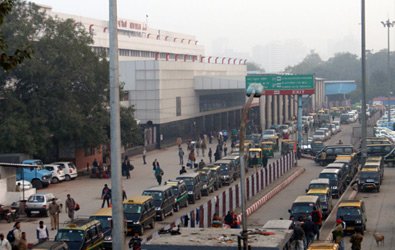
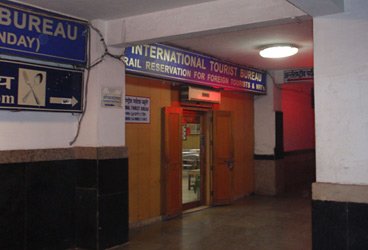
New Delhi international tourist counter
-
Tourists & non-resident Indians can also buy train tickets at the international tourist counter (counter 124) at the Rail Reservation Centre in Chelmsford Road, a 300m walk from the Paharganj entrance of New Delhi station, see walking map. They can often sell you places out of the tourist quota, even when a train is fully-booked for Indian passengers.
-
Open 08:00-20:00 Monday-Friday, 10:00-16:00 Sundays & holidays.
Update 2026: They may have closed this counter now that the International Tourist Bureau has reopened, feedback appreciated.
-
Ignore touts! As always, ignore any touts trying to guide you to the reservations centre, which will of course be a private travel agency. Even if they tell you it's closed, shut down, moved, been abducted by aliens, even if they have an official-looking badge, ignore everything they say, ignore them and press on to the gate shown below left, to the counter shown below right.
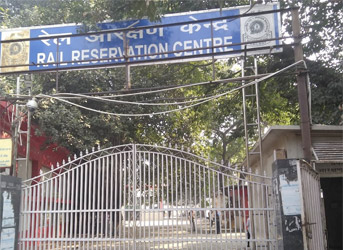
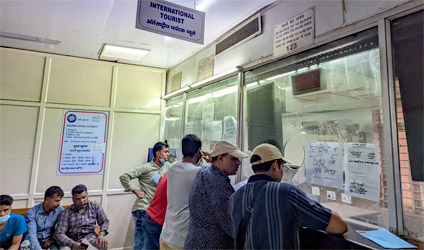
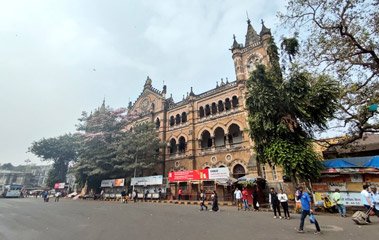
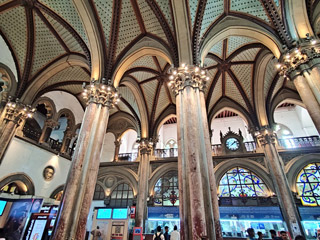
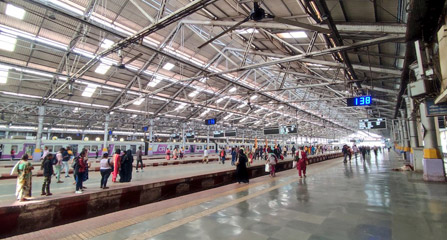
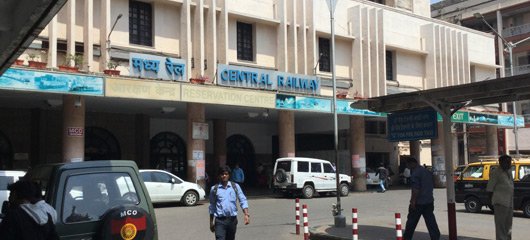
Mumbai CSMT, formerly Bombay Victoria Terminus
A station to rival London St Pancras, Mumbai CSMT is an attraction in its own right. Completed in 1887, its full title is Chhatrapati Shivaji Terminus or (officially) Chhatrapati Shivaji Maharaj Terminus, station code CSMT. Known as Bombay Victoria Terminus until 1996 and still known as 'VT' by many, see en.wikipedia.org/wiki/Chhatrapati_Shivaji_Terminus.
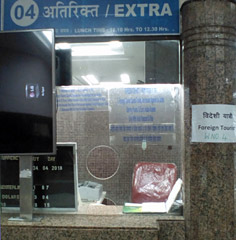
Foreign Tourist Counter: At Mumbai CSMT you can easily buy tickets from the foreign tourist quota at the Foreign Tourist counter, counter 4 downstairs in the Reservation Centre at CSMT. It moved from counter 20 upstairs in 2018, please let me know if it changes again.
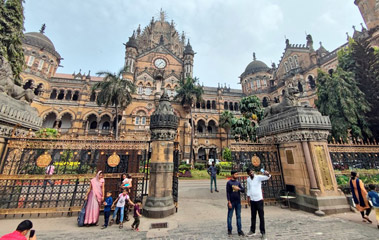
Tips for train travel in India
Checking your reservation
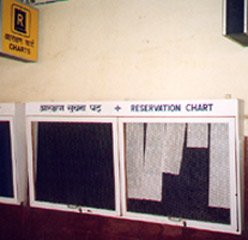 The reservation lists posted on the platform at Agra Cantonment station. |
|
 |
|
 |
|
|
Use an app! |
The reservation system is very efficient and the days of finding your reserved berth already occupied by several passengers are long gone. Your train, coach & berth number will be printed on your ticket - unless you're travelling in AC1 in which case the reservation list with your allocated berth numbers is only compiled a 2-4 hours before departure.
Reservation lists for each class in each long-distance train are posted on the notice board at each station about two hours before departure, showing the name, age and sex of each passenger reserved in each berth in each coach. The age and sex help the ticket inspector identify that the right passenger is in the right berth. A reservation list for each coach used to be pasted next to the entrance door on the train itself, but this is no longer done.
If you need to check your reservation, you can do so on your phone or laptop by entering your PNR (= booking reference) a PNR status-checking website such as www.railyatri.in/pnr-status or etrain.info/in, or using one of the Indian railways apps.
Download an app
I recommend downloading an app for your phone. There are a bewildering range to choose from, some official, some 3rd party. The official IRCTC apps seem unavailable outside India, so try these:
Indian Rail IRCTC for iPhone or Ixigo for iPhone.
Indian Rail IRCTC for Android or Ixigo for Android.
With these you can:
Check train schedules between any two stations.
Check a train's schedule at each of its calling points. It also shows the train formation and carriage numbering to help you find your seat or berth.
Check your PNR status to see whether a Waitlisted ticket has become RAC or Confirmed.
Check real-time train running to see if your train is on time.
Check the platform for your train using the Live Station Info button, so you won't have to rely on the station departure displays to find your train.
Set a destination alarm to warn you a certain number of kilometres before your destination.
Luggage on Indian trains
Luggage is not a problem on Indian trains, you take your bags with you onto the train and place them on the overhead racks or underneath the lower berths.
The free luggage allowance is generous: You can take to 70 Kg in AC1, 50 Kg in AC2, 40 Kg in AC3, AC Chair class or Sleeper class, 35 Kg in 2nd class seats. Most western travellers are unlikely to exceed that, but if you really need to, you can pay an excess luggage fee and take up to 150 Kg in AC1 or 100 Kg in AC2. However, the maximum is 40 Kg in AC3 or AC Chair class.
Theft of luggage is rare, but for peace of mind take along a bicycle lock or medium-sized padlock to secure your bags. In the sleeping-cars, there are wire hoops hanging down underneath the seats to which you can padlock your luggage while you sleep.
Carriage numbers
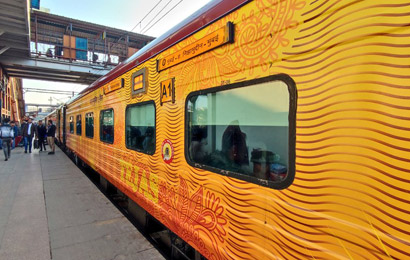
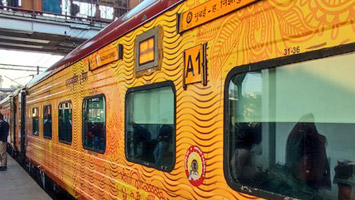 Carriage number A1: The 'A' denotes AC 2-tier, the '1' shows it's AC 2-tier car number 1. The wooden board above the 'A1' shows the train's origin & destination in Hindi, the board to the left of it shows it in English. Courtesy of Nonstop Eurotrip. |
The carriage numbers shown on tickets, on reservation lists and on the side of each coach consist of a letter and a number, for example H1, A1, A2, B1, B2, S1, S2, S3 and so on. The letter shows the class of accommodation in that car.
A = air-con 2-tier (2A).
B = air-con 3-tier (3A).
AB = composite coach, half air-con 2-tier, half air-con 3-tier.
C = air-con chair car (CC).
D = non-air-con 2nd class reserved (2S).
E = executive chair class (EC).
G & J are used for AC 3-tier & Air-conditioned Chair class on Garib Rath trains.
GS = General Seating = non-air-con 2nd class unreserved (GN).
H = air-conditioned 1st class (1A).
HA = composite coach, half AC1, half AC2.
M = air-con 3-tier economy (3E).
S = sleeper class (SL).
There's typically just one air-con 1st class sleeper on a given train, so that's usually numbered H1. If there were two air-con 2-tier cars on a train, those cars would be numbers A1 & A2. So if you booked an AC2 ticket you'd expect to be given a car number 'A1' or 'A2', if you booked AC1 you'd expect to be in car H1 or HA1.
You may also see EOG = generator car. PC = pantry car, for catering. SLR = Second class Luggage Rake, a car with luggage space, guard's compartment and limited 2nd class seating.
How to check train formations & seat maps
Go to www.trainman.in/coach-position and enter the train number or name. You'll see a diagram of the train formation, and a seat map for each car.
Food and drink on Indian trains
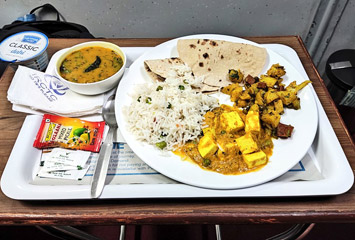 Dinner in AC1, included in the fare on the Mumbai-Delhi Rajdhani Express & served at your seat. Courtesy of Nonstop Eurotrip. |
There are no restaurant or buffet cars on Indian Railways, but on long distance trains an attendant will appear in your coach and ask you if you would like to order food. He will note down your order (usually a choice of 'veg' or 'non-veg') on a bit of paper. An hour or so later he will reappear with some rice and curry in small foil containers from the kitchen car. It is not expensive - you can reckon on £2-£3 per meal.
Attendants also regularly pass down each car selling soft drinks, snacks, or excellent hot sweet Indian tea (garam chai) for a few rupees.
On the premier Rajdhani Express trains (linking Delhi with Mumbai, Kolkata, etc.) and the premier daytime Shatabdi Express trains (linking Delhi with Jaipur & Agra, etc.), food is included in the fare, served at your seat.
Pre-order your food from a restaurant of your choice. Alternatively, there are now several Indian websites that allow you to pre-book food to be delivered to your seat on the train from various vendors along the way. If you have a confirmed train booking you can go to railrestro.com, enter your PNR, select a vendor you like the sound of who is located at a station where your train calls at a suitable time, and select specific items from their menu to be delivered to you on board the train at that station - reports so far have been very positive, but feedback is always appreciated!
Cleanliness, toilets & crowding
The efficient reservation system means that you can safely forget any pictures you've seen of overcrowded Indian trains with people on the roof or hanging on the side. These these photos show suburban or local trains, or unreserved 2nd class on long-distance ones. On fast long-distance trains in AC1, AC2, AC3, or AC Chair Class, all passengers have an assigned seat or sleeping berth so there's no overcrowding. Don't expect pristine western standards anywhere in India, but you'll find AC1, AC2, AC3 and AC Chair class clean by Indian standards, with both western-style and squat toilets usually in a reasonably sanitary condition, see the train interior photos below. On the other hand, Sleeper Class gets much grubbier than the AC classes and unreserved passengers can sometimes enter the coaches making it crowded. 2nd class unreserved can be incredibly crowded. Toilets in sleeper class or basic non-AC 2nd class seats can leave a lot to be desired.
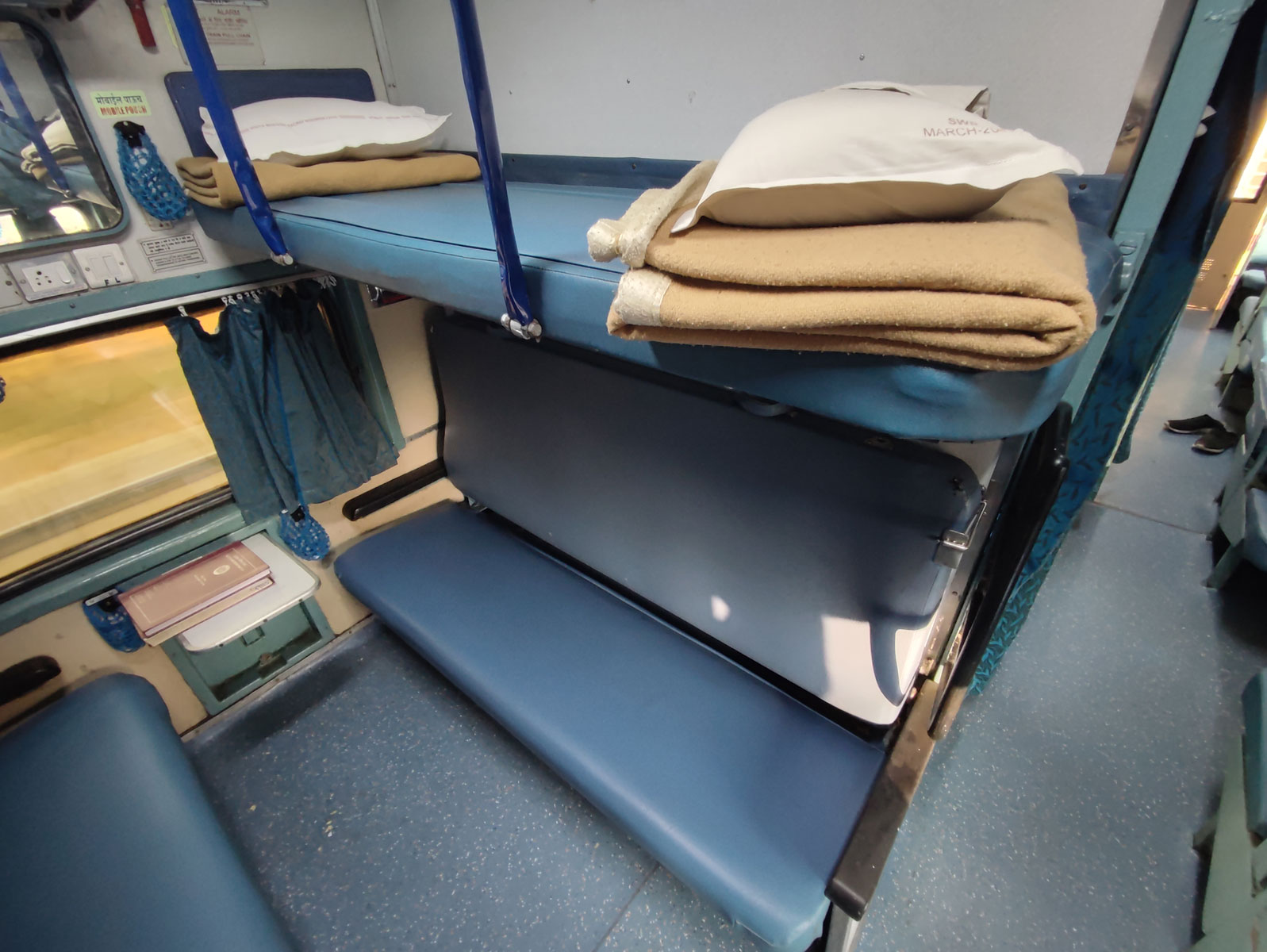 AC2 2-tier sleeper: An AC2 bay of 4 berths. There are more photos of what each class is like below. Courtesy of Nonstop Eurotrip. |
Safety & security
Indian trains are safe to travel on, even for families or women travelling alone, and you are unlikely to have any problems. As in any busy place anywhere, pickpockets operate at the major stations (for example Delhi and New Delhi), so take care. Oh, and be prepared: If anyone tells you that your train is cancelled, that the ticket office has closed or has moved to a travel agency across the road, or your pre-booked hotel has burnt down or been abducted by aliens, please politely ignore them, even if they look 'official', to avoid ending up in a travel agency paying for a car and driver at vast expense, or booking their 'alternative' hotel which of course will luckily have a room available. These are all well-known scams (yawn!) to get travel agency business, usually obvious to any regular India hand, but first-timers have been known to fall for them.
Do Indian trains run on time?
Indian Railways are generally remarkably efficient, but Indian trains do run late, sometimes hours rather than minutes. To get a feel for it, why not go to either www.trainenquiry.com or www.erail.in and see how late yesterday's Delhi-Jaisalmer Express arrived, or last Thursday's Mumbai-Delhi Rajdhani Express?
At www.erail.in, select the origin and destination that interests you, and bring up the train list. Now find the train that you want and click on it. Now select a date and click the Train running status button. It will show you a table of scheduled times and actual times at each station. Data is only held for the last few days, not weeks or months ago. At www.trainenquiry.com, you simply enter the train number or name, then select from a list of possible trains.
Alternatively, these examples from my own travels may give you a feel for the likely delay: Delhi-Varanasi overnight express spot on time, Bombay-Howrah Mail 1½ hours late, Chennai-Mumbai Chennai Express 40 minutes late, Kolkata-Delhi Rajdhani Express spot on time (Rajdhani Expresses get priority and are pretty punctual), Delhi-Agra Shatabdi Express spot on time (Shatabdi Expresses also get priority and are pretty punctual), Jaisalmer-Delhi Express 2 hours late starting and 3 hours late arriving, Delhi-Kalka-Simla Himalayan Queen spot on time, Varanasi-Agra-Jaipur Marudhar Express 50 minutes late, Chennai-Delhi Grand Trunk Express 1½ hours late.
Recharging mobiles & cameras
There are shaver sockets in most AC1/2/3 sleeper cars and many Indian trains now have power outlets for mobiles and laptops. However, I never travel without an Anker powerbank which can recharge your phone several times over if you're on the move and can't get to a power outlet.
Other Indian train tips
Bring your own toilet paper. You'll normally find one western toilet and one squat toilet at one or both ends of the car. In AC1, AC2, AC Chair Class and even AC3 the toilets are normally reasonably clean by Indian standards, and in full working order. Sleeper Class and 2nd class toilets may be a different matter!
Make sure you research when to visit India carefully - in summer it can be unbearably hot, and you also want to avoid the monsoon rains. And in January & February in Northern India that there can be major disruption to road, rail & air due to thick fog, so bear that in mind.
Finally, forewarned is forearmed
In India, if someone asks which hotel you're going to, then announces that this hotel has been flooded, burnt down or abducted by aliens, they are of course trying to get commission from sending you to another hotel - that's often painfully obvious and it's almost funny! Smile, ignore them, and persist in walking to your own hotel, which will of course be open as usual. But similarly, especially at big stations such as New Delhi, if an official-looking person (they may even show you a badge) says your train has been cancelled, or says you can't board without a boarding pass (with an e-ticket you can get on the train, there's no such thing as a boarding pass), smile, ignore them, walk past, and persist until you see the actual departure indicators and get your train. If necessary, go and see the station master! Although this has never happened to me, there are occasional reports of travellers being conned into buying new tickets from a nearby travel agency, being sent to a nearby travel agency when they wanted the genuine New Delhi foreigners booking office, or being conned into hiring a private car and driver for hundreds of dollars when they already had trains booked, which of course weren't really cancelled. So smile, ignore, persist, go and see the departure boards with your own eyes, find and get on your train, and have a giggle about it later! If you encounter any of this, feedback (and a good laugh) is always appreciated!
The 11 classes on Indian trains
There are 11 classes of accommodation on Indian trains or at least, 11 different class codes in the system. You can argue that 3E is a variation of 3A, EA a variation of EC and that 2S & GN are the same (both are 2nd class seats, one reserved, the other unreserved). But that's still 8 classes!
Only a small selection of classes is available on any given train. A typical long-distance train might have one AC1 car, one or two AC2 cars, perhaps an AC3 car, then maybe 6, 7 or 8 Sleeper class cars with one GN or 2S car at the end. But it varies.
Here are the classes, in roughly descending order of cost, together with the usual 2 & 3-letter abbreviations. A request: If you get any clear interior photos of AC2, AC3 or Sleeper class which would better illustrate these classes, please get in touch!
Air-conditioned first class (AC1 or 1A)
AC1 is a comfortable and civilised way to travel, but it's only found on the most important long-distance trains and costs twice the price of AC2. In AC1 you'll be mixing with bank managers and army officers.
A corridor runs down one side of the car, off which open a number of spacious 4-berth & 2-berth sleeper compartments with washbasin, lockable from the inside. All necessary bedding is provided, and berths convert to seats for daytime use.
Unfortunately, you can't choose a 2-berth or a 4-berth compartment when you book, you get what you're given. In fact, in AC1 you aren't assigned berth numbers at all when you book. Berths are only allocated a few hours before departure when the train is 'charted', after which passenger names and assigned berth numbers are shown on a reservation list posted at the station and online when you check your PNR status. Normally, couples are given preference for the 2-berth coupés, families and passengers travelling alone are allocated berths in one of the 4-berth compartments, but nothing is guaranteed. As I said, you get what you're given.
Click for car plans & berth numbering in AC1, AC2, AC3, AC Chair, Sleeper Class.
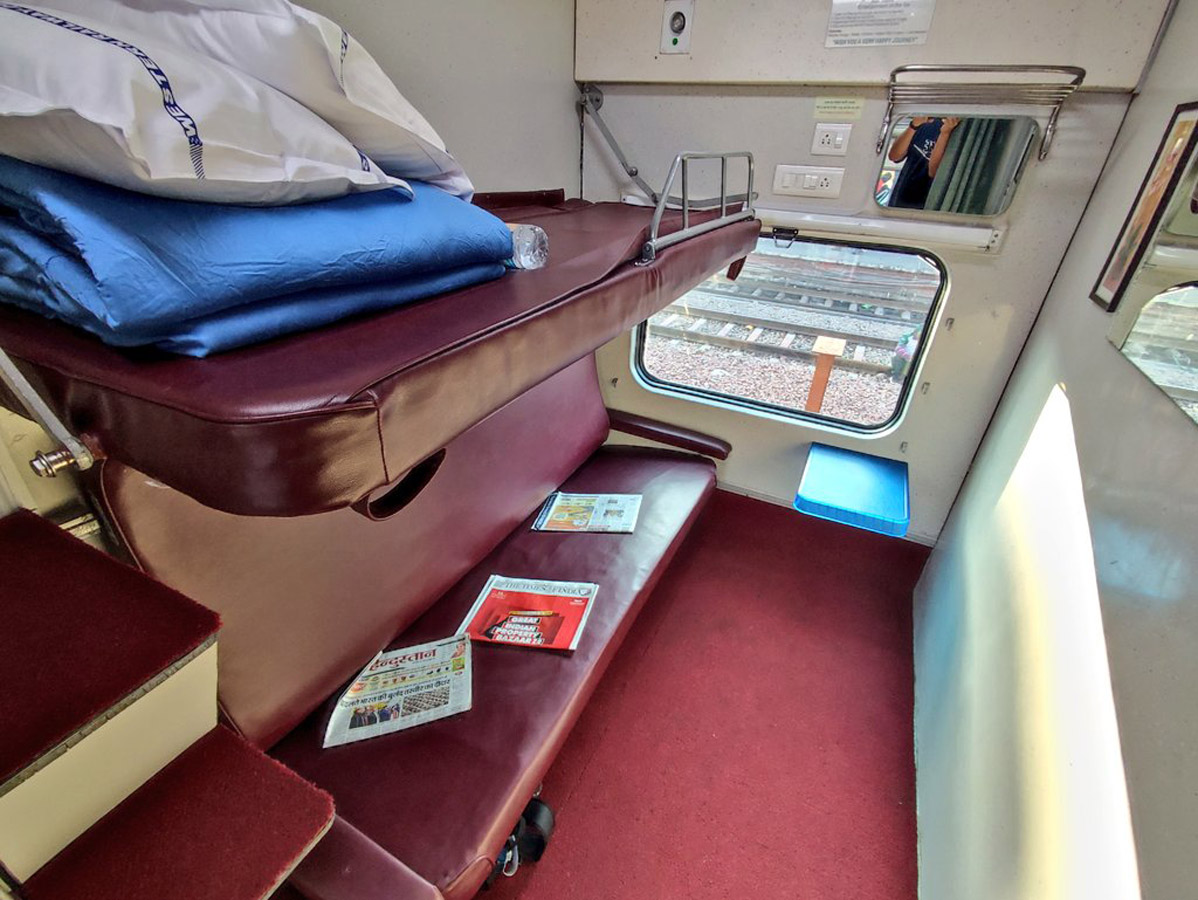
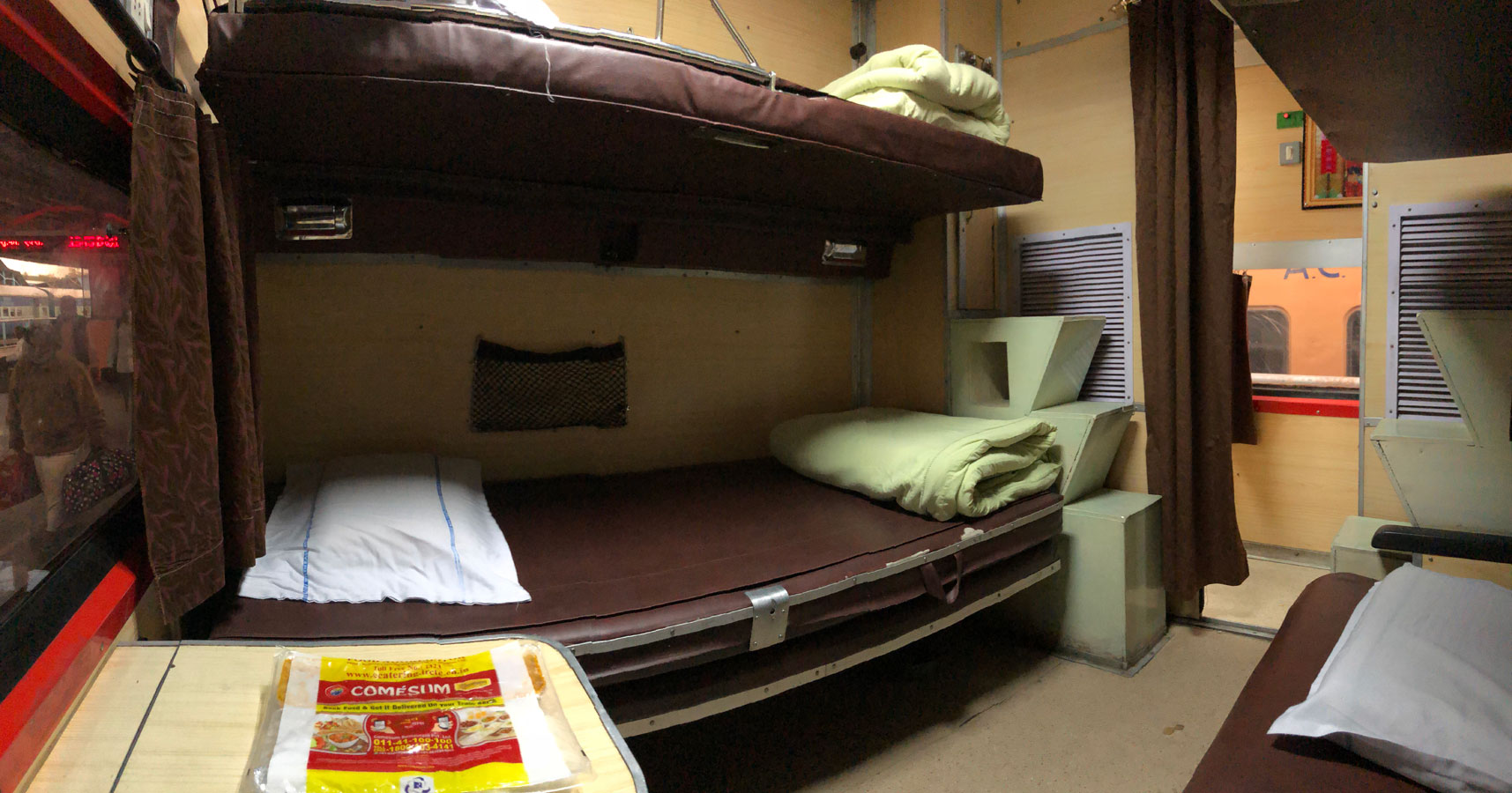
Newer AC1 2-berth sleeper on a Rajdhani Express: This is a 2-berth coupé on the Mumbai-Delhi Rajdhani Express, the car also has 4-berth compartments although you cannot choose which you'll be allocated. Clean sheets, pillow and blankets are provided. The better trains usually have more modern Linke Hofmann Busch (LHB) cars like this Photos courtesy of Nonstop Eurotrip. See larger photo.

Newer AC1 4-berth sleeper on the Darjeeling Mail: Above right, a 4-berth compartment, also in a more modern Linke Hofmann Busch (LHB) car, seen from the doorway from the corridor. Photos courtesy of Nonstop Eurotrip. Larger photo.
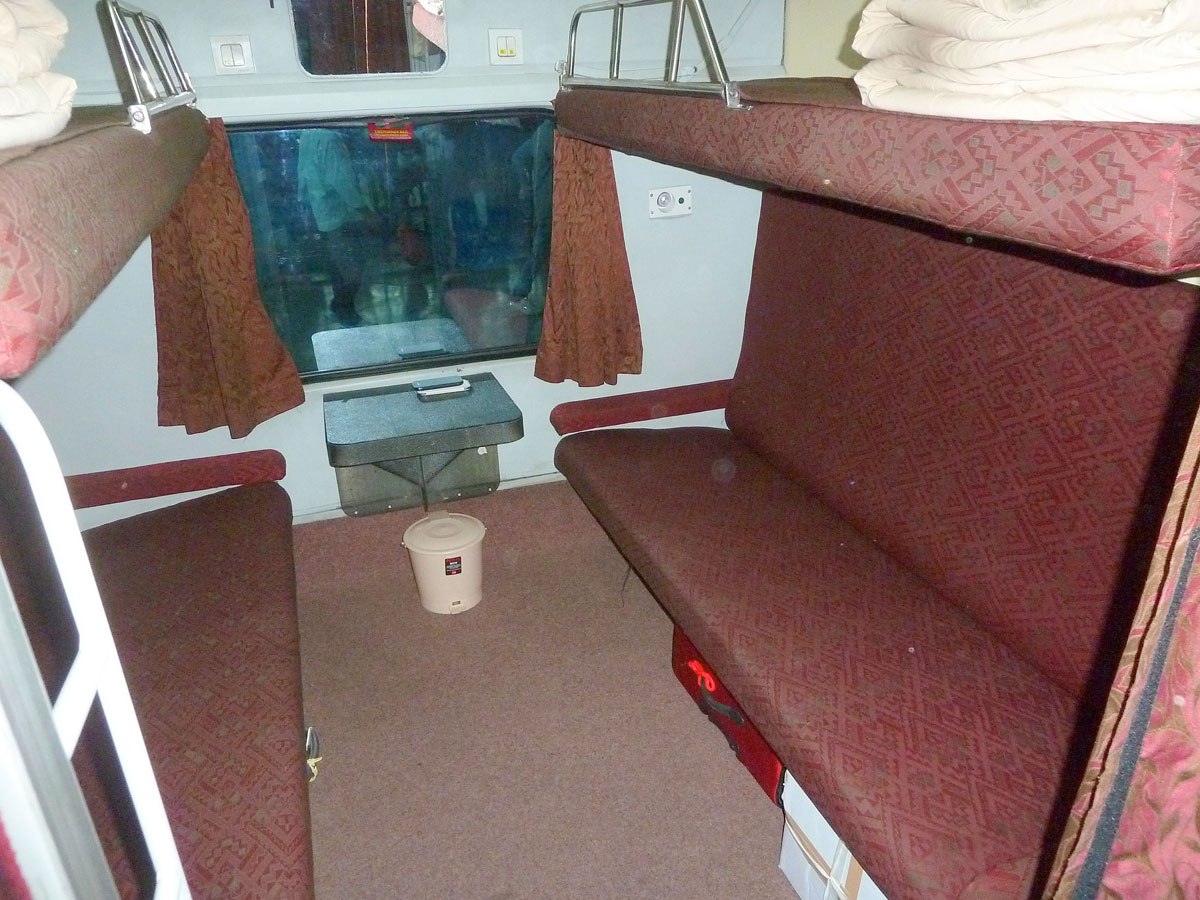
Older AC1 4-berth sleeper: Above left, a spacious 4-berth compartment, looking towards the door into the corridor. Older trains are usually now painted cream with red lining as shown here, using cars built by the Integrated Coach Factory (ICF) in Chennai. Photos courtesy of Peter Pitt & Nonstop Eurotrip. Larger photo.
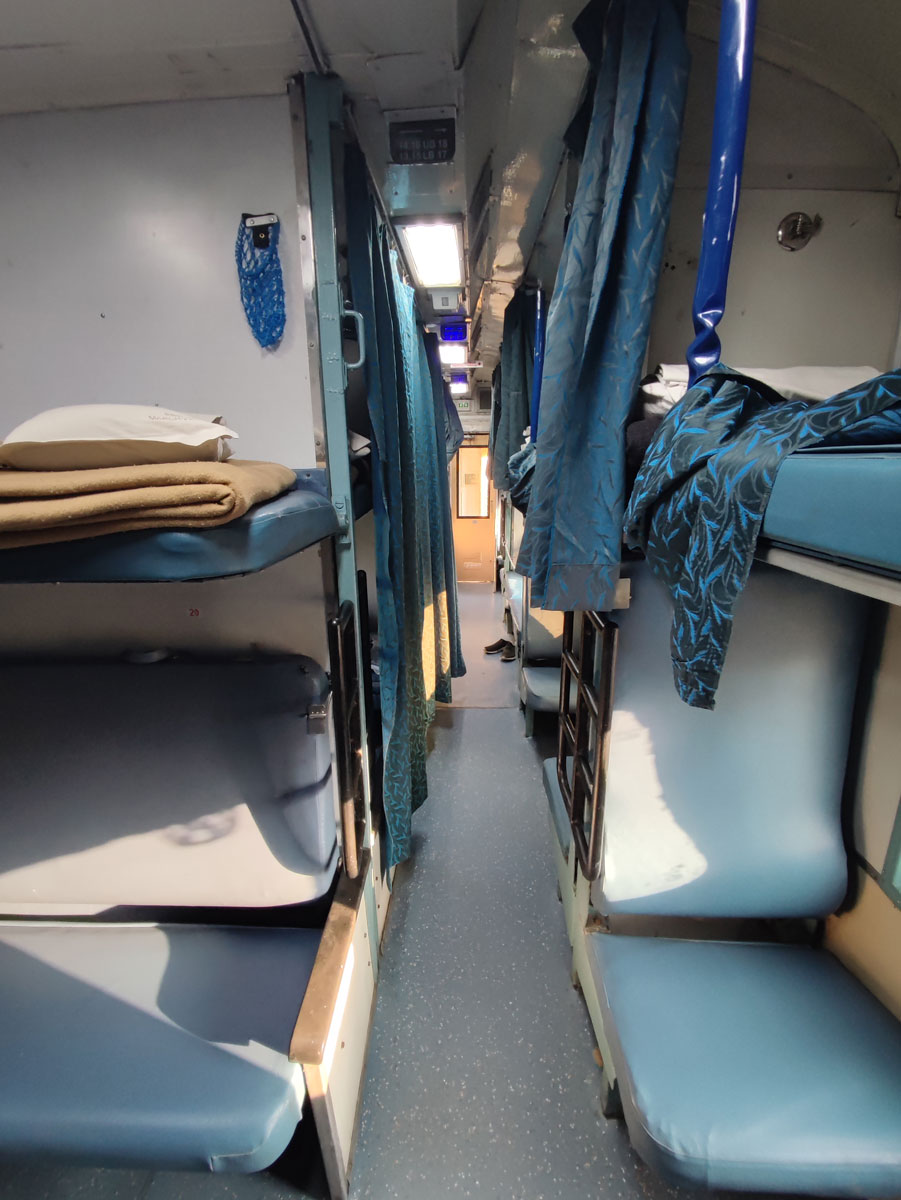
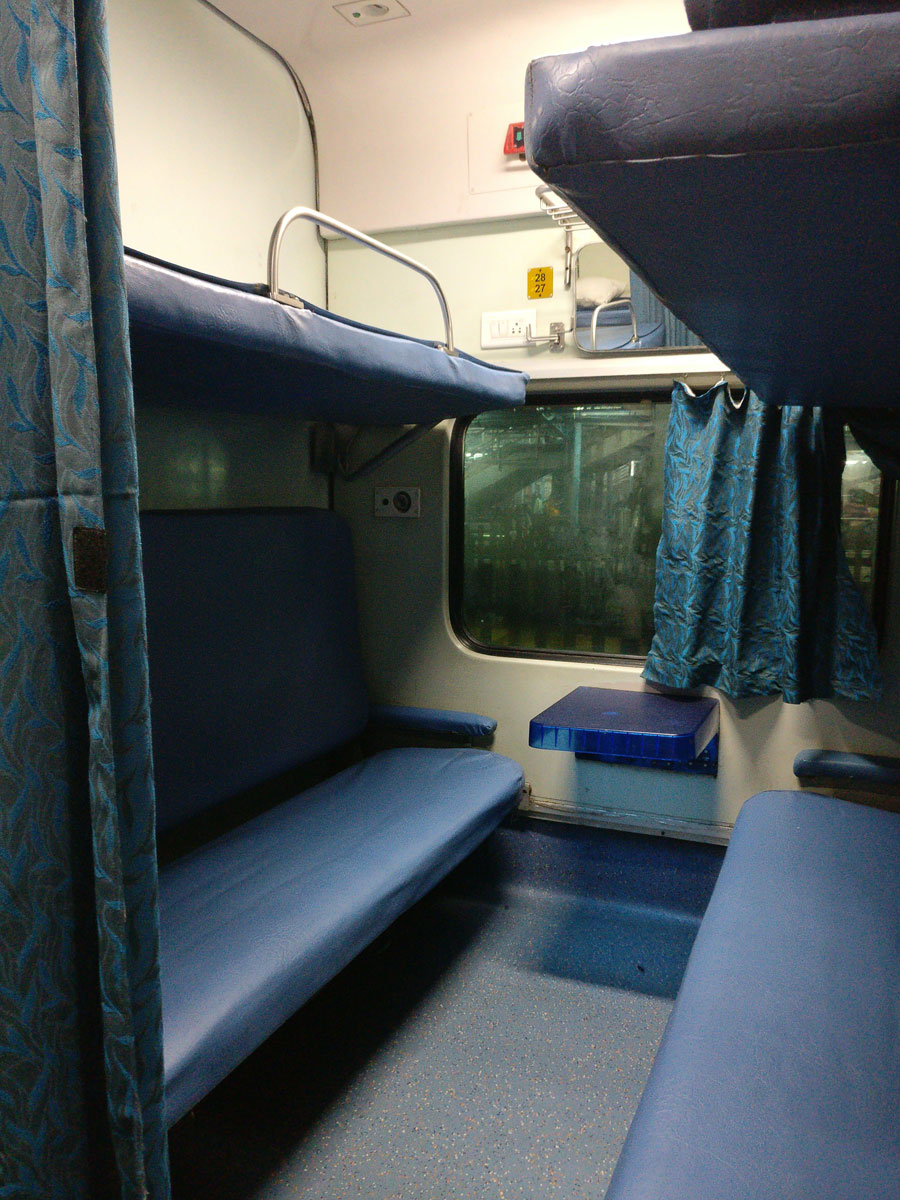
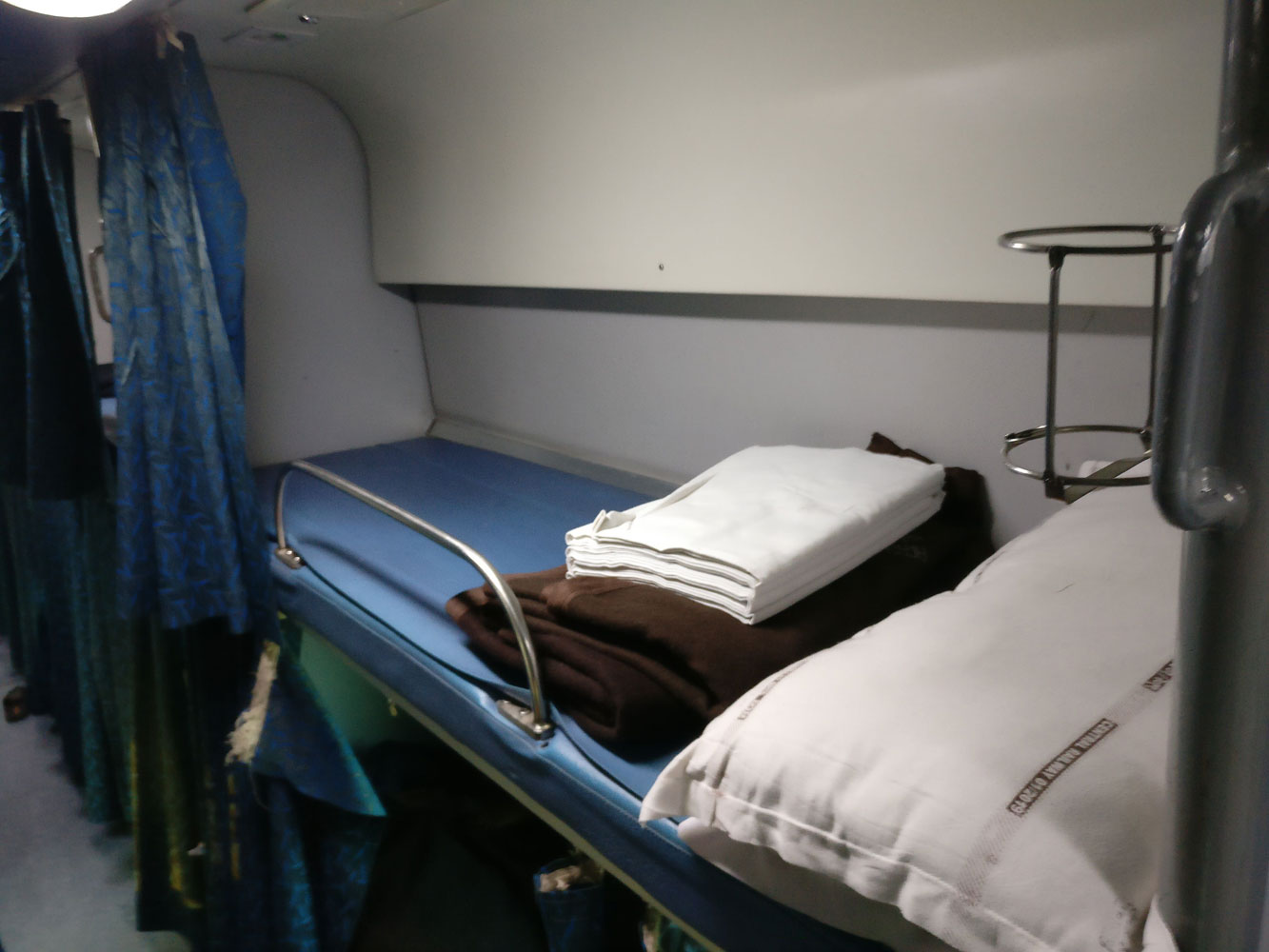
Air-conditioned 2-tier (AC2 or 2A)
AC2 is relatively clean & comfortable, with room to spread out. It's the class typically used by middle class Indian families and a good choice for most western visitors. AC2 is found on all decent long-distance trains including the premier Rajdhani & Duronto expresses.
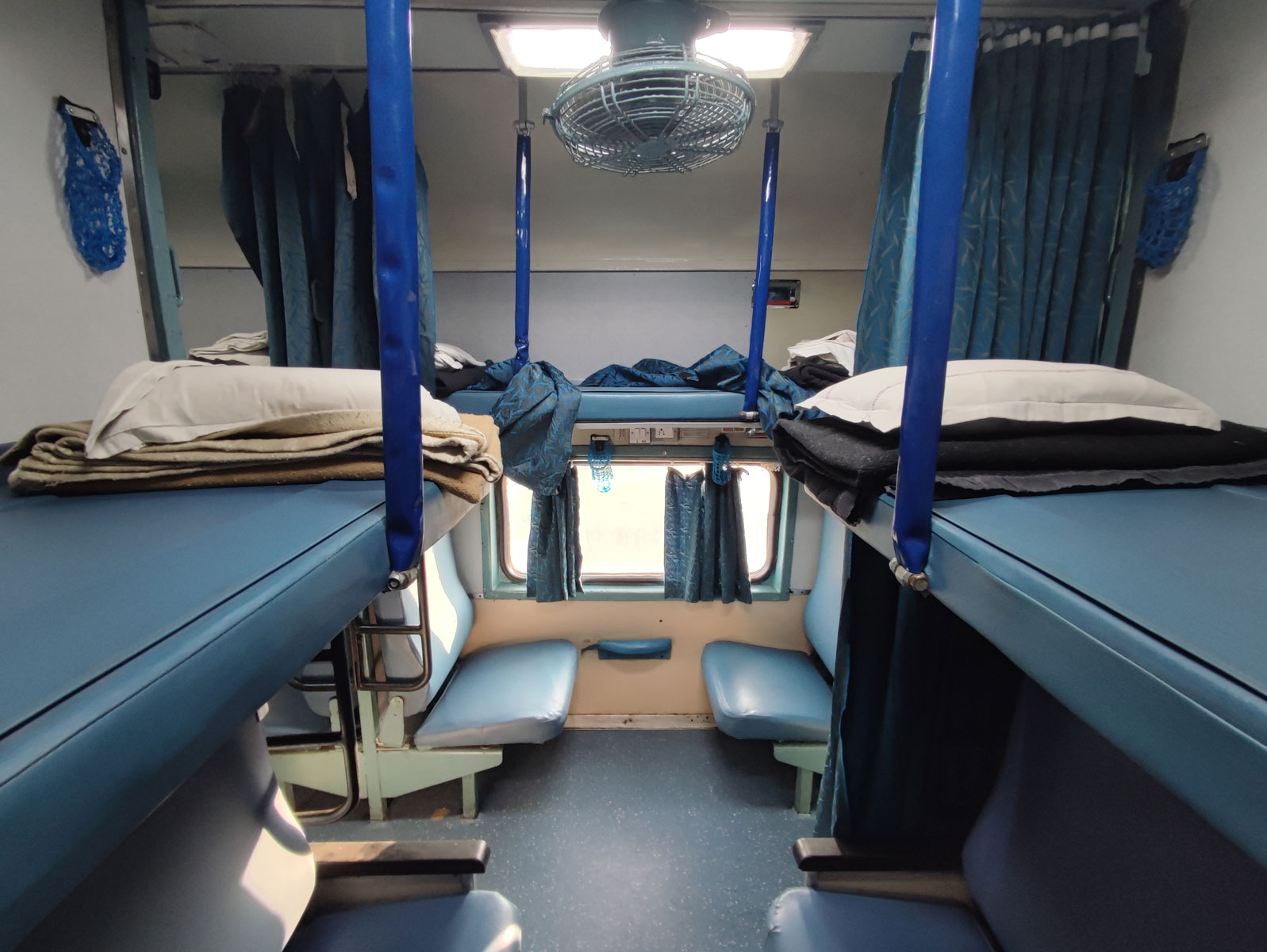
AC2 offers padded leatherette seats by day which convert to flat padded bunks at night. AC2 coaches are open-plan with berths arranged in bays of four on one side of the aisle (two upper, two lower, transverse across the car width), and in bays of two on the other side of the aisle, arranged longitudinally along the coach side above and below the windows. If you're tall, you should book a transverse berth.
Each bay is curtained off for privacy, and an attendant distributes pillows, clean sheets and blankets in the evening. Update: Curtains were removed as a Covid-19 precaution and may still be absent.
Click for car plans & berth numbering in AC1, AC2, AC3, AC Chair, Sleeper Class.
Air-conditioned 3-tier (AC3 or 3A)
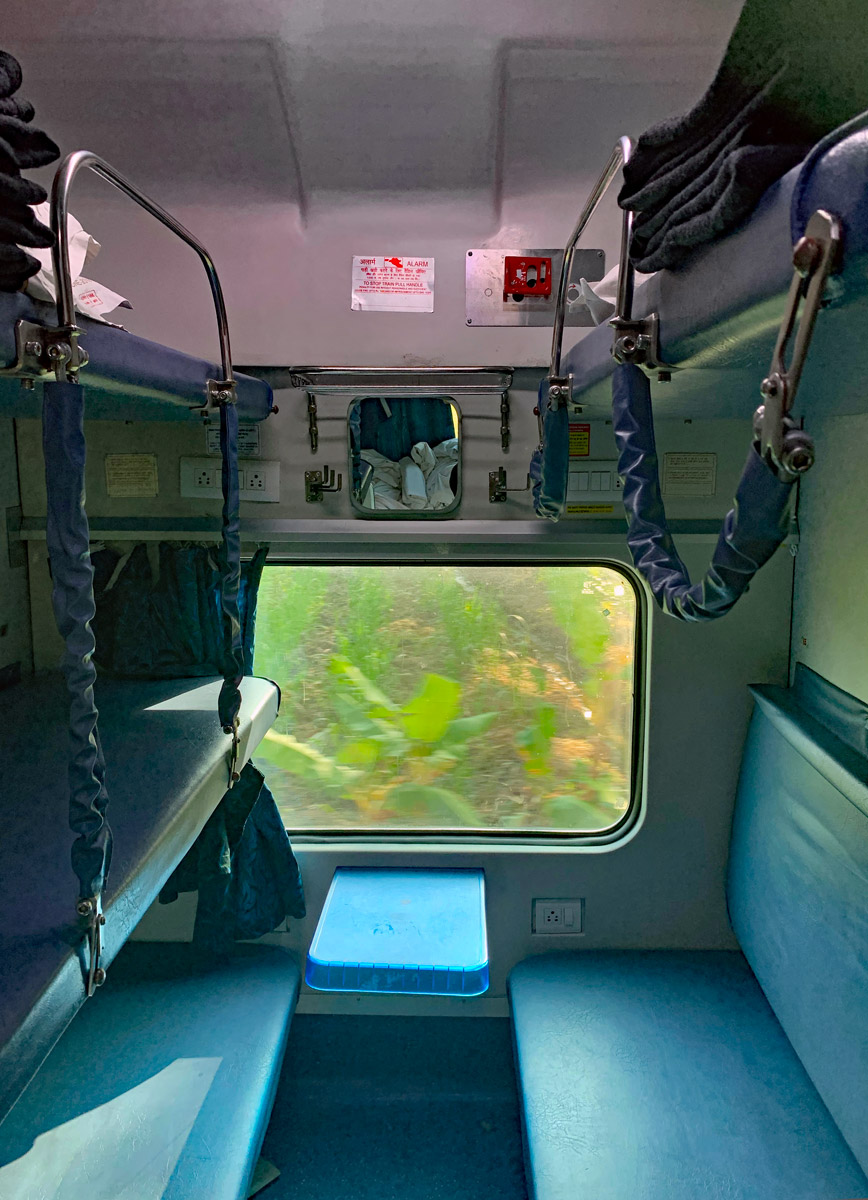
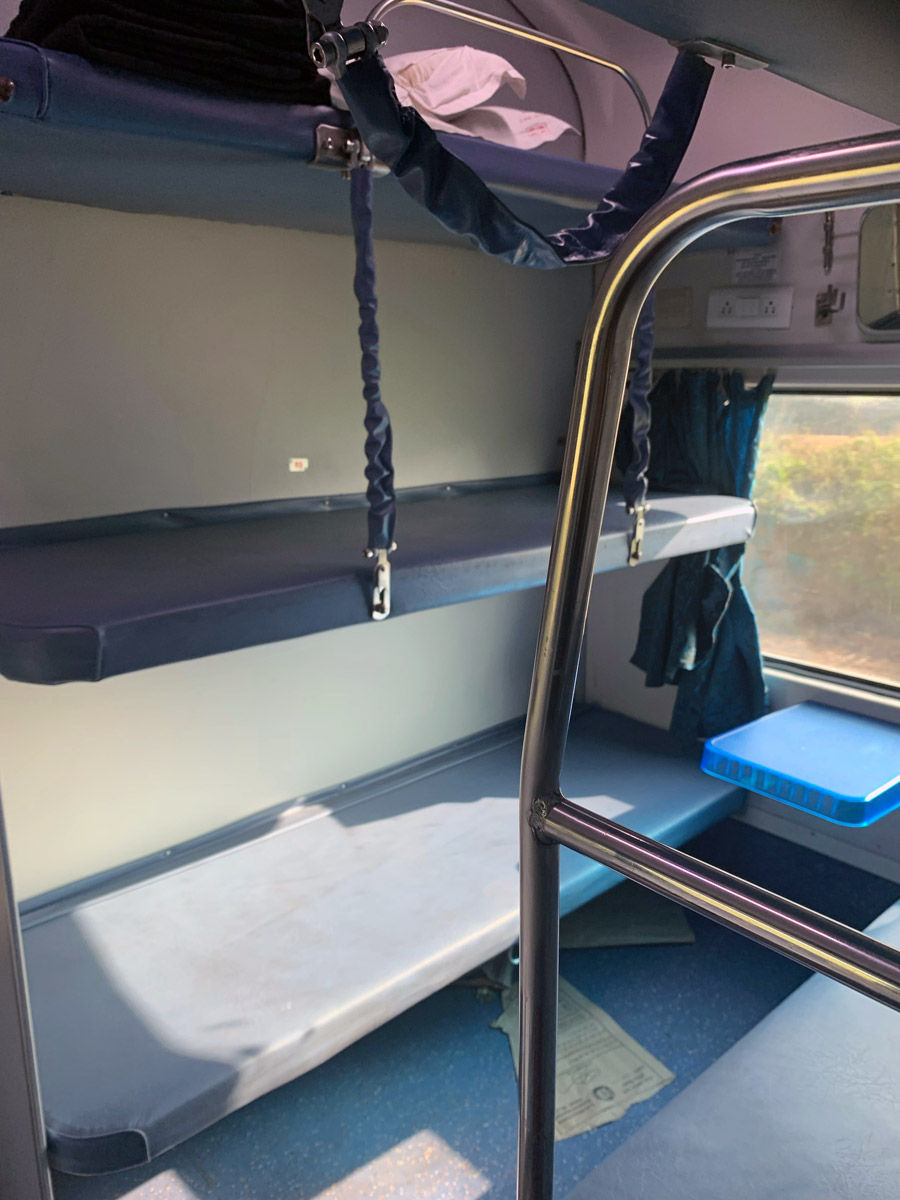
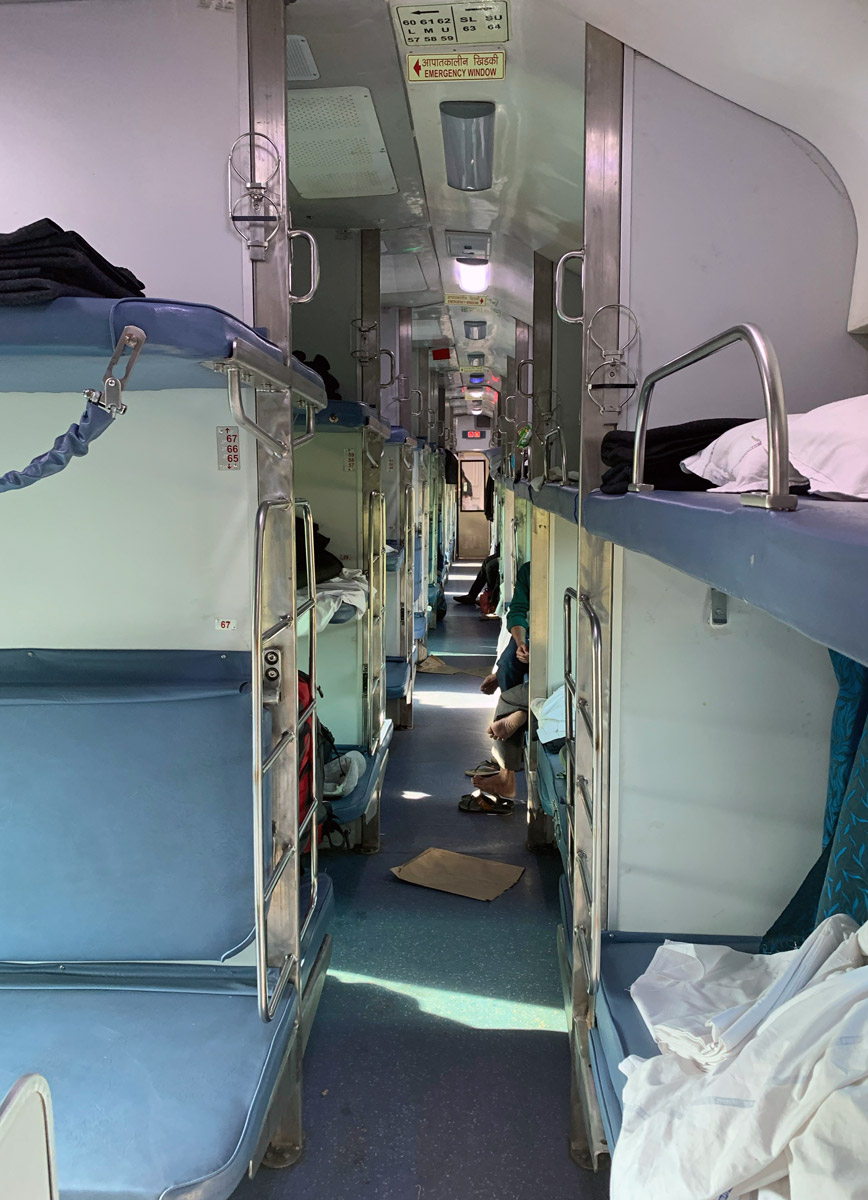
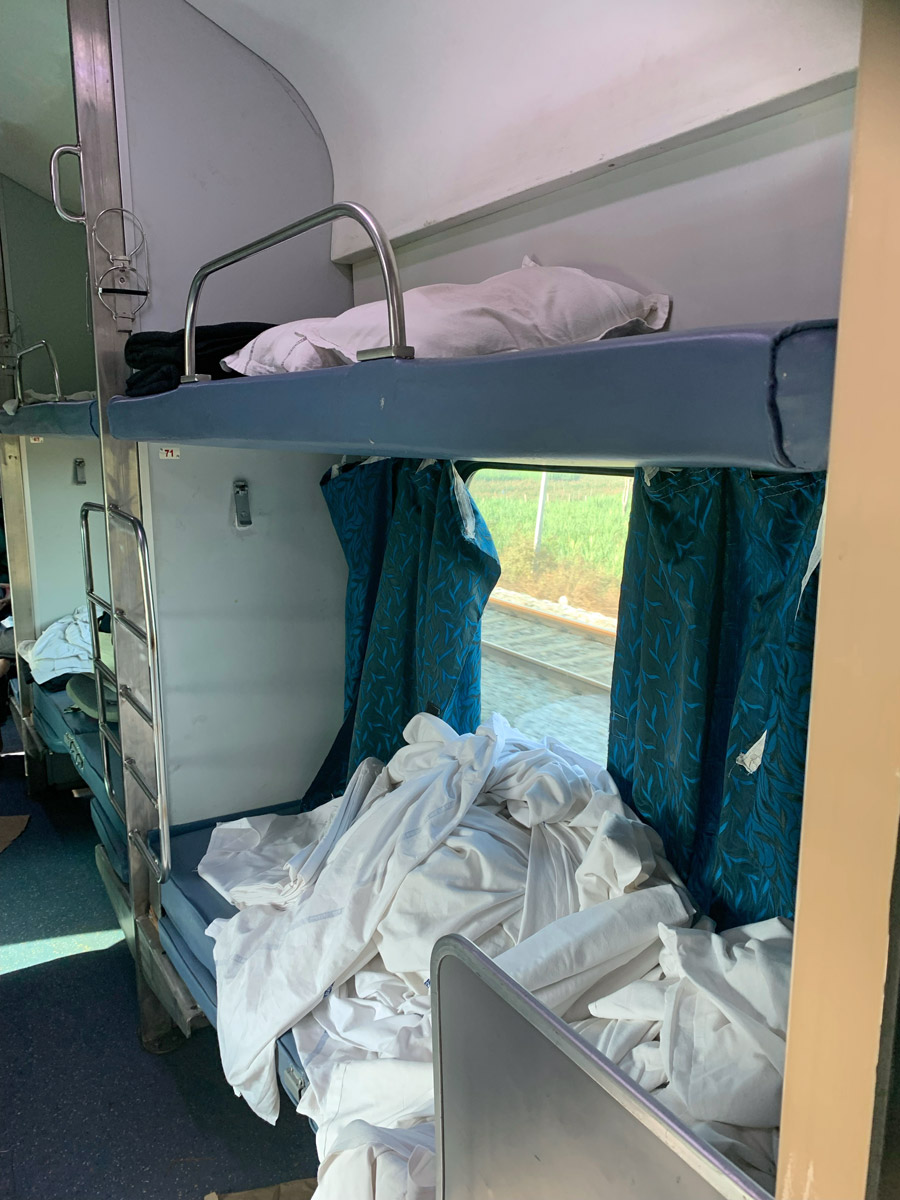
AC3 has a similar layout to AC2, but instead of upper & lower berths it has 3 tiers of bunks - upper, middle and lower - arranged in bays of six on one side of the aisle, and longitudinal bays of two - upper and lower - along the wall on the other side of the aisle. As in AC2, an attendant distributes pillows, sheets and blankets in the evening. Berths convert to seats for daytime use.
With 3 people sitting on each bench seat during the day rather than just 2, it feels a lot more crowded than AC 2-tier, and at night there is less height-space between each bunk - the top bunks are significantly higher up near the ceiling. AC3 may lack the privacy curtains and individual berth lights usually found in AC2. As in AC2, you should avoid the longitudinal berths if you are tall. Still, if you find AC2 fully-booked, most western travellers will find AC3 an acceptable fall-back. See car plans & berth numbering in AC1, AC2, AC3, AC Chair, Sleeper Class. Photos courtesy of Rachel Poschi.
Air-conditioned 3-tier economy (3E)
A handful of trains offer AC 3-tier economy, shown as 3E. The only difference from normal AC3 is that on the side of the aisle with the longitudinal berths there are upper, middle & lower bunks instead of just upper & lower as in 3A.
Executive Anubhuti chair car (EA)
This is only available on a few Shatabdi Express trains, very similar to Executive Chair class but with a few extra amenities such as seat-back TVs and legrests.
AC Executive chair class (EC)
AC Executive Chair Class is only found on the high-quality Shatabdi Express, Vande Bharat Express & Tejas Express trains. Seats are arranged 2+2 across the car width, basic pre-packaged food & drink is included in the fare, served at your seat. It's also known as First AC Chair class. Seat numbering plan for AC Chair cars.
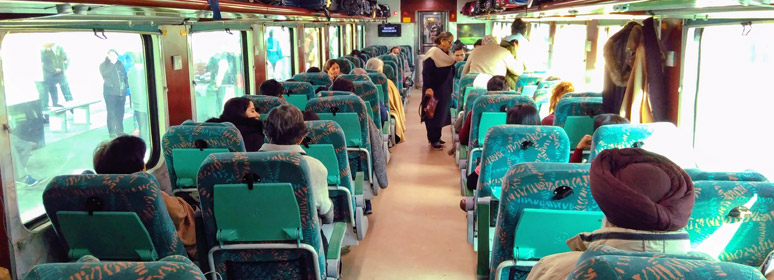
AC Executive Chair class on a Shatabdi Express. Courtesy of Dan Stowell.
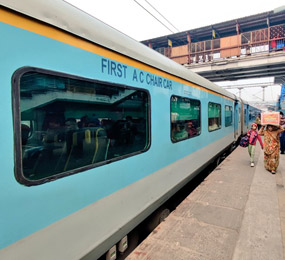
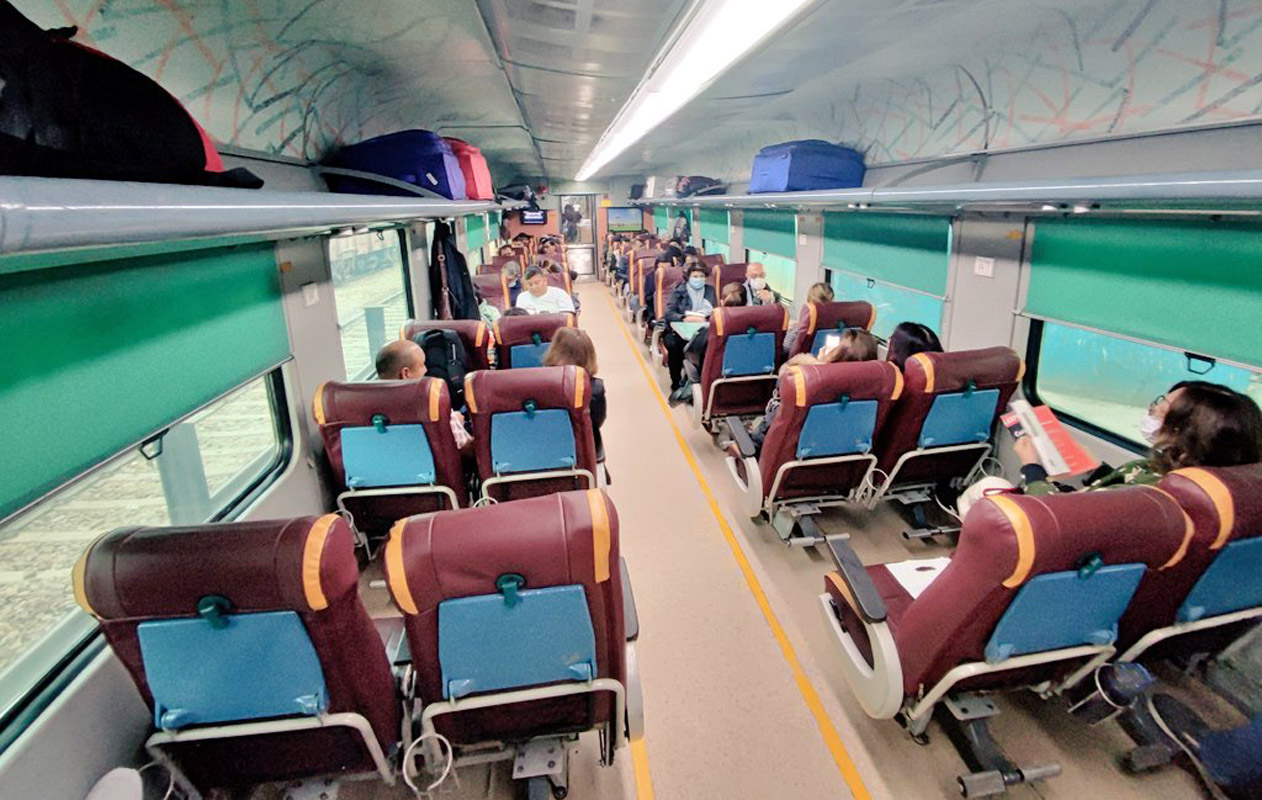
AC Executive Chair class on the Gatimaan Express, also a popular choice between Delhi (H.Nizamudin station) & Agra Cantonment. Photos courtesy of Nonstop Eurotrip. Larger photo.
AC Chair class (CC)
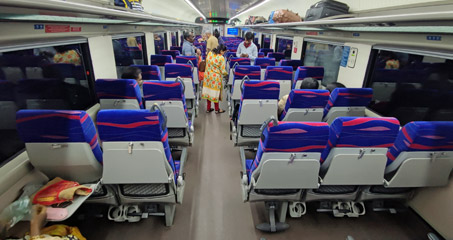
AC Chair class is a good choice for daytime journeys. Comfortable & air-conditioned, they have seats arranged 2+3 across the car width. AC Chair Class is found on the Shatabdi Expresses, Vande Bharat Express, the several Tejas Express trains and a number of other inter-city daytime trains, for example Delhi-Jaipur, Delhi-Agra, Delhi-Kalka for Simla. Seat numbering plan, AC Chair cars.
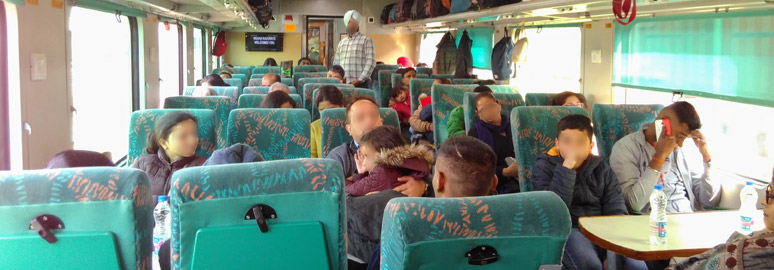
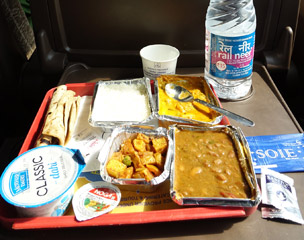
Sleeper Class (SL)
This is the way the bulk of the Indian population travels on long-distance trains, but it's also used by many more adventurous backpackers who are prepared to take the rough with the smooth. The majority of cars on a typical long-distance mail or express train will be sleeper class.
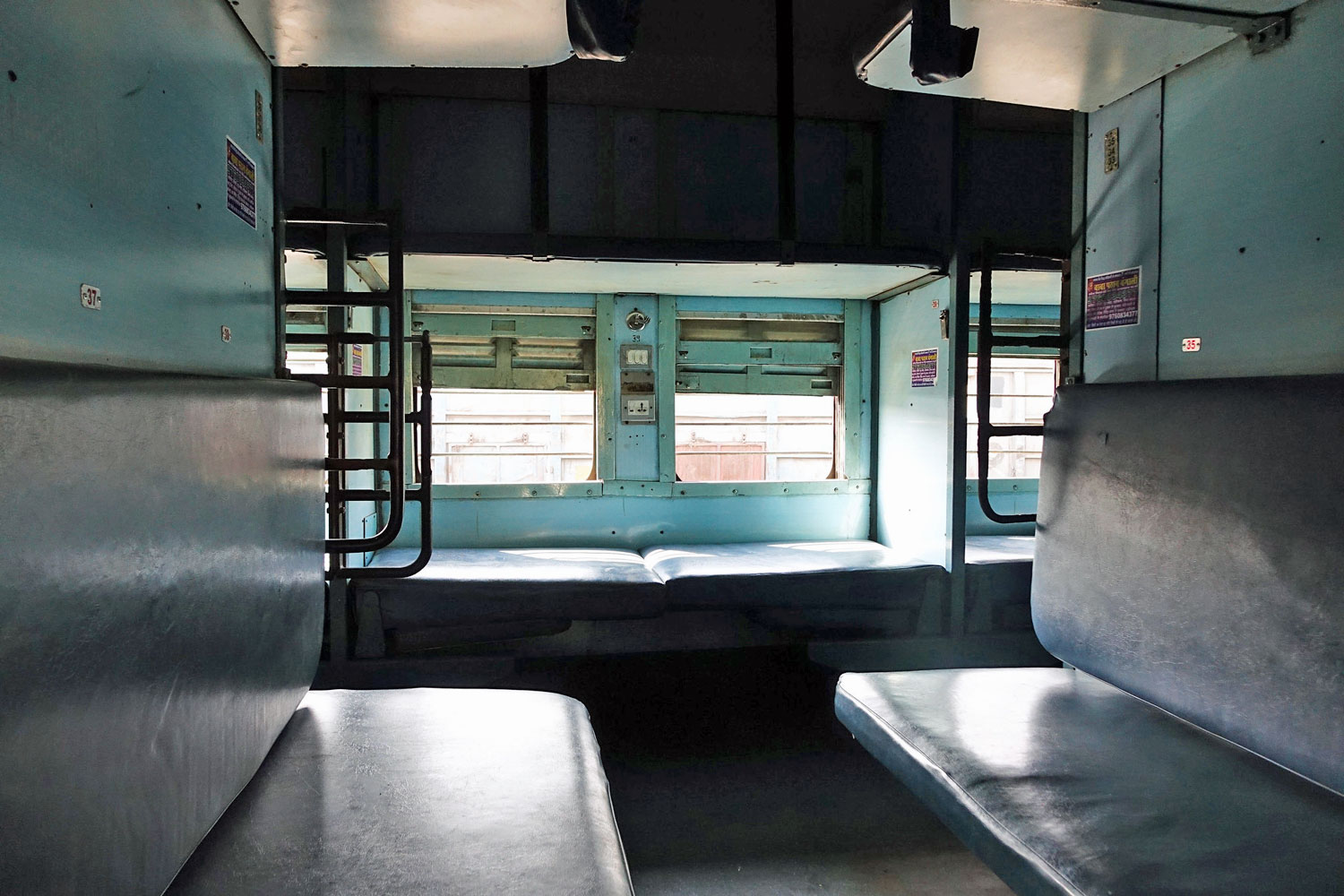
Sleeper class consists of open-plan berths, arranged in bays of 6 bunks (upper, middle and lower) on one side of the aisle, and bays of 2 bunks (upper & lower) along the coach wall on the other side of the aisle. Bunks fold away to form seating for daytime use. It's the same basic layout as AC3, but without the air-con and without any privacy curtains. Bedding is not provided, so bring a sleeping-bag.
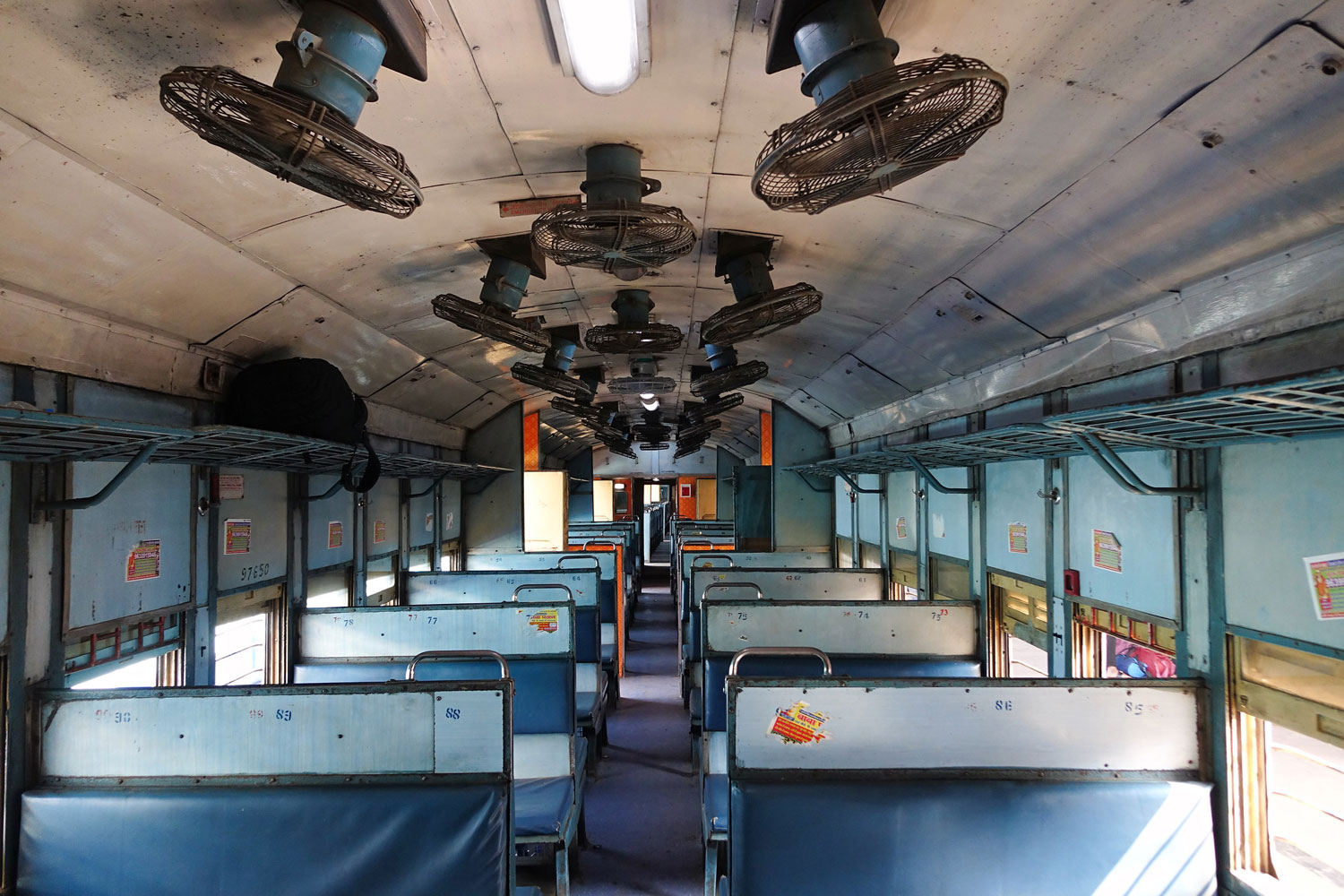
Sleeper class is found on almost all long-distance trains except for the premier Rajdhani & Duronto services. Sleeper class can be crowded (although in theory all berths must be reserved, so it can't get overcrowded), and it's fairly grubby and basic. On the other hand, you get a better view of the countryside then in AC coaches, where the windows are sealed, tinted and sometimes dirty. In summer, there are fans on the ceiling and a breeze from the windows. In winter, wrap up warm at night and take a sleeping bag and fleece, as it can get cold. Berth numbering system, AC1, AC2, AC3, AC Chair, Sleeper Class cars.
1st class (FC)
Traditional non-air-con 1st class has now almost disappeared, as Indian Railways have progressively phased it out in favour of AC 2-tier. But for the record, ordinary first class consists of non-air-conditioned sleeper coaches with lockable 4-berth and 2-berth compartments, a similar layout to AC1 but without the AC. Bedding is not provided, and it's much grubbier than AC1, AC2 or AC3 as it's not sealed against the dirt.
2nd class seats (2S = reserved or GN = unreserved)
Open plan cars with wooden or padded plastic seats, sometimes reserved and shown online as 2S, sometimes unreserved and shown online as either GN or II. Not recommended for long distance overnight journeys (you'll see the huge scrum of Indians all trying to bag a seat in unreserved 2nd class), but quite acceptable for daytime journeys of up to a few hours if you're on a budget.
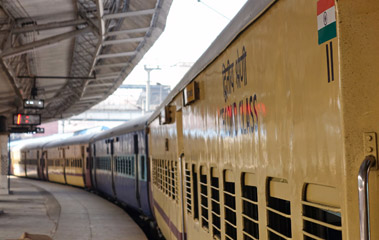
IndRail passes: Discontinued in 2017
Indrail pass agency SD Enterprises reports that Indian Railways discontinued the Indrail pass scheme at the end of 2017. A quite incredible decision, given the difficulty of booking Indian train tickets. You will now need to book an itinerary as point to point tickets, either through a reliable agency such as 12go.asia or online as above.
First-time visitors often wonder where to start in such a vast country and they're sometimes told to tour only a small area, for example Rajasthan or the beaches of Goa. But I suggest a bolder approach. Use the remarkable Indian train network to see a varied cross-section of India's highlights, picking one example from each type of place: A big city, a colonial hill station, a princely city or two in Rajasthan, then Agra of course for the Taj Mahal, and also Varanasi, the classic Hindu holy city on the Ganges. This way, you'll see some incredible highlights and complete contrasts, with overnight trains minimising both daytime travelling time and hotel bills.
A suggested itinerary
Here's what I personally consider the best itinerary around Northern India, taking in an amazing variety of classic Indian cities in as little as 2 weeks. Highlight after highlight in a 2-week itinerary. If you have longer to spare, add an extra day or two here and there and/or add one more Rajasthani city, Udaipur.
-
Delhi 1-3 days. Contrast the bustling old city with Lutyens' gracious New Delhi. See New Delhi hotel suggestions.
-
Take the Swatantrta S Express leaving New Delhi at 21:15 arriving Varanasi Junction at 08:05 next morning. AC1, AC2, AC3, Sleeper class.
-
Varanasi 2-3 days. Formerly called Benares, Varanasi is the must-see Hindu holy city on the Ganges.
Make sure you stay in a local Indian riverside hotel such as the Hotel Alka or Ganpati Guest House, with a terrace overlooking the Ganges. Western hotels are usually located in the new town, well away from all the amazing riverside action. The Hotel Alka and Ganpati Guest House are two of the better hotels in this riverside location, and eating a Thali on the Alka's terrace as the Diwali fireworks went off overhead and Lilly pads with candles drifted down the Ganges was something I will never forget.
-
Take the Marudhar Express from Varanasi Junction around 18:25 arriving Agra Fort at 06:40 next morning. AC2, AC3, Sleeper class. No AC1.
-
Agra 2 days. It may be the most touristy place in all India, but the Taj is utterly beautiful and well worth the tourist tout hassle. Agra fort and the ‘baby Taj’ are also worth a visit. Remember to visit the fantastic deserted royal city of Fatephur Sikhri, 30km away by bus or car.
The Taj Mahal is a 15-minute 5.8 km drive by taxi or tuk-tuk from Agra Cantonment station or 4 km from Agra Fort station. To stay a stone's throw from the Taj Mahal, try the inexpensive Hotel Shyam, Palace, for a more upmarket stay try the ITC Mughal.
-
Take the Marudhar Express from Agra Fort around 06:45 arriving Jaipur at 11:50 the same day. AC2, AC3, Sleeper class (No AC1).
-
Jaipur 2-3 days. The 'Pink City' is one of the most wonderful princely cities in Rajasthan or indeed India.
To stay somewhere special, try the Padmaa Haveli or Dera Pandawa. For somewhere decent at the budget end, try the Khatu Haveli.
-
Take the daily Raniket Express leaving Jaipur at 10:10 arriving Jaisalmer at 22:30 the same day, with AC1, AC2, AC3, Sleeper class.
-
Jaisalmer 2-3 days. This is Rajasthan’s ultimate fairytale city and one of the most beautiful cities in the whole of India, in the desert close to the Pakistan border. For many years it had no airport so only those who made the effort got to experience it, although sadly it may now have flights using the military airbase nearby.
I recommend the Mandir Palace hotel, a former palace with rooms straight out of Arabian Nights. It's a gem and a bargain, but if you can't stretch to the Mandir Palace, try the inexpensive Hotel Garh Jaisal Haveli.
-
Take the Runicha Express leaving Jaisalmer at 19:00 daily, arriving Old Delhi at 10:35 next day. AC1, AC2, AC3, sleeper class.
Spend a day and night in Delhi.
-
Take the Kalka Shatabdi leaving New Delhi at 07:40 arriving Kalka at 11:40. AC Executive chair class and AC Chair class, meal included served at your seat. Change onto the waiting narrow-gauge Simla toy train leaving Kalka at 11:55 arriving Simla at 16:45 with (non-AC) 1st class, AC Chair class, 2nd class. The journey to Simla by narrow gauge Toy Train is an absolute delight.
-
Simla 2-3 days. Cool relaxation and colonial mock-Tudor charm in this lovely Himalayan hill station from the days of the Raj. The ideal final destination for your trip! My favourite Clarkes Hotel is still closed for renovation, perhaps try the Hotel Combermere.
-
Take the Shivalik Deluxe Express toy train leaving Simla at 17:25 arriving Kalka at 22:05. Change onto the mainline Netaji Express leaving Kalka at 23:55 and arriving Old Delhi at 06:00. AC1, AC2, AC3, Sleeper class.
-
Delhi.
How to book this itinerary
Option 1, arrange it all yourself. First sketch out your itinerary, perhaps using the technique explained here. Then book each train journey at 12go.asia (hassle-free, although naturally they charge a reasonable agency mark-up) or get yourself registered with IRCTC and book as explained here. Then book each of your hotels separately using Booking.com. This is the budget option, if you don't mind the legwork and managing it yourself.
Option 2, have it booked for you, hassle-free. I've arranged for train specialists Railbookers to offer this exact itinerary as a package, with trains, hotels, transfers (and if you like, your flight to India) all sorted for you. This costs more than sorting it yourself, but it saves a lot of effort and possible frustration, and as it's a package, if anything affects one part of the tour Railbookers will sort things out for you. Their suggested tour can be adjusted to your own requirements, to spend more or less time in each place. Railbookers is an ABTA member and holidays including flights are ATOL protected.
 UK call 0207 864 4600,
www.railbookers.co.uk.
UK call 0207 864 4600,
www.railbookers.co.uk.
 US call free 1-888-829-4775,
see
website.
US call free 1-888-829-4775,
see
website.
 Canada call free 1-855-882-2910,
see
website.
Canada call free 1-855-882-2910,
see
website.
 Australia call toll-free 1300 971 526,
see website.
Australia call toll-free 1300 971 526,
see website.
 New Zealand call toll-free 0800 000 554 or
see website.
New Zealand call toll-free 0800 000 554 or
see website.
Alternative versions
Alternatively, just pick on big city, one hill station, a couple of cities in Rajasthan, and a couple of places from the 'other' list below and create your own itinerary. How about: Kolkata - (overnight sleeper train to New Jalpaiguri then the famous Darjeeling Toy Train) - Darjeeling - Varanasi - (overnight sleeper train) - Agra - (daytime train) - Jaipur - (overnight sleeper train) - Kolkata?
The big cities
The royal cities of Rajasthan
Old Colonial hill stations
Other places to see
Two personal favourites: A ride to Darjeeling
A personal favourite is the ride to Darjeeling on the narrow gauge Darjeeling Himalaya Railway (DHR), and a night or two at the wonderful Windamere Hotel. The DHR is now a UN World Heritage Site.
Travel from Kolkata's Sealdah station to New Jalpaiguri (NJP) on the broad gauge Darjeeling Mail, leaving Sealdah at 22:05 and arriving NJP at 08:15 next morning. The Darjeeling Mail has AC1, AC2, AC3, sleeper class and 2nd class accommodation. Then take the connecting DHR 'toy train' up to Darjeeling, leaving NJP at 10:00 daily, arriving Darjeeling at 17:30. It's a long ride on a narrow gauge train, sometimes next to the hill road, sometimes through jungle, and sometimes through the streets.
You can check the current status of the Darjeeling Himalayan Railway at www.dhrs.org/page4.html - it has it's ups and downs, if you'll pardon the expression.
Some guide books recommend taking the bus from NJP to Darjeeling (a 4 hour journey, so much quicker than the 'toy train') and treating the railway as a theme park ride for a quick trip on a short section - ignore them. Four hours on a bus is cramped, uncomfortable and hardly a UNESCO world heritage experience. The leisurely day spent on the toy train through the Himalayan foothills will be one of the best you spend in India. The daily 10:00 train from NJP is diesel-hauled except for certain days when the diesel is being maintained, but other services are still hauled by steam locomotives.
Once in Darjeeling, the place to stay is the Windamere Hotel. Originally a boarding house for bachelor tea planters, it became a hotel in 1939. Meals are served by white-gloved, turbanned waiters and eaten by candlelight to the sound of Cole Porter tunes on the piano. Even if you can't afford it, make sure you come along for afternoon tea - probably the best cup of tea you will ever drink.
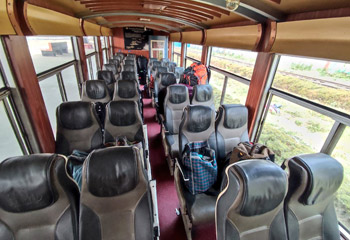
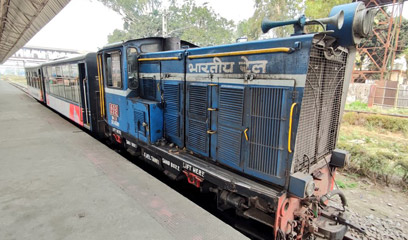
The daily Toy Train from NJP to Darjeeling on the Darjeeling Himalayan Railway. Photos courtesy of Nonstop Eurotrip.
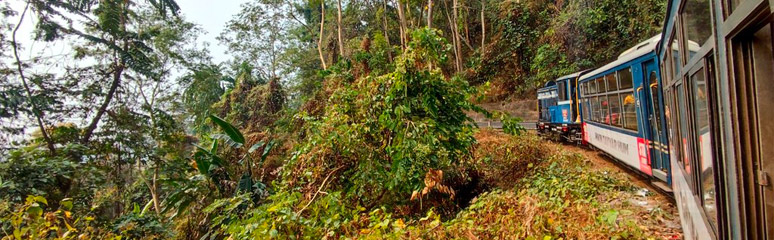
For much of the way, the line runs next to the hill road with wonderful views, at one point it runs around a loop to gain height. At Kurseong, the train runs through the streets like a tram. Forget the bus, take the toy train.
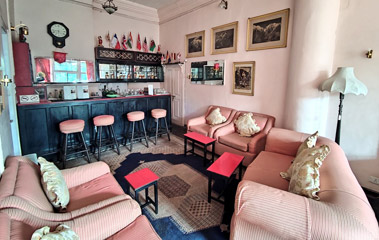
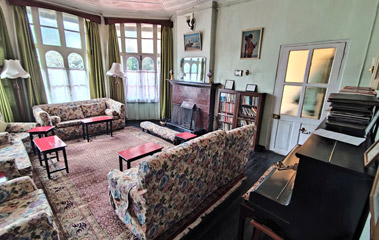
The wonderful Windamere Hotel, Darjeeling. Photo courtesy of Nonstop Eurotrip.
...and a ride to Simla.
A little bit more robust than the line to Darjeeling, the similar toy train up to Simla in the Himalayan foothills is the way to reach Simla, once India's summer capital. Take a fast broad-gauge train from New Delhi to Kalka and change there onto the Toy Train up into the hills. The train ride to Simla is one of Simla's highlights on its own. If you get the chance, use the Shivalik Deluxe Express on the way back down from Simla (it connects with the overnight express to New Delhi going forward next day to Kolkata). The Shivalik Deluxe has plush fabric-covered first class armchairs, and a meal is served at your seat, included in the price. Although it gets dark as you descend, at stations without electricity the signalmen hand the single-line token to the driver whilst holding burning torches, the shimmering flames lighting up the side of the train. It's wonderfully atmospheric.
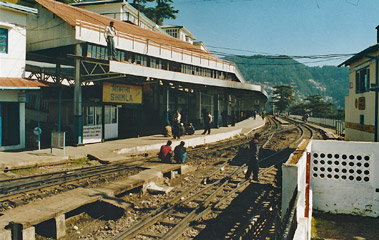
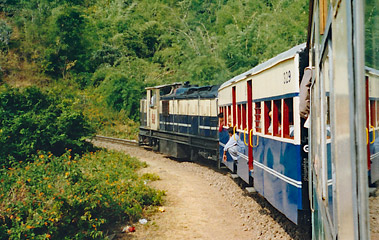
Tours of India by train
Railbookers - independent tours
The cheapest option is to arrange everything yourself, independently, but this takes time and effort. If you want a customisable itinerary with all your train tickets, up-market hotels and transfers arranged for you, you can do this through train specialists Railbookers. Their website has various example itineraries including a one-week Golden Triangle one visiting Delhi, Agra and Jaipur, but have a look at the suggested itinerary above covering Delhi, Agra, Varanasi, Jaipur, Jaisalmer & Simla as I think it's the best 2-week itinerary around northern India that you'll find, and I've arranged for Railbookers to offer it. Railbookers takes good care of their clients and gets very good reviews.
UK call 0207 864 4600,
www.railbookers.co.uk.
US call free 1-888-829-4775,
see
website.
Canada call free 1-855-882-2910,
see
website.
Australia call toll-free 1300 971 526,
see website.
New Zealand call toll-free 0800 000 554 or
see website.
Wendy Wu Tours - escorted group tour
If you'd rather travel in an escorted group, UK operator Wendy Wu Tours (www.wendywutours.co.uk) offers escorted group tours by train covering Delhi, Agra, Jaipur, Varanasi, Amritsar & Simla with a range of departure dates. They get a sound Trustpilot ranking, feedback always appreciated. See www.wendywutours.co.uk/rail-tours and scroll down to the India by Rail tour.

Tourist cruise trains
There are now several luxury cruise trains catering for tourists and offering sightseeing itineraries around Indian cities. All of these trains are in effect 5 star international hotels on wheels, allowing you to see India in great comfort. They're not cheap, prices are in the $000s.
The Palace on Wheels
-
See www.palacesonwheels.com and see the Palace on Wheels video. This is India's first and most celebrated cruise train, voted as the world's 4th best luxury train by Condé Nast Traveller magazine. All suites feature private shower & spotlessly clean toilet, TV & CD player, and the train's two elegant restaurant cars offer both Indian and international cuisine.
-
You can book the Palace on Wheels through recommended train holiday specialist Railbookers who can also arrange flights, hotels and other Indian trains for you.
UK call 0207 864 4600,
www.railbookers.co.uk.
US call free 1-888-829-4775,
see
website. Canada call free 1-855-882-2910,
see
website.
Australia call toll-free 1300 971 526,
see
website.
New Zealand call toll-free 0800 000 554 or
see
website.
Other luxury cruise trains
The Palace on Wheels is no longer the only cruise train in India, and it's not even the best. Others have sprung up, though prices are sky-high. Be warned that most of these companies quote a rate per night, not for the whole tour!
-
Maharaja's Express, see www.the-maharajas.com - See the Maharaja's Express video. Runs various 3 or 7 night tours from Delhi back to Delhi or between Delhi & Mumbai, via places such as Agra, Jaipur, Varanasi, Lucknow, Khajuraho. This train is run by Indian Railway Catering and Tourism Corporation (IRCTC), originally as a joint venture with Cox & Kings. Gets very positive feedback, 'ten out of ten' from one correspondent. You can now book the Maharaja's Express through train holiday specialist www.railbookers.co.uk.
-
Royal Rajasthan on Wheels, www.royalsrajasthanonwheels.com - See the Royal Rajasthan on Wheels video. Offers 8-day (7-night) itineraries with weekly departures from Delhi back to Delhi, stopping at Jodhpur, Udaipur, Ranthambore National Park, Jaipur, Khajuraho & Varanasi. Has also had great feedback, and can also be booked through www.railbookers.co.uk.
-
Golden Chariot, www.goldenchariot.org - see the Golden Chariot video. A luxury train offering weekly departures from Bangalore for a week-long tour to Goa & southern India.
-
Deccan Odyssey, www.deccan-odyssey-india.com - see the Deccan Odyssey video. A luxury train offering weekly departures from Mumbai for a week-long tour to Goa, Pune, and the caves at Ajanta & Ellora.
-
Indian Maharaja, www.theindianmaharaja.co.in. Offers 8-day 7-night 'land cruises' between Delhi & Mumbai in either direction on various dates between October & April, with stopovers & tours at Agra, Jaipur, Udaipur, Ellora & Ajanta Caves.
-
These trains can also be arranged through Railbookers. On their website, select 'Private trains'.
UK call 0207 864 4600,
www.railbookers.co.uk.
US call free 1-888-829-4775,
see
website. Canada call free 1-855-882-2910,
see website.
Australia call toll-free 1300 971 526,
see website.
New Zealand call toll-free 0800 000 554 or
see
website.
International trains, buses & ferries
There are international trains to Pakistan & Bangladesh, and buses to Nepal. Here's a quick summary:
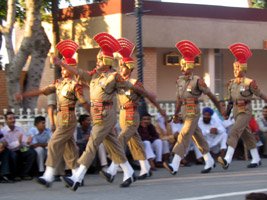 |
|
|
The border closure ceremony at Atari. You can attend this if you use buses or taxis to cross. Photo courtesy of Koen Berghuis. |
|
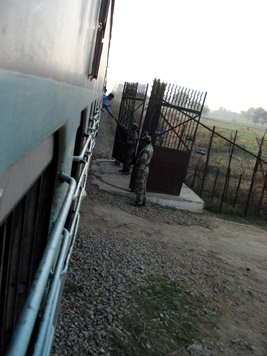 |
|
|
The Samjohta Express crosses the India/Pakistan border. Photo courtesy of Sudhir Mehra. |
Delhi - Amritsar - Lahore, Pakistan
-
Take a train from Delhi to Amritsar, there are lots to choose from. See www.indianrail.gov.in for times & fares.
-
Take a bus or taxi the 26km from Amritsar to the India/Pakistan frontier at Atari. Walk through the border posts to Wagah on the Pakistani side. You may want to hang around Wagah to see the spectacular ceremony at sunset when the border closes. Indian and Pakistani guards try to outdo each other with their performances, watched by Indians and Pakistani crowds!
-
Take another bus or taxi the remaining 20km to Lahore. Allow plenty of time for this deceptively short journey.
-
There used to be a cross-border train, but tension in Kashmir means all India-Pakistan trains are suspended at the moment.
Delhi - Jodhpur - Karachi, Pakistan
-
A weekly international train called the Thar Express started in February 2006 from Jodhpur to Karachi via the border at Munabao. But it's currently suspended.
-
Eastbound: The Thar Express leaves Karachi every Friday at 23:00, arriving at 'Zero Point' on the Pakistan/India frontier at around 08:00 next morning. After customs checks, the train goes forward to Munabao on the Indian side, arriving around 11:00.The Indian train departs Munabao at 19:00 after customs formalities, arriving Jodhpur (Bhagat Ki Kothi station) at 23:50 Saturday.
-
Westbound: The Thar Express leaves Jodhpur (Bhagat Ki Kothi station, about 4km from the main station) every Saturday morning at 01:00 arriving Munabao at 07:00, leaving Munabao at around 14:30 on Saturdays, reaching Karachi at 02:15 on Sunday morning.
-
The sleeper fare from Jodhpur to Munabao/zero point is about Rs170, and from Munabao/zero point to Karachi is about Rs230. No more information is yet available, but feedback would be appreciated! The train has one sleeping-car and several economy cars.
-
Update: Tension in Kashmir means all India-Pakistan trains are suspended at the moment.
Delhi to Kathmandu, Nepal
-
It's quite easy, cheap, and an adventure to do this journey overland. You take an overnight train from New Delhi to Gorakpur, then a bus. For details, see the Nepal page.
Kolkata to Dhaka, Bangladesh
-
A new direct train from Kolkata (Calcutta) to Dhaka started in April 2008, see the Bangladesh page.
India to Sri Lanka by ferry
-
After many years of being cut off from each other (with at least one short-lived attempt to start a ferry service in 2011), a new ferry service started in late 2023, linking Nagapattinam (mainland India) with Kankesanthurai (on Sri Lanka, near Jaffna).
-
The fast ferry Cheriyapani sails from Nagapattinam (India) at 07:00 arriving Kankesanthurai (Sri Lanka) at 11:00.
She sails from Kankesanthurai (Sri Lanka) at 13:30 arriving Kankesanthurai (India) at 17:00.
Crossing time 3 hours for the 60 nautical miles. Service will be suspended during the monsoon season in November-December.
Fare around 8,000 Indian rupees, luggage allowance 40 Kg.
-
Online booking will be available starting in January 2024, website not yet known. Until then, call +91 978 987 9971 at least 24 hours in advance. You will be required to send a copy of your passport and visa details via WhatsApp to confirm the booking.
Be careful with e-visas when using this ferry, they will not initially be accepted at these entry points, but may be in future.
India to Burma (Myanmar)
-
The India/Burma border is closed to foreigners. It is not possible to travel to Burma overland from India. For train and river steamer service within Burma, see the Burma page.
India to China
-
The direct route from India into China is difficult and mountainous, there are no trains, you need some serious permits to be in that part of India, and most if not all border crossings are closed to foreigners. If you wish to travel this way, do your research before attempting it!
-
For most practical purposes, you are better off going from India to Kathmandu in Nepal (see the Nepal page), then taking an organised tour from Kathmandu to Lhasa in Tibet (see the Nepal page), then a train to Beijing. For train service within China, including Lhasa to Beijing, see the China page.
Europe to India overland
 Europe
to India via Istanbul, Iran, Pakistan
Europe
to India via Istanbul, Iran, Pakistan
-
It's possible to travel from Europe to India overland by train and bus via Turkey, Iran & Pakistan, along what in the 1960s & 70s was the hippy train. However, these days there are serious security problems affecting this route in Turkey, SE Iran & Pakistan. If you are foolhardy enough to brave these, it takes a minimum of 2-3 weeks and you should consider it as an adventure or expedition rather than a routine way to travel there.
-
Administratively, the main issue is getting a tourist visa for Iran - see the London to Iran page for agencies to contact to get one. Finally, there are major security issues in southeast Iran to be aware of - see the official travel advice for Iran and Pakistan at the British Foreign Office website, www.gov.uk/foreign-travel-advice. If you are still interested, see the Europe to India overland page. I'd suggest planning the trip out carefully before you start to book anything - this may help: How to plan an itinerary & budget.
Europe to India via Moscow, the Trans-Siberian Railway, Beijing & Lhasa
-
A safer though somewhat round-about way is London to Moscow by Eurostar and onward trains to Moscow (2 nights, £300, daily departures), Moscow to Beijing via the Trans-Siberian Railway (6 or 7 nights, £500, two per week), Beijing to Lhasa by train (2 nights, £100, daily), then an organised tour by bus from Lhasa to Nepal (7 nights, maybe $400), then bus and train to Delhi. Again, you may find this helpful: How to plan an itinerary & budget. Trains to Russia are suspended due to Covid-19 and now sanctions. All travel to Russia is inadvisable.
Suggested hotels
In New Delhi
Top end: New Delhi's most iconic hotel is The Imperial, opened by the Viceroy in 1936. It's just 10 minutes walk from Connaught Place and an easy 2.2 km taxi ride to New Delhi station. It'll take something of a splurge to stay here, but you'd be staying where Ghandi, Nehru, Gandhi, Mohammad Ali Jinnah and Lord Mountbatten met to discuss partition. Read more at en.wikipedia.org/wiki/The_Imperial,_New_Delhi.
Mid-range: If you can't stretch to the Imperial, the next best thing is either The Claridges or The Connaught, the latter located near Connaught Place in the centre of New Delhi, the former a little further south. Both get great reviews.
Budget: To stay near Connaught Place, try the highly-rated but inexpensive Hotel Palace Heights. Many of Delhi's budget hotels line the Main Bazaar in Paharganj, a traditional traveller hangout handy for New Delhi station. In this area, try The Gold Regency, just 2 minutes walk from the station, or the Newly-Built Gold The Royal only a little further on. The Hotel Nameste is in the same category.
In other cities
Agra
To stay a stone's throw from the Taj Mahal, try the inexpensive Hotel Shyam, Palace. Or for a more upmarket stay, the ITC Mughal.
Varanasi
The Hotel Alka is cheap, simple, clean, and in a perfect location overlooking the Ganges where all the action is - most of the western-style hotels are miles away in the new town, you really want to be on the river. I stayed here during Diwali and will never forget dining on the terrace after dark, overlooking the river with fireworks going off and lily pad lights floating down the Ganges. At that time, the Ganpati Guest House next door was similarly-rated, it now seems to be ahead of the Alka in review score, so by all means check it out. Just don't be tempted by western hotels in the new town, this is where the action is!
Simla
Clarke's hotel is in classic colonial-era building right in the heart of town, walking distance from all the sights, I stayed here some years ago and it was excellent. However, it's been closed since 2023 allegedly for renovations. Perhaps try the Hotel Combermere instead.
Jaipur
For somewhere special but very affordable by western standards, try the Padmaa Haveli or Dera Pandawa. For somewhere special at the budget end, try the Khatu Haveli.
Udaipur
The Lake Pichola Hotel is an excellent mid-range choice right on the waterfront, the next best choice if you can't afford the Taj Lake Palace Hotel - that's the famous and expensive luxury hotel on the island in the lake!
Jaisalmer
The Mandir Palace hotel is a real palace with rooms straight out of Arabian Nights. It's an absolute gem and a real bargain, but if you can't stretch to it, try the inexpensive Hotel Garh Jaisal Haveli.
Darjeeling
The Windamere Hotel is one of my all-time favourite hotels, staying here is an experience straight out of the Raj. It's a 'must' if your budget will stretch. They serve the best Darjeeling tea I have ever tasted, so at least go there for afternoon tea.
If you can't get a room at the Windamere, try the Elgin Heritage Resort & Spa. Built in 1887, it's the former summer residence for the Maharaja of Cooch Behar.

Tripadvisor hotel reviews
www.tripadvisor.com is a good place to find independent travellers' reviews of the main hotels. It also has the low-down on all the sights & attractions too.
Flights to India
Overland travel by train around India is an essential part of the experience, so once there, don't cheat and fly, stay on the ground! But if you need a long-haul flight to reach India in the first place.
1) Check flight prices at Opodo, www.opodo.com
2) Use Skyscanner to compare flight prices & routes worldwide across 600 airlines

3) Lounge passes
Make the airport experience a little more bearable with a VIP lounge pass, it's not as expensive as you think! See www.loungepass.com
For independent travel, the best guidebook to take is either the Lonely Planet or Rough Guide. I gave Sarah the Lonely Planet and Karen the Rough Guide and we road-tested both of them head-to-head across India. The result was a tie, with similarly excellent levels of both practical travel information and historical and cultural background. I personally prefer the Lonely Planet, but Karen preferred the Rough Guide. Just make sure you take one of these two guides with you..! If you buy anything at Amazon through these links, Seat61.com gets a small commission to help support the site.
Buy Lonely Planet India at Amazon.co.uk Buy Rough Guide India at Amazon.co.uk


Alternatively, you can download just the chapters you need in .PDF format from the Lonely Planet Website, from around £2.99 or US$4.95 a chapter.
Also for your reading list
OK, so Rudyard Kipling's 'Kim' is a novel, not a guidebook - but you'll need a reading book for your trip, right? Trust me on this - 'Kim' is a magical tale, that captures the feel of Northern India even today. Buy Kim online - it costs all of about £1.25!
Once hooked, you'll probably want to get Peter Hopkirk's book, 'The Quest for Kim', which tells you about the real people and places on which the characters and places in the novel are based. Buy 'The Quest for Kim' online.
Travel insurance & other tips
|
|
|
|
|


Always take out travel insurance
Never travel overseas without travel insurance from a reliable insurer, with at least £1m or preferably £5m medical cover. It should also cover cancellation and loss of cash and belongings, up to a sensible limit. An annual multi-trip policy is usually cheaper than several single-trip policies even for just 2 or 3 trips a year, I have an annual policy with Staysure.co.uk myself. Here are some suggested insurers. I get a small commission if you buy through these links.
www.staysure.co.uk
offers enhanced Covid-19 protection & gets 4.7 out of 5 on
Trustpilot.
www.columbusdirect.com
is also a well-know brand.
 www.staysure.com/ie if you live in Ireland.
If you live in the USA try
Travel Guard USA.
|
|

Get an eSIM with mobile data package
Don't rely on WiFi, download an eSIM with a European mobile data package and stay connected. Most newer mobile phones can download a virtual SIM including iPhone 11 & later, see device compatibility list. There's no need to buy a physical SIM card! Maya.net is a reliable eSIM data retailer with a 4.5 out of 5 Trustpilot rating and a range of packages including unlimited data.
|
|

Get a VPN for safe browsing. Why you need a VPN
When you're travelling you often use free WiFi in public places which may not be secure. A VPN encrypts your connection so it's always secure, even on unsecured WiFi. It also means you can select the geographic location of the IP address you browse with, to get around geoblocking which a surprising number of websites apply. See VPNs & why you need one explained. ExpressVPN is a best buy with a 4.7 out of 5 Trustpilot ranking which I use myself - I've signed up as an ExpressVPN affiliate, and if you go with expressvpn.com using the links on this page, you should see a special deal, 3 months free with an annual subscription. I get a small commission to help support this site.
|
|


Get a Curve card for foreign travel
Most banks give you a poor exchange rate, then add a foreign transaction fee on top. A Curve MasterCard means no foreign transaction fees and gives you the mid-market exchange rate, at least up to a certain limit, £500 per month at time of writing. The money you spend on your Curve card goes straight onto one of your existing debit or credit cards.
How it works: 1. Download the Curve app for iPhone or Android. 2. Enter your details & they'll send you a Curve MasterCard - they send to the UK and most European addresses. 3. Link your existing credit & debit cards to the app, you can link up to two cards with the free version of Curve, I link my normal debit card and my normal credit card. 4. Now use the Curve MasterCard to buy things online or in person or take cash from ATMs, exactly like a normal MasterCard. Curve does the currency conversion and puts the balance in your own currency onto whichever debit or credit card is currently selected in the Curve app. You can even change your mind about which card it goes onto, within 14 days of the transaction.
I have a Curve Blue card myself, it means I can buy a coffee on a foreign station on a card without being stung by fees and lousy exchange rates, just by tapping the Curve card on their card reader. The money goes through Curve to my normal debit card and is taken directly from my account (in fact I have the Curve card set up as payment card on Apple Pay on my iPhone, so can double-click my phone, let it do Face ID then tap the reader with the phone - even easier than digging a card out). I get a little commission if you sign up to Curve, but I recommend it here because I think it's great. See details, download the app and get a Curve card, they'll give you £5 cashback through that link.
|
|

Carry an Anker powerbank
Tickets, reservations, vaccination records and Interrail or Eurail passes are often held digitally on your mobile phone, so it's vital to keep it charged. I always carry an Anker powerbank which can recharge my phone several times over if I can't get to a power outlet. Buy from Amazon.co.uk or from buy from Amazon.com.
Touring cities? Use hill walking shoes!
One of the best things I've done is swap my normal shoes for hill-walking shoes, in my case from Scarpa. They're intended for hiking across the Pennines not wandering around Bangkok, but the support and cushioning for hiking works equally well when you're on your feet all day exploring foreign cities. My feet used to give out first and limit my day, now the rest of me gives up before they do!