


London to Cyprus without flying
It's possible to travel by train + ferry from the UK (or anywhere in Europe) to Cyprus, an exciting journey across Europe and the Mediterranean, taking 5 days. There are three options, each explained here:
 London to Cyprus via
ferry from Greece - All regular ferries were suspended in 2001, but a new
ferry finally started in June 2022. This is the easiest, fastest, most
comfortable option. Operates June to mid-September. It's running in
2024.
London to Cyprus via
ferry from Greece - All regular ferries were suspended in 2001, but a new
ferry finally started in June 2022. This is the easiest, fastest, most
comfortable option. Operates June to mid-September. It's running in
2024.
London to Cyprus via
ferry from Turkey - The only practical all-year option to Cyprus when
the ferry to Limassol isn't running. You enter via
Northern Cyprus.
London to
Cyprus via freighter from the UK & Italy - Limited
number of passenger places available on direct
UK-Italy-Cyprus freight ships.
Useful country information
London to Cyprus, via Greece
It used to be easy to travel to Cyprus by train and ferry via Athens, using one of three regular all-year shipping lines (Poseidon Lines, Salamis Lines or Access Ferries) from Piraeus to Limassol. All three services stopped running indefinitely in 2001 because of unrest in Israel, the ships' ultimate destination.
However, a ferry service started in June 2022 between Piraeus in Greece and Limassol on Cyprus, weekly or twice weekly in summer. Timetable & fares, see scandroholding.com.
If you get any photos of the ferry, ferry cabins or restaurants, or the voyages generally, please let me know!
London ► Cyprus
-
Day 1, travel from London to Athens as shown on the London to Greece page, arriving in the evening of day 3.
The journey takes you by Eurostar to Paris and high-speed train through the Alps to Milan. You stay overnight in Milan, then take a fast train along Italy's Adriatic coast to Bari for the overnight ferry to Patras, with comfortable cabins available. You then transfer from Patras to Athens by bus/train combo. The whole journey from London to Athens takes 2 nights, 3 days.
-
Day 4, sail from Piraeus to Limassol in Cyprus overnight by ferry, with reclining seats, comfortable private cabins, bar & cafeteria available.
The ferry sails once or twice a week from June until mid-September for sailing dates & times see scandroholding.com.
The ship is the m/v Daleela, built in 1991. She typically sails from Piraeus at 01:00 arriving Limassol 07:00 next day, or at 06:00 arriving Limassol 12:00 next day. If you choose to arrive in Athens the evening before, you'll sail from Piraeus on day 4 (counting from London) and arrive in Cyprus on day 5 from London. If you choose to stay overnight and spend day 4 at leisure in Athens, you'll sail from Piraeus on day 5 and arrive in Cyprus on day 6.
Cyprus ► London
-
Day1, sail from Limassol in Cyprus to Piraeus overnight by ferry, with reclining seats, comfortable private cabins, bar & cafeteria available.
The ship is the m/v Daleela, built in 1991. She sails once or twice a week from June until mid-September, for sailing dates & times see scandroholding.com.
The ferry typically sails from Limassol around 13:00 on day 1 and arrives Piraeus around 19:00 on day 2.
-
Day 2, stay overnight in Athens. Piraeus is the port of Athens, linked to it by metro.
-
Day 3, travel from Athens to London as shown on the London to Greece page, arriving London in the evening of day 5.
The journey takes you by bus t/train combo to Athens and overnight ferry to Bari. Train to Milan, overnight stop. High-speed train to Paris and Eurostar to London. The whole journey from London to Athens takes 2 nights.
How much does it cost?
-
For London to Athens costs, see the London to Greece page.
-
Piraeus to Limassol starts at €60 each way including a single-bed cabin, or €55 each way per person in a 2-bed cabin.
How to buy tickets
-
Buy tickets from London to Athens as shown on the London to Greece page.
-
Book the Piraeus to Limassol ferry at scandroholding.com. You should book the ferry at least 10 days in advance.
London to Cyprus via Turkey
Thanks to a daily ferry from southern Turkey to northern Cyprus, it's possible to travel from the UK or anywhere in Europe to Cyprus via Istanbul, year-round, without flying. If and when the ferry to Limassol isn't running, this is the only practical non-flying route onto the island.
London ► Nicosia
-
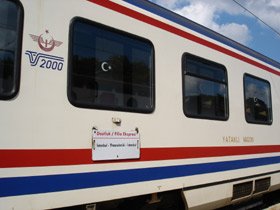
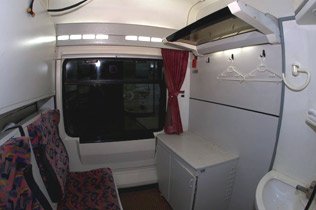
Days 1-5: Travel from London to Istanbul by train as shown on the London to Turkey page. The journey from London takes 4 nights and departures from London are daily. You'll need to stay at least 1 night in Istanbul.
-
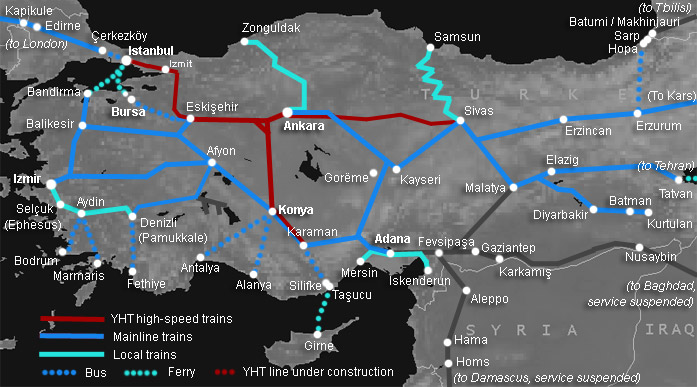
From Istanbul to Cyprus, see the route map below.
-
Day 6, travel from Istanbul (Pendik) to Konya on the 07:30 YHT high-speed train and by connecting bus to Karaman arriving around 13:40, see the train travel in Turkey page for details.
-
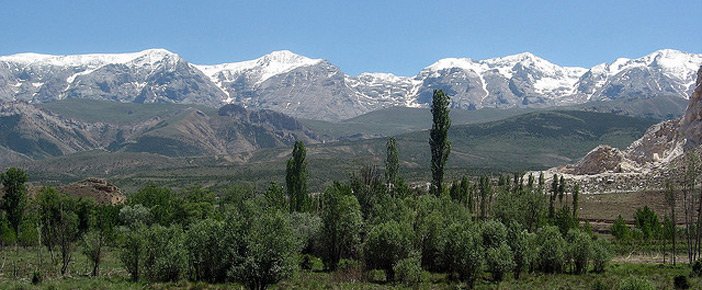
In Karaman, you can take a taxi or even walk to the bus station. Now take a bus from Karaman bus station to Silifke, which is the main town in the area. The best bus operators for Karaman to Silifke are Özkaymak and Kontur, which both do the ride in 2½ hours, fare around TL 18 (£7 or $13). The scenery is breathtaking as the bus descends from the Taurus along the steep and cavernous valley of the Göksu River to the Mediterranean. A dolmus taxi from Silifke to the ferry terminal at Taşucu costs about TL 1.5 (less than £1) and takes 15-20 minutes. You'll probably need to stay overnight somewhere along the way, perhaps in Silifke, and catch the fast ferry from Taşucu the following morning, unless you want to catch the midnight truckers' ferry with cabins available.
-
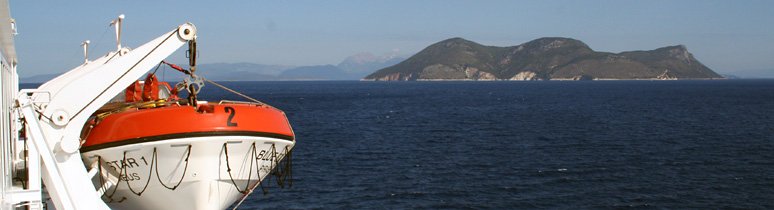
Day 7, take a fast ferry (departure at 11:30 May-September, crossing time 2 hours) or the truckers' ferry (4 or 5 sailings a week, midnight departure, crossing time 4-5 hours, all year round) from Taşucu to Girne (Kyrenia) in northern (Turkish) Cyprus, just north of Nicosia. The fare is about TL 69 (£29 or $45) one-way, TL 138 return, though there may also be port taxes to add. The ferry company is www.akgunlerdenizcilik.com, see the photo below. The return fast ferry leaves Girne daily at 09:30. See www.akgunlerdenizcilik.com to confirm sailing times & fares.
-
Note that you arrive in northern (Turkish) Cyprus. The traveller's report below might help explain arrival formalities and the crossing into southern Cyprus.
-
Feedback from travellers on this route is always appreciated. A westbound journey would of course be the reverse of this.
You should arrange tickets for the London-Istanbul train journey as shown on the London to Turkey page. You can book the Istanbul-Karaman train at the station when you get to Istanbul, or pre-book as shown on the train travel in Turkey page. You can book the ferry at the port when you get there, or book in advance via the ferry operator's website, www.akgunlerdenizcilik.com. It may seem a bit daunting to plan a train + ferry journey from the UK to Cyprus this way, so you may find this planning technique helpful.

Traveller's reports
Traveller Philip Bignell reports from a London-Cyprus trip by train and ferry: "In Tasucu we were advised to arrive 90 minutes before ferry departure to buy tickets and clear security (10am for 11.30am departure). A return ferry ticket is TRY 92, including TRY 12 departure tax. The departures hall has a till to issue a receipt for the departure tax, and there is much waiting, queuing, several examinations of passports and or boarding cards, scanning of luggage and persons. Having cleared all this there are two or three tax free shops, then a catamaran to board in the harbour. Luggage, substantial and various, is placed on deck and covered with a tarpaulin for the voyage, with passengers taking a seat in the one large saloon, three steps down. This room has about twenty five rows of seating in all, with two aisles front to back and each row has about six seats either side and eight seats in the centre block. A group of rows in the very centre of the saloon is replaced with a small cubicle forming a shop. There are several television screens dotted around tuned to a local station in port or playing a film at sea. The ferry left about half an hour late, and the journey is around two and a half to three hours. Leaving the port the saloon doors are secured closed and passengers have to be seated, but they may go on the deck at sea, especially to enjoy smoking, after the doors are unlocked around five minutes into the voyage. It can be quite a bumpy ride, and I noticed it was particularly choppy when having generally followed the coast for about forty minutes we struck out past a headland over the open sea towards Cyprus. Poor sailors should consider taking the air. On the way out, around quarter of the passenger complement was manifestly queasy.
Cyprus is unhappily partitioned. Broadly, the northern third forms the Turkish Republic of Northern Cyprus, TRNC, a state recognised only by Turkey; the currency is Turkish Lira (TRY). The places in the north have both Turkish and Greek names. The southern part is Greek Cyprus, a member of EU and from January 2008 the currency is the euro - the Cyprus pound for the few remaining days of this year. In the last three years there has been free movement between the north and the south, through a very small number of crossing points on the green line, which is still supervised by United Nations armed forces. The ferry lands at Girne (Kyrenia in Greek) in TRNC and passengers arriving go through passport control. A TRNC visa is required, which is free of charge on entry. This can be provided on a separate piece of paper, postcard sized, which is stamped on arrival and again on departure and UK passport bearers should specifically ask for this. We had been categorically informed that TRAVELLERS WISHING TO VISIT SOUTHERN CYPRUS MUST NOT HAVE THEIR PASSPORTS STAMPED ON ARRIVAL IN THE NORTH - evidence in a passport would demonstrate that the traveller arrived on the island at an unrecognised port of entry and could be denied entry to the south.
Taxis and cars hired in the north cannot cross the green line to the south. The ferry port is east of the town centre of Girne, the main tourist resort in TRNC, with plenty of hotels shops and restaurants, and its old castle and pretty yacht harbour. From the port there are taxis or dolmus available, or it is about twenty minutes walk to the main town. Our destination was in the south. The dolmus from Girne to Lefkosa (Lefkosia in Greek, Nicosia in English) was TRY 3 per person for a 20 km journey, just over half an hour, ending at the north walls of the old city by the Kyrenia gate. The green line bisects the old city of Nicosia. There are no signposts either side indicating where or how to cross to the other, indeed it seems that each side disregards the existence of the other. There is a crossing at the Ledra Palace, outside the western walls of the old city. From the dolmus stop it is about seven minutes walk to the Ledra Palace, following the exterior of the city walls west or anti clockwise. Having completed the exit formalities of TRNC, including the stamping of the visa, it is necessary to walk about 200m south along a street between the city walls on one side and boarded property on the other to reach the entry point at the south. Once entry formalities are completed at the south, then it is a further fifteen minutes walk continuing anti clock wise around the walls, to reach Eleftheria Square, a transport hub of southern Nicosia.
The return journey is the reverse of the outward, with the following observations. For the return ferry, holding a return ticket, arrive one hour before departure (8.30am for 9.30 departure) and go to a first floor office in a side building to obtain boarding card and pay a further sum of TRY 20 for TRNC departure tax. In the departures hall, similar to the way out, passport, visa and boarding card documents are inspected several times, luggage and persons are scanned, a further cash payment of TRY 5 has to be made, luggage is deposited, taken to the harbour side then collected again for boarding the ferry.
On landing at Tasucu, be prepared for a thorough customs inspection of luggage. We had more time on the return journey so had lunch in Tasucu after landing, then took a dolmus for TL 1.25 to Selifke otogar, which is on the west side of the town. There is competition between coach companies and travellers will be greeted by several representatives each stressing the merits of their appointed coach company. We travelled on an Ozkaymak coach to Karaman, only waiting for a few minutes for the 1.45pm departure: each ticket cost TRY 17.5, and the coach arrived about 5pm, when it was getting dark. We stayed in the centre of Karaman, then the following morning took a dolmus TRY 1 from the centre to the otogar - this dolmus went via the railway station. With the same company, the coach to Konya was TRY 10 and took an hour and a half. From Karaman this company runs twenty coaches a day to Konya (from 7am to midnight), and seven to Adana (via Selifke), six between 8am and 7.30pm and one leaving at 3am. The dolmus from the otogar at Konya to the centre cost TRY 1.25 for a forty minute journey.
Route map Istanbul - Cyprus
London to Cyprus - from UK via Italy
-
Grimaldi Freighter cruises (www.grimaldi-freightercruises.com) sail to Cyprus from Southampton calling at Salerno in Italy. Reckon on 13 days for the voyage from Southampton to Limassol, 4 days for Salerno to Limassol. They are freight ships which carry just 10-15 passengers, their schedule can change at short notice as freight is the priority. It's easier to travel all the way from the UK to Cyprus than to take the train to Salerno and pick up the ship there, because Grimaldi will only take bookings for the shorter Salerno-Cyprus journey a maximum of 10 days before each sailing date, whereas they will take bookings for the whole UK-Cyprus run months ahead.
European Rail Timetable & maps


 The
European Rail Timetable
(formerly the Thomas Cook European Timetable)
has train & ferry times for every country in Europe plus
currency & climate information. It is essential
for regular European train travellers and an inspiration for armchair
travellers. Published since 1873, it had just celebrated 140 years of
publication when Thomas Cook decided to pull the plug on their entire publishing
department, but the dedicated ex-Thomas Cook team set up a private venture and
resumed publication of the famous European Rail Timetable in March 2014.
You can buy it online at
www.amazon.co.uk (UK addresses) or
www.europeanrailtimetable.eu (shipping worldwide).
More information
on what the European Rail Timetable contains.
The
European Rail Timetable
(formerly the Thomas Cook European Timetable)
has train & ferry times for every country in Europe plus
currency & climate information. It is essential
for regular European train travellers and an inspiration for armchair
travellers. Published since 1873, it had just celebrated 140 years of
publication when Thomas Cook decided to pull the plug on their entire publishing
department, but the dedicated ex-Thomas Cook team set up a private venture and
resumed publication of the famous European Rail Timetable in March 2014.
You can buy it online at
www.amazon.co.uk (UK addresses) or
www.europeanrailtimetable.eu (shipping worldwide).
More information
on what the European Rail Timetable contains.
Rail Map Europe is the map I recommend, covering all of Europe from Portugal in the west to Moscow & Istanbul in the east, Finland in the north to Sicily & Athens in the south. Scenic routes & high-speed lines are highlighted. See an extract from the map. Buy online at www.europeanrailtimetable.eu (shipping worldwide) or at www.amazon.co.uk (UK addresses).
Hotels in Cyprus

Travel insurance & other tips
|
|
|
|
|


Always take out travel insurance
You should take out travel insurance with at least £1m or preferably £5m medical cover from a reliable insurer. It should cover trip cancellation and loss of cash & belongings up to a reasonable limit. These days, check you're covered for covid-19-related issues, and use an insurer whose cover isn't invalidated by well-meant but excessive Foreign Office travel advice against non-essential travel. An annual policy is usually cheapest even for just 2 or 3 trips a year, I have an annual policy with Staysure.co.uk myself. Don't expect travel insurance to bail you out of every missed connection, see the advice on missed connections here. Here are some suggested insurers, I get a little commission if you buy through these links, feedback always welcome.
 www.staysure.co.uk
offers enhanced Covid-19 protection and gets 4.7 out of 5 on
Trustpilot.
www.staysure.co.uk
offers enhanced Covid-19 protection and gets 4.7 out of 5 on
Trustpilot.
www.columbusdirect.com is also a well-know brand.
 If you live in the USA try
Travel Guard USA.
If you live in the USA try
Travel Guard USA.
|
|

Get an eSIM with mobile data package
Don't rely on WiFi, download an eSIM with a European mobile data package and stay connected. Most newer mobile phones can download a virtual SIM including iPhone 11 & later, see device compatibility list. There's no need to buy a physical SIM card! Maya.net is a reliable eSIM data retailer with a 4.5 out of 5 Trustpilot rating and a range of packages including unlimited data.
|
|


Get a Curve card for foreign travel
Most banks give you a poor exchange rate then add a foreign transaction fee on top. A Curve MasterCard means no foreign transaction fees and gives you the mid-market exchange rate, at least up to a certain limit, £500 per month as I write this. The money you spend on your Curve card goes straight onto one of your existing debit or credit cards. And you can get a Curve card for free.
How it works: 1. Download the Curve app for iPhone or Android. 2. Enter your details & they'll send you a Curve MasterCard - they send to the UK and most European addresses. 3. Link your existing credit & debit cards to the app, you can link up to two cards with the free version of Curve, I link my normal debit card and my normal credit card. 4. Now use the Curve MasterCard to buy things online or in person or take cash from ATMs, exactly like a normal MasterCard. Curve does the currency conversion and puts the balance in your own currency onto whichever debit or credit card is currently selected in the Curve app. You can even change your mind about which card it goes onto, within 14 days of the transaction.
I have a Curve Blue card myself, it means I can buy a coffee on a foreign station on a card without being stung by fees and lousy exchange rates, just by tapping the Curve card on their card reader. The money goes through Curve to my normal debit card and is taken directly from my account (in fact I have the Curve card set up as payment card on Apple Pay on my iPhone, so can double-click my phone, let it do Face ID then tap the reader with the phone - even easier than getting a card out). I get a little commission if you sign up to Curve, but I recommend it here because I think it's great. See details, download the app and get a Curve card, they'll give you £5 cashback through that link.
|
|

Get a VPN for safe browsing. Why you need a VPN
When travelling you may use free public WiFi which is often insecure. A VPN encrypts your connection so it's always secure, even on unsecured WiFi. It also means you can select the geographic location of the IP address you browse with, to get around geoblocking which a surprising number of websites apply. See VPNs & why you need one explained. ExpressVPN is a best buy with a 4.7 out of 5 Trustpilot ranking which I use myself - I've signed up as an ExpressVPN affiliate, and if you go with expressvpn.com using this link you should see a special deal, 3 months free with an annual subscription. I also get some commission to help support this site.
|
|

Carry an Anker powerbank
Tickets, reservations, hotel bookings and Interrail or Eurail passes are often now held on your mobile phone. You daren't let it run out of power, and you can't always rely on the phone's internal battery or on being near a power outlet. I always carry an Anker powerbank which can recharge my phone several times over. Buy from Amazon.co.uk or Buy from Amazon.com.
Touring cities? Use hill walking shoes!
One of the best things I've done is swap my normal shoes for hill-walking shoes, in my case from Scarpa. They're intended for hiking across the Pennines not wandering around Florence, but the support and cushioning for hiking works equally well when you're on your feet all day exploring foreign cities. My feet used to give out first and limit my day, now the rest of me gives up before they do!