


|
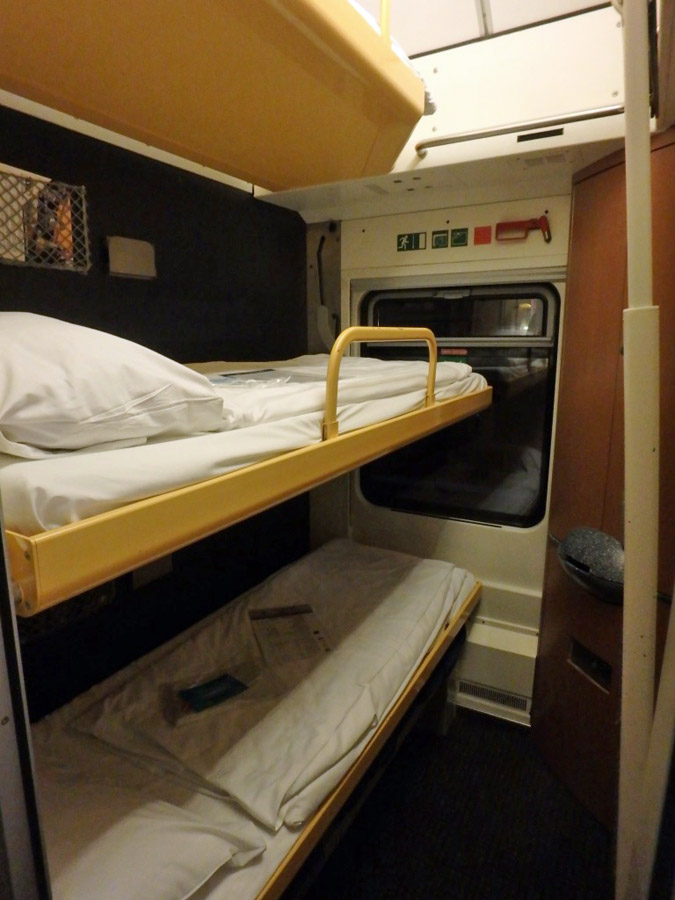
Sleepers...Sleepers have proper beds with washbasin. This is a 2-berth double sleeper on a Nightjet train... |
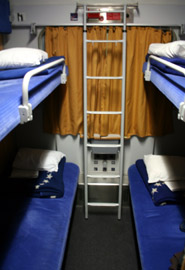
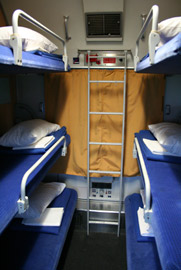
Couchettes...Couchettes are padded bunks with rug & pillow. This is a 6-berth, there are also 4-berths. |
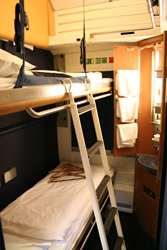
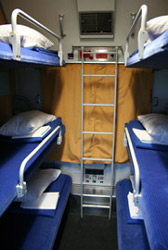
Sleepers & couchettes explained
European overnight trains have two different types of sleeping berth, sleepers & couchettes. This page explains the difference, and tells you what travel by sleeper or couchette is like.
Information on specific sleeper trains:
 Nightjet
new-generation sleeper trains
Nightjet
new-generation sleeper trains
Italian
InterCity Notte sleeper trains
European
Sleeper Brussels/Amsterdam - Berlin/Prague
European
Sleeper Paris/Brussels - Berlin
Stuttgart/Munich - Budapest sleeper
Stuttgart/Munich - Ljubljana/Zagreb sleeper
Zurich - Ljubljana/Zagreb sleeper
Travelling in a sleeper
A sleeper is the most civilised, comfortable and romantic way to travel. European sleeping-cars are hotels on rails, with compact bedrooms with proper beds freshly-made up with mattress, sheets and blankets or duvet. There's a washbasin, towels & toiletries provided. For evening or morning use, compartments usually convert to a private sitting room. On a handful of routes (for example, on Nightjet sleeper trains) you can opt for a deluxe room with private shower & toilet.
Cabin or compartment? Trains don't have bows or sterns, or port or starboard. Or cabins, as they are not a ship. The correct term is compartment.
How many beds per compartment?
There are many different designs of sleeping car, but most follow a time-honoured layout, with a corridor along one side, and 10, 11 or 12 sleeper compartments. Each compartment has 3 beds one above the other & a washbasin in the corner. Each compartment can be sold as:
-
Single with only the bottom bed folded out, other beds folded against the wall. Ticket or railpass + typically €120 supplement (€50-€80 in central & eastern Europe). A 1st class ticket used to be required for a single, now only a 2nd class ticket is needed on many routes including Nightjets. Nightjet fares are now yield-managed so can be more expensive.
-
Double with the bottom & middle beds used, top bunk folded away. Ticket or railpass + typically €80 supplement per person (€30-€50 in central & eastern Europe). Traditionally a 1st class ticket is required for a double, but now only a 2nd class ticket is now required on Nightjets and most central & eastern European routes. On domestic sleepers in Italy a 1st class ticket or pass is still required for a double.
-
Triple, known as Tourist or T3 with all 3 beds in use: Travel ticket or railpass + typically €60 supplement per person (€20-€35 in eastern Europe). Only a 2nd class ticket or railpass is necessary on all routes.
Single, double, triple...
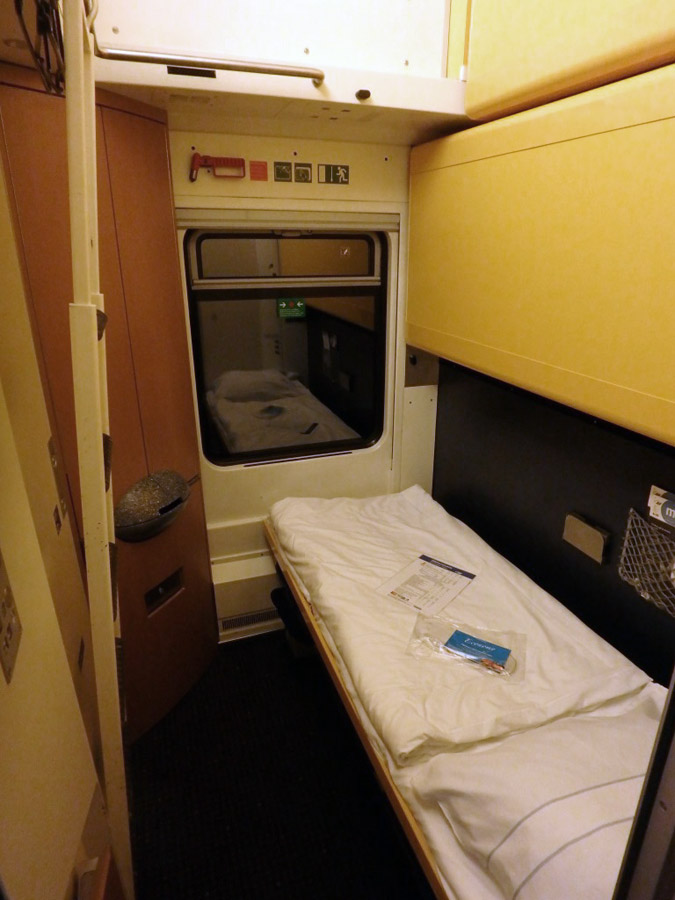
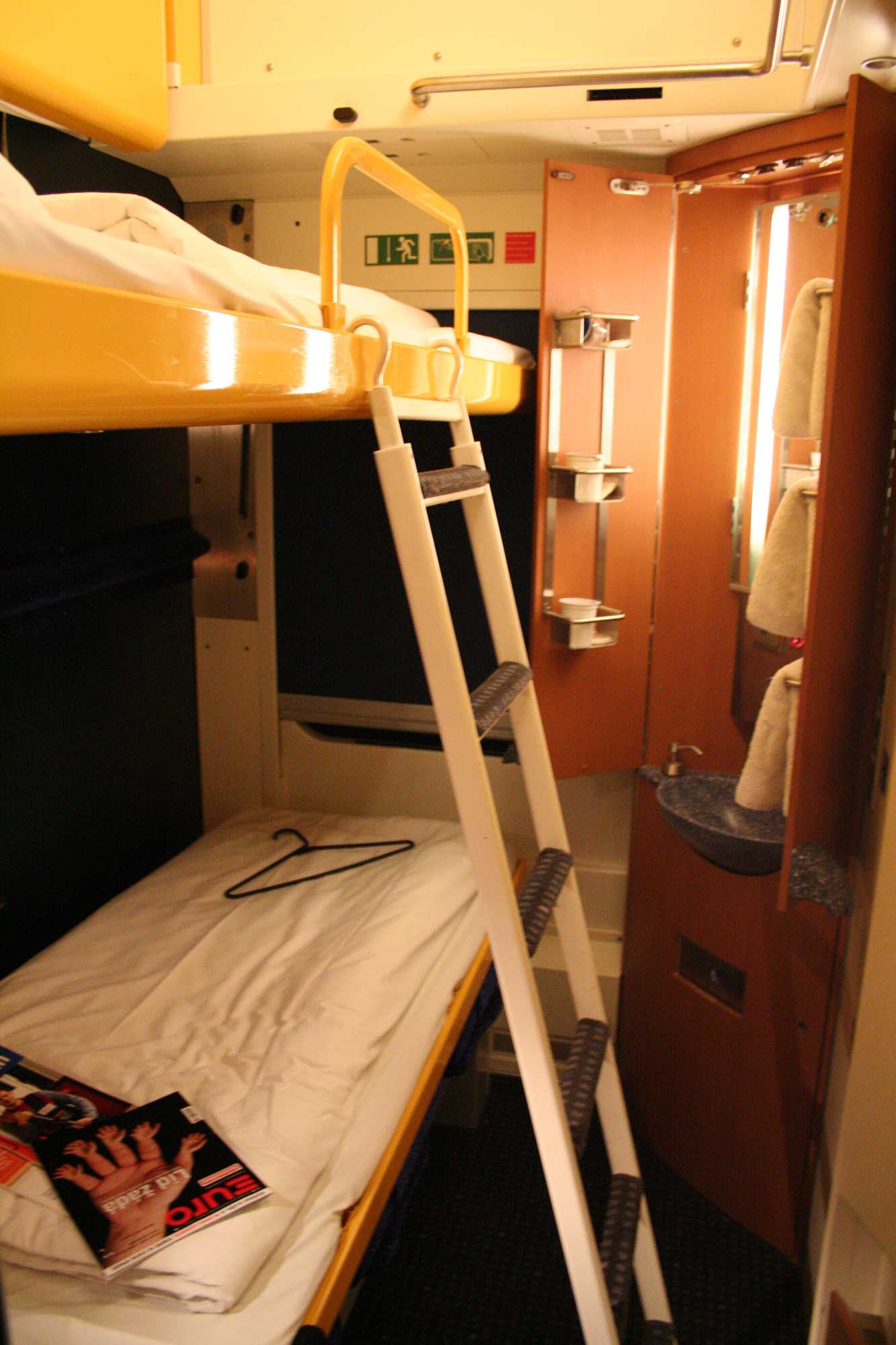
A typical sleeper is shown below. This is a Czech Comfortline sleeper, but it shows the classic layout where exactly the same compartment can be sold as a single, double or triple. The berths fold away to form a sitting room for evening & morning use. How are berths numbered?
Sharing & single-gender
Berths are sold individually, one ticket = 1 person = 1 bed. I'll spell it out for you: If you book one ticket for a 2 or 3 bed sleeper, you get one bed and the other beds in the compartment will be sold to other passengers. Sharing with other civilised sleeper passengers is much cheaper than paying for a single-berth sleeper all to yourself.
Normally, sleeper compartments are single-gender unless all the berths are booked by people travelling together. So if a woman books one bed in a 3-bed sleeper she will share with two other female passengers. If a man & woman travelling together buy two tickets in 3-berth sleepers, they'll be booked into two different 3-berth rooms, one for male passengers, one for female passengers. But if a man & woman travelling together pay for two tickets in a 2-berth double sleeper, they get the whole compartment and can share, no problem.
From 2026, Nightjet & European Sleeper are exceptions, where sleeper compartments are mixed gender by default, but women travelling alone can book a bed in a ladies-only compartment.
Boarding, luggage, power sockets
The sleeper attendant normally greets you at the door to the sleeping-car and checks your reservation. You then walk down the corridor, looking for the door with your room number on it, like walking down a hotel corridor. You take your luggage with you and stow it in your compartment - there's usually a rack above the window and a big recess above the door projecting over the ceiling of the corridor.
The sleeper attendant will come round shortly after departure to take your rail tickets or passes so you aren't disturbed by ticket inspections. They'll be kept safe and handed back to you next morning. In western Europe the attendant used to take your passport as well so you weren't disturbed by border controls, but there are now no border controls (other than spot checks) between countries in the Schengen area. In eastern Europe you keep your passport, and may be briefly awakened by a knock on your compartment door at the border, you open the door, show your passport from your bed and are soon back asleep.
If you're sharing, you can agree a time when you ask the attendant to convert the seats into beds. It may be polite to stand in the corridor while the other person(s) get undressed and into bed. Once in bed in your own cosy berth, you can't see the people above or below you, and this gives you all the privacy you need.
Most sleeper & couchette compartments have one or more power sockets for laptops & mobiles, you'll need a European 2-pin adapter. However, I wouldn't recommend relying on these to work a sleep apnoea machine, power usually comes from the locomotive so goes dead when the locomotive is changed or powers down.
Room service & breakfast
Your sleeping-car attendant can usually sell a limited range of drinks or snacks on request, and may ask you in the evening whether you would like morning tea, coffee or light breakfast. A light breakfast is included in the fare on Nightjet trains, EuroNight trains and an increasing number of other sleeper services, usually delivered to your compartment. However, never assume that there will be a buffet or restaurant car on your sleeper train unless you are specifically told there is one - always take provisions with you, including perhaps a bottle of wine!
Safety & security
In 40 years of travelling in sleepers I have never experienced any problem. Compartment doors have a normal lock which in older cars can be opened from outside with a staff key, so always use the secondary security deadbolt or chain which cannot be opened from outside, even with a staff key, so you're safe & snug. More modern sleepers such as Nightjet Comfortlines have a hotel-style card key and are as secure as any hotel room. On most routes, a sleeper attendant is on duty, occupying the attendant's room at one end of the car.
Sleeper berth numbering
Here is the standard numbering used for sleepers, which often confuses people. If you book a 2-berth sleeper, the berth numbers will be those of the bottom & top bunks, with the middle bunk number unused. So berths 21 & 25 are in the same compartment. If there are enough of you to need two compartments, you can often ask for a pair of compartments with a connecting door. In the diagram below, 11/13/15 usually has a communicating door with 12/14/16, and 21/23/25 has a door with 22/24/26, and so on. You'll find berth numbering plans for specific sleeper trains (if available) on the train seating plan page. Couchette car numbering plan.

1st or 2nd class?
Please don't use the terms 1st & 2nd class when booking sleepers. In terms of comfort, the 'classes' on an overnight train are really (1) sleeper, (2) couchette & (3) sit-up-all-night seat. So by '1st class' you really mean a sleeper rather than couchette or seat. But sleepers can be 2nd class, even deluxe ones, depending on the route. And in France there are 1st class couchettes. And on some routes you can sit up all night slumped in a 1st class seat, very much a 3rd class experience compared to a sleeper (which can be 2nd class, did I mention that?). 'Class' is now a technicality.
As I've explained, the same sleeper compartment can be sold as a single, double or triple. Historically, singles required a 1st class ticket plus the single sleeper supplement, doubles required a 1st class ticket plus the cheaper double sleeper supplement, and triples only required a 2nd class ticket plus the tourist sleeper supplement. Singles and doubles still require a 1st class ticket or railpass on domestic routes in Italy.
However, on many routes in central Europe, singles still require a 1st class ticket + supplement, but doubles & triples now only require a 2nd class ticket + supplement. And on the excellent Nightjet sleeper trains with 9 types of accommodation (seat, 6-berth couchette, 4-berth couchette, single/double/triple sleeper with washbasin, single/double/triple deluxe sleeper with shower & toilet, everything is 2nd class. Even a deluxe single sleeper only requires a 2nd class ticket or railpass + the relevant passholder fare.
Travelling in a couchette
Couchettes are basic padded bunks supplied with rug, sheet & pillow which you arrange yourself. There are 6 bunks per compartment, but on many routes you can pay a little more to travel in a less-crowded 4-berth compartment. By day, a couchette compartment is an ordinary seating compartment, with three-a-side bench seats facing each other. At night, the bunks are folded out. Each berth has its own reading light. There are washrooms and toilets at the end of the corridor. The sexes are normally mixed in couchettes as you do not normally fully undress, but on many routes women can book berths in a ladies-only compartment. Couchette cars come in many different designs, all based on the same format. How are couchettes numbered?
6-berth or 4-berth?
On many routes you get a choice of a couchette in a 6-berth or 4-berth compartment. The compartments are identical, but in 4-berth compartments the top two bunks remain folded away and the middle bunks are folded out in their alternative slightly higher position. The difference in price can be as little as €10 between travelling in a 6-berth and travelling in a 4-berth, but you get far more space per passenger in 4-berth. If there's a long evening/morning component to the journey, the extra space to spread out over the 3-a-side seats is very welcome and well worth the extra cost.
What does a couchette cost?
A supplement is charged for a couchette in addition to the 2nd class fare or railpass. It varies, but in western Europe reckon on about €39 for a bunk in a 6-bunk compartment or €49 in a 4-berth compartment, less than this in eastern Europe. Many overnight trains now charge inclusive fares covering both travel and couchette or sleeper accommodation.
Luggage? Security? Breakfast?
You take your bags with you into your compartment. There's space for luggage under the seats, on the rack above the window and in the big recess above the door projecting over the corridor ceiling. In addition to the normal lock, all compartments have a security deadbolt or chain which cannot be opened from outside even with a staff key, so you'll be quite safe. On most international routes there's an attendant in charge of the couchette car, and they may take your tickets on departure so you are not disturbed by ticket checks during the night. There are no border controls between countries in the Schengen area, although you might be briefly awakened at borders in eastern Europe to show your passport. On the excellent Nightjet sleeper trains the couchette fare includes a light breakfast with tea or coffee in the morning. On other routes it's safest to assume that you should bring your own supplies.
Couchette berth numbering
Numbering system: Your car & berth number will be shown on your ticket. The first digit is usually the compartment number, the last digit is the berth number: Berths 1 & 2 are bottom bunks, 3 & 4 are middle bunks, 5 & 6 are top bunks. So for example, berths 32 & 34 are in compartment 3, and are the bottom and middle bunks on the right-hand side of the compartment. In 4-berth couchettes, it's usually the middle bunk number that isn't used, so for example 41, 42, 45 & 46 would be in one 4-berth compartment.
There are exceptions: Some Nightjet couchette cars only have 4 berths per compartment and the upper berth numbers end in 3 & 4. European Sleeper also number 4-berth couchettes this way.

First class couchettes
1st class couchettes, with 4 berths per compartment, are available on the handful of domestic overnight trains still running in France, but hardly anywhere else. The supplement is the same as for a 2nd class couchette, but you need to have a 1st class travel ticket or railpass. The 1st class compartments are slightly bigger and plusher than 2nd class couchette compartments, with slightly wider bunks, see the Intercité de nuit page.
