

|
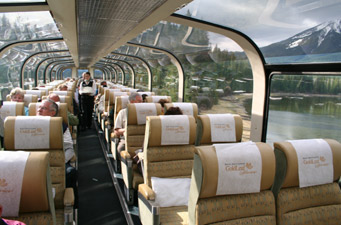
Rocky Mountaineer Gold Leaf: Probably the best view of Canada's Rockies you can get.
|
|
|
|

A guide to the Rocky Mountaineer
In 1990, Canada's national rail operator VIA Rail sold off it's Rockies by daylight scenic train to a private company called Rocky Mountaineer Vacations, who renamed it The Rocky Mountaineer. It's developed into a world-class travel experience operating on 3 different routes through the spectacular Canadian Rockies, with excellent on-board service. In 1990 the trains carried 10,000 guests, they now carry over 100,000 each year. Rocky Mountaineer offers regular departures April-October and you can buy one-way tickets. This page is an insider's guide to the Rocky Mountaineer.
Routes, dates, times & tickets
 Vancouver - Whistler - Quesnel - Jasper
What are the trains like?
What's the journey like?
First Passage to the
West: Banff - Vancouver
Journey to the Clouds:
Jasper - Vancouver
Rainforest to
Gold Rush: Vancouver-Quesnel-Jasper
Other trains in Canada
VIA Rail Canadian,
Toronto-Jasper-Vancouver
VIA Rail Ocean,
Montreal-Halifax
Vancouver-Seattle by Amtrak train
Which route to choose?
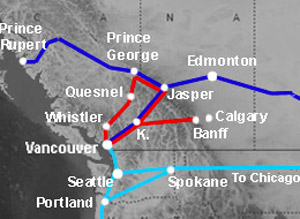
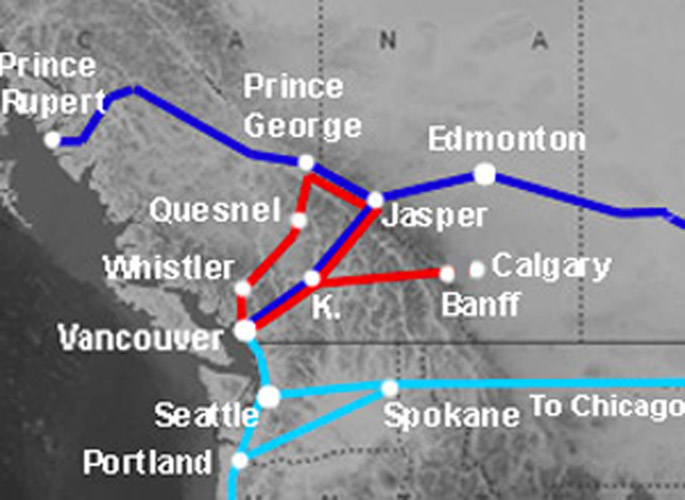 Red = Rocky Mountaineer Dark Blue = VIA Rail Light blue = Amtrak K = Kamloops |
|
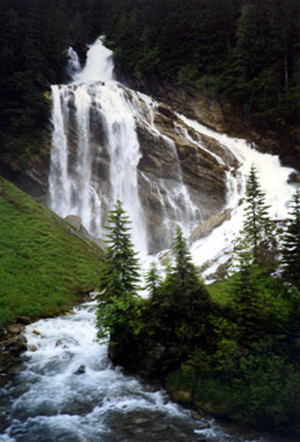 Pyramid Falls, seen from the Yellowhead route between Jasper & Kamloops |
Rocky Mountaineer runs on 3 different routes. Independent travellers can buy one-way or return tickets between Vancouver and either Banff or Jasper. You can go eastbound or westbound as each route runs in both directions. There's no real 'better' direction, as all the trains are designed to do all scenic sections in daylight.
Vancouver - Kamloops - Banff
Branded First Passage to the West, this is the route I'd recommend. Formerly called the Kicking Horse route after the mountain pass it takes through the Rockies, this is by far the most historically-significant of the 3 routes as it travels over Canada's first trans-continental line opened in 1885, the famous Canadian Pacific Railway. It's Rocky Mountaineer's original route which they started running in 1990 when the last regular passenger trains on this line were discontinued. Rocky Mountaineer is now the only passenger train over this famous & historic Canadian Pacific line.
It's also arguably the most scenic route to choose, as the Canadian Pacific route between Vancouver & Banff has always been considered more scenic than the later Canadian National route between Vancouver & Jasper, although the two routes share the same tracks between Vancouver & Kamloops. You'll run along the wonderfully-scenic Fraser & Thompson rivers, pass the site of the 1885 Last Spike and the Continental Divide, cross the much-photographed Stoney Creek bridge, and pass the pretty station at Lake Louise, Morant's Curve (where countless Canadian Pacific publicity photos were taken) and Castle Mountain. You're likely to see bald eagles, ospreys, and maybe black bears or even grizzly bears.
The Rocky Mountaineer First Passage to the West route runs 3 times a week in each direction from mid-April to mid-October, the journey takes 2 full days with an overnight hotel stop in Kamloops included in the fare. The train used to run to/from Calgary, but currently only runs to/from Banff.
First Passage
to the West timetable &
fares
Vancouver - Kamloops - Jasper
Branded Journey through the Clouds, it was formerly called the Yellowhead route after the mountain pass it takes through the Rockies. This route uses the second and later of Canada's two great trans-continental railways, the Canadian Northern line opened in 1917, nationalised in 1921 as part of Canadian National Railways. Between Vancouver & Kamloops the Journey Through the Clouds & First Passage to the West routes are exactly the same - indeed, the two trains sometimes run coupled together. Also note that this route and the Rainforest to Goldrush route share the few miles of line past Mount Robson and through the Yellowhead Pass into Jasper. So if you want to make a circular tour, the best combination avoiding duplication is probably the First Passage to the West route Vancouver-Banff, then by bus between Jasper & Banff calling at the Columbia Icefields, then the Rainforest to Goldrush route between Jasper & Vancouver (you can go in either direction).
The Rocky Mountaineer Journey Through the Clouds route runs twice a week from mid-April to mid-October, the journey takes 2 full days with an overnight hotel stop in Kamloops included in the fare.
Incidentally, Rocky Mountaineer's Journey through the Clouds train takes exactly the same route as VIA Rail's Toronto-Jasper-Vancouver Canadian which runs several times per week all year round. If you're on a budget, an economy class seat on the Canadian between Vancouver & Jasper starts at around $164 versus over $1,000 on the Rocky Mountaineer, making it a much cheaper way to travel through the Rockies by train between Vancouver & Jasper. However, the Canadian runs day & night (sleeping-cars are available) so it passes half the scenery in daylight, the rest in darkness. The Rocky Mountaineer runs the whole route in daylight with an overnight hotel stop in Kamloops so you don't miss any scenery, and of course on-board food & drink is included.
Journey to the Clouds timetable &
fares
Vancouver - Whistler - Quesnel - Jasper
Branded Rainforest to Goldrush, formerly the Fraser Discovery route, this journey is all about getting off the beaten track into gold-rush and timber country, rather than taking a famous trans-continental rail line. It takes you along the mighty Fraser River over the Pacific Great Eastern Railway (PGE), started in 1885 and only fully completed in 1952 - no wonder it was nicknamed the Prince George Eventually! The scenery is truly wonderful, especially the Fraser River canyon, and you may see bald eagles, ospreys and black bears or even grizzly bears. It runs roughly once a week from mid-April to mid-October, and the journey takes 3 full days with 2 overnight hotel stops at Whistler & Quesnel included in the fare. Until 2015 this train used to start from Whistler, with passengers using the 5-days-a-week Whistler Mountaineer between North Vancouver & Whistler, but the latter train was sadly discontinued in 2016. On the plus side, the main Rainforest to Goldrush train now runs direct to and from North Vancouver station and you still get half a day at leisure to explore Whistler, a ski resort and sort of Canadian Zermatt.
Rainforest to Goldrush timetable &
fares
Departures, timetable & fares
First Passage to the West
Check departure dates: Vancouver to Banff. Banff to Vancouver. The train no longer serves Calgary.
How much does it cost? Silver Leaf starts at CAD 2,245 inc tax, Gold Leaf starts at CAD 3,065 inc tax.
Fare per person if 2 people travel together, including train travel, meals, 1 night hotel & motor coach transfers. Solo travellers pay a small single supplement.
Journey through the Clouds
Check departure dates: Vancouver to Jasper. Jasper to Vancouver.
How much does it cost? Silver Leaf starts at CAD 2,245 inc tax, Gold Leaf starts at CAD 3,065 inc tax.
Fare per person if 2 people travel together, including train travel, meals, 1 night hotel & motor coach transfers. Solo travellers pay a small single supplement.
Tip: If you're on a budget, you can also travel between Vancouver & Jasper on VIA Rail's Canadian from only $164.
Rainforest to Goldrush
Check departure dates: North Vancouver to Jasper. Jasper to North Vancouver.
How much does it cost? Gold Leaf starts at CAD 4,485 inc tax. There's now no Silver Leaf service on this route.
Fare per person if 2 people travel together, including train travel, meals, 1 night hotel & motor coach transfers. Solo travellers pay a small single supplement.
How to buy tickets
-
To book the Rocky Mountaineer on its own:
To book the Rocky Mountaineer on its own WITHOUT any extra hotel nights before or after the trip (but including the hotel that's an essential part of the journey), use these links to canadarail.ca. Check train departure dates before filling in the booking form. You should select Rail Only under What type of Tour Category, not One-Way.
Vancouver to Banff / First Passage to the West (2 days including hotel in
Kamloops)
Vancouver to Jasper / Journey Through the Clouds (2 days including
hotel in Kamloops)
Vancouver to Jasper via Quesnel / Rainforest to Goldrush (3 days including 2
nights hotel)
Banff to Vancouver / First Passage to the West (2 days including hotel
in Kamloops)
Jasper to Vancouver / Journey Through the Clouds (2 days including
hotel in Kamloops)
Jasper to Vancouver via Quesnel / Rainforest to Goldrush (3 days
including 2 nights hotel) -
To book a cross-Canada trip including the Rocky Mountaineer:
Canadarail offer a 12-day Toronto-Vancouver trip combining VIA's Canadian between Toronto & Jasper, a road transfer via the icefields between Jasper & Banff, and the Rocky Mountaineer between Banff & Vancouver. It can be done in either direction with a range of departures April-October.
12-day Toronto-Vancouver westbound
12-day Vancouver-Toronto eastboundOr book the ultimate 16-day trip across Canada combining VIA's Ocean from Halifax to Montreal, a VIA intercity train from Montreal to Toronto, VIA's Canadian from Toronto to Jasper, a road transfer from Jasper to Banff via the icefields and the Rocky Mountaineer from Banff to Vancouver. It can be done in either direction with a range of departures from April to October.
-
Or book it with Railbookers
Train travel specialist Railbookers can sometimes get special rates for the Rocky Mountaineer when added to hotels at one or both ends, they can also arrange VIA Rail & Amtrak tickets. In my opinion their package combining VIA Rail's Canadian from Toronto to Jasper with the Rocky Mountaineer from Banff to Vancouver is the ultimate trans-Canada experience.
 US call free 1-888-829-4775,
www.railbookers.com.
US call free 1-888-829-4775,
www.railbookers.com. Canada call free
1-855-882-2910,
www.railbookers.com.
Canada call free
1-855-882-2910,
www.railbookers.com. UK call 0207 864 4600,
www.railbookers.co.uk.
UK call 0207 864 4600,
www.railbookers.co.uk. Australia call toll-free 1300 971 526,
www.railbookers.com.au.
Australia call toll-free 1300 971 526,
www.railbookers.com.au. New Zealand call toll-free 0800 000 554 or
see
website.
New Zealand call toll-free 0800 000 554 or
see
website. -
Or book it with Tailor Made Rail
Tailor Made Rail is a UK-based agency who can also organise a Rocky Mountaineer trip. Call their dedicated phone line 020 3778 1461 and quote seat 61 when booking. From outside the UK call +44 20 3778 1461. Lines open 09:00-17:30 Monday-Friday. See www.tailormaderail.com/trains/rocky-mountaineer.
-
You can also book at www.rockymountaineer.com.

What's the train like?
The Rocky Mountaineer offers two classes of service on its two main routes, Silver Leaf & Gold Leaf.
Which class to choose?
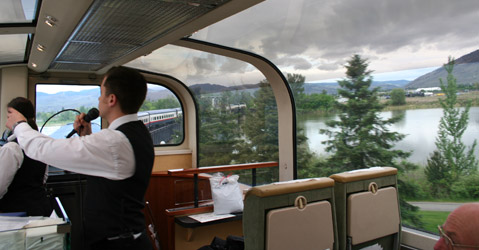
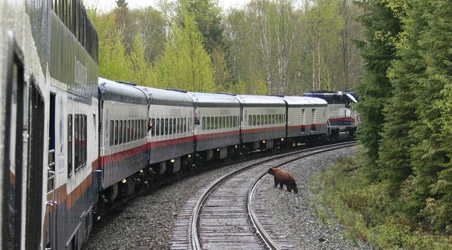
The Man in Seat 61 says, "The Silver Leaf panorama cars are excellent, food & wine is included, and the scenery is exactly the same as you'd see in Gold Leaf. The cost alone may decide for you, and you'll be very happy with your choice if you go Silver Leaf. That said, there are three reasons to consider paying more for Gold Leaf: First, you sit up high in the double-deck Gold Leaf cars, which can give you a better view over trees and so on. Second, the food is more extensive, served in a restaurant rather than at your seat. Third, there's an open air viewing platform, meaning reflection-free photos - for me the incident with the bear proved the value of that viewing platform, nothing between me and a grizzly..." Take a virtual tour inside the Rocky Mountaineer.
Silver Leaf
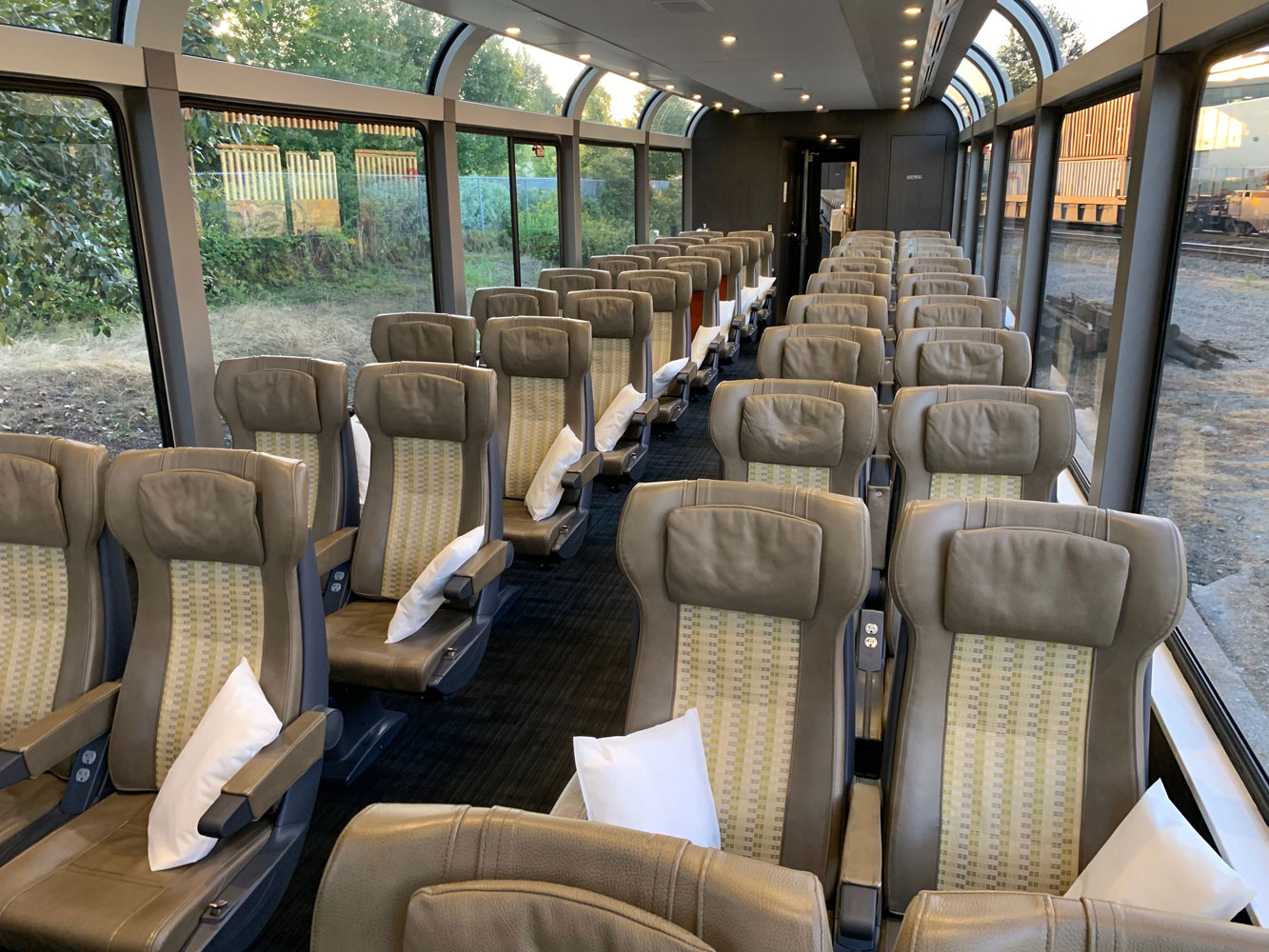
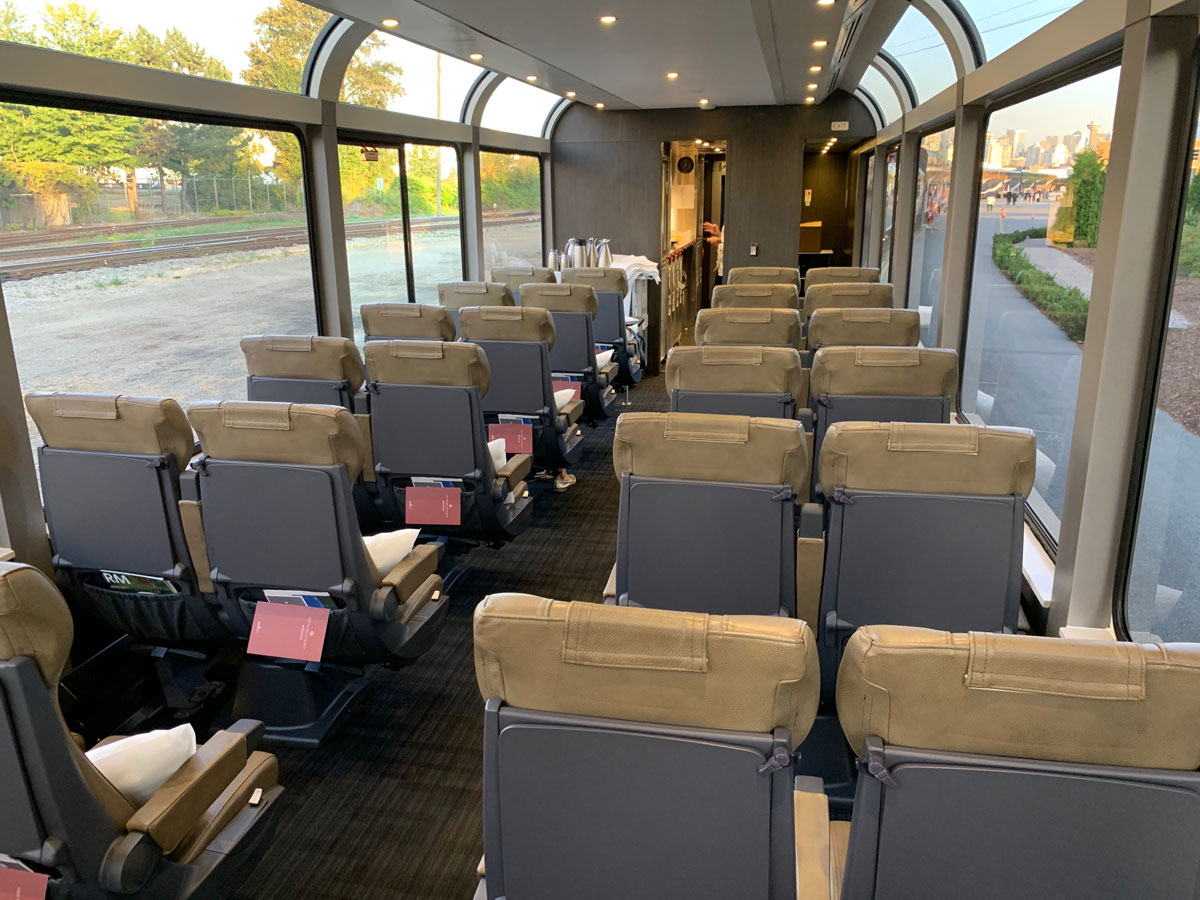
Silver Leaf service was introduced in 2011, and replaced the cheaper Red Leaf service on all routes from 2016. Silver Leaf passengers travel in a single-deck dome car with huge panoramic windows. The fare includes breakfast and lunch with complimentary beer or wine and non-alcoholic drinks.
Gold Leaf
-
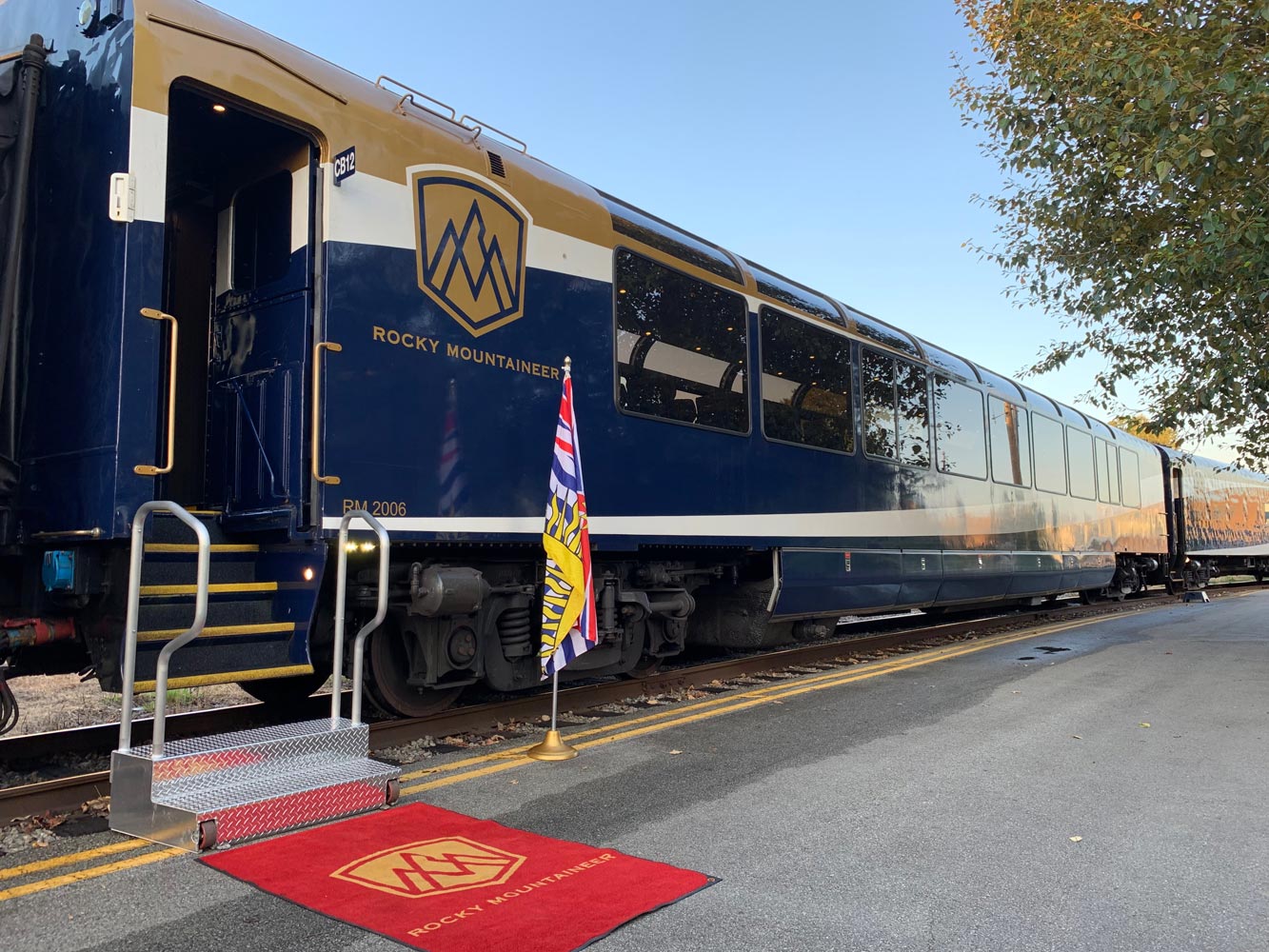
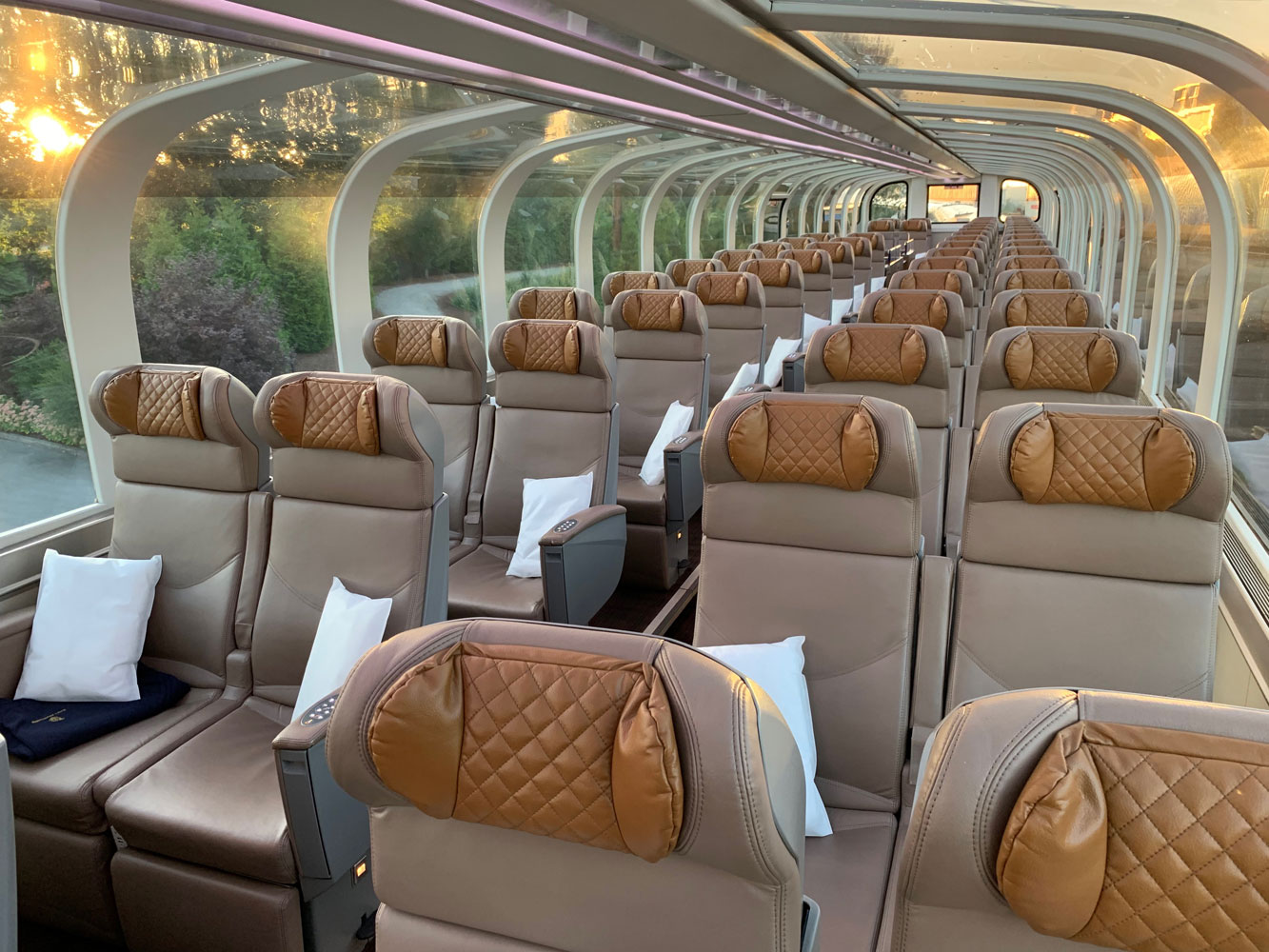
This is the premium option. It's not cheap, and the scenery is the same as you'll see in Silver Leaf, but the onboard experience is excellent and more than meets expectations. Is it worth the extra over Silver Leaf? If you can afford it, yes, because of the food, wine, service, and not least, those upper level glass domes give the best all-round view of the Canadian Rockies you can get.
-
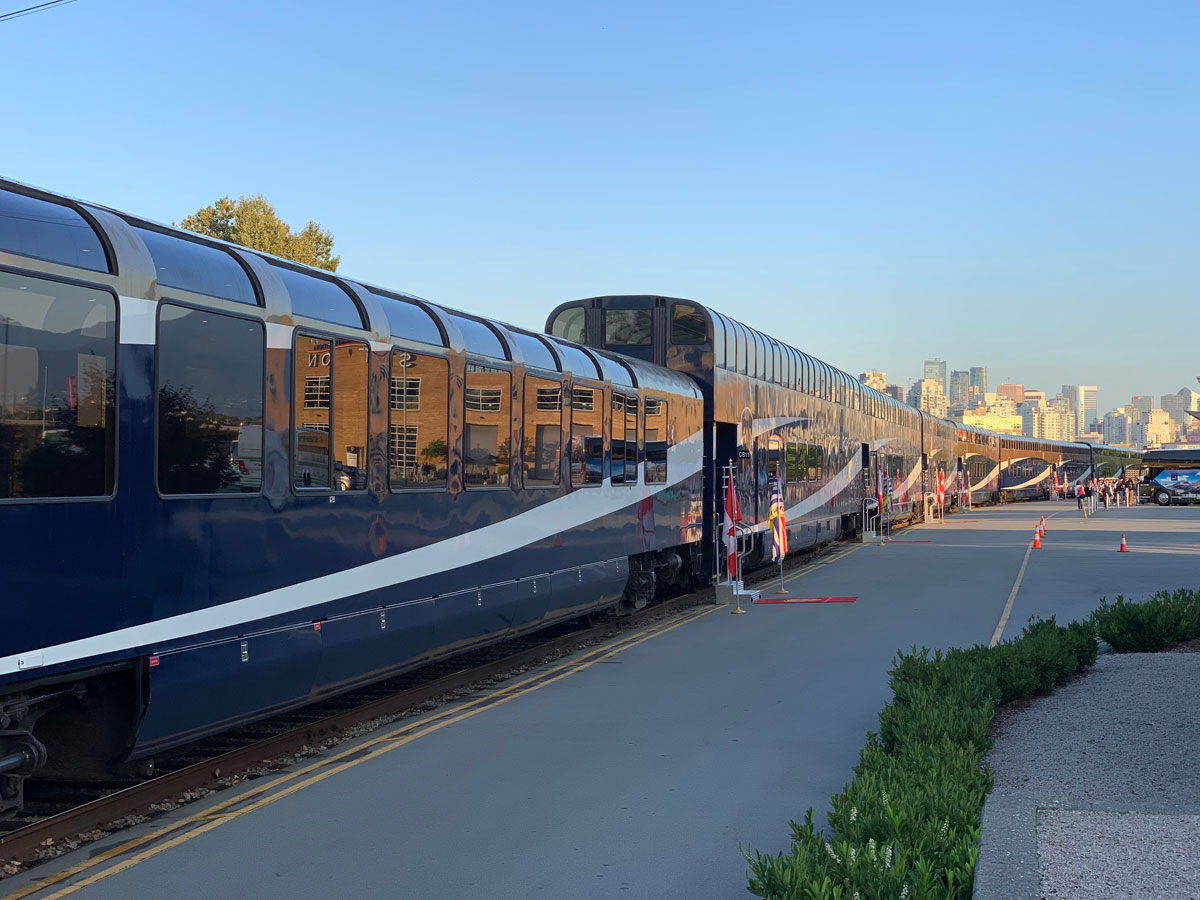
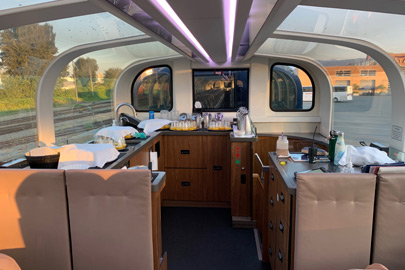
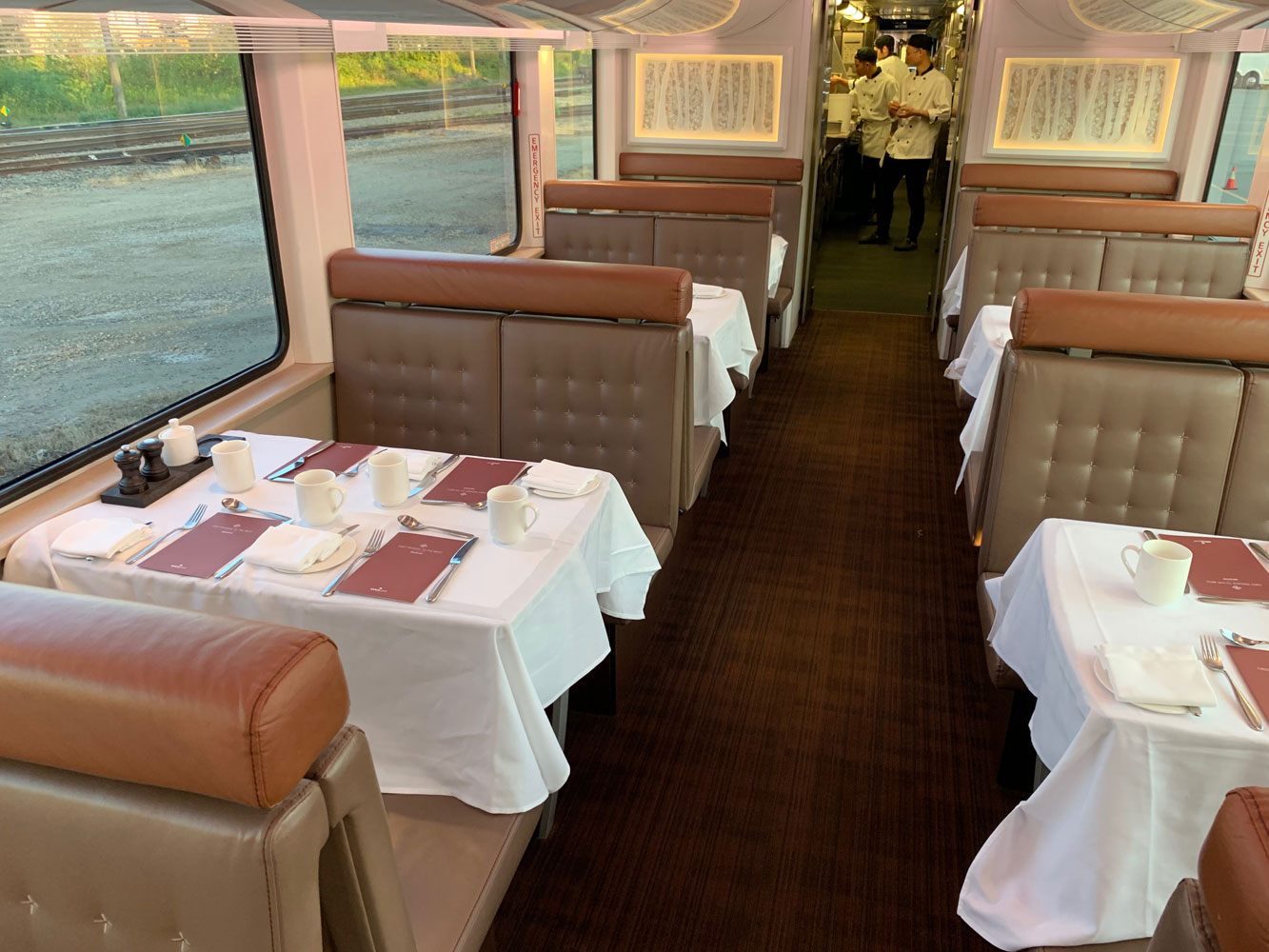
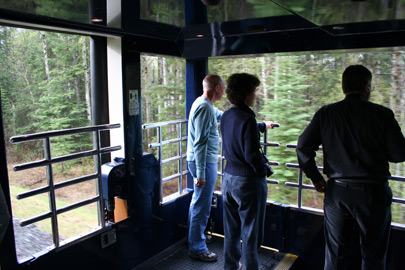
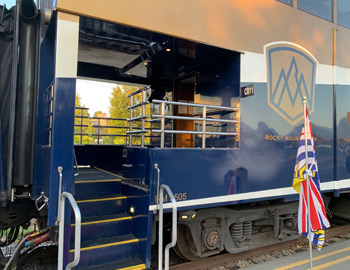
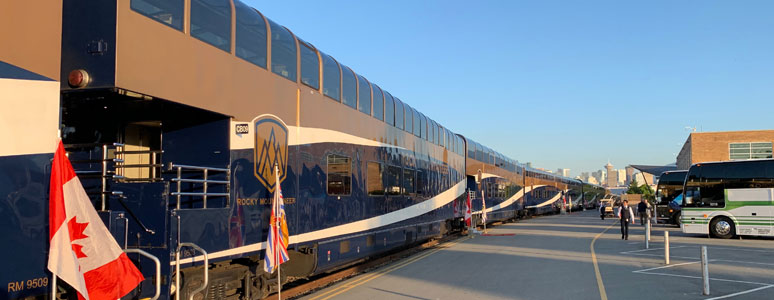
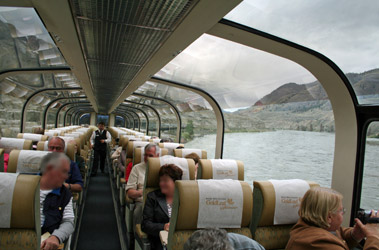
Gold Leaf passengers travel in modern purpose-built double-deck dome cars. Upstairs under the glass roof there are 72 reclining seats with loads of legroom and drop-down tables. Downstairs, reached by spiral staircase or wheelchair lift there are toilets, kitchens, a 36-seat restaurant for breakfast & lunch, and a small open-air viewing platform for fresh air and reflection-free photography.
-
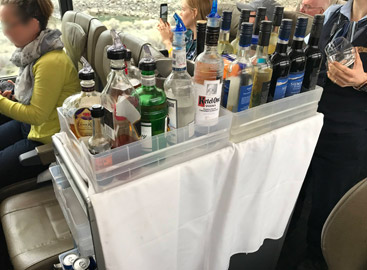
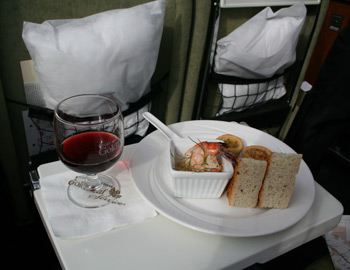
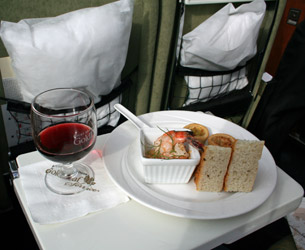
A pair of attendants in each coach provide live commentary and keep the snacks and complimentary alcoholic & non-alcoholic drinks flowing. Rocky Mountaineer's excellent own-label Sumoc Ridge merlot is very easy to drink - all too easy, really.
-
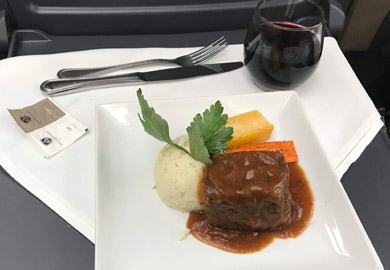
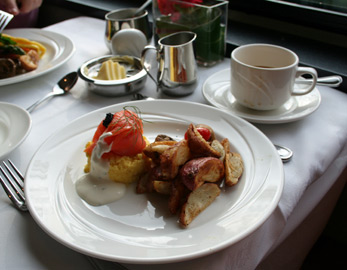
Breakfast & lunch are served downstairs in the restaurant in two sittings, included in the fare. There's a choice of excellent main courses freshly prepared in the kitchen and served on real china. Lunch comes complete with Rocky Mountaineer's own-label British Columbian red or white wine.
-
All passengers get a copy of the 'Rocky Mountaineer newspaper', which features a route guide listing points of interest along the way (referenced by mile post), a map, and information about the train, the history of the route, and the wildlife you might see.
-
The fare includes a hotel room for the overnight stop, and transfers by motor coach to and from the hotel.
Virtual tour
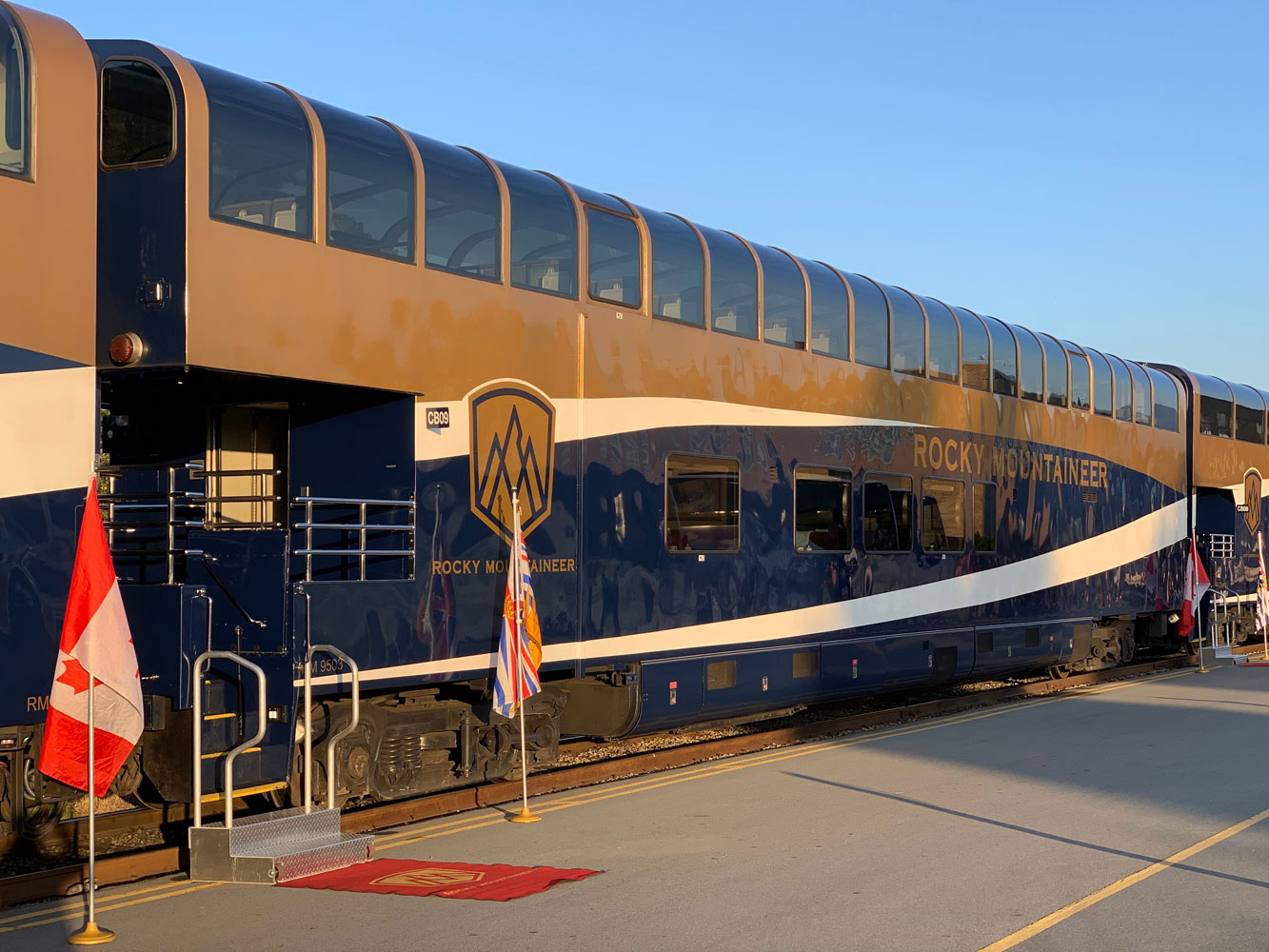
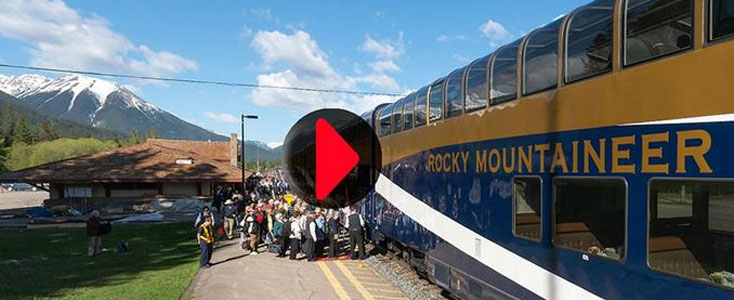
This excellent virtual tour by Willy Kaemena shows the train in its latest form, with its latest blue and gold colour scheme.
Boarding in Vancouver
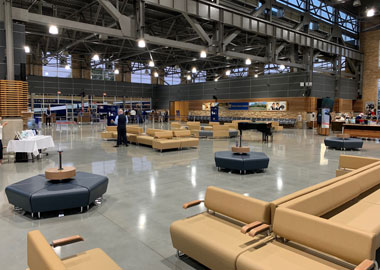
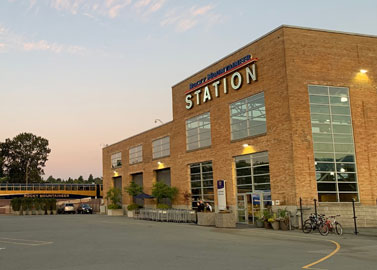
If you travel from Vancouver towards Kamloops, Jasper or Banff, see location map of the Rocky Mountaineer Vancouver station. It is located in a former goods yard a little way behind the main Vancouver Pacific Central station used by VIA & Amtrak. When you arrive you'll find complimentary tea & coffee available, and a row of check-in desks for Silver and Gold Leaf. Note that the Rainforest to Goldrush route via Qesnel leaves from North Vancouver station.
What's the journey like?
This section gives you a flavour of what there is to see on each route. The route guide in your Rocky Mountaineer newspaper on board the train lists these and other highlights, quoting the nearest milepost - the mileposts are black numbers on small white signs placed next to the track every mile. The miles reset to zero at every railway divisional point. Approximate times are used here to give you a better idea of the journey.
First Passage to the
West: Banff - Vancouver
Journey to the Clouds:
Jasper - Vancouver
Rainforest to
Gold Rush: Vancouver-Quesnel-Jasper
First Passage to the West: Banff to Vancouver
This is the most historic and arguably most scenic route operated by the Rocky Mountaineer, previously known as the Kicking Horse route. It takes the original Canadian Pacific Railway through the Rockies, opened in 1885, indeed it is now the only passenger train operating over the original Canadian Pacific trans-continental line. You can make the journey in either direction, between Vancouver and Banff, a resort town in the Rockies. It no longer extends to or from the big city of Calgary. This account shows a westbound journey, note that the departure times have changed slightly since I made this trip, with an earlier departure from Banff, and that the train is shown here in its earlier colour scheme, with red leaf cars ahead of the gold leaf domes, rather than (as now) silver leave cars.
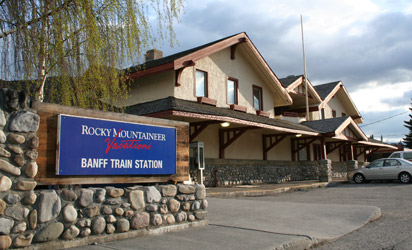
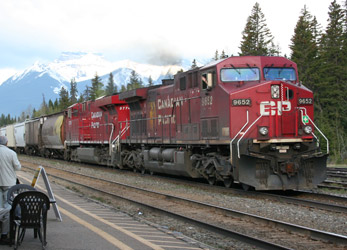
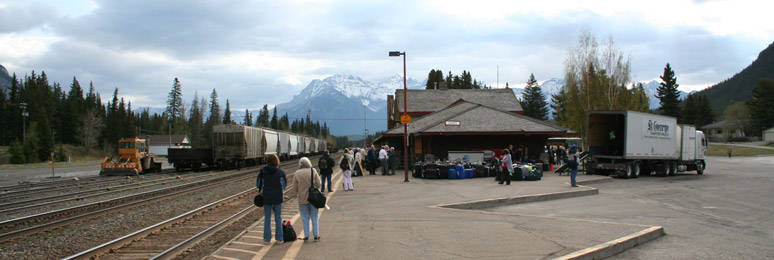
08:40 Banff station: Originally known simply as 'siding 29' on the Canadian Pacific Railway, Lord Strathcona named it 'Banff' after his home town in Scotland in 1880. Banff station is just a few minutes walk from the town centre and 30 minutes walk from the best place to stay in Banff, the famous Banff Springs Hotel. The station building dates from 1910, a replacement for the original 1886 log cabin. If you're joining the train here, you check in at the Rocky Mountaineer desk placed just outside the station waiting room, you're given your seat allocation and your luggage is taken from you - it goes by the truck seen in the photo above and will arrive at your overnight hotel in Kamloops before you do. Tea and coffee are available inside the waiting room until the train arrives. The train left around 09:00 (current departure time is a couple of hours earlier, see the timetable above).
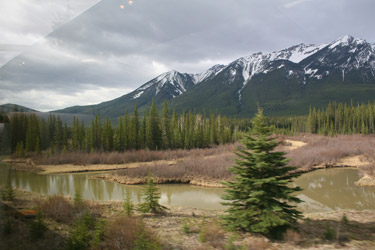
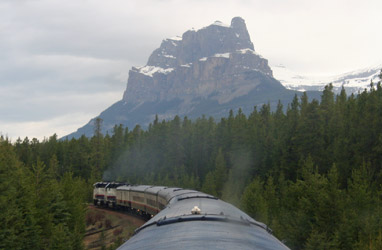
09:30 Castle Mountain (above right): On leaving Banff, the train winds through the pine trees along the Bow River, with snow-capped mountains on either side of the broad valley. Look out for the impressive and imposing Castle Mountain to your right, around milepost 99. It's an appropriate name!
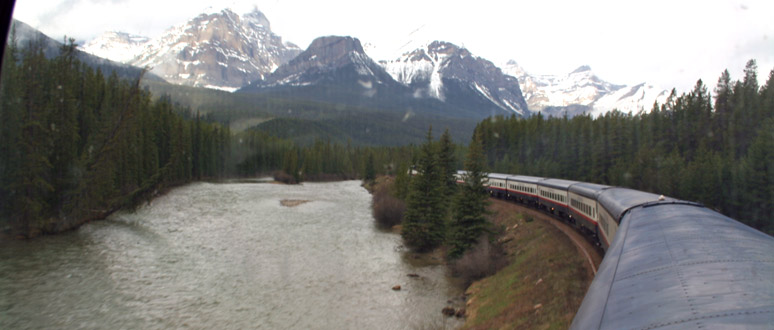
10:10 Morant's Curve: At milepost 113, 3 miles east of Lake Louise, the train snakes through what has become known as 'Morant's Curve', although strangely it isn't mentioned anywhere in the Rocky Mountaineer route guide or on any map. Nicholas Morant was a photographer with the publicity department of the Canadian Pacific Railway, and this was one of his favourite spots for taking PR shots of CPR trains. If you've ever had a 'railway encyclopaedia' or 'boys book of trains', the chances are that it has an illustration of a Canadian passenger or freight train on 'Morant's Curve', and even today, many of Rocky Mountaineer's brochure photos are taken here. The other classic location for PR shots of Canadian trains in the Rockies is the Stoney Creek bridge, which we'll come to later.
10:15 Lake Louise: The Rocky Mountaineer passes the beautiful 'log cabin' style station at Lake Louse, on the left on a track slightly lower than the one that westbound trains now use. Lake Louise station was used for the station scenes in the film 'Dr Zhivago'. The lake itself is up in the mountains, out of sight. The train now crosses and briefly runs alongside Highway 1, the Trans-Canada Highway.
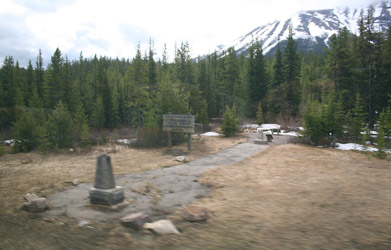
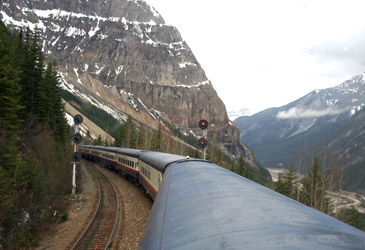
10:25 Continental Divide (above left): A small monument and wooden sign on the left mark the Continental Divide, and the boundary between Alberta & British Columbia. Rainwater falling east of the divide flows to the Atlantic, rainwater falling to the west makes its way to the Pacific. It's the highest point on the trip, 5,332 feet above sea level. Travelling west, you now put your watch back an hour, as BC is an hour behind Alberta.
09:40 (BC time) Spiral Tunnels: The train passes Wapta Lake and enters the first of the two famous 'Spiral Tunnels'. Inside the Upper Spiral Tunnel, the train describes a complete spiral and emerges further down the mountainside, facing the opposite way. The train then crosses the deep wooded valley and plunges into the Lower Spiral Tunnel to descend even further. Long freight trains can even cross over themselves here! There's a cut-away diagram of the spiral tunnels in your route guide, and the commentary from your carriage attendant will explain it, but it's still disorientating. The spiral tunnels were built in 1907, replacing a dangerously steep section of line known as the 'Big Hill', where many CPR trains and staff came to grief.
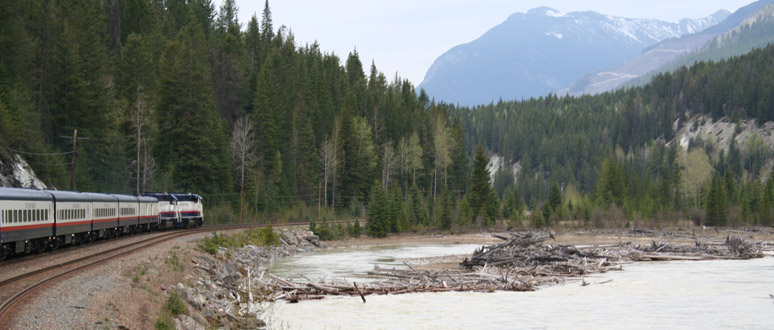
10:15 Kicking Horse Canyon: The train calls at Field, an important operating centre for the Canadian Pacific Railway, then heads through the Kicking Horse canyon, crossing and re-crossing the Kicking Horse river several times. The river is narrow, fast running, and blue with meltwater sediment. The train follows the Kicking Horse river for 30 scenic miles, with many bridges and tunnels.
11:40 Rocky Mountain Trench: The train now runs through a wide flat valley full of pines - the Rocky Mountain Trench. The Columbia River is on the left.
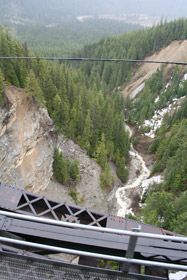
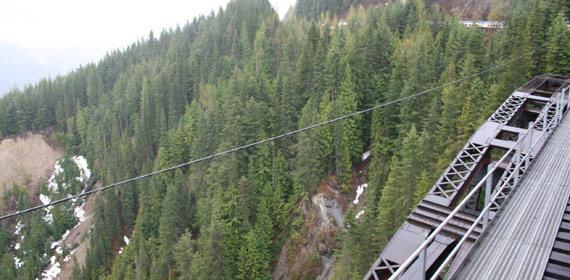
13:00 Stoney Creek bridge: This is the other classic location for illustrations of trains crossing Canada. It's a beautiful arched steel girder bridge at milepost 76.2, 484 feet long and 325 feet above the creek bed below, built in 1929. It's the latest of three bridges built on this spot. The approach to the bridge is dead straight, so there's little opportunity to see or photograph the bridge, and although the line curves sharply to the left immediately afterwards there are so many trees in the way that it's still difficult to get a clear view of the bridge. A new tunnel (the 9-mile long MacDonald Tunnel) was built in 1988 to increase capacity by by-passing both the Stoney Creek Bridge and the shorter 1916-built Connaught Tunnel, but the Rocky Mountaineer deliberately takes the original route.
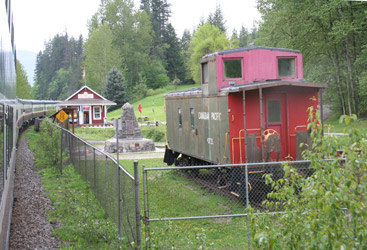
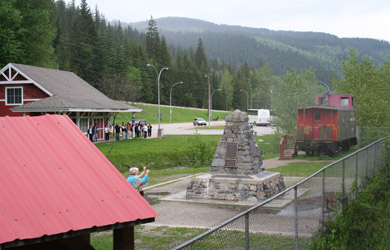
15:55 The Last Spike: The train passes Craigellachie, where on 7 November 1885 the last ceremonial rail spike was driven in, completing the Canadian Pacific Railway and linking Montreal to Vancouver by rail. Here there's a monument and small museum by the tracks, on the right hand side.
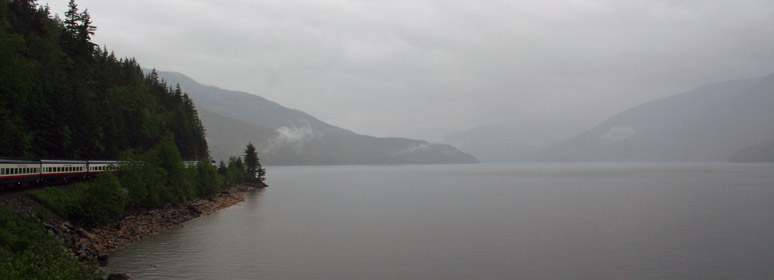
16:20 Lake Shuswap & Osprey Alley: The train passes Sicamous, 'The houseboat capital of the world' and for some miles runs along the shore of the huge and beautiful Lake Shuswap. It passes 'Osprey alley', a long line of osprey nests in the tops of telegraph poles and trees by the lake. Watch out for bald eagles, too. After Lake Shuswap comes Lake Mara.
18:50. The mountain give way to gentle hills along the South Thompson River. The hills are volcanic, but at their feet lie sandstone mounds or 'hoodoos', which are the moraines left by ancient glaciers. The country is more arid here, rocky and sandy with fewer trees, very different from the morning's scenery.
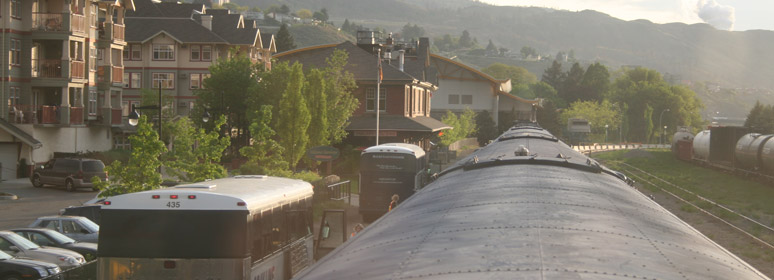
19:55 Kamloops: The train pulls into Kamloops for its overnight stop. Motor coaches meet the train and transfer passengers to their hotels. There is a choice of two evening entertainment shows (with food) whilst in Kamloops, both bookable through Rocky Mountaineer, but don't overestimate how sprightly you'll feel on arrival at your hotel at 8pm after a day travelling with so much to take in. Banff to Kamloops is 309 miles.
----- day 2 -----
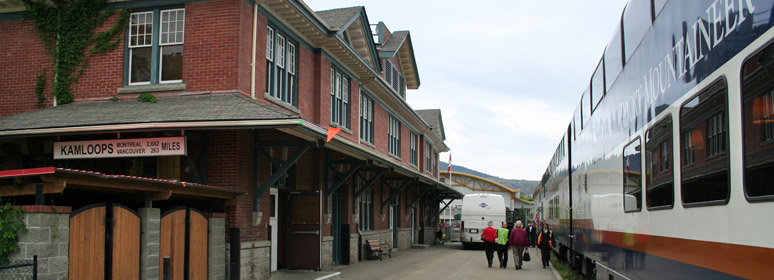
07:20 Kamloops: Motor coaches pick you up from the hotel and transfer passengers to the station. You may find a longer train than the one you left last night, as the Journey through the Clouds train from Jasper is usually coupled up to the First Passage to the West train between Kamloops & Vancouver. This is the main Kamloops station, VIA Rail's Toronto-Kamloops-Vancouver Canadian uses the smaller Kamloops North. 263 miles to Vancouver, says the station sign.
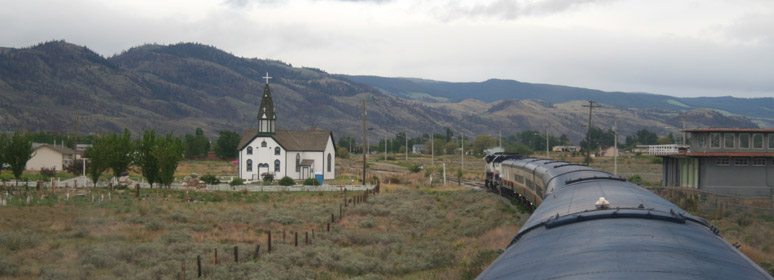
07:55 The Rocky Mountaineer leaves Kamloops, combined with the Jasper-Vancouver train. It veers right and crosses the Thompson River onto Indian ('first nation') territory, passing a small wooden church on the left that was allegedly used in the film 'Unforgiven' with Clint Eastwood.
Canadian National or Canadian Pacific? Between Kamloops & Vancouver, the 1885 Canadian Pacific (CP) and the later 1917 Canadian National (CN) trans-continental routes run parallel, usually on opposite sides of the river. For the first 58 miles west of Kamloops, the Rocky Mountaineer uses CN tracks in both directions, but between Basque and Vancouver there is 'directional running' where CN & CP co-operate, sending all westbound trains including the westbound Rocky Mountaineer down CN tracks on one side of the river, and all eastbound trains including the eastbound Rocky Mountaineer down the CP tracks on the other side. You see the same scenery, of course, from a slightly different angle, but if you really want to travel on the original 1885 CP tracks (almost) all the way between Vancouver and Banff, you'll need to take an eastbound Rocky Mountaineer.
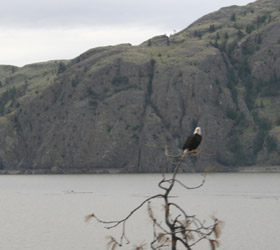
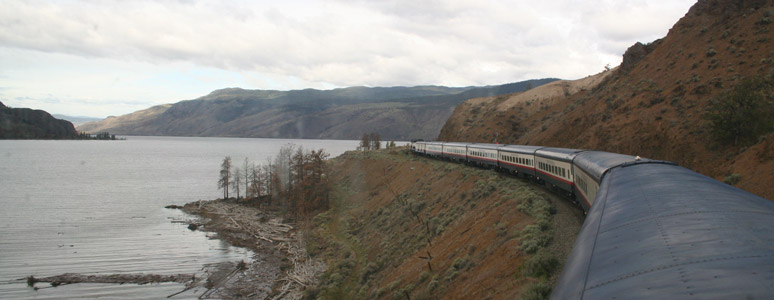
08:40 Kamloops Lake: The train runs along the shore of Kamloops Lake - watch out for more bald eagles, and for the coloured rocks at 'Painted Bluff' on the right.
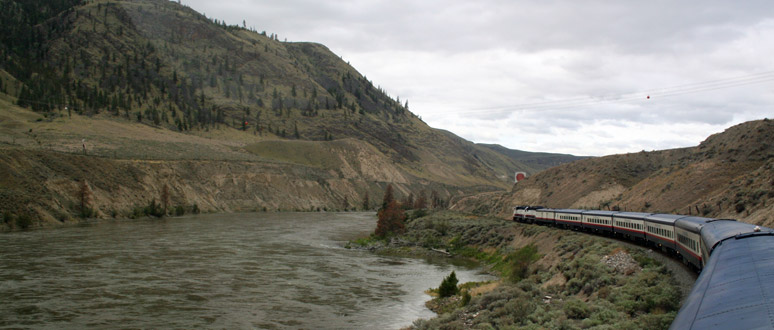
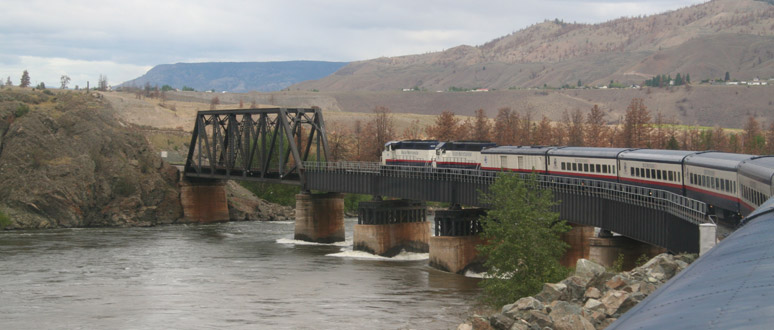
09:25 The train reaches the end of the lake and runs alongside the Thompson River. The countryside here is even more arid than before - indeed, it passes Ashcroft, the driest town in Canada.
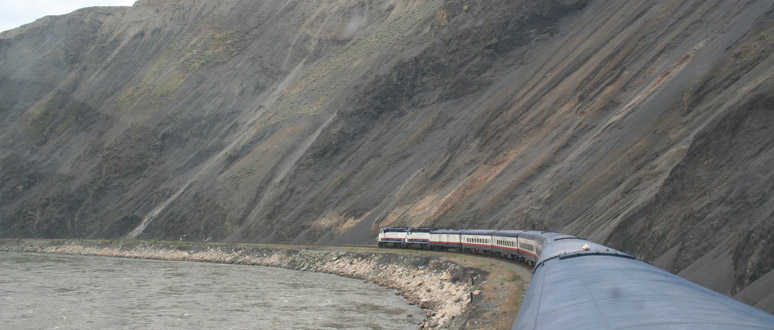
10:35 Black Canyon: The train passes 'Black Canyon', a section of black lava cliff on the right, with the Thompson river on the left. After Black Canyon Tunnel, the Rocky Mountaineer crosses the Thompson on a steel girder bridge.
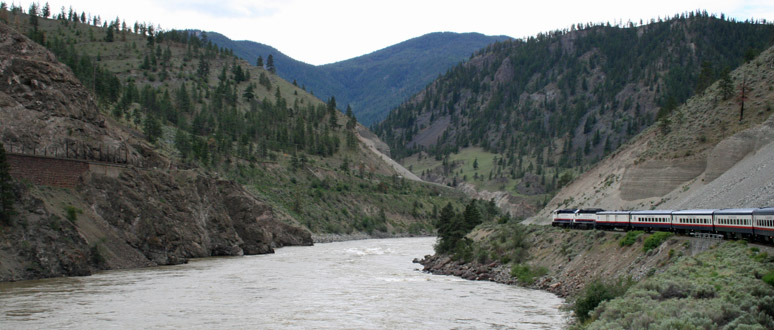
11:30 The scenery now changes again, from dry & sandy back to rocky with pine trees. The train enters the Thompson River canyon, with CP tracks one side of the river, CN tracks on the other side.
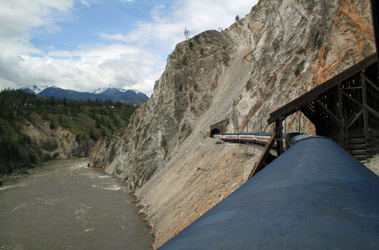
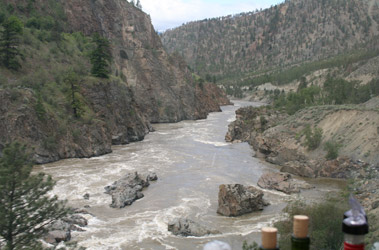
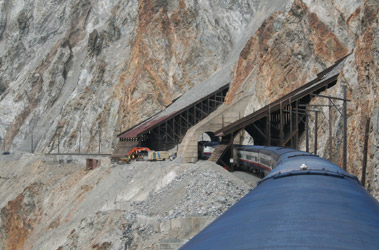
11:55 Avalanche alley (above right): The Rocky Mountaineer travels at the very edge of the river under a sheer cliff wall with avalanche protection sheds in several places. One section of the rock wall is attractively coloured, known as 'rainbow canyon'.
12:05 Confluence of Thompson & Fraser Rivers: Just after Lytton the train curves to the left over a bridge across the Fraser River. The confluence of Thompson & Fraser rivers is now on the right.
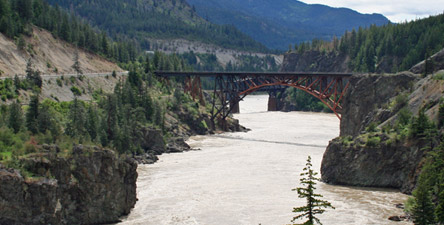
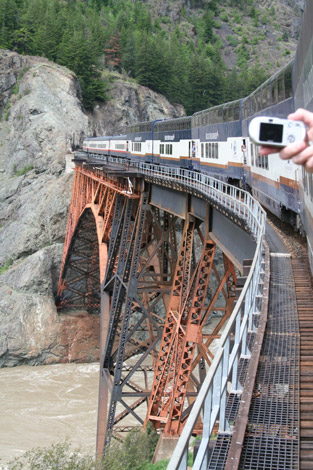
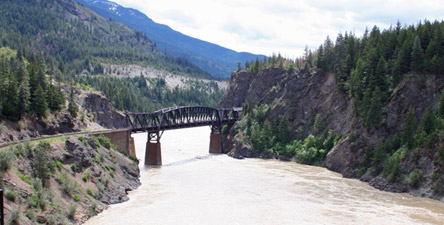
12:15 Cisco crossing: At Cisco, CP and CN tracks swap sides of the river. The CN line crosses first on a distinctive orange-painted girder bridge (above right), the CP tracks then crossing in the opposite direction on a squared-off black steel bridge lower down (above left, lower picture). Being the first, the CP engineers built their line down whichever was the easier side of the canyon, the later CN engineers had to made do with the opposite, trickier side.
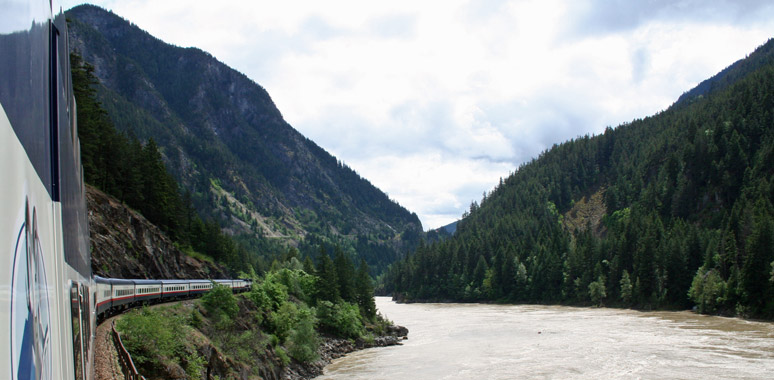
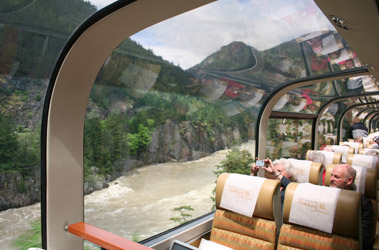
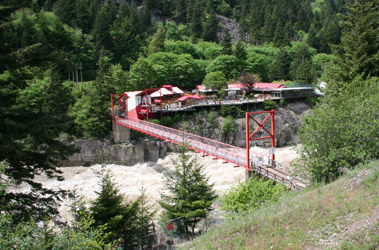
13:35 Hell's Gate: This is the narrowest and fastest-flowing point of the Fraser River. On the right on the far bank is the Hell's Gate cafe, with a suspension footbridge across the river below the train and a cable car over the river and up the mountain.
15:15: We're no longer right next to the Fraser River, which has become very broad. The train is in a wide flat valley, with farms and greenhouses starting to appear. The historic site of Fort Langley is just visible through the trees on the left.
16:50 Approaching Vancouver: The train slows through the freight cars in Thornton Yard, finally curving right over a very long, low steel bridge across the Fraser River with a much higher arched road bridge on the left, which also carries the Vancouver 'Skytrain' metro. Once across the river the Rocky Mountaineer curves sharply right again, weaving its way through the Vancouver suburbs.
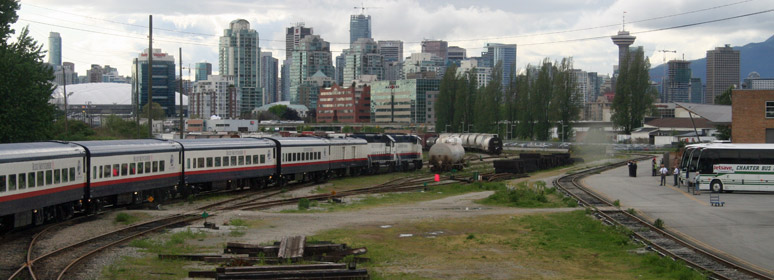
17:40 Arrival at Vancouver: We've travelled 594 miles from Banff. Pictured above, the Rocky Mountaineer rolls past the Rocky Mountaineer terminal (on the right, with the buses parked outside). It then slowly reverses back into it. The Rocky Mountaineer terminal is a block away from the Pacific Central station where VIA Rail's Canadian arrives. Rocky Mountaineer's impressive and spacious terminal building was once a diesel locomotive maintenance shed.
Journey through the Clouds: Jasper to Vancouver via Kamloops
This train travels over the second trans-continental line built across Canada, the Canadian National route between Jasper (in Jasper National Park) and Vancouver, opened in 1917. Originally known as the Yellowhead route, it's been marketed as the Journey through the Clouds since 2010.
-
The Rocky Mountaineer leaves Jasper station around 8am, and heads up through the Yellowhead Pass. This is the easiest pass through the Rockies (in other words the lowest, at 3,718 feet above sea level). The Canadian Pacific chose a more difficult route through the Kicking Horse pass to the south because of political tensions between Canada and the USA at the time, and a desire to safeguard Canadian territory.
-
Look out for the highlight of the trip, views of snow-capped Mount Robson to the right of the train. At 12,972 feet it's the highest mountain in the Rockies.
-
After running alongside Moose Lake, the train crosses the Fraser River.
-
For almost 20 miles, the train passes some of Canada's most magnificent mountains in the Premier range, named after early Canadian prime ministers.
-
The train passes the site marked by a small cairn, where 12 members of the Royal Canadian Horse Artillery were killed when two CN trains collided.
-
The train passes Pyramid Falls (see photo above), where water cascades 300 feet beside the tracks.
-
The train arrives at Kamloops and passengers stay overnight in a hotel, included in the fare.
-
Between Jasper & Kamloops the Journey through the Clouds takes exactly the same route as VIA Rail's Canadian, which also (if it's on time, of course...) does this section in daylight, before continuing through the night to Vancouver. So see the Jasper-Kamloops photos on the Toronto-Vancouver Canadian page.
----- day 2 -----
-
On day 2 the Journey through the Clouds travels from Kamloops to Vancouver coupled to the First Passage West, see the Kamloops-Vancouver photos above.
Rainforest to Goldrush: North Vancouver - Whistler -Quesnel - Jasper
This is a less well-known but remarkable route, through the gold rush & timber country of the Cariboo. Until 2010 this route was marketed as the Fraser Discovery route and until 2015 it started at Whistler and you had to take Rocky Mountaineer's Sea to Sky Climb train between North Vancouver & Whistler, which was also useful for local journeys as it ran 5 times a week and could be used by people just going to Whistler. Unfortunately, Rocky Mountaineer have discontinued their Vancouver-Whistler train, instead from 2016 the main Rainforest to Goldrush train will start from North Vancouver.
06:15 - 07:15: Passengers are collected by motor coach from central Vancouver hotels, and driven through Stanley Park and across the Lion's Gate Bridge to the North Vancouver station, a simple siding a block or two away from the original BC Rail passenger station. BC Rail stopped normal passenger service on his route in 1999.
07:30 Leaving Vancouver: After leaving North Vancouver, the train passes right under the Lion's Gate Bridge and over a girder bridge across the Capilano River (Vancouver's famous Capilano footbridge, www.capbridge.com, is out of sight further up the valley). Breakfast is served.
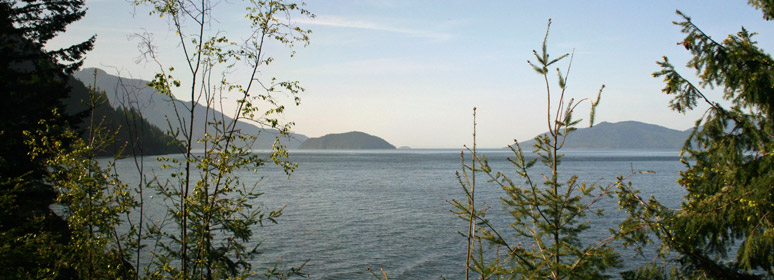
The train runs alongside the sea (on left hand side) until it heads off into the mountains. It passes through the mile-long Horseshoe Bay Tunnel, built to eliminate a difficult section of line around the headland, emerging onto the banks of Howe Sound. For some miles the train run along the banks of this beautiful sound (also on left hand side) past the BC Ferries terminal serving the islands. The trains passes waterfalls and an old copper mine, once the largest copper mine in the British Empire and now a museum.
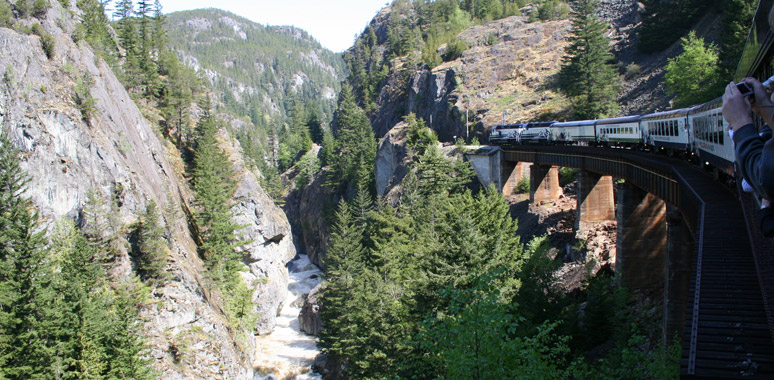
09:50 Cheakamus Canyon: The train starts to climb, away from Howe Sound up into the hills. This is the most scenic part of the journey, as the train passes over several high trestle bridges along the Cheakamus canyon (pictured, above) with the narrow fast-flowing river way down below.
The train passes over the top of 195-feet-high Brandywine Falls.
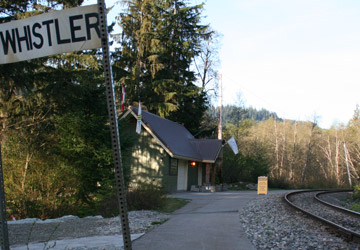
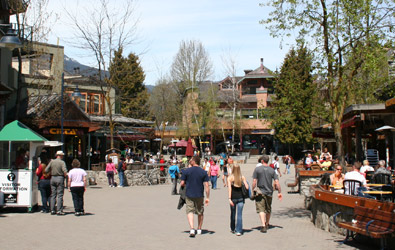
11:30 Whistler: The train arrives at Whistler station. This is in the Creekside area of Whistler, near Nita Lake. A fleet of buses meets the train and transfers passengers to their hotels in Whistler Village a mile or two away. You now have the afternoon and evening free to explore Whistler, and you stay there in a hotel overnight. Whistler is one of Canada's biggest ski resorts, a sort of North American Zermatt. Cable cars run up the mountains, seaplanes run scenic flights, and there are many outdoor activities in both summer and winter. The centre of Whistler village is pedestrianised, with many bars and restaurants.
----- day 2 -----
07:30 Leaving Whistler: The Rocky Mountaineer train leaves Whistler at 07:30 on day 1. Whistler station is in the Creekside area of Whistler between Alta and Nita lakes, a few minutes' taxi or motor coach transfer from Whistler village itself. Check-in opens at 06:30, you hand over your luggage (which travels by road) and you are given a boarding card with seat allocation.
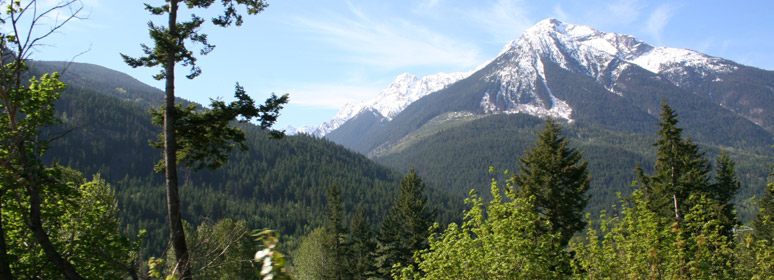
08:10 Green River, Birkenhead River: Breakfast is served as you pass through snow-capped mountains and run alongside the Green River. The scenery is beautiful, although there are still houses and occasional timber yards here, not to mention a few power pylons! The Green River soon gives way to the Birkenhead River, also on the right, but flowing in the opposite direction.
08:35 Nairn Falls: The train crosses a low bridge just above the top of a waterfall in the pine trees, Nairn Falls.
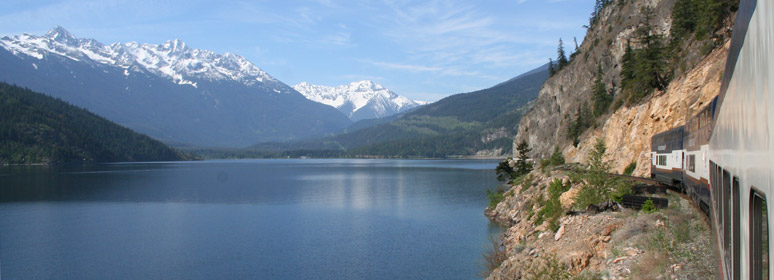
10:00 Anderson Lake: The train skirts the blue waters of Anderson Lake right by the water along the cliffs. The tracks follow the shore for 15 miles, with many photo opportunities.
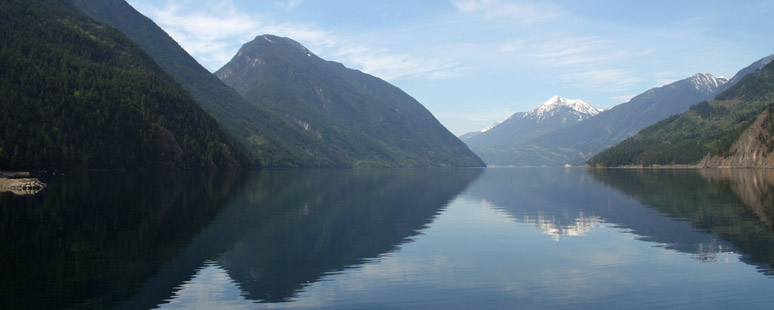
10:30 Seton Lake: The train passes the end of Anderson Lake and crosses the spit of land known as Seton Portage separating it from another lake, Lake Seton. Originally one big lake, lakes Anderson and Seton were separated by a landslide over 1,000 years ago. Lake Seton is a luminous turquoise colour, an effect caused by the sediment washed down by meltwater from the mountains. The train passes the BC Hydro Bridge River hydro electric plant and a timber yard.
11:20 Lillooet: Lillooet is a major railway town, and there's a 10-minute locomotive crew rest stop here in the freight yards.
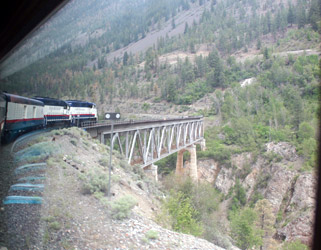
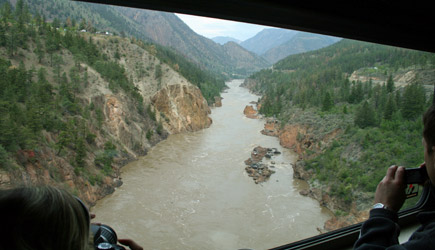
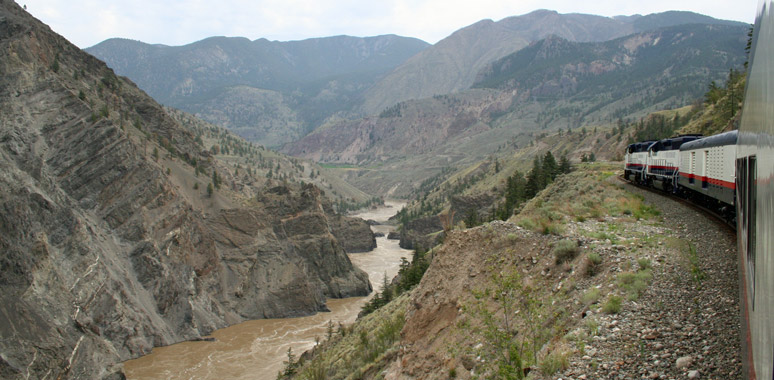
11:35 Fraser River Canyon: After leaving Lillooet, the train crosses the wide and brown Fraser River on a massive and dramatic girder bridge, 800 feet long and 190 feet above the river. Immediately after the bridge the train snakes left onto the Fraser's left bank and starts climbing a steep 2.2% gradient for the next 30 miles. It's one of the longest sustained 2.2% rail gradients in America. This 30 mile stretch is the highlight of the trip: The train follows the Fraser River canyon, high up on the mountainside with the river far below. The sheer scale of the canyon is spectacular. There are few trees, the landscape is arid and sandy here.
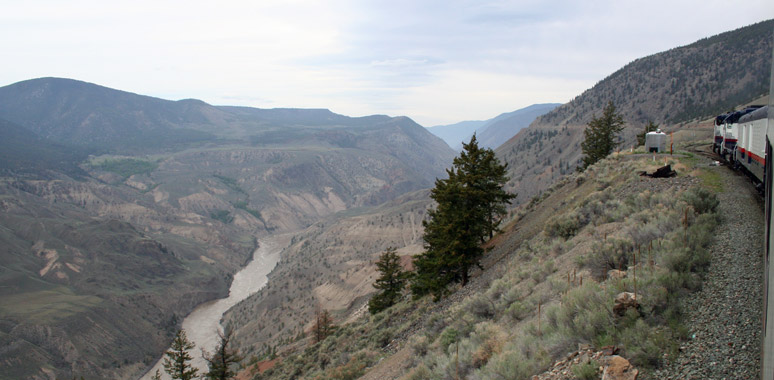
13:00 Cariboo Plateau: The train finally leaves the Fraser River canyon. It's now on the Cariboo plateau, and pine trees make a welcome reappearance. These are the gentle rolling hills of cattle country.
16:00-17:00: Still on the Cariboo plateau, this is also timber country. You can smell the sawdust from the many lumber yards. You pass Lac La Hache and Williams Lake.
18:00 Deep Creek Bridge: 1,194 feet long, 312 feet high, one of the highest rail bridges in North America (in fact, only the Stoney Creek bridge on the Banff-Vancouver route is higher). You pass many cattle ranches, and can spot many deer in the wooded areas.
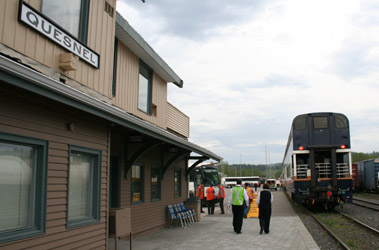
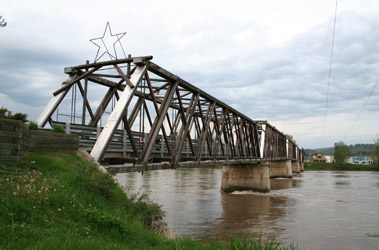
20:00 Quesnel: The train passes lumber yards and the occasional osprey nesting in telegraph poles or tall trees, and arrives at Quesnel (pronounced 'kwanell') for the overnight hotel stop. Quesnel is the local centre for the Cariboo, and if you've never seen small-town Canada it's well worth an evening wander. This is easier to do if you're at a town centre hotel such as the Best Western, less easy if you're in a hotel a few miles out (Gold Leaf passengers are currently bussed a few miles out to the Sandman's hotel in an industrial/retail area). Personally, I'd suggest requesting the town-centre Best Western even if you're in Gold Leaf. In Quesnel you'll find the longest wooden truss footbridge in the world across the wide and fast-flowing Fraser River, pictured above right - check out the steak house & pub on the hill the other side! There's also a Greek restaurant, a casino built to look like an old paddle steamer, and a gift shop by the river that's often open in the evenings when the train arrives. There's a town museum (complete with allegedly haunted doll 'Mandy') which you may or may not find open when the train comes in.
----- day 3 -----
07:40 Leaving Quesnel: Motor coaches transfer you from the hotel around 06:45, and the Rocky Mountaineer leaves Quesnel around 07:40 when everyone is on board.
08:00 Cottonwood Bridge: The train crosses the dramatic Cottonwood bridge, 1,023 feet long and 236 feet high, over a valley full of pine trees with a river racing beneath. The bridge was only completed in 1952, the last major link in the railway from Vancouver to Prince George and Prince Rupert. The 'last spike' was driven in 8 miles further on, at the slightly smaller Abhau Creek bridge, on 31 October 1952. Since they started building the line in 1912, it was no wonder the Pacific Great Eastern Railway became known locally as the 'Prince George Eventually'!
09:10: The Fraser River is sighted again, on the left. Endless pines and birch trees, and the odd sawmill including a fully automated one at Dunkly.
10:20 Prince George (almost!): The Rocky Mountaineer makes slow progress through the yards approaching Prince George. The train heads for a long low steel bridge across the Fraser into Prince George, which is the route passengers trains (when there were any) would normally take. But immediately before the bridge the train turns right at a triangular junction onto the line leading out of Prince George towards Jasper. The train is no longer on the Pacific Great Eastern but on the Grand Trunk Pacific. The GTP is Canada's third trans-continental line, built from Jasper through Prince George to the pacific ocean at the port of Prince Rupert. Although not in the same league as Vancouver, much freight is still shipped overseas via Prince Rupert. The GTP was nationalised after its bankruptcy in 1921 and is now part of Canadian National Railways.
12:30: Lunch is served as the train enters the Rocky Mountain trench, a wide valley between the mountains. The train follows the meandering brown river through the pines and birches.
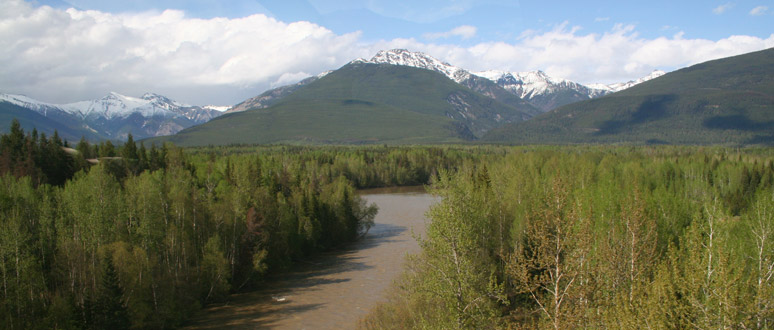
16:00: The train passes McBride, with agriculture now in evidence across the valley.
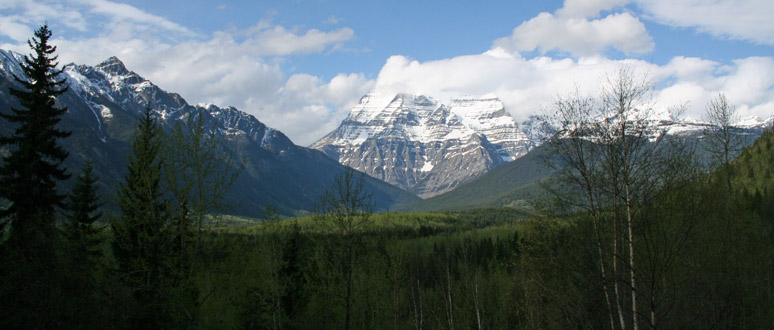
17:50 Mount Robson: Another highlight of the trip, the train passes Mount Robson, the highest mountain in the Rockies at 12,972 feet. The Rocky Mountaineer Journey through the Clouds route also passes this spot, so gets this same view of Mt Robson, as does VIA Rail's Toronto-Vancouver Canadian.
18:10: The Fraser river is now narrower, cleaner and greener. The valley narrows, with snow-capped mountains on each side.
18:50 Yellowhead Pass: The train joins the Jasper-Kamloops-Vancouver main line, and passes through the Yellowhead Pass. This is the easiest and lowest pass through the Rockies at 3,718 feet above sea level. The train crosses from British Columbia into Alberta, and the clocks go forward an hour.
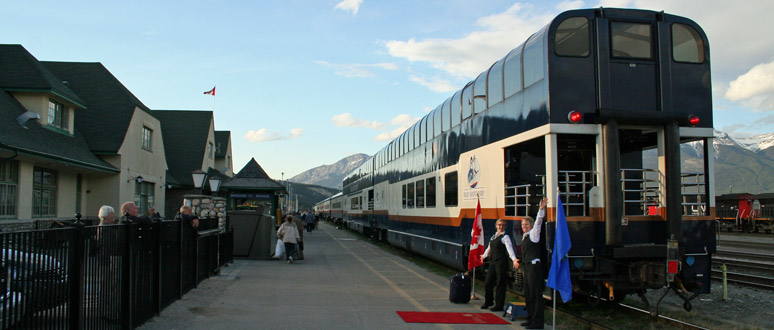
20:30 (19:30 BC time) Jasper: The train arrives at Jasper, at the heart of Jasper National Park. The station is right at the front of this small town, which grew up around the railway. Jasper station is used by two Rocky Mountaineer routes and VIA Rail's Toronto-Jasper-Vancouver Canadian.
Bear! bear! bear!
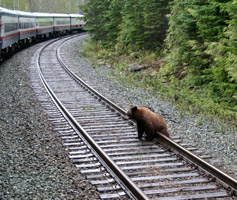
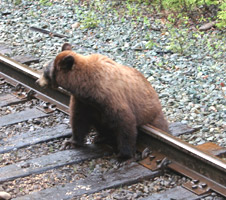
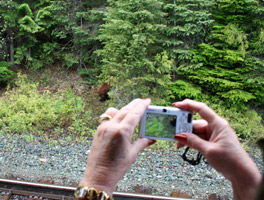
You may see ospreys, bald eagles and deer from the train, and if you're lucky maybe a bear or two. There are two sorts of bear, black bears are more common, grizzly bears less so. Keep your eyes peeled! In Jasper, you'll see many elk just wandering about the outskirts of the town. Below, the best bear sighting they've had for several years on the Rainforest to Goldrush route, approaching Jasper near Mt Robson.
Guidebooks
 Paying for a
guidebook may seem an unnecessary expense, but it's a tiny
fraction of what you're spending on your whole trip. You
will see so much more, and know so much more about what you're
looking at, if you have a decent guidebook. For the independent traveller this
means either the Lonely Planet or the Rough Guide.
Both guidebooks provide the same
excellent level of practical information and historical
background.
Paying for a
guidebook may seem an unnecessary expense, but it's a tiny
fraction of what you're spending on your whole trip. You
will see so much more, and know so much more about what you're
looking at, if you have a decent guidebook. For the independent traveller this
means either the Lonely Planet or the Rough Guide.
Both guidebooks provide the same
excellent level of practical information and historical
background.
Buy Lonely Planet from
Amazon.co.uk
 or
Amazon.com
or
Amazon.com
Buy Rough Guide from Amazon.co.uk or Amazon.com
Or buy direct from the Lonely Planet website, with shipping worldwide.
The Trans-Canada Rail Guide
Trailblazer's Trans-Canada Rail Guide is well worth buying if you're planning a trans-Canada train trip. It will help you plan your journey, and best of all it includes mile-by-mile lineside route guides showing what to see from the train on all the main VIA Rail & Rocky Mountaineer services. Buy in the UK from Amazon.co.uk. Buy in the USA from Amazon.com
Recommended hotels
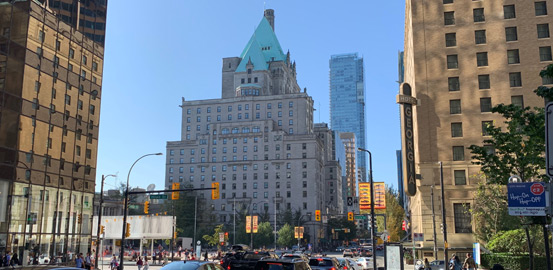
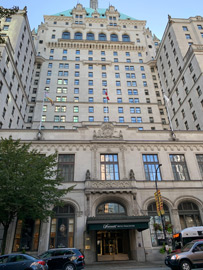
In Vancouver: Fairmont Vancouver Hotel
In the centre of downtown Vancouver, next to Christ Church Cathedral and only a few blocks from the Waterfront, the Fairmont Vancouver Hotel is a former railway hotel. It was started by Canadian National Railways but completed in partnership with rival Canadian Pacific, opened in 1939 by King George VI and Queen Elizabeth. It's another iconic Canadian chateau-style hotel, a true Vancouver landmark. And if your budget will stretch, Fairmont won't disappoint.
If you want something cheaper, try the St Regis Hotel, also excellently located downtown and also a historic Vancouver landmark, opened in 1913.
In Jasper: Fairmont Jasper Lodge
First established in 1915 in association with the Grand Trunk Pacific Railroad, it became a Canadian National Railway hotel in the 1920s. Bing Crosby, Marilyn Monroe, and members of the British Royal family including King George IV and the Queen have stayed here. It's on Lake Beauvert, a 9 minute drive from Jasper station.
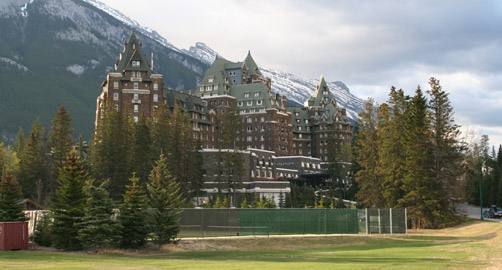
In Banff: Fairmont Banff Springs Hotel
Another famous classic hotel, originally built & owned by the Canadian Pacific Railway and designed in the style of a Scottish castle. If your budget will stretch, it's the most celebrated hotel in Banff and an experience in itself.

Flights to Canada
Overland travel around Canada by train & bus is an essential part of the experience, so once there, don't cheat and fly, stay on the ground! But a long-haul flight might be unavoidable to reach Canada in the first place. To compare prices for flights to Montreal, Toronto or Vancouver, check Skyscanner.

Lounge passes
Make the airport experience a little more bearable with a VIP lounge pass, it's not as expensive as you think! See www.loungepass.com.