

|
Buy tickets ateurostar.com or sncf-connect.comOr www.thetrainline.com or www.raileurope.comas these can also book onward European trains & trains within the UK. |
|
|
|
|
|
|
A practical guide to Eurostar 2026
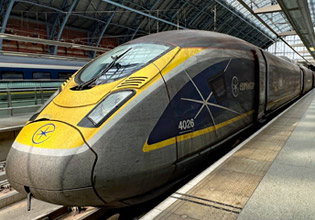
Eurostar is the high-speed passenger train linking London with Paris, Lille, Brussels & Amsterdam via the Channel Tunnel at up to 300km/h (186 mph). This page explains Eurostar fares, classes, check-in procedures, seat options and luggage rules for travel between London and Paris, Lille or Brussels.
Planning your trip
 Eurostar fares &
how to find the cheapest
tickets
Eurostar fares &
how to find the cheapest
tickets
Video guide: London to Paris by Eurostar
Eurostar's 3 classes
explained
Tips on
choosing a Eurostar seat
Interrail &
Eurail passes on Eurostar
Check-in, on board, the journey
On-board facilities, food & WiFi
What's the Eurostar journey like?
Station guides
London St Pancras
Paris Gare du Nord
Lille Europe
Brussels Midi
Other Eurostar routes
Eurostars
from London to
Rotterdam & Amsterdam
Eurostar
ski train to the French Alps
Other useful information
Starting your
journey from the UK regions
Taking a bike on Eurostar
& European trains
Taking a pet on Eurostar & European trains
How to travel to any country in Europe via Eurostar
Recommended hotels in London & Paris
Ferry alternatives to Eurostar
Crossing Paris by metro, taxi or
private transfer
Luggage storage in London, Paris, Lille, Brussels
Scotland to Paris by sleeper & Eurostar
Cornwall to Paris by sleeper & Eurostar
General
European train travel information
Eurostar routes & times
What is Eurostar?
-
Eurostar is the high-speed passenger train linking London with Paris, Lille, Brussels & Amsterdam via the Channel Tunnel. Running since 1994, it's majority-owned by SNCF French Railways, part-owned by SNCB Belgian Railways & by overseas investors who bought the UK government's share.
-
Don't confuse Eurostar with Getlink (formerly EuroTunnel) who own the Channel Tunnel and whose Le Shuttle car-carrying trains shuttle vehicles across the Channel from Folkestone to Calais.
-
Eurostar merged with Thalys in 2022 and Paris-Brussels-Amsterdam/Cologne Thalys trains are now also branded Eurostar. The former Thalys routes have different check-in, catering, bike & pet policies so on this website I call Eurostars to/from London Eurostar and Thalys trains Eurostar (formerly Thalys). This page is about Eurostars to/from London.
Core routes
-
London to Paris
Eurostar runs from London St Pancras to Paris Gare du Nord every hour or two, 7 days a week all year except Christmas Day.
Fastest journey time 2h15 non-stop. Check train times at www.eurostar.com.
-
London to Lille & Brussels
Eurostar runs from London St Pancras to Brussels Midi every couple of hours. Most Brussels-bound Eurostars call at Lille in northern France, the interchange for French TGV high-speed trains to destinations all over France, see the London to France page.
Typical journey time 2h01. Check train times at www.eurostar.com.
-
London to Rotterdam & Amsterdam
In April 2018 Eurostar started a new service from London St Pancras via Brussels to Rotterdam & Amsterdam Centraal. For times, fares & information, see the London to Amsterdam page.
Other Eurostar routes
-
Eurostar ski train to the French Alps
There's a Eurostar ski train from London to Bourg St Maurice in the French Alps once a week in winter, although this now involves a change in Lille onto a Eurostar (formerly Thalys), see the Eurostar Ski Train page.
-
Direct Eurostar to Lyon, Avignon, Marseille
Eurostar used to run a direct train from London to Lyon, Avignon & Marseille 1-4 times a week May-September, but this has not run since 2019.
-
Eurostar to Disneyland Paris
Eurostar used to run a direct train from London to Marne la Vallée, the station right outside the entrance to Disneyland Paris, several times a week, daily in school holidays, but this was cancelled in June 2023, for more information see here.
-
Ebbsfleet, Ashford, Calais: Eurostars no longer call at Ebbsfleet, Ashford or Calais Fréthun.
Faster & more reliable than flying
-
90% of Eurostar trains arrive on time or within 15 minutes, competing short-haul flights typically manage only 70% by the same standard. From central London to central Paris, Eurostar is faster than flying, as well as more comfortable and convenient. Not surprisingly, Eurostar has now captured over 70% of the London-Paris air/rail market.
-
Eurostar has commissioned independent research estimating that a Eurostar train from London to Paris emits 11Kg of CO2 per passenger, over 90% less than the 122Kg per passenger emitted by a London to Paris flight. In addition, planes emit the CO2 directly into the upper atmosphere, where it is thought to do around 2.7 times the damage of the same CO2 emitted at ground level. Another reason for taking the train! See www.eurostar.com/uk-en/sustainability.
Route map
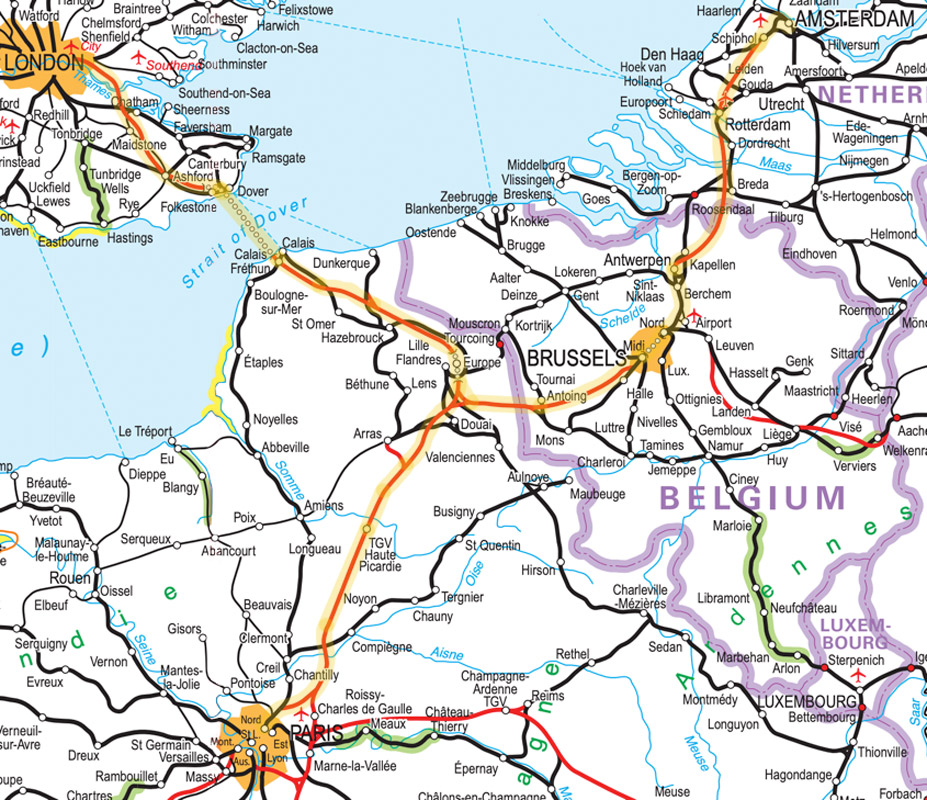
London to Paris is 492 km (305 miles). London to Brussels is 373 km (232 miles).
Eurostar fares
-
London to Paris, Lille or Brussels starts at £52 one-way or £78 return.
Eurostar Plus (1st class) fares start at £98 one-way, £140 return.
Fares work like air fares, so book ahead.
-
Booking opens up to 11 months ahead.
However, if you look more than around 3 months ahead, some dates or trains may be missing from the search results due to trackwork planning. If the train you want is missing next month, assume it's cancelled, if it's missing in 9 months' time, assume data is incomplete, just wait!
If you're going beyond Paris or Brussels, I recommend waiting until onward trains open for booking 4-6 months ahead so you can confirm onward trains before committing to a Eurostar ticket. Unless you're prepared to take a calculated risk.
-
Refunds & changes
Eurostar Standard & Eurostar Plus tickets are refundable until 7 days before travel, minus a €25/£25 fee. Then they're non-refundable. You can change the date or time until an hour before departure with no fee, paying any difference in fare.
-
In the fares table below, fares with a from in front vary like air fares, with limited availability at each price level. The fares without a 'from' do not increase and are what you'll pay as long as there are seats left - except for railpass holder fares which are limited by a quota.
How to find the cheapest tickets
-
Book ahead and avoid busy days such as Friday or Sunday afternoons. Eurostar have said that the cheapest return fares will only be found between midday Monday & midnight Thursday, and between midday and midnight on Saturday. The cheapest return tickets require a Saturday night away. Check fares & times at www.eurostar.com.
-
Eurostar has a fare-finder page so you can see what days have the cheapest fares, www.eurostar.com/uk-en/find-lowest-fares.
If you have to travel at short notice
-
Like airline tickets, Eurostar can be expensive if not booked well in advance. If heading to Belgium, the Netherlands, Switzerland, Italy, Germany and so on, it may be cheaper to use the Stena Line Rail & Sail from London to Hoek van Holland plus onward train tickets as this is often very affordable even booked just 24 hours before departure.
-
You can also look at using an Interrail or Eurail pass, but check availability first.
One-way & open jaw fares
-
Eurostar's return fares are cheaper than two one-ways, so always book a round trip as return rather than two one-ways.
This is different from most European trains, where a return is simply twice the one-way.
-
There are no open jaw return fares, for example out London to Paris, back Brussels to London. You need to buy one-way tickets for this, which costs more than a return to just one destination. So avoid making open jaw journeys if you can.
Children & babies
-
Children under 4 go free on Eurostar, no ticket required, just bring them and their passport along. A child fare applies to children from 4 to 11 inclusive. Children 12 & over travel at the adult fare.
-
Children under 12 must be accompanied by an adult. Unaccompanied children from 12 to 16 require a consent form signed by their parent or guardian, see www.eurostar.com for details.
Interrail & Eurail passes
-
You can use Interrail & Eurail passes on Eurostar on payment of a passholder fare, for prices & how to book see here.
How to buy Eurostar tickets
-
If you're only using Eurostar with no onward trains, buy at www.eurostar.com or www.sncf-connect.com, with no booking fee.
-
Eurostar bookings open up to 11 months ahead.
-
You print your own ticket or can load it into the Eurostar app on your phone.
-
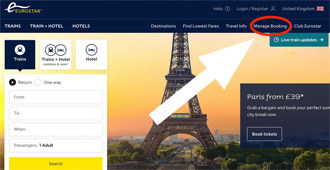
After paying, you can return to the www.eurostar.com home page, click Manage your booking and use your booking reference and surname to find your booking and change your allocated seats. Tips on choosing a seat.
-
If you have an Interrail or Eurail pass, you can buy Eurostar passholder tickets as shown here.
Buying tickets beyond Paris or Brussels
-
If you're going beyond Paris or Brussels, it's best to book Eurostar and onward trains together in one place at www.thetrainline.com or www.raileurope.com. The relevant page of this website explains how best to buy tickets for your specific destination.
-
Eurostar bookings open up to 11 months ahead, but most other European trains only open 3-6 months ahead. I recommend waiting until onward bookings open so you can confirm onward train times before committing to a Eurostar ticket. Timings for onward trains can sometimes change because of engineering work.
-
After buying Eurostar tickets at www.thetrainline.com or www.raileurope.com you can choose better seats using Manage your booking at www.eurostar.com, just as if you'd booked direct with Eurostar. Tips on choosing a seat.
-
See the Train travel to Europe page for more about buying European train tickets. How to change trains & stations in Paris by metro or taxi. Advice on changing trains in Brussels.
If your journey starts outside London
-
Option 1, use www.raileurope.com. This site can book through from any rail station in Britain to Paris, Brussels and destinations all over Europe. There's a small booking fee. Personally I'd want a bit more time in London between trains than the system gives by default, so click More options and enter London (any station) with a stopover duration of say 1h30.
-
Option 2, buy a separate UK train ticket to London. There are special fares from most stations in Britain to a destination called London International CIV designed for connecting with Eurostar, you can buy these online as explained here. Stations sell these tickets, but staff aren't always familiar with them. These fares often have few or no time restrictions, so you can travel in the Monday-Friday peaks at an affordable price, and they ensure that international conditions of carriage (CIV) apply to your whole journey, so if the UK train is late & you miss your Eurostar or vice versa you'll be rebooked on a later train at no charge. More about buying UK train tickets to connect with Eurostar.
To buy tickets by phone
-
Call 03432 186 186 in the UK or +44 1233 617575 from overseas.
-
Eurostar's UK telesales office is open 08:00-19:00 Mondays-Fridays, 09:00-17:00 weekends & holidays.
-
There's a £10 phone booking fee, although no fee is charged to those buying Eurostar Premier tickets.
-
Tickets can be sent to you by email to print or show on your phone.
Video guide
The video shows a Eurostar e320. Some journeys are operated by refurbished e300 trains.
Eurostar classes explained
Eurostar Standard: 2nd class
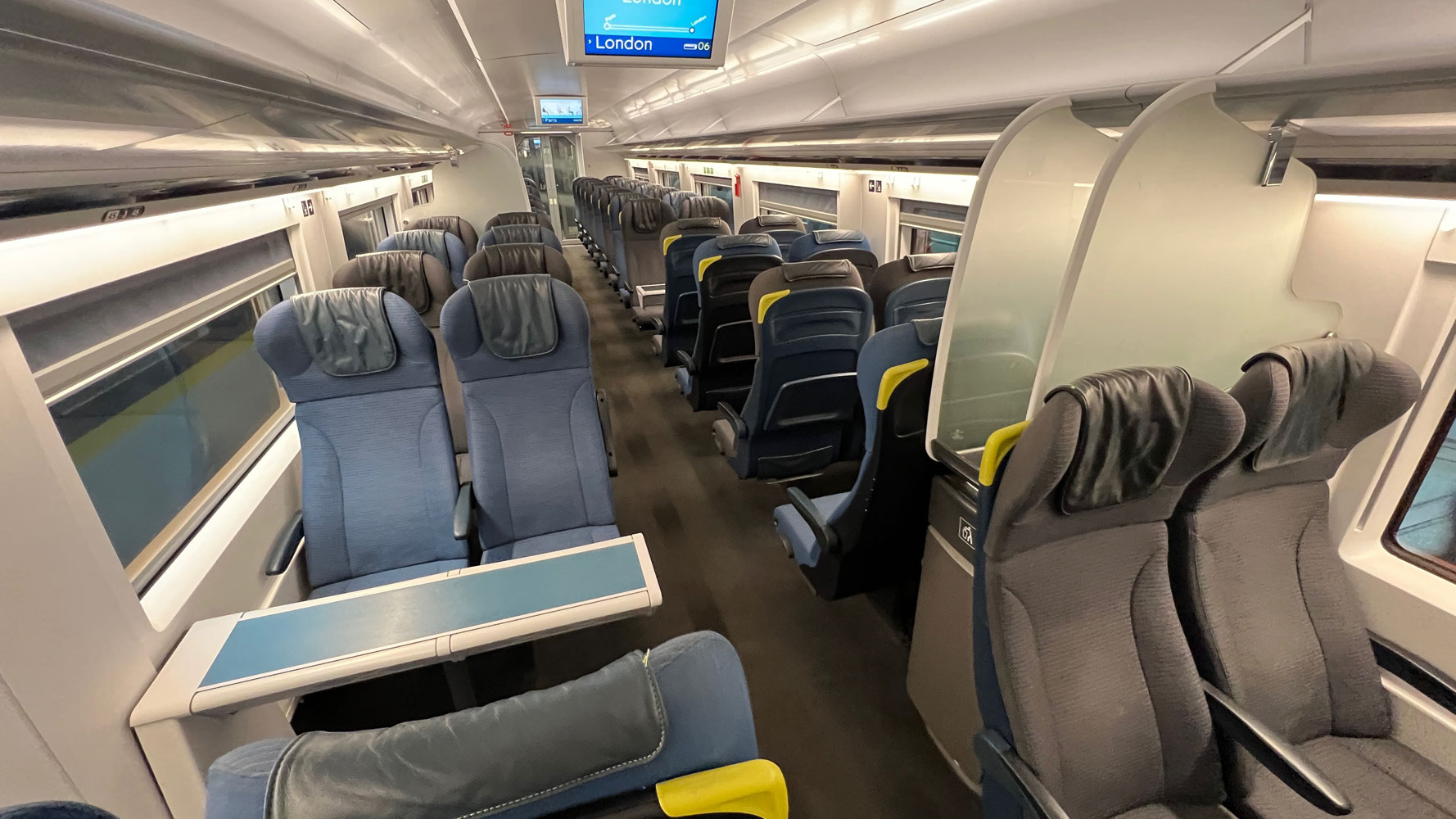
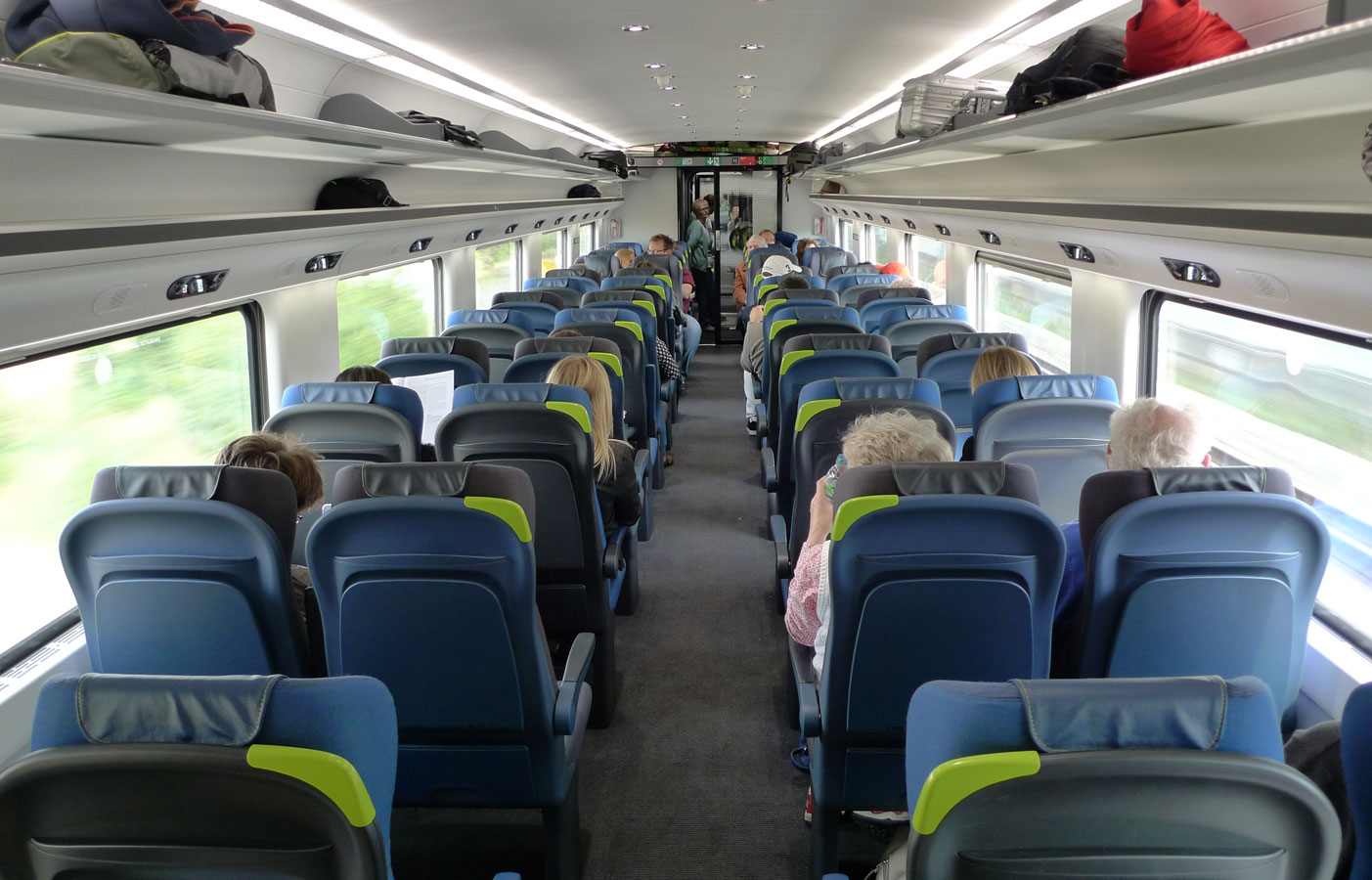
Eurostar Standard is comfortable, carpeted and air-conditioned, some seats unidirectional, some around tables for four, ideal for families or friends. All seats have an individual reading light and fixed or drop-down table, all seats have power sockets and there's free WiFi. There's a cafe-bar cars or you can bring your own food & drink. Standard class seats on the e320 and refurbished e300 trains can be reclined slightly, for posture rather than sleeping.
Eurostar Plus: 1st class for leisure
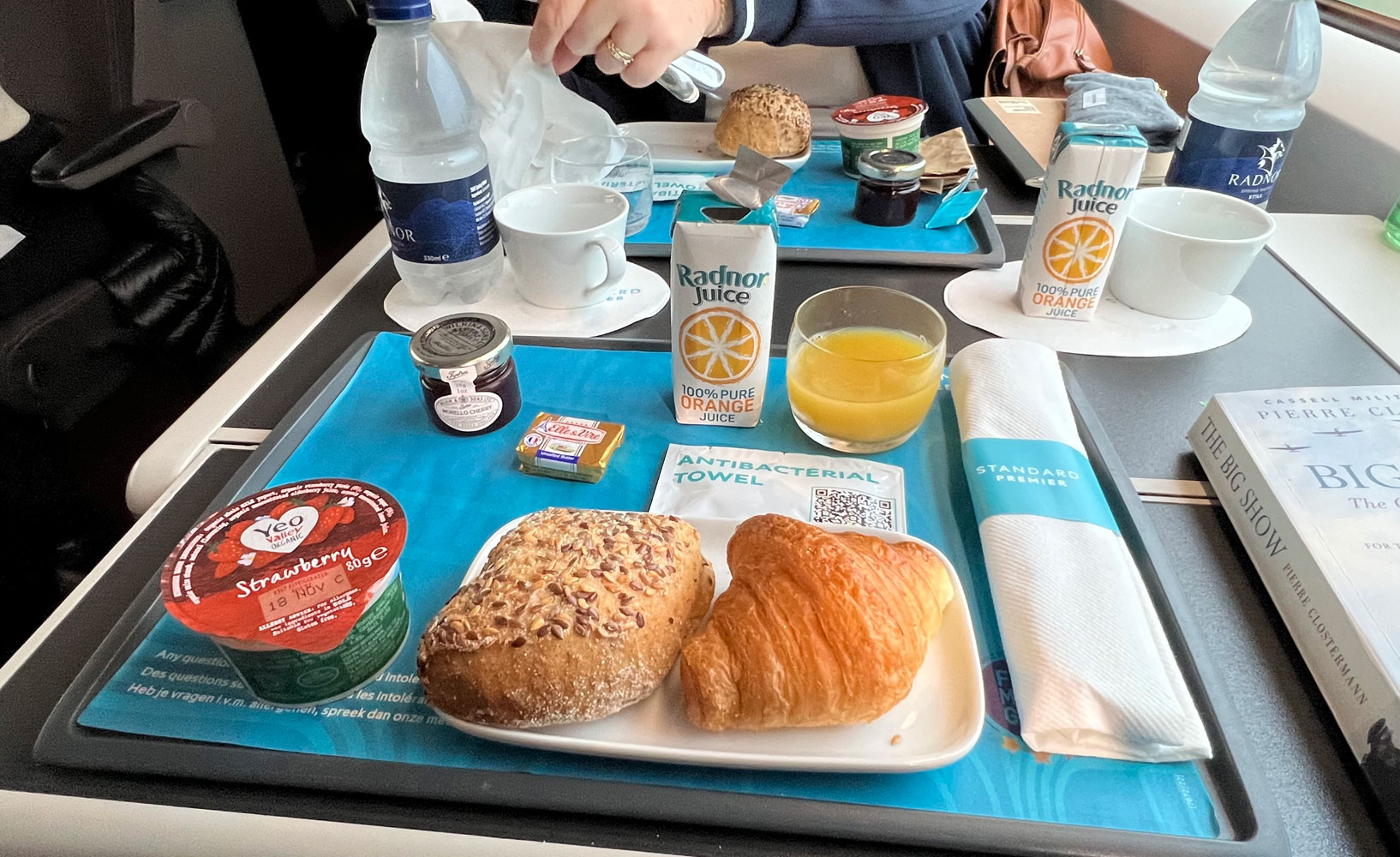
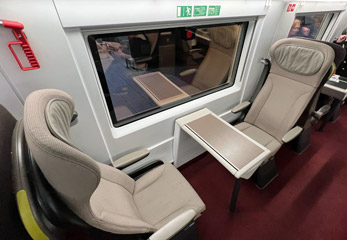
Eurostar Plus (called Standard Premier until November 2024) offers 1st class seating for upmarket leisure travellers & budget-conscious business travellers. Check-in times are the same as standard class and there's no access to the Premier lounge. A complimentary cold light meal and a round of alcoholic & non-alcoholic drinks are served at your seat. There are power sockets & USB ports at all seats & free WiFi. All seats have a fixed or drop-down table and individual reading light, they adjust from upright to a slight recline.
Is Eurostar Plus worth the extra? Standard class is perfectly adequate and it's only 2h20 to Paris or 2h to Brussels. There's no need to pay more if you don't want to. But Eurostar Plus gives you wider seats with more leg & elbow room, the chance to choose solo seats or face-to-face tables for two, it's quieter with fewer families & kids and of course there's a meal included with wine, beer, tea, coffee & soft drinks. So yes, it's a nice experience especially if it's a special occasion. Check the price difference on your date, I've seen Eurostar Plus cost only £10 more than Standard, given Eurostar's dynamic pricing.
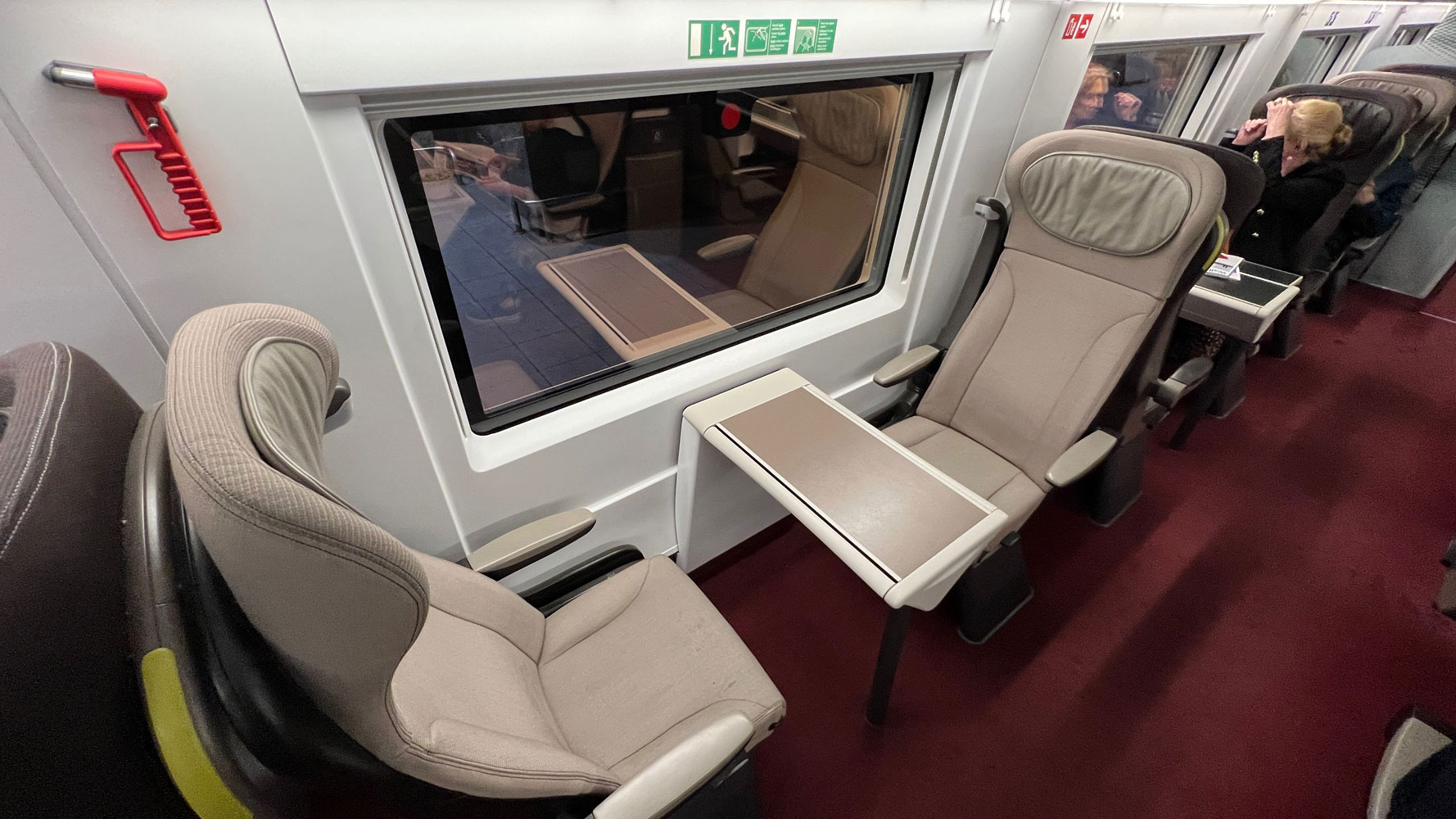

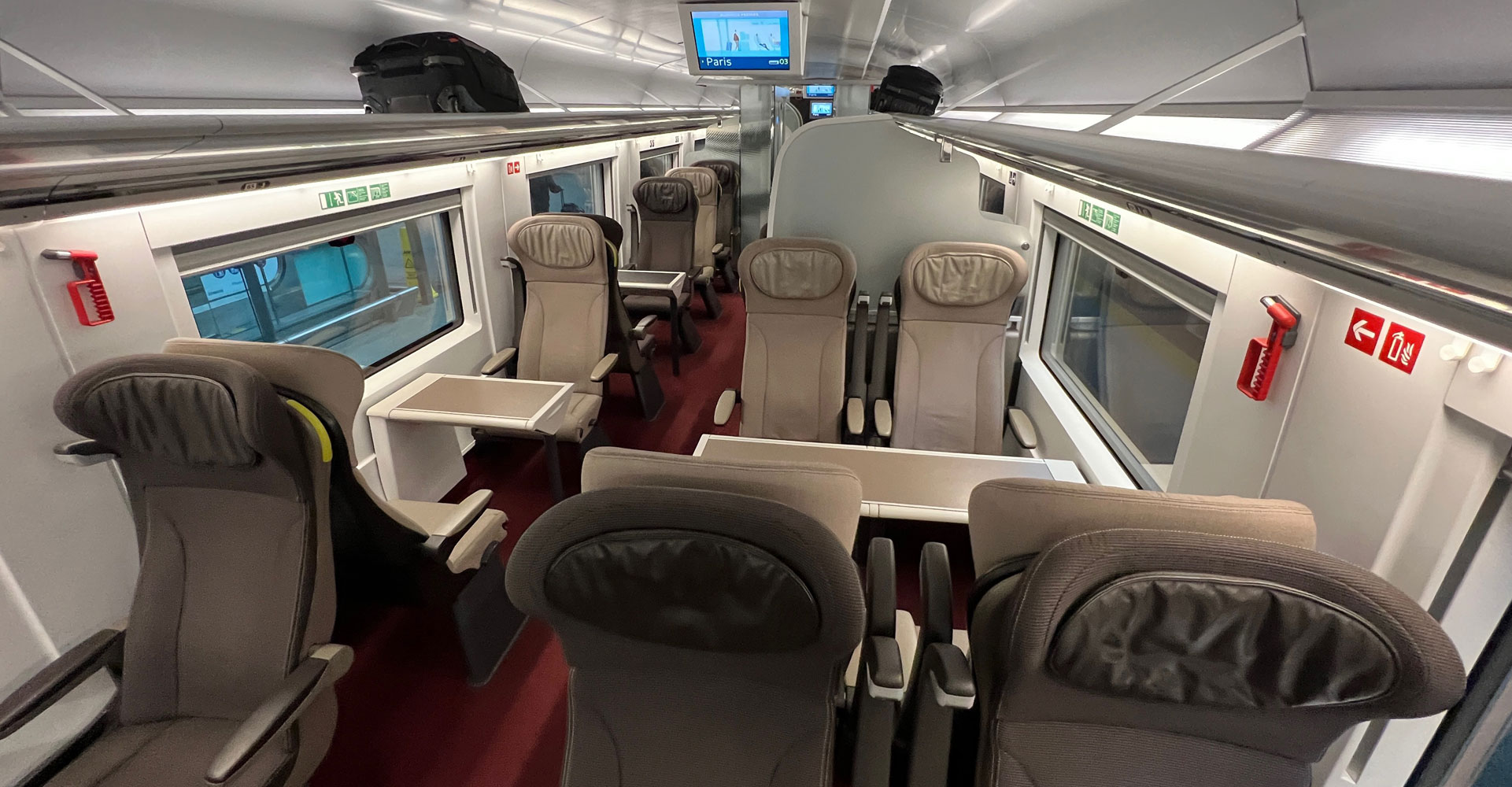
Eurostar Premier: 1st class for business
Eurostar Premier (called Business Premier until November 2024) uses the same 1st class seating as Eurostar Plus, but in designated coaches with fully-flexible tickets that are fully-refundable until 48 hours after departure time, access to Eurostar's excellent Premier lounges in London, Paris & Brussels and a fast-track check-in with a shorter minimum check-in time. The fare includes a complimentary hot airline-style meal, champagne (a nice Monopol brut), wine, beer & soft drinks served at your seat. There's free WiFi and power sockets & USB ports at all seats. All seats adjust from upright to a slight recline, all seats have a fixed or drop-down table and an individual reading light. The only downside? It's priced assuming your company is paying!
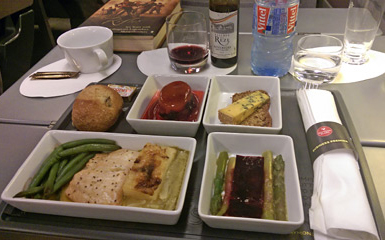
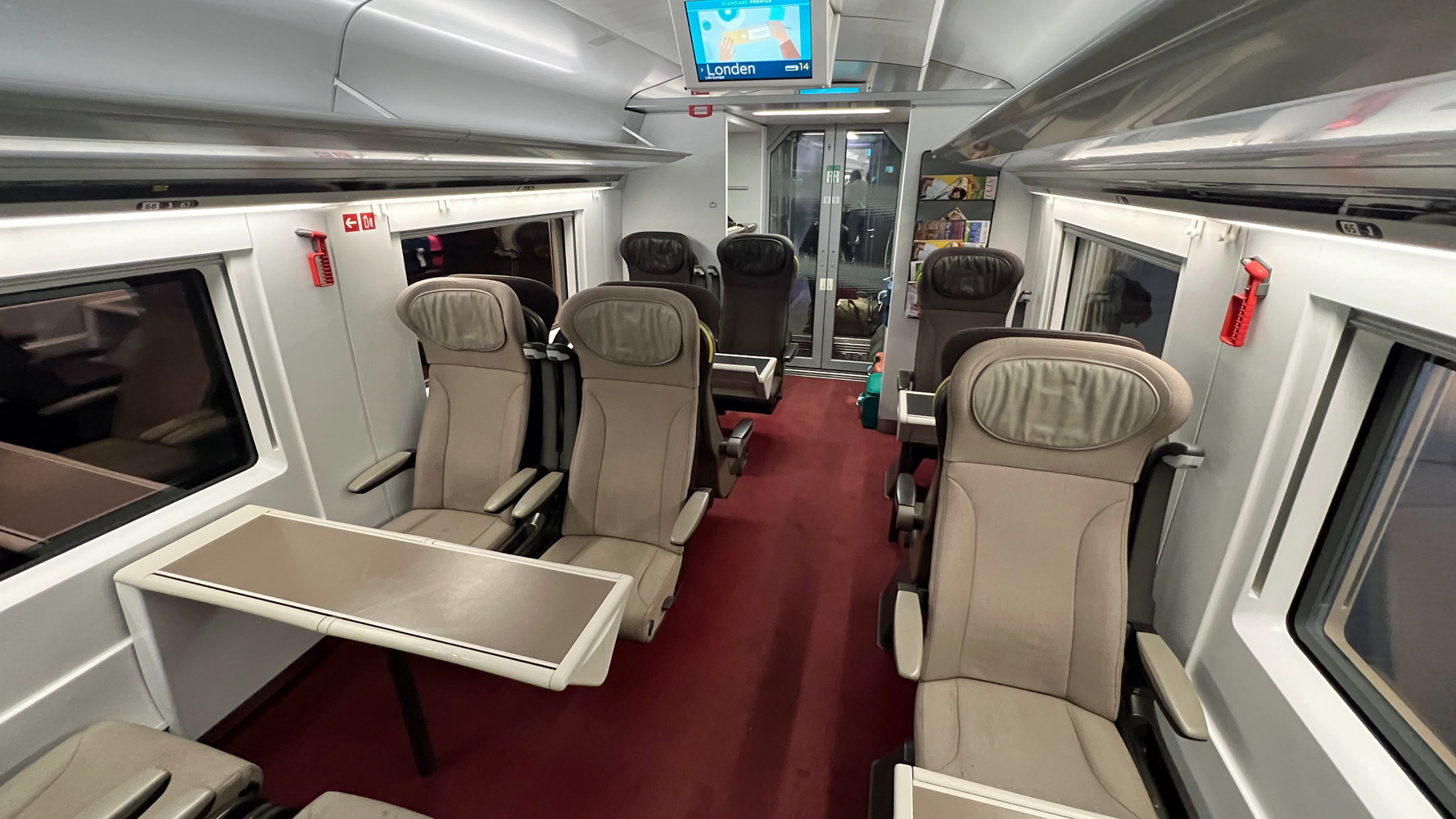
Plus and Premier passengers sit in separate first class carriages but the seating is identical, with seats arranged 2+1across the car width. Eurostar vary the allocation of cars on each train between these two classes according to demand. 1st class seats have extra legroom compared to the higher-density seating in Standard class which has a 2+2 configuration. See the tips for choosing your seat below for seat maps.
Choosing your seat
 |
-
All Eurostar tickets include a specific reserved seat, initially you're allocated a seat.
-
When you buy tickets at www.eurostar.com, you can change your allocated seats by clicking View or change seats after payment. Then you can select better seats from a seat map.
-
If you book Eurostar via raileurope.com, thetrainline.com or sncf-connect.com, or buy passholder tickets at interrail.eu, eurail.com, raileurope.com or b-europe.com, you can view & change seats like this:
Go to www.eurostar.com and click Manage your booking at the top.
Enter your 6-character Eurostar booking reference & last name and it'll retrieve your booking.
Look for the View or change seats link, you can then select seats from a seat map, see tips on choosing the best seats.
Note that when a train gets fairly full, for example close to departure, the change seat option may not appear.
You'll be sent an email confirming the change.
-
Tip: Eurostar's 6-character alphanumeric booking reference is shown on your Eurostar ticket, for example KJ4T7Z. It may not be the same as your retailer's booking reference. On a ticket bought from B-Europe.com, it's shown as Reservation code.
-
Tip: You can also view & change seats using the Eurostar app. Download and open the app. Click Bookings and load your booking into the app by entering your last name and 6-character Eurostar booking reference. You can now view or change seats and manage your booking in the app. This works however you bought your Eurostar ticket, it even works with Interrail or Eurail passholder bookings.
-
Tip: Eurostar sometimes switch an e320 for an e300 or vice versa for operational reasons, without telling you. When this happens, your chosen seats will become un-chosen. It pays to check back from time to time, then if you spot that your seats have changed, you can change them again to seats you like.
Eurostar seat maps
-
Here are accurate seat maps showing which seats face forwards, which line up with a window, which are airline-style face-to-back and which are arranged in bays around a table. You might then understand why this website is called The Man in Seat Sixty-One.
Will your Eurostar be e320 or e300?
-
Eurostar have 17 e320 trains and 8 refurbished e300 trains. You can only tell which type it is once you have a booking:
-
Go to www.eurostar.com, click Manage your booking and use the View or change seats feature to see a seat map. If your train has 16 cars with 1st class at each end, it's an e320. If it's 18 cars with 1st class cars in the middle, it's an e300.
Tips for picking the best seats
-
If you're travelling as a group of 3 or 4 people, choose seats around a table as this is more sociable.
-
If you're a couple in first class, choose a face-to-face table-for-two. Seat 61 was one of a pair like this on the original Eurostar trains, and still is in 1st class cars 2, 3, 14 & 15 on an e320 train.
-
If you want seats facing forward, this can be seen on these seat maps, they show which way the train goes when heading to Paris/Brussels, and when heading to London. Car 1 is always at the London end of the train, car 16 or 18 at the Paris/Brussels/Amsterdam end.
-
If you prefer a seat which lines up with the window (rather than one next to a pillar between windows), look carefully at the plan. The white or pale blue sections in the coach walls on the plan are the windows.
-
In standard class, a seat in the car next to the bar car makes it easier to get food & drink. On the other hand, you get more people walking through to get to the bar. End cars are quieter!
-
If you've a tight connection when you arrive in Paris, Brussels or London, book a seat at the front of the train - car 16 or 18 going towards to Paris or Brussels, cars 1 or 2 going towards London. This can save a huge amount of time compared to shuffling slowly past the front of the train off the platform behind 900 slow-moving fellow passengers!
-
Quiet coach: Eurostar trialled a 'quiet coach' in Business Premier and Standard Premier (but not Standard class) in 2012, but the trial ended, and there is now no designated quiet coach.
Tip for the tall: Extend your seat
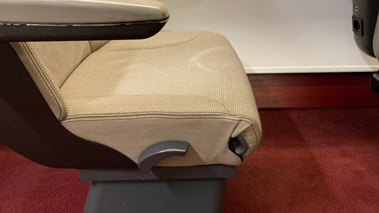
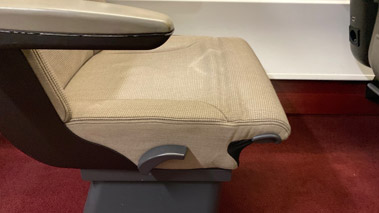
On Eurostar's e320 trains in all classes (but not e300), the edge of your seat can be extended 2 inches just by pulling it out. I'm 6'2" and I love this feature!
Useful telephone numbers
-
Eurostar telesales: 03432 186 186 (08:00-19:00 Mon-Fri, 09:00-17:00 weekends, from overseas call +44 1233 617575). £10 fee for phone bookings, except for Eurostar Premier tickets for which there's no fee.
-
Lost Property in London 020 7928 0660 (from outside the UK call +44 20 7928 0660)
-
Lost Property in Paris 00 33 155 31 58 40
-
Lost Property in Brussels 00 32 2 224 88 62
-
Group travel: 08448 224 800 (from outside the UK call +44 8448 224 800)
-
Eurostar customer relations: 020 7928 5163 or e-mail new.comments@eurostar.co.uk
-
Eurostar train arrival information & passenger assistance: 020 7928 0660
-
Bikes & registered baggage service: 0844 822 5822 (from outside the UK call +44 207843 7554).
Checking-in for Eurostar
-
Unlike other European trains, you have to check in for Eurostar.
Checking in consists of a ticket check, security checks, and UK & EU passport controls. All formalities are done before you board, at the other end you're free to just walk off.
-
Eurostar advise passengers to arrive at the terminal 60-90 minutes before departure.
If you can't make the full 60-90 minutes because you're arriving on a connecting train that's fine as long as you check in longer than 30 minutes before departure (15-20 minutes for Eurostar Premier).
-
Check-in usually opens 1½ hours before departure, but this can vary depending how busy they expect the Eurostar terminal to be.
-
Check-in closes 30 minutes before departure, or 15-20 minutes for Eurostar Premier passengers & Carte Blanche loyalty cardholders.
Check-in procedure in London
-
Step 0, EES pre-registration:
The EU will introduce its Schengen Area Entry-Exit System (EES) during 2026, it should have been in by April, but it's been deferred.
When it finally goes 'live', non-EU citizens will need to pre-register for entry to the EU Schengen area before they check-in for Eurostar. You pre-register by having your photo & fingerprints taken at one of the EES terminals located in zones A, B or C at London St Pancras.
Zone A is a glass-fronted room opposite the national rail ticket office near the escalators down to the Thameslink platforms. Zone B is a glass-fronted room opposite the Eurostar Premier check-in gates, probably only for Premier & Carte Blanche passengers. Zone C is inside a former retail unit on the upper level near the John Betjeman statue. You must pre-register on the day of departure, you cannot do this in advance.
-
Step 1, go through the Eurostar ticket gates:
At London St Pancras there's a row of check-in gates in a wide passageway marked Eurostar Departures, off the lower level retail arcade, one floor below the platforms.
If you've a Premier ticket or Carte Blanche card you can use the Eurostar Premier check-in, on the far right-hand end of the row of gates.
Place your ticket QR code (on your phone or printed) against the scanner on one of the ticket gates.
If you want to change your allocated seat, or if your ticket doesn't work the gate, go to a staffed kiosk.
-
Step 2, security check:
After the check-in gates, you put your bags through an X-ray machine and walk through a metal detector. It's quicker & easier than an airport, no need to remove shoes and no nonsense with liquids (though they don't like you carrying a cup of coffee through).
-
Step 3, UK passport check: Staff at a desk scan your passport.
-
Step 4, EU passport check: You pass through automated passport gates. Until EES is fully implemented, French border police in a kiosk then stamp your passport.
-
Departure lounge
You're now free to use the shop, bar, cafe & other facilities until boarding. At St Pancras there's a Prêt a Manger, bar, newsagents & travel goods shop, toilets, phone/laptop charging points and a Eurostar information desk. The desk can provide you with Eurostar info, a free map of Paris and Paris visitor metro passes. And luggage labels, if you've forgotten to label your bags!
-
Premier lounge
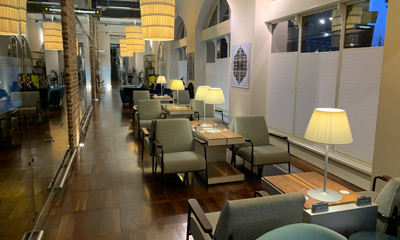
If you have a Eurostar Premier ticket or Eurostar Carte Blanche loyalty card, you can use the Premier lounge with armchairs, charging points, free WiFi and complimentary tea, coffee, wine, beer, spirits, juice & snacks. There are Premier lounges at London St Pancras, Paris Nord & Brussels Midi but not Lille. The entrance to the Premier lounge at St Pancras is on the right immediately after the EU passport check.
-
Boarding
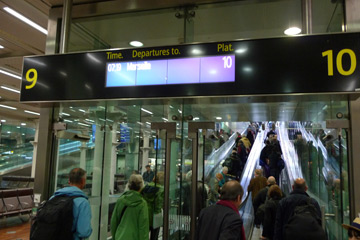
The six Eurostar platforms at St Pancras (platforms 5-10) are directly above the departure lounge. A boarding announcement is made around 20 minutes before departure. There are two gently-sloping moving walkways up to each platform, plus a lift. If your reservation is in cars 1-5, you use one walkway, if your reservation is in cars 6-18 you use the other. Just follow the signs!
Tip: To get ahead of the crowd and be first onto the platform, open www.realtimetrains.co.uk on your phone and enter STP as location. Find your Eurostar in the list of St Pancras departures, it will show the planned platform number before it's announced. You can be ready and waiting at the doors to the relevant travelator when staff open them for boarding.
-
There are no formalities on arrival in Paris, Lille or Brussels, it's all done before you board. You just walk off the train, easy as that.
-
More about St Pancras including left luggage and places to eat or drink before checking-in.
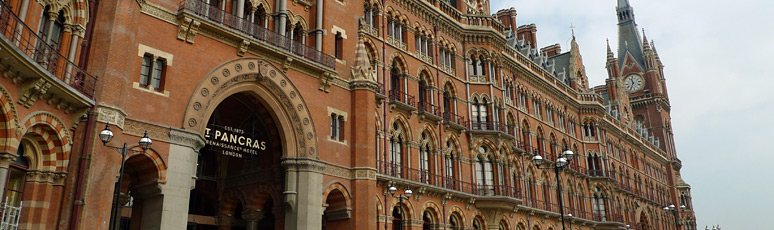
St Pancras' beautiful gothic facade. The station building is now a luxury hotel, the Renaissance, accessed from the forecourt via the big archway in the photo above. See London St Pancras station guide.
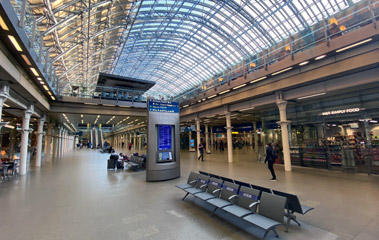
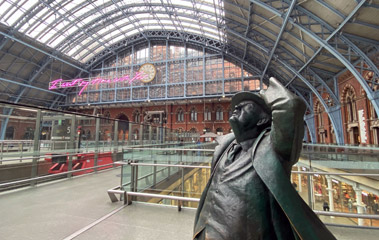
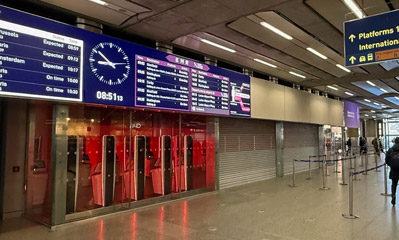

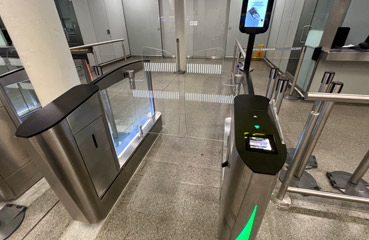
EES pre-registration: When the full EES system goes 'live' (some time during 2026) you'll need to pre-register by having your photo and fingerprints taken at an EES terminal in zone A, B or C before checking-in for Eurostar. Above left, Zone A, near the national rail ticket office. Above right, Zone C on the upper level.
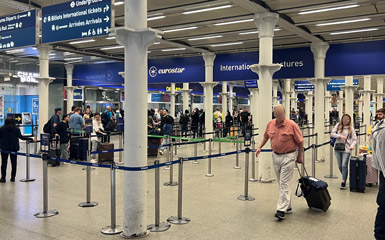
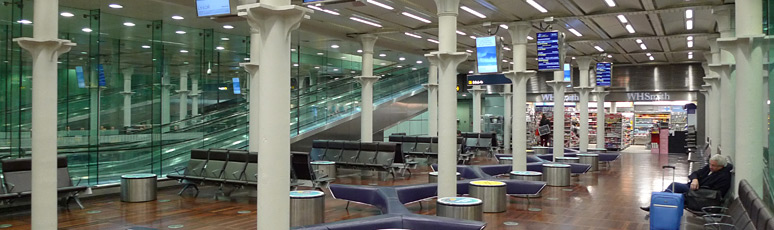
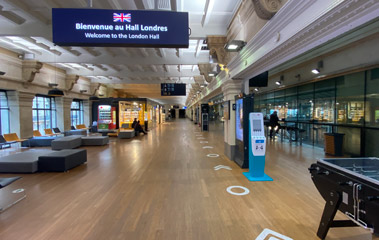
Departure lounge. The Eurostar main departure lounge, with seats, mobile recharging bar, info desk, cafe, shop, toilets & bar. In this photo you can see the travelator up to the platform. The blue bench seating in the centre of this photo has now been improved with more regular seating of the brown type.
Check-in procedure in Paris
-
To reach the Eurostar terminal at Paris Gare du Nord, go up the escalator or steps opposite platform 17 onto the first-floor balcony. Walk along the balcony to the Eurostar check-in gates and staffed kiosk, roughly level with platform 3.
-
Step 0, EES exit registration:
The EU will introduce its Schengen Area Entry-Exit System (EES) during 2026, it should have been in by April, but it's been deferred.
When it finally goes 'live', all non-EU citizens will have to have their fingerprints scanned at an EES terminal for exit from the Schengen area, before checking in for Eurostar. At Paris Nord, the EES terminals are in a room at the top of the escalators on the first-floor balcony.
-
Step 1, Eurostar ticket check: To check in, place your ticket QR code (on your phone or printed) against the scanner on one of the ticket gates. If you want to change your allocated seat, use the staffed kiosk.
-
Step 2, EU passport check: After the ticket check you enter the terminal and have your passport checked by French police at staffed kiosks.
-
Step 3, UK passport check: Then there's a passport check by UK Border Force, with both staffed kiosks and passport e-gates.
-
Step 4, security check: You then put your bags and coat through an X-ray machine and walk through a metal detector. It's quicker & easier than an airport, no need to remove your shoes, no nonsense with liquids (though they don't like you carrying a cup of coffee through!).
-
Departure lounge: You then turn right and enter the departure lounge, it's on the first floor alongside platform 3 (there isn't a platform 1 or 2). The lounge has seats, toilets, shops & cafes and EU sales tax refund machines.
-
Premier lounge: If you have a Eurostar Premier ticket or Carte Blanche loyalty card, you can use the Premier lounge with complimentary wines & spirits, soft drinks, tea coffee & snacks, charging points and free WiFi. It also has a cocktail bar, open afternoon and evenings. It's on the second floor, turn left after the security check and go up the stairs or lift.
-
Boarding: Boarding is announced 15-20 minutes before departure, follow everyone else onto one of two short footbridges (labelled Portes A & B) leading from the side of the terminal over platforms 3-6, and down a travelator or steps onto the platform.
Porte A is the one closest to the buffer stops, for cars 11-18 at the rear of the train.
Porte B is the far one, for cars 1-10 at the London end of the train. They lead to the same platform, so no big deal if you use the wrong one!
-
There are no formalities on arrival in London, unless UK customs people pull you over you just walk off the train, simple as that.
-
More about Paris Gare du Nord including station layout, places to eat & drink or buy food.
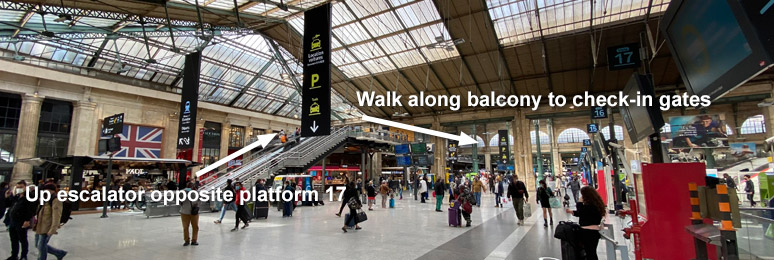
Above, we're looking across the station concourse with the platforms on the right. That's the escalator opposite platform 17 up to the balcony leading to the first-floor Eurostar check-in.
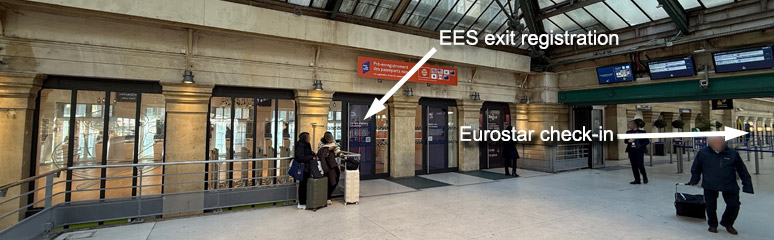
EES pre-registration: When EES finally goes 'live', non-EU citizens will need to do their EU exit registration at an EES terminal in this room before checking-in for Eurostar. It's at the top of the escalators on the first-floor balcony leading to check-in.
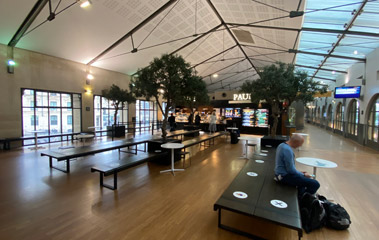
Departure lounge at Paris Nord. Much improved since the early days, there are toilets, shops and cafes.
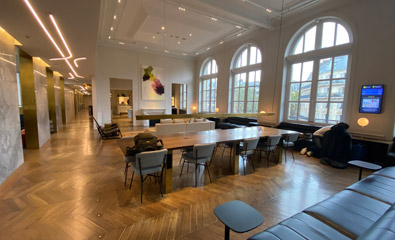
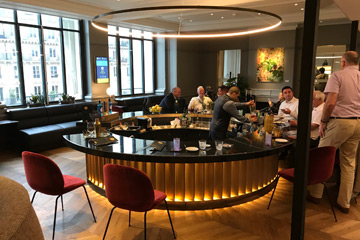
Eurostar Premier lounge, upstairs from the main lounge, featuring this great cocktail bar. You can use this lounge with a Eurostar Premier ticket, with a Eurostar Carte Blanche loyalty card. The lounge offers complimentary wine, spirits, beer, tea, coffee & soft drinks.
Check-in procedure in Brussels
-
Find the Channel Terminal at Brussels Midi: The main concourse at Brussels Midi is a wide and (it has to be said) gloomy street-level passageway running underneath all 22 platforms. Eurostar trains leave from platforms 1 & 2 (or, if coming through from Amsterdam, platform 3), and the Eurostar terminal opens off this concourse at the platform 1 end, marked Channel Terminal.
-
Step 0, EES exit registration:
The EU will introduce its Schengen Area Entry-Exit System (EES) during 2026, it should have been in by April, but it's been deferred.
When it finally goes 'live', non-EU citizens will need to use one of the EES terminals outside the check-in area to have their fingerprints scanned for exit from the Schengen area, before going through the Eurostar check-in gates. Follow the instructions given by Eurostar.
-
Step 1, Eurostar ticket check: In the Channel Terminal foyer you'll find staffed check-in desks and automatic ticket gates. To use the automatic gates, place your ticket QR code (on your phone or printed) against the scanner.
-
Step 2, security check: After the ticket gates you put your bags & coat through an X-ray machine and walk through a metal detector. Quicker & easier than an airport, no need to remove shoes, no nonsense with liquids (though they don't like you carrying a cup of coffee through!).
-
Step 3, EU passport check: Belgian police in a kiosk check your passport.
-
Step 4, UK passport check: UK Border Force check your passport, either at a staffed kiosk or automatic passport gates.
-
Departure lounge: Walk through the vast duty-free shop into the departures area. There are seats, toilets, a cafe & information desk.
-
Premier lounge: If you have a Eurostar Premier ticket (or Eurostar Carte Blanche loyalty card) you can use the Premier lounge with complimentary wines & spirits, soft drinks, tea coffee and snacks. The entrance is to the left at the back of the departure lounge.
-
There are no formalities on arrival in London unless UK customs people pull you over, you just walk off the train, simple as that.
-
More about Brussels Midi station including station layout, left luggage lockers, places to eat & drink or buy food.
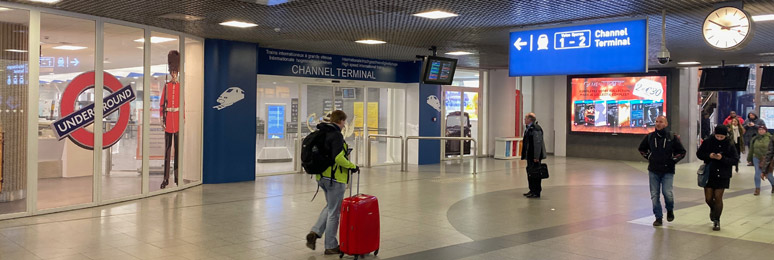
Entrance to the Eurostar terminal in Brussels.
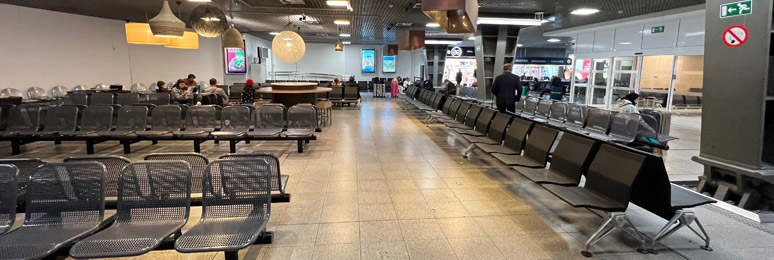
Once past check-in, security & passport control, you wait in the Eurostar departure hall.
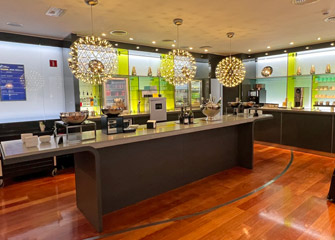
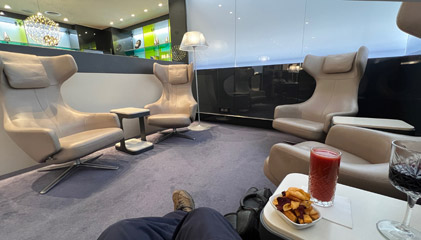
The Premier lounge, complimentary drinks area and seating. You can use the lounge with a Eurostar Premier ticket, Eurostar Carte Blanche card.
On board Eurostar
Eurostar operate two types of train to/from London:
-
e320 trains are new trains built by Siemens in 2015. Eurostar have 17 e320 trains.
-
e300 trains are the original Eurostar trains from 1994, rebuilt with a similar interior to the e320. Eurostar have 8 e300 trains.
-
How to tell which type of Eurostar operates which departure.
Eurostar e320 trains
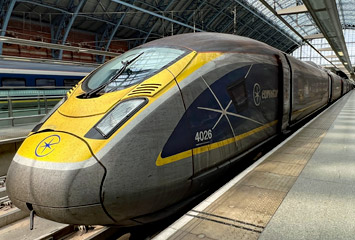
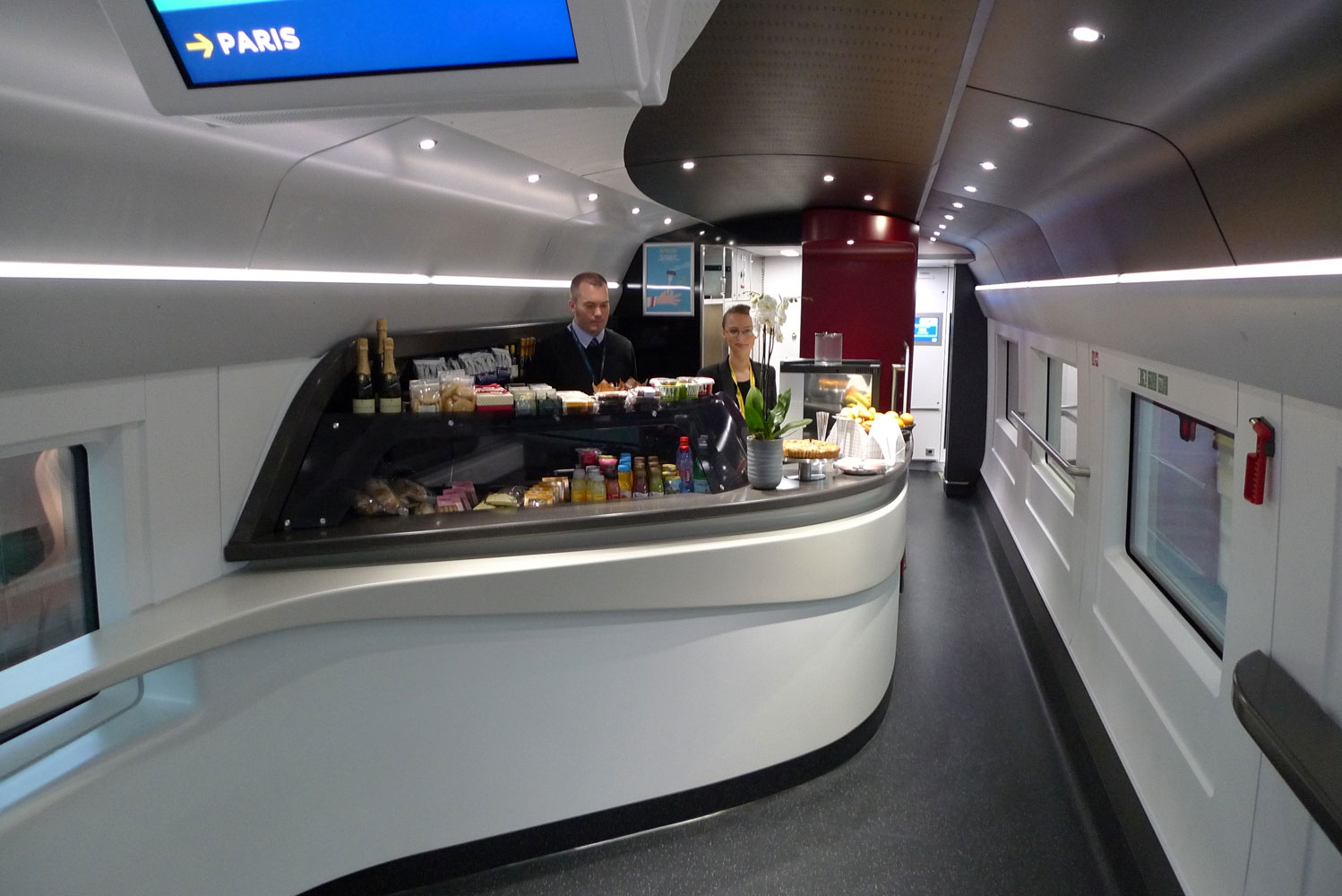
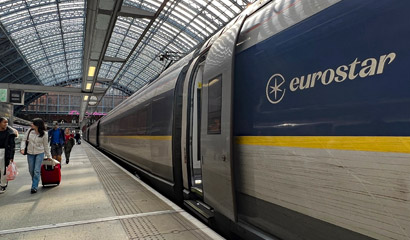
e320 trains have free WiFi in all classes and power sockets at all seats. The designation refers to the train's top speed, 320 km/h, although it can't currently exceed 300km/h on the London-Paris route. And yes, seat 61 is still the best seat in the house - if you pick seat 61 in the right first class car, that is. Cars 2, 3, 14 or 15, since you ask. e320 seat map.
Eurostar's refurbished e300 trains
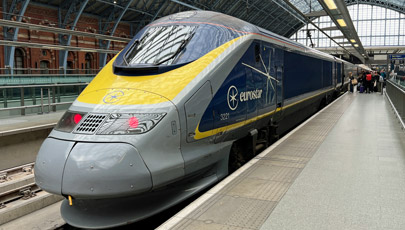
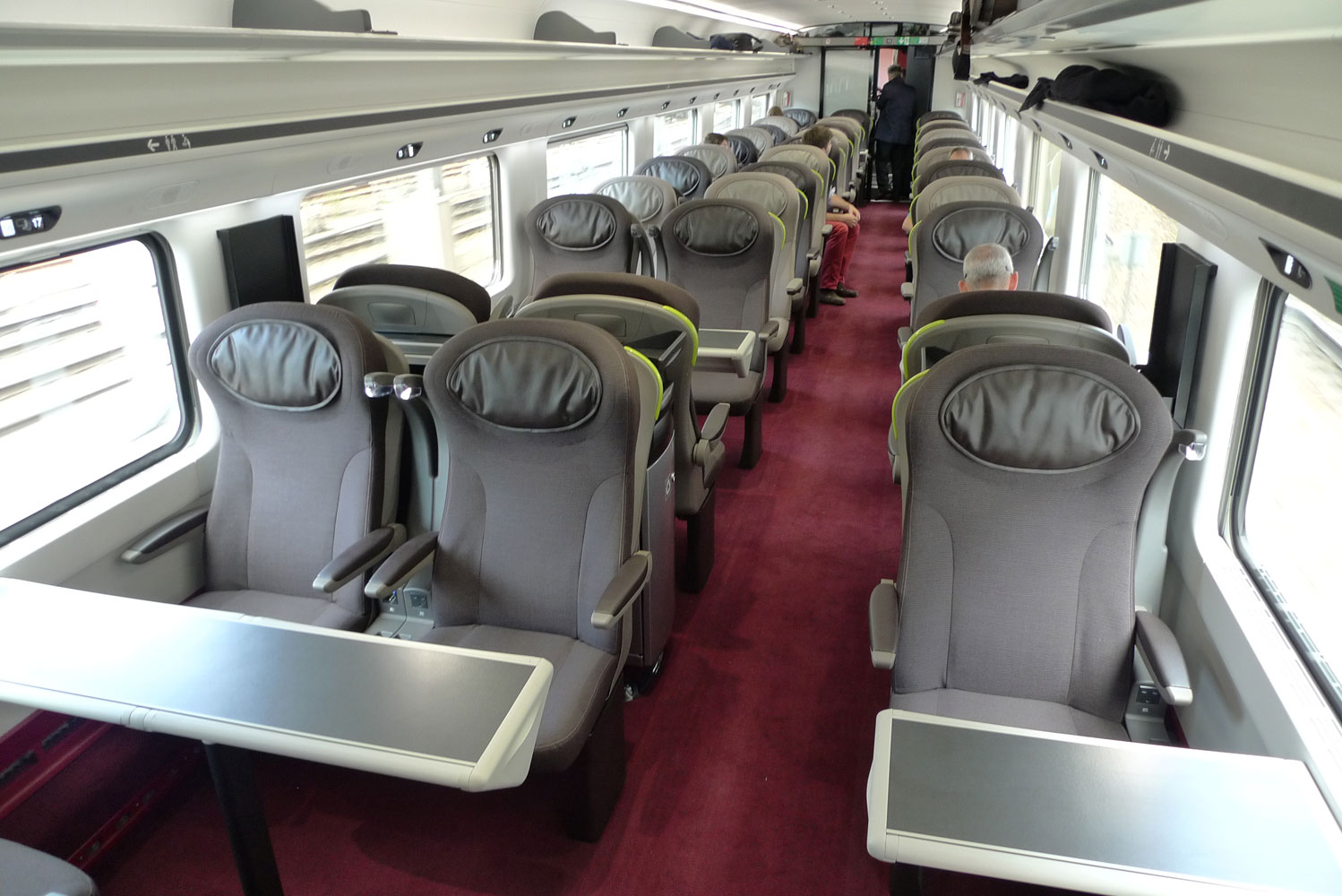
Eight of the original Eurostar trains (Trans-Manche Super Trains, TMST) introduced when Eurostar first started in 1994 have been refurbished and designated e300 - a reference to its 300 km/h top speed. This was no mere change of the seat covers, it's a completely new interior, making them almost indistinguishable from the newer e320s - the much larger cafe-bar area is one difference. Like the e320s, the refurbished e300 trains feature free WiFi in all classes, power sockets at all seats, and USB sockets as well as power sockets in 1st class.
The seat layout is similar to the original TMST but with a few slight differences. Notably seats 61 & 65 in cars 7, 8, 11 & 12 no longer face each other over a table, but are both solo seats, face to back. e300 seat map.
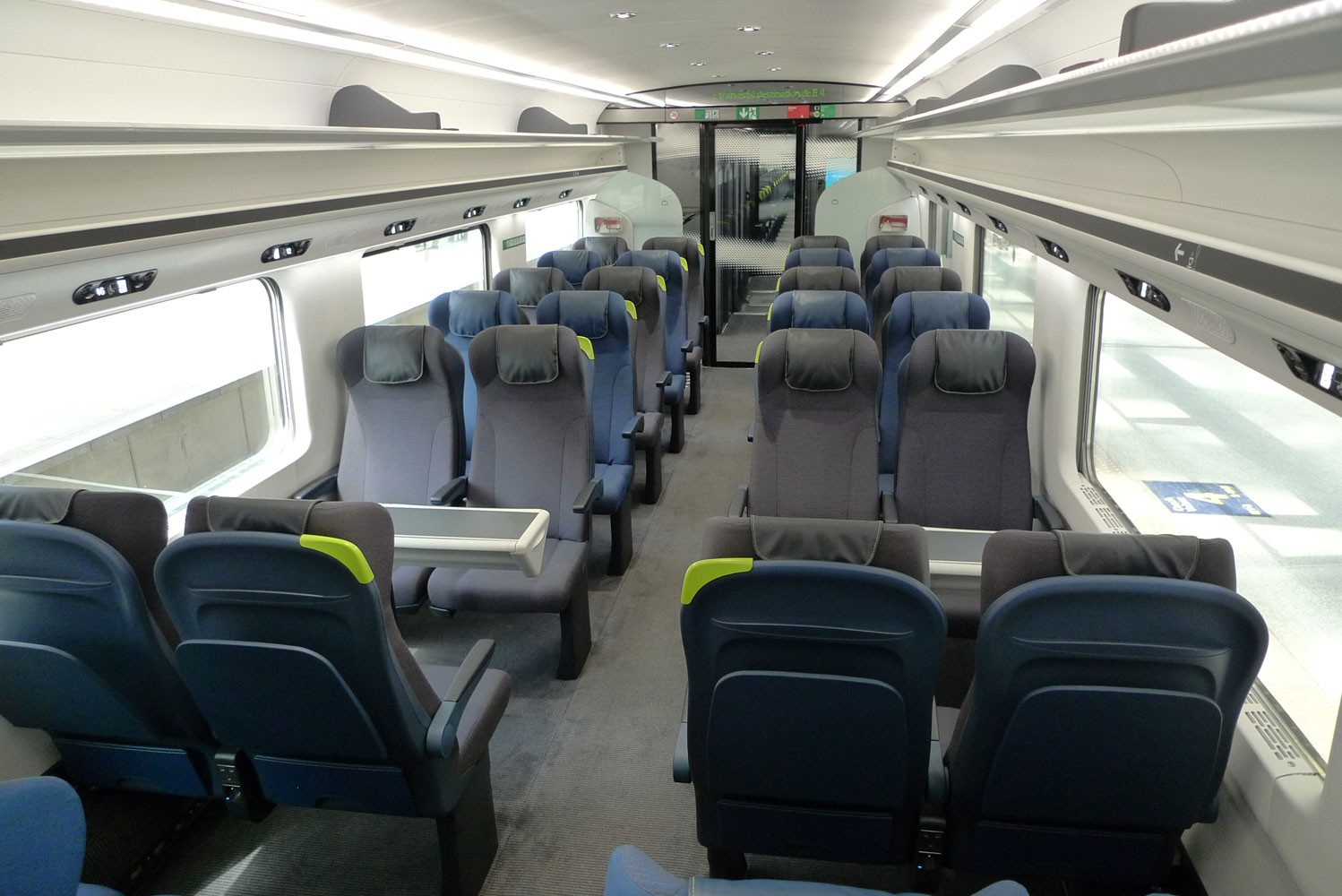
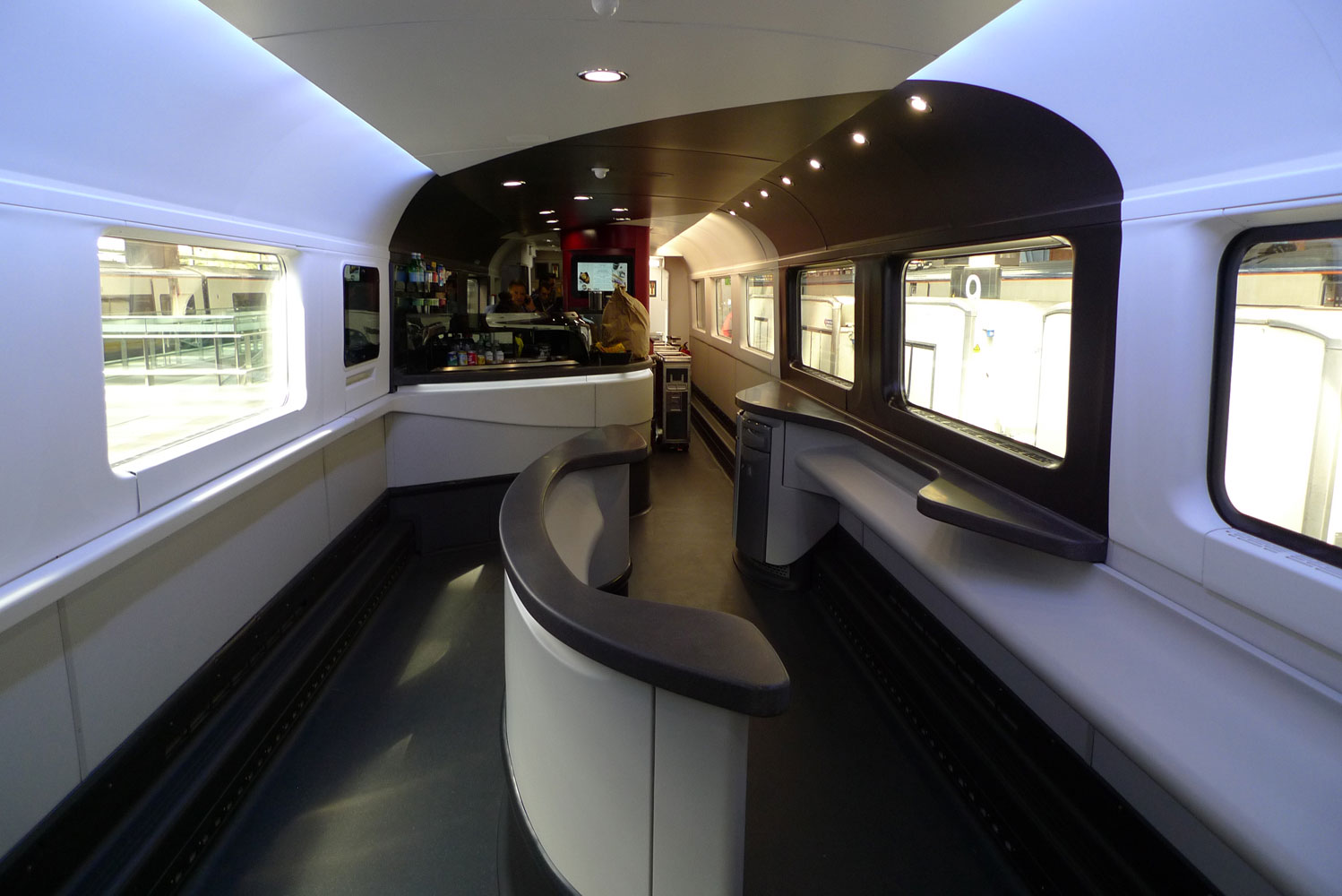
 |
|
|
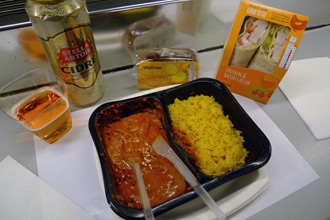
Chicken tikka massala, wraps & a cider bought from the Eurostar cafe-bar. |
Food & drink on Eurostar
-
Eurostar trains are all non-smoking.
-
Eurostar Premier includes a complimentary hot airline-style 3-course meal, served at your seat.
On trains leaving before 10:15 you're served breakfast. On all trains leaving at or after 10:15 you're served lunch/dinner with complimentary wine, champagne, beer or soft drinks.
-
Eurostar Plus includes a simple cold tray meal. On trains leaving before 10:15 you're served breakfast with tea, coffee & juice. On trains leaving at or after 10:15 you're served lunch/dinner with complimentary red or white wine, beer or soft drinks.
-
All passengers have access to two bar cars, located in cars 6 & 13 in the refurbished e300 trains and in cars 8 & 9 on the new e320 trains. The cafe-bars serve tea, coffee, hot chocolate, beer, wine, spirits, sandwiches, wraps and a few hot dishes such as Chicken Tikka Massala. The bar accepts credit cards as well as cash. You can eat and drink in the bar area (standing space only, there are no seats) or take food & drink back to your seat.
-
Alternatively, feel free to take your own food and drink, even your own bottle of wine if you like.
-
The bar car also sells Paris metro tickets. They sell Navigo Easy smartcards loaded with 2 metro/RER tickets, for only slightly more than you'd pay at a metro station, so if you have to cross Paris to catch an onward train and haven't managed to buy a metro ticket on your phone, this is the next best way.
Power outlets for laptops & mobiles
-
On the e320 trains and refurbished e300 trains there are power sockets & USB ports at all seats in all classes, under the armrest. They are alternately of the UK-type 3-pin and European-type 2-pin, so your seat could have either type, but the seat next to you will have the other type.
Free WiFi, TV shows & movies
-
The e320 trains and refurbished e300 trains have free WiFi in all classes. You'll find a selection of TV & movies to stream for free at onboard.eurostar.com as well as journey information.
-
There's good mobile phone voice & data reception throughout almost all the Eurostar journey including inside the Channel Tunnel, where it's provided by French telecoms companies in the northbound (towards London) running tunnel and by British telecoms companies in the southbound (from London) running tunnel.
-
There's free WiFi at St Pancras International station for everyone. WiFi access at Paris & Brussels is also available, but must be paid for.
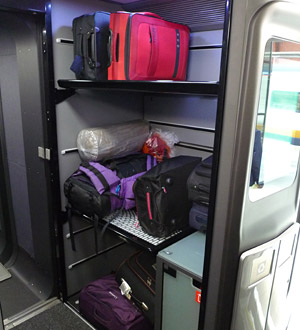 You bring your bags with you and put them on the luggage racks. Large racks near the entrance doors easily take large items. Anything up to back-pack sized will fit on the overhead racks above your seat. |
Luggage on Eurostar
-
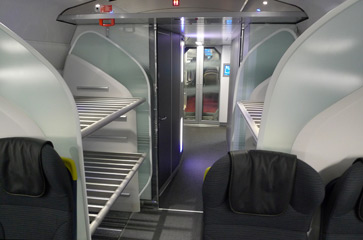
Unlike travelling by air, you don't check in your bags. You keep them with you, placing small or medium size bags (up to backpack-size) on the rack above your head and larger items on the big suitcase racks at the end of the coach just inside the entrance doors.
-
Labelling your bags: You must label your bags with your name (first name and surname), you'll find free paper labels at the terminal if you've forgotten. More about luggage on European trains.
-
Luggage limits on Eurostar: In principle at least, Eurostar limits luggage to 2 large items per passenger, maximum 85cm in any one dimension, plus a small item of hand luggage. There's no weight limit, so you can pretty much pack what you like, and (again unlike anally-retentive airports and airlines) nobody actually measures your bags or even worries if you have an extra carrier bag or two, as long as they all fit through the X-ray machines and don't cause any problems.
-
Items over 85cm: In theory there's a maximum size limit of 85cm in any one dimension. Which is odd, as there's no such limit on any other British or French train, and there's no logic to it as far as I can see, as long as items fit through the X-ray scanners at check-in. If you call Eurostar, staff may repeat the official 85cm limit and say you should use Eurostar's baggage service, but this is useless for anyone continuing beyond Paris, Brussels or London as items are only available for collection with 24 hours of your Eurostar's arrival. But in reality nobody measures your bags, and in practice people take guitars, 1 metre long tubes with rolled-up plans or posters inside, and other items that are a little over 85cm onto Eurostar, as they do on any train. I can't guarantee you won't meet a jobsworth of course, but I've yet to hear of anyone having a problem. In practice Eurostar is generally relaxed as long as you don't take the P.
-
Skis & snowboards: One pair of skis or a snowboard (of any length) is allowed on Eurostar.
-
Guitars & other musical instruments: Eurostar's policy on taking musical instruments is at www.eurostar.com/uk-en/travel-info/travel-planning/luggage. Basically, if it's under 85cm long, no problem, but over that and you pay a child rate for a seat next to you. In practice nobody measures things so you'd probably get away with taking a 90cm guitar as normal luggage. I can understand the official policy with a cello or double bass, but it does seem nonsense to pay for a guitar when a guitar is free of charge on any other UK or European train. See the paragraph above about items over 85cm in practice as well as theory.
-
Alcohol: You're free to bring & consume your own wine or beer on Eurostar as long as you don't become a nuisance to other passengers. To this end they typically limit alcohol brought for your own consumption to 1 bottle of wine or 4 cans of beer or 1 small bottle of spirits. You can transport more than this if it remains unopened in your bags.
-
Prohibited items that can catch you out: As well as the obvious prohibited items such as firearms or explosives, Eurostar prohibits any knife with a blade over 3", which has been known to catch out people returning to London with a nice set of Sabatier kitchen knives they bought in Paris. Eurostar offer a checked baggage service for extra large items, which costs extra, see the baggage information page at www.eurostar.com.
-
Ice axes: Until 2013 ice axes were not officially allowed on Eurostar. Eurostar then changed their policy in 2013 and ice axes were officially allowed, if suitably tucked away in your luggage. Since 2018 we're back to them not allowed again.
Left luggage lockers at stations
-
London St Pancras has a left luggage office run by the Excess Baggage Company, see opening hours & prices.
-
Paris Gare du Nord has a left luggage office (consigne in French) downstairs under the main concourse just off the end of the Eurostar platforms and to the right. Opening hours & prices.
-
Brussels Midi has contactless bank card-operated luggage lockers near platforms 3-6. Opening hours & prices
Taking a bicycle
-
Bicycles can be taken on Eurostar trains, see the Taking your bike by train page.
Taking dogs & pets
-
Unfortunately, you cannot take dogs or other pets on Eurostar trains, except for guide dogs.
-
For alternative ways to take your dog or pet to Europe by train, see the taking your dog by train page.
Travellers with disabilities
-
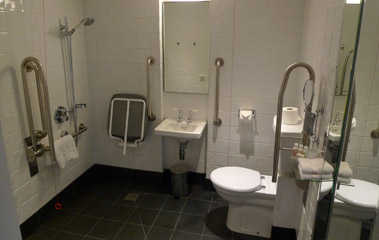
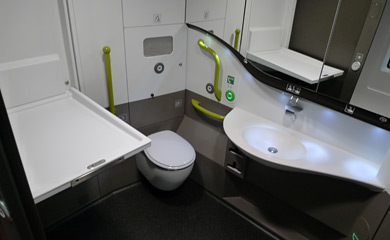
Eurostar can provide assistance to passengers with special needs travelling from London to Paris, Lille or Brussels. If you are confined to a wheelchair, there are wheelchair spaces and wheelchair-friendly toilets on each Eurostar train. There are also special fares for people travelling in wheelchairs and a travelling companion. Electric-powered scooters can also be carried, subject to some maximum dimensions, in the baggage area on each train. For more about travel with disabilities specifically on Eurostar, see www.eurostar.com.
-
For more about travelling by train throughout Europe if you have a disability, see the Travelling with Disabilities page.
What's the journey like?
This section describes a journey from London to Paris, but the journey from London to Brussels is identical until just after Lille, where the train leaves the Paris route and enters Belgium for the last half hour or so.
The train leaves St Pancras
The train manager makes his announcement that your Eurostar train to Paris is about to leave, the door alarm sounds and the doors then hiss shut. As you settle into your seat, the brakes hiss off and the Eurostar very gently eases itself out of the magnificent arched trainshed of St Pancras International Station. At this stage, the train is heading north, but almost immediately it makes a sharp right-hand turn past the huge steel gasometers that have been a familiar sight behind Kings Cross/St Pancras for years and which are now, believe it or not, listed structures. Within a minute or two the Eurostar enters a covered bridge across the tracks leading out of the adjacent Kings Cross station, which becomes a long tunnel under east London taking the Eurostar east and south.

East London & Dartford Crossing
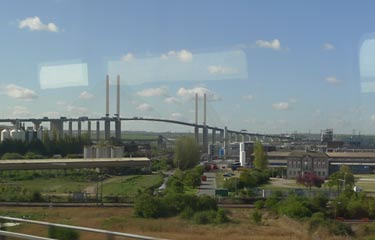
About 5 minutes after leaving St Pancras, you'll see a glimpse of daylight and the platforms of Stratford International station, only served by the domestic high-speed trains. Around 8 minutes after leaving St Pancras, the Eurostar train emerges from the tunnel and starts crossing the wastelands of east London, past warehouses and run-down housing estates. Just 10-12 minutes from St Pancras you'll see the impressive Queen Elizabeth II suspension bridge on the right, which carries the M25 London orbital motorway across the River Thames at the Dartford Crossing. The Eurostar now plunges back into a short tunnel for its own crossing underneath the Thames, emerging the other side in the county of Kent.
Over the Medway Viaduct
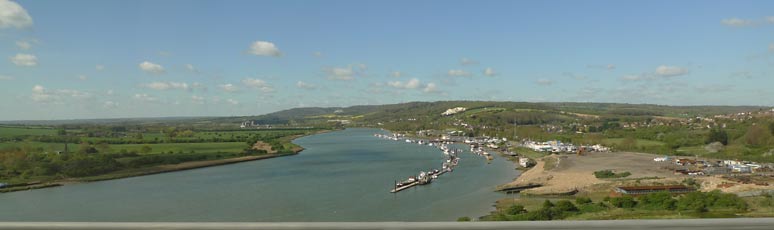
The Eurostar train is now running at its full service speed of 186mph (300 km/h), with traffic on the adjacent London-Dover M2 motorway almost standing still in comparison. Just 15-20 minutes after leaving London, the train crosses the most dramatic structure on the new high-speed line, the viaduct high over the River Medway. To the right of the train as it crosses the viaduct, you'll see small boats moored on the muddy riverbanks far below you. To the left of the train, over the top of the adjacent M2 motorway bridge, you can see Rochester Cathedral and Rochester Castle in the distance.
Across rural Kent
Now at last you're in green and pleasant rural Kent, with villages nestling at the foot of the chalky hills to the left. Eurostars all now 'fly' over the railway junction town of Ashford on a huge flyover, with the station way below you, the town centre to the left and the old Southern Railway Ashford works to your right.
Into the Channel Tunnel
Just 35 minutes from St Pancras, the fields and hedgerows of east Kent give way to the roadways and check-in lanes of the Folkestone Eurotunnel terminal. This is where cars and lorries are put on the Eurotunnel car-carrying shuttle trains to go through the tunnel to France. Your Eurostar train passes through the middle of the terminal non-stop, and the train manager announces that you are about to enter the Channel Tunnel. Passing through the Channel Tunnel takes just 20 minutes, and is something of an anti-climax. The Channel Tunnel (these days only called the 'Chunnel' by American visitors) is just like any other rail tunnel, only a bit longer. As a precaution, the yellow fire safety doors between each pair of coaches are closed during the tunnel transit, but you can still pass through freely if you want. You still get phone reception inside the tunnel now, with mobile data too.
Welcome to northern France
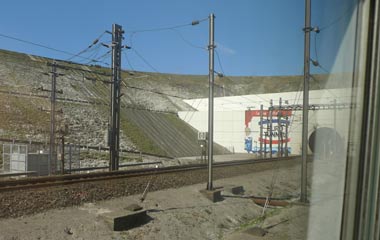
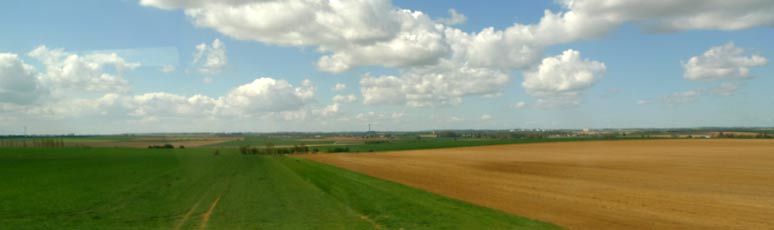
The tunnel is dark, so nothing to see, and no, you can't see the fishes. But the Eurostar soon bursts into the daylight again at up to 100 mph, and you're now in France. You'll see the French terminal for the car-carrying trains away to your left. If you look to the horizon on the left, you can just see the distinctive clock tower of Calais town hall. Eurostar accelerates onto the French high speed line, passing non-stop through Calais-Fréthun station, a few miles from Calais town centre. Unlike conventional railways, the high speed line follows the contours of the land more like a motorway, and you will feel the Eurostar rising onto the hills and settling into the dips. The area of Northern France crossed by Eurostar is largely flat farmland, dotted with villages built around ancient stone churches. The variety of church spires you can see is remarkable! The Eurostar may call at Lille or simply pass through on the centre tracks. The line to Brussels curves off to the left soon after Lille. Paris is now less than an hour away.
Your train arrives in Paris!
The high-speed line to Paris ends just short of Paris Gare du Nord, and the Eurostar passes seamlessly onto a short stretch of conventional line to complete its journey into Paris Gare du Nord, the historic terminus where the 'boat trains' from Calais or Boulogne used to arrive. The Gare du Nord is also the station for trains to Brussels, Amsterdam, and Cologne in Germany, and you will see red & silver Eurostar (formerly Thalys) trains heading to and from these places.
Eurostar arrives at platforms 3-6 at the Gare du Nord, you get off the train and walk forward through the open glass gates off the end of the platform onto the concourse. Turn right for taxis, forward & veer left for the escalator down to the metro & RER, or just head out into the streets of Paris. There are no checks or other formalities to go through on arrival, you just walk off the train, it's that easy! For the taxi rank, walk off the end of the platform onto the concourse, turn right and walk out of the side entrance. This video may help you know what to expect. See the Paris Nord station guide.

Above, arrival at Paris Nord. An e300 in the foreground on platform 5, an e320 in the background on platform 3.
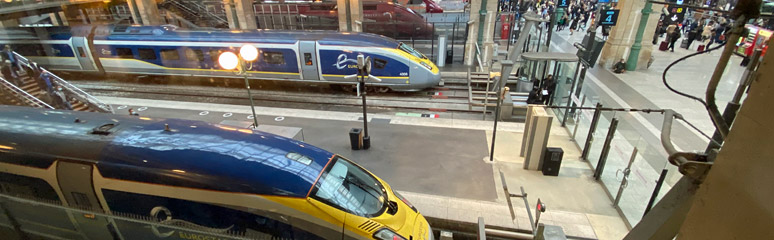
Above, Eurostars on platforms 3-6 at Paris Gare du Nord. Those glass gates are open on arrival, you just walk off the train onto the station. This photo was taken from the 1st floor Eurostar terminal, waiting to board a departing Eurostar back to London.
Changing in Paris or Brussels
Changing trains & stations in Paris: See the Paris metro page
-
Eurostar trains from London to Paris arrive at the Gare du Nord, but your connecting train will probably leave from one of the other Paris stations. The Gare de l'Est is a 10-minute walk from the Gare du Nord, but to get to any of the other Paris stations you'll need to take the metro or RER (Express Metro) across Paris. See the guide to changing trains & stations in Paris by metro or taxi. Left luggage lockers are available in Paris.
Changing trains in Brussels: See the Brussels Midi station guide
-
In Brussels, all long-distance trains including Eurostar use Brussels Midi station (Brussel Zuid in Flemish, Brussels South in English), so changing trains is easy. The 15-20 minute change into an ICE to Cologne & Frankfurt is quite normal. Left luggage lockers and a staffed left luggage office are available at Brussels Midi (24 hours). For more information & tips, see the Brussels Midi station guide.
The ferry alternatives to Eurostar
London to Paris
-
London to Paris via Dover-Calais
You can still travel from London to Paris by train and ferry if you want. The traditional route via Dover & Calais now takes over 9 hours and is not particularly convenient as you have to make your own way by taxi or on foot between Dover Priory station and the Eastern Docks in Dover, and between Calais ferry terminal and Calais Ville station in Calais. It usually costs more than a cheap Eurostar ticket, too.
But if you want to try is, see London to Paris by train & ferry page.
-
London to Paris via Newhaven-Dieppe
This is a longer sea crossing than Dover-Calais, but on the UK side you can walk from station to ferry terminal and on the French side there's a transfer bus, see London to Paris by train & ferry page.
-
London to Paris overnight via Portsmouth-Caen
There's an overnight train-ferry-train option leaving London Waterloo around 18:00, you sleep in a comfortable cabin with shower & toilet 22:45-06:45 on Brittany Ferries' overnight sailing from Portsmouth to Caen, then take a train from Caen to Paris St Lazare arriving around 11:05.
This is good alternative to Eurostar, see London to Paris by train & ferry page.
Harwich to Hoek van Holland
-
There's an excellent rail & sail option from London, Cambridge & Harwich to Hoek van Holland with rail connections to Rotterdam, Amsterdam, Germany and beyond, see the Stena Line Rail & Sail London to Amsterdam page.
This excellent route has easy train-ferry connections on both sides of the Channel. You'll find journey options via this ferry crossing from the UK to Germany, Austria, Poland, Czechia, Denmark, Sweden and so on shown on the relevant country pages.
Hull to Rotterdam
-
P&O Ferries sail overnight from Hull to Rotterdam Europoort, see the Hull to Rotterdam page.
A transfer bus takes you from Europoort to Rotterdam Central. Once in Rotterdam it's easy to take a train to Amsterdam, Utrecht, Antwerp or Brussels, change at Amsterdam for trains to Berlin, Cologne or Frankfurt, or sleeper trains to Zurich, Vienna, Munich & Prague.
Newcastle to Amsterdam
-
DFDS (www.dfds.com) sail overnight from Newcastle to IJmuiden (the port of Amsterdam), see the Newcastle to Amsterdam page.
A transfer bus takes you from IJmuiden to Amsterdam Centraal. Once in Amsterdam it's easy to take a train to Antwerp, Brussels, Berlin, Cologne or Frankfurt, or a sleeper train to Zurich, Vienna, Munich or Prague.
UK to Spain by ferry
-
Brittany Ferries (www.brittany-ferries.co.uk) sails from Portsmouth & Plymouth to Bilbao & Santander in Spain, from where trains run to Madrid. For details, see the UK to Spain by ferry page.
European Rail Timetable & maps

 The
European Rail Timetable
(formerly the Thomas Cook European Timetable)
has train & ferry times for every country in Europe plus
currency & climate information. It is essential
for regular European train travellers and an inspiration for armchair
travellers. Published since 1873, it had just celebrated 140 years of
publication when Thomas Cook decided to pull the plug on their entire publishing
department, but the dedicated ex-Thomas Cook team set up a private venture and
resumed publication of the famous European Rail Timetable in March 2014.
You can buy it online at
www.amazon.co.uk (UK addresses) or
www.europeanrailtimetable.eu (shipping worldwide).
More information
on what the European Rail Timetable contains.
The
European Rail Timetable
(formerly the Thomas Cook European Timetable)
has train & ferry times for every country in Europe plus
currency & climate information. It is essential
for regular European train travellers and an inspiration for armchair
travellers. Published since 1873, it had just celebrated 140 years of
publication when Thomas Cook decided to pull the plug on their entire publishing
department, but the dedicated ex-Thomas Cook team set up a private venture and
resumed publication of the famous European Rail Timetable in March 2014.
You can buy it online at
www.amazon.co.uk (UK addresses) or
www.europeanrailtimetable.eu (shipping worldwide).
More information
on what the European Rail Timetable contains.
Rail Map Europe is the map I recommend, covering all of Europe from Portugal in the west to Moscow & Istanbul in the east, Finland in the north to Sicily & Athens in the south. Scenic routes & high-speed lines are highlighted. See an extract from the map. Buy online at www.europeanrailtimetable.eu (shipping worldwide) or at www.amazon.co.uk (UK addresses).
Hotels in London or Paris
A Paris hotel for a romantic break
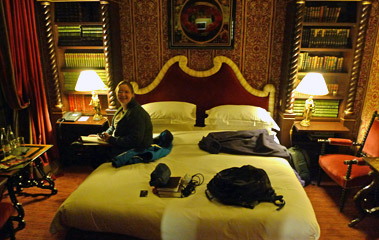
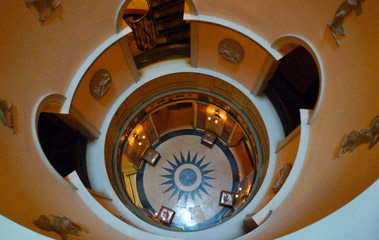
There's the famous & flashy Paris Ritz in the Place Vendôme (over €500 a night) or the similarly-priced Le Meurice, but if you want a really special hotel for a luxury break or romantic weekend and can afford around €300 a night, I'd recommend the small, sumptuous, intimate L'Hotel.
It's on the bohemian left bank, walking distance from the Seine, the Ile de la Cité & Notre Dame. Oscar Wilde spent the last days of his life here in room 16, famously quipping, "My wallpaper and I are fighting a duel to the death. One or the other of us has to go.". Fortunately the wallpaper is now all in very good taste. The hotel has been used by many famous people since then, from Sinatra to Mick Jagger. Rooms are on the cosy side, but they are beautifully decorated and have character that bigger and flashier hotels lack. Book a stay at l'Hotel. Book a private transfer from station to hotel.
Hotels near the Gare du Nord & other Paris stations
Hotels near the Gare du Nord with good reviews: Libertel Gare du Nord Suede (5 min walk from Gare du Nord, 2-star), 25 Hours Terminus Nord (formerly the Mercure Terminus Nord, now refurbished in a decidedly funky style, 3-star, directly across the road from the station); Art Hotel (3-star); Avalon Hotel (2-star); Hotel Cambrai (5 min walk from Gare du Nord, 1-star).
Hotels near the Gare de l'Est with good reviews: Libertel Gare de l'Est Français (opposite the station, 3-star); Libertel Gare du Nord Suede (350m from the Gare de
Hotels near the Gare de Lyon with good reviews: Hotel Terminus Lyon (right in front of the station, 3-star); Mercure Paris Gare de Lyon (on the station itself, 4-star); Novotel Paris Gare de Lyon (opposite the station, 4-star); Mistral Hotel (800m from Gare de Lyon, 1-star); Hotel 26 Faubourg (5 min walk from Gare de Lyon, 2-star);
Hotels near the Gare de l'Est with good reviews: Libertel Gare de l'Est Français (opposite the station, 3-star); Libertel Gare du Nord Suede (350m from the Gare de l'Est, 2-star); OKKO Hotels Paris Gare de l'Est (2-star).
Hotels near the Gare Montparnasse with good reviews: Mercure Paris Gare Montparnasse (150m from the Gare Montparnasse, 4-star); Best Western Sevres Montparnasse (15 minute walk to Gare Montparnasse, 3-star); La Maison Montparnasse (10 min walk from station, 2-star); Hotel du Maine (5 min walk from station, 2-star).
Affordable hotels near London St Pancras
These affordable hotels are close to St Pancras with good or great reviews:
Alhambra Hotel, Meridiana Hotel, MacDonald Hotel, Angus Hotel or Crestfield Hotel.
Top choice: St Pancras Renaissance Hotel
In March 2011 the luxurious, expensive and beautifully-restored 5-star St Pancras Renaissance Hotel opened for business. Designed by the renowned architect Sir George Gilbert-Scott, it first opened in 1873 as The Midland Grand Hotel, a railway hotel built into the Victorian architectural masterpiece that is St Pancras station. The hotel closed its doors in 1935, considered too large and outdated to continue as a hotel, and after a period of being used as railway offices, this beautiful landmark building was left derelict and slowly decaying. However, its fortunes have now been totally reversed. High-speed Eurostar trains to Paris leave from St Pancras station's magnificently-restored 1868 trainshed designed by William Barlow, and the once derelict Midland Grand Hotel has been reborn as a glorious 5-star hotel, St Pancras Renaissance Hotel. No expense has been spared in recreating and restoring this Grade 1 listed building to its former glory.
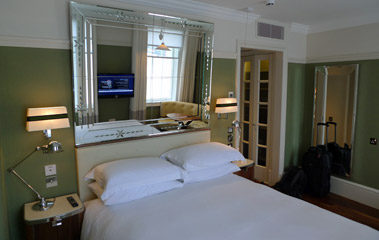
Barlow rooms are in the newly-built Barlow House wing at the side, these start at around £250 a night.
Chambers rooms are in the original St Pancras Midland Hotel building, rooms start at around £500 a night, rising to suites costing several thousand.
If you're going to splurge, make sure you book a Chambers room.
You can of course just have a drink in the bar or meal in the restaurant, accessible from the south west corner of the upper level concourse, the same level as the Eurostar trains. The bar-restaurant is housed in what was once St Pancras station's booking office, the Grade 1 listed wood-panelled booking windows are still there behind the bar, and it still says 'Booking office' in the stones above the entrance doors. The hotel lobby has been built in what was once the station's taxi rank.
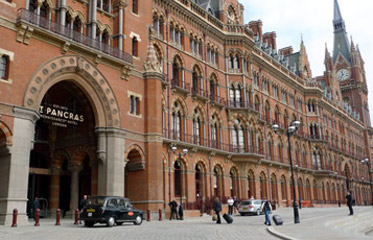
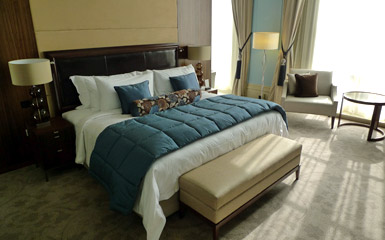
5 stars. The magnificently-restored St Pancras Renaissance Hotel. Above left: A Chambers room.
It's arch-rival: Great Northern Hotel
Another classic railway hotel (and arch-rival to the former Midland Hotel at St Pancras) re-opened after refurbishment to top class standards in 2013. It's cheaper than the Renaissance St Pancras, it's just across the road from the entrance to St Pancras International's Eurostar check-in area so ideal for an early morning train. On each floor you'll find a pantry with complimentary coffee, tea, cake and even jelly-babies. Check prices & book.