


 |
||
|
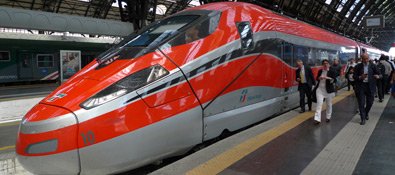
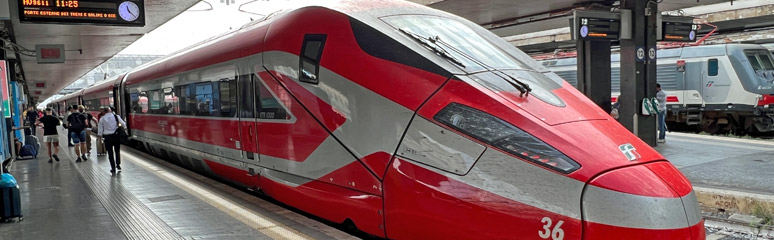
These Frecciarossa 1000s link Milan, Florence, Rome and Naples at up to 300 km/h (186 mph). |
||
|
|
||
|
||
|
|
||
|
|


Times, fares & how to buy tickets
The best way to visit the cities of Italy is by train, trains link almost every town & city of any size, there are even trains to Sicily! This page explains how Italian trains work, whether to use Trenitalia or Italo, whether a rail pass is worth buying, and how best to buy tickets.
 How to check
train schedules & fares
How to check
train schedules & fares
Maps of the Italian rail network
CartaFRECCIA - Trenitalia's loyalty card
Railpasses - the Trenitalia Pass
Railpasses - the Italia In Tour pass
Frecciarossa,
Frecciargento,
Frecciabianca & Italo
Intercity trains &
Intercity Notte sleeper trains
Regional & Regional Express trains (R, RV)
Travel tips: ticket validation,
food, lounges...
Which station to use in which city?
Luggage storage at
stations in Italy
How to use the
Italian Railways website
How to use self-service ticket machines
Holidays, vacations & tours
in Italy
by train
Hotels in Italy convenient for arrival by train
How to reach specific places
How to reach
Herculaneum &
Sorrento
How to arrange a day trip to Pompeii
How to reach Capri, Ischia &
the Amalfi coast
How to reach Sardinia & trains in Sardinia
Airport links: Milan Malpensa, Rome Fiumicino, Pisa
Station guides
Milan Centrale
& Porta Garibaldi
Turin Porta Susa & Porta Nuova
City maps showing stations
Map of Milan
Map of Venice
Map of Florence
Map of Rome
Map of Naples
Map of Turin
International trains to & from Italy
Train travel from the UK to Italy
Trains to Italy from other European cities
Trains from Rome to other European cities
Trains from
Florence to other European cities
Trains from Venice to other European cities
Trains from Milan to other European cities
Trains from Naples to other European cities
Other useful information
Useful country information
- currency, dial code...
Suggested hotels
in Venice, Florence, Rome, Naples
How to use an Interrail pass -
the European railpass
An introduction to European train travel
Nice,
Cannes & Monaco to Italy by train
TGV high-speed
trains from Paris to Italy
Travel insurance, mobile data,
VPN & other tips
Useful country information
How to check train schedules & fares
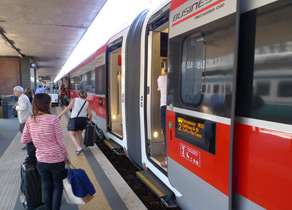 No check-in, no hassle. Simply walk from the city centre into the station, glance at the departures board, walk to your train and hop on, any time up to departure. Above, a Frecciarossa has arrived at Rome Termini |
|
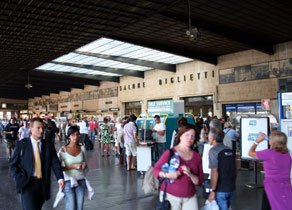 Concourse at Florence SMN, walking distance from the famous Duomo & Ponte Vecchio. |
-
Check train times & fares within Italy using any of the websites shown here.
-
Some major cities have more than one main station, see which station to use in which city. If you're not sure, most websites allow you to select the plain city name, or any station.
-
Most Italian trains are run by state-owned national operator Trenitalia, but privately-owned high-speed Italo trains compete with Trenitalia on the high-speed lines linking Turin, Milan, Venice, Bologna, Florence, Rome, Naples & Salerno. If you use Trenitalia.com or Italiarail.com you'll only see Trenitalia's trains, but if you use Thetrainline.com or Raileurope.com you'll see both operators' trains and can compare prices. This is worth remembering! More about Italo. Which is better, Trenitalia or Italo?
-
Some tourist destinations have no station but can be reached by bus, such as San Marino, Positano, Praiano & Amalfi. To reach the islands of Ischia, Capri & Sardinia you'll need a ferry. See how to reach major tourist destinations not on the rail network.
-
A few tourist destinations are served by a local railway run by a transit authority and cannot be found using websites that only show Trenitalia trains. For example, Sorrento, Pompei and Herculaneum are linked to Naples by the Circumvesuviana Railway run by EAV, see the information here.
Maps of the Italian rail network
-
Schematic rail map (not all routes shown) with real-time train info.
Do you need to buy in advance?
-
Regional trains, no
For example, Pisa to Florence, Florence to Lucca or Siena, Milan to Como or Tirano, Venice to Trieste.
There's no need to buy in advance and no cost advantage in doing so as the price is fixed, buying online or in an app just saves time at the ticket office. There are no assigned seats, you sit where you like. In most cases tickets are sold in unlimited numbers so the train can't sell out, although regional trains on a few routes now have limited numbers.
Since August 2023, online tickets for regional trains work in a fiddly but flexible way, learn more about regional (R) & regional express (RV) trains and how regional tickets work.
-
Long-distance trains, yes
For example, Venice to Florence or Rome, Rome to Naples or Turin, Milan to Venice.
All seats on Frecciarossa, Frecciargento, Frecciabianca & InterCity trains are reserved, so they can in theory sell out. However, as there are so many trains each with hundreds of seats there are almost always places available on most trains even just before departure. So you can buy at the station on the day if you want. The issue is price. Trenitalia ditched the old fare-per-kilometre approach to pricing in 2009 and adopted airline-style dynamic pricing for advance-purchase fares whilst increasing the fully-flexible Base price. So on the day of travel you'd pay the Base fare, Rome-Florence €55, Rome-Venice €99, but if you book in advance you can buy a cheap Economy or Super-Economy fare from as little as €19.90 Rome-Florence or €29.90 Rome-Venice, assuming you're OK with limited or no refunds or changes to travel plans. It's your call!
When does booking open?
-
Booking opens up to 4 months ahead, but this varies
It can shrink to as little as 30 days for dates immediately after Europe-wide timetable changes on the 2nd Saturday in June and the second Saturday in December.
-
If some trains are shown, but others are missing...
Trenitalia loads trains in blocks, usually high-speed trains first and regional, InterCity & sleeper trains later. I've seen high-speed trains loaded, but not regional trains. I've seen regional trains loaded, but not high-speed trains. Intercity trains to Sicily and ICN sleeper trains usually get loaded last, after other trains. The Milan-Sicily night train usually gets loaded last of all!
So if you don't see all the trains you expect to see, don't assume that the missing trains have all been mysteriously cancelled, assume they haven't been loaded yet. Wait! Remember that the Italians themselves buy train tickets just hours, days or weeks ahead, not 6 months!
Types of fare
-
Base fare
This is the fully-flexible fare for Trenitalia's high-speed Frecce & intercity trains, it's what you'd pay at the station on the day. Refundable, only valid on the train booked but can be changed as many times as you like before departure or (just the once) up to an hour after departure.
The Base fare was originally one fixed price for a given journey, but since 2017 the Base fare for Frecciarossa & Frecciargento trains varies slightly by day of the week or the popularity of each particular train.
-
Economy & Super-Economy
These are cheaper advance-purchase fares for Trenitalia's high-speed & intercity trains, only valid on the train booked, no refunds, limited availability. Economy tickets can be changed before departure, paying any difference in fare. Super-Economy tickets cannot be changed, use it or lose it.
These are the fares you want for cheap travel if you are certain what time train you want. The price varies like air fares, cheaper in advance and on less popular dates, more expensive close to departure and on busy days or times of day.
-
Speciale Frecce
An ultra-cheap advance purchase fare for Trenitalia's high-speed & intercity trains, buy at least 14 days ahead. No refunds, no changes.
-
Insieme
A small group fare for 3-5 people. Limited availability, price varies. No refunds, no changes, use it or lose it.
-
Senior & FrecciaYoung
These can only be bought if you have Trenitalia's Cartafreccia railcard which you probably haven't, so ignore these. When you select them it immediately asks for your Cartafreccia card number, so you can't buy them by mistake!
-
Ordinaria
This is the normal fare for regional trains. It's fixed-price, you can buy a ticket at that price even on the day. Since 2023, online regional tickets are only good for the specific train you've selected, but you can change the date or time of departure free of charge up to 23:59 the day before departure, and you can change the time of departure until 23:59 on the day of travel.
Ordinaria tickets are available in unlimited numbers on most regional trains, although there are now some regional trains where the ticket numbers sold are limited, see more about how regional (R) & regional express (RV) trains are ticketed.
-
Smart & Smart2
These are cheap advance-purchase fares for international journeys. No refunds or changes, specific train only, limited availability, must be bought at least a week before departure.
-
Child fares & child age limits
Trenitalia changed its child age limits in 2012. On all trains, children under 4 go free with no ticket required, just bring them along. On regional trains, the old age limit still applies, children under 12 travel at the child rate. But now, on national trains children under 15 can travel at the child rate. National trains means Frecciarossa, Frecciargento, Frecciabianca, InterCity, InterCity Notte (ICN) sleeper trains. See the train travel with children page.
How to buy tickets
-
Option 1, buy at Italiarail.com - no booking fee!
You can buy Trenitalia tickets at www.italiarail.com in €, £, $, Ca$ or Au$ - to buy in US$ click here.
ItaliaRail are an established and reliable US-based agency who link to Trenitalia's ticketing system.
Italiarail books the same trains as Trenitalia's own website, but in plain English with no quirky translations. You can use familiar English place-names such as Venice or Florence. However, they don't sell tickets for Italo.
Italiarail shows a whole day's trains in the search results and can book up to 20 people at a time, Trenitalia's own website only shows a few hours-worth of trains at a time and can only book up to 5 people at a time.
Italiarail has implemented its own fare types, different from Trenitalia:
Basic is the cheapest fare, no refunds, no changes. It's the same price as whatever Trenitalia's cheapest fare is for that train, whether Super-Economy, Economy or Base, but it's always non-changeable & non-refundable when bought from Italiarail.
Viva is the flexible fare, 100% refundable and 100% changeable, often costing little more than the Basic fare. A Viva fare can be a better deal than Trenitalia's own fares as only Trenitalia's most expensive Base fare is refundable (and even then not 100%). Viva fares include free seat selection from a seat map, Trenitalia charge €3 for this. Viva fares also include access to ItaliaRail's lounge at Roma Termini.
Primo offers exactly the same features as Viva, but adds entry to major attractions in Rome, Florence & Venice such as the Colosseum, Pantheon or a gondola ride and some key travel-related discounts. Only buy the Primo fare if those add-ons make it worthwhile.
On a Frecciarossa, Italiarail refers to standard, premium, business & executive classes as standard, premium, 1st & VIP.
High-speed & intercity trains are ticketless, you print your booking reference or can show it on your phone. For regional trains you print your own ticket, show them in an app or in a few cases collect it from the self-service machines at a Trenitalia station.
-
Option 2, buy at Thetrainline.com
Thetrainline also connects to Trenitalia's system to sell tickets in plain English at the same prices as Trenitalia, in €, £, $, Ca$ or Au$, overseas credit cards no problem, small booking fee.
For an extra €4, you can choose your seats from a seat map on Trenitalia high-speed & intercity trains.
Thetrainline.com has two key advantages:
First, it sells tickets for Italo as well as Trenitalia, so you can compare times & prices for both operators.
Second, it also links to the French, Spanish, Swiss, German, Austrian & Benelux national ticketing systems so you can book train tickets across much of western Europe together all in one place.
High-speed & intercity trains are ticketless, you simply print your booking reference or show it on your phone. For regional trains you print your own ticket, can show them in an app or in some cases collect them from the self-service machines at a Trenitalia station. Who are Thetrainline.com?
-
Option 3, buy at Raileurope.com
You can also buy Trenitalia & Italo tickets at www.raileurope.com, also in plain English with prices in €, £ or $, small booking fee. It also connects to the French, German, Austrian, Spanish, British ticketing systems (but not the Swiss) so can sell train tickets for much of western Europe all in one place. Again, high-speed & intercity trains are ticketless so you simply print out your booking reference or show it on your phone, for regional trains you usually print your own ticket or collect tickets from the self-service machines at any main Trenitalia station. Who are Raileurope.com?
-
Option 4, buy at Trenitalia.com
You can of course buy Italian train tickets direct from Italian Railways at www.trenitalia.com, English button at the top, only in €. It's pretty easy to use but you'll need to use Italian-language place names (for example, Firenze or Venezia) and it has a few quirky translations & processes especially when booking sleepers or international trains so see the step-by-step guide.
High-speed & intercity trains are ticketless, you print your booking reference or show it on your phone, other tickets can be printed or collected at any main Italian station from the self-service machines. It also offers seat selection for €3 on high-speed & intercity trains.
Obviously, they don't sell tickets for their competitor Italo, or for other European trains outside Italy.
Buying tickets at the station
-
It's easy to buy tickets at the station on the day of travel, even if you don't speak Italian. You can buy at the staffed ticket office counters, but you may have to queue. It's usually much quicker to use one of the many Self service machines installed at all main stations, these have a touch screen with an English language facility, see an illustrated guide to using the ticket machines.
The machines sell both regional and long-distance tickets including seat reservations for long-distance trains (but unfortunately not Interrail passholder reservations), for any date you like in the next 90 days. They take Visa & MasterCard, but your card needs to have a PIN code.
Tip: You can also buy or change tickets or make passholder reservations for Trenitalia trains leaving in the next half hour or so at any of the little mobile Last Minute desks (servizi last minute) on the concourse. Much quicker than queuing at the ticket office!
-
Trains seldom sell out, finding tickets even on the day of travel isn't a problem unless you hit a major holiday period. If one train is full, the next will have seats. Just remember that high-speed & Intercity trains are cheaper booked in advance, just like flights. If you buy on the day, you will have to pay the 'Base' fare, in other words the top tier flexible price.


How to buy international tickets
-
The easy way
The easiest option is to use either www.thetrainline.com or www.raileurope.com as they can book most international journeys to/from Italy.
Both sites connect to the Trenitalia, SNCF (French), SBB (Swiss), ÖBB (Austrian) and DB (German) ticketing systems so they can book most routes to/from Italy including any Italian domestic connecting trains.
They're very easy to use, you can book in €, £ or $, international credit cards are no problem. There's a small booking fee.
Thetrainline.com allows you to select seats from a seat map on Trenitalia's high-speed & Intercity trains, and on French TGVs in 1st class.
For more specific information on international trains from Italy to other European cities and how to book them, click on your starting city:
-
The advanced way
Alternatively, you can book with the relevant operator, usually with no booking fee, but you need to know which operator runs which route. You'll often need to book any connecting trains separately, as most operators can't book each other's trains.
To/from Switzerland
The direct EuroCity trains between Milan and Brig, Lausanne, Geneva, Lugano, Luzern, Bern, Basel & Zurich can be booked at either www.italiarail.com or www.trenitalia.com.
Both sites can book from anywhere in Italy to any Swiss station that is directly served by the EuroCity trains from Milan. But they can't book onward tickets within Switzerland such as Brig to Zermatt, Arth-Goldau to Luzern or Spiez to Interlaken, so buy those separately from Swiss Railways at www.sbb.ch.
To/from Paris
The Frecciarossa trains between Milan/Turin & Lyon/Paris can be booked at either www.italiarail.com or www.trenitalia.com. Both sites can book from anywhere in Italy to Lyon or Paris. However, they can't book onward French trains to other French cities (or to London or Brussels) so you'll need to book those separately at www.sncf-connect.com.
The French TGV trains between Milan, Turin & Paris can be booked at the French Railways website www.sncf-connect.com with no booking fee. It allows you to choose a seat from a seat map in 1st class, too. However, it cannot book connecting Trenitalia trains within Italy, so you'll need to book those separately at either www.italiarail.com or www.trenitalia.com.
To Nice, Cannes, Monaco or Marseille
First book from anywhere in Italy to Ventimiglia (on the French border where Trenitalia's trains terminate) at either www.italiarail.com or www.trenitalia.com. Trenitalia can't sell an onward French ticket, so buy your onward ticket from Ventimiglia to any French destination at the French Railways website www.sncf-connect.com. There's more about the Italy-Nice route on the Italy to Nice page.
To Innsbruck, Munich & Germany by daytime trains
The railjet trains between Bologna/Venice/Verona and Innsbruck or Munich can be booked at the German Railways website int.bahn.de with no booking fee, this can book tickets from the EuroCity train's starting stations to anywhere in Germany, but it cannot book connecting Trenitalia trains within Italy (at least not in their main system with through fares), so book those separately at either www.italiarail.com or www.trenitalia.com.
To Vienna by daytime trains
The railjet trains between Venice and Vienna can be booked at the Austrian Railways website www.oebb.at with no booking fee, this can book tickets from Venice to anywhere in Austria, but it cannot book connecting Trenitalia trains within Italy, so book those separately at either www.italiarail.com or www.trenitalia.com.
To Munich & Vienna by Nightjet sleeper train
The Nightjet sleeper trains between Rome, Florence, Genoa, Milan, Venice and Munich or Vienna can be booked at the Austrian Railways website www.oebb.at, but this can't book connecting trains within Italy, so book those separately at either www.italiarail.com or www.trenitalia.com.
CartaFRECCIA loyalty scheme
-
CartaFRECCIA is Trenitalia's loyalty scheme, free to join.
-
For most visitors, there's not much point in applying as you probably won't clock up enough points to make it worth it. Basically, €1 spent = 1 point. 300 points = €10 off a train journey. So only worth considering if do lots of train travel, perhaps on multiple trips to Italy.
-
However, if you are under 30 or over 60, becoming a CartaFRECCIA member allows you to buy the cheap FrecciaYOUNG & FrecciaSENIOR fares for Frecciarossa & Frecciargento trains and the Young & Senior fares for Frecciabianca, Intercity and Intercity Notte trains.
But here's a reality check: If you're booking a month or more in advance, a normal advance-purchase Super-Economy fare without any youth or senior discount is often cheaper than the FRECCIAyoung/FRECCIAsenior fare. So again, it may not be worth applying.
Only if travelling in the next few weeks when normal advance-fares have risen in price do the CartaFRECCIA youth/senior fares save money. But the CartaFRECCIA youth/senior fares must be bought at least 5 or 6 days in advance, so aren't any good for very short notice flexible travelling.
So before applying for a CartaFRECCIA card, do some dummy bookings and compare the senior/youth prices with the normal Economy & Super-Economy fares. Is it worth it?
CartaFRECCIA points and youth/senior fares do not apply to regional trains, only Frecce & Intercity.
-
How to get a CartaFRECCIA card
Go to www.trenitalia.com/it/cartafreccia.html (please let me know if that link changes).
At the time I write this it's in Italian with no English version, so use Google's Chrome browser, right-click and select Translate to English or use Google Translate. Click the red Inscrivit a CartaFreccia button.
Fill in the form to sign up. The normal process requires an Italian address, as a foreigner you should tick the I do not have a tax code box and use the My residence is abroad toggle.
-
Using a CartaFRECCIA card
You can use a CartaFRECCIA card when booking at raileurope.com, thetrainline.com or trenitalia.com, but not italiarail.com.
Should you buy a railpass?
-
If you just want to make one, two or perhaps three journeys from A to B, book point-to-point tickets in advance online, it's the cheapest & easiest option. But for a more extensive itinerary, consider a railpass. A railpass allows you to stay flexible.
Interrail passes
-
Global & one-country passes
You can buy an Interrail pass giving unlimited travel on Trenitalia trains all over Italy. An Interrail global pass covers most of Europe including Italy, a cheaper Interrail one-country pass only covers Italy.
Interrail passes cover all Trenitalia trains, high-speed, intercity, Intercity Notte and regional. They don't cover Italo trains, or some small railways such as the Circumvesuviana Railway Naples-Sorrento.
-
Reservation fees
Interrail passholders must reserve seats to travel on Frecciarossa, Frecciargento & Frecciabianca trains, this costs €13 in addition to the cost of the pass. The reservation fee for Intercity trains is €3. For Intercity Notte sleeper trains, see the reservation fees here.
You can make passholder reservations online as explained in the Italy section of the Interrail reservations page. You can also make them at stations, but at the staffed counters only, not the self-service machines. Passholder reservations cannot be made at Trenitalia.com.
-
Is a rail pass worth it?
People struggle with this, perhaps because they think point-to-point fares have one fixed price that can be compared with a pass. But point-to-point fares vary like air fares so you have to check actual fares for your specific trains & dates. And it's not just about price, it's about how you value the flexibility of a pass versus cheap but inflexible no-refunds no-changes tickets. Here's how to make a decision:
First go to www.thetrainline.com/passes and check the current price for a single-country Interrail pass for Italy for however many days you want. Divide the cost by the number of days. That's the cost-per-day. Now add in the €13 reservation fee for a high-speed train.
At the time I write this, a 4-day Italy pass works out as €49 per day + €13 = €62 assuming you only make one journey per day.
Here are some point-to-point fares for comparison:
Rome to Florence: Cheapest possible price, no refunds, no changes, €19.90. Flexible 'Base' fare €50.
Florence to Venice: Cheapest possible price, no refunds, no changes, €19.90. Flexible 'Base' fare €57.
Naples to Florence: Cheapest possible price, no refunds, no changes, €29.90. Flexible 'Base' fare €76.
Rome to Venice: Cheapest possible price, no refunds, no changes, €29.90. Flexible 'Base' fare €92.
Do you notice anything? It's not a trick question!
As you can see, point-to-point fares can be cheaper than a [pass + reservation fee], but (a) you get zero flexibility with the cheapest point-to-point prices, specified train only with no changes allowed, no refunds and (b) I'm quoting the cheapest possible price here, point-to-point fares vary like air fares and for your date or train usually cost significantly more than the cheapest possible price.
If you need flexibility, a [pass + reservation fee] costs a little more than the full-flex Base fare for short hops such as Rome-Florence, but saves money on longer trips such as Rome-Venice or Naples-Florence.
I'm assuming one trip per day here. Passes give you unlimited trips and mileage, with complete flexibility. As soon as you want to make multiple trips the same day (Rome to Florence and back, for example, or Rome to Florence then a side trip to Pisa and back to Florence), a pass makes sense.
Also, children under 12 qualify for a free Interrail pass (but still have to pay for reservations), so if you have kids, that can swing it towards a pass.
The Trenitalia Pass
-
Trenitalia also sell their own railpass called the Trenitalia Pass. It can be bought by anyone resident outside Italy.
-
How is it different from an Interrail pass?
Unlike an Interrail pass, it only covers Trenitalia high-speed, Intercity & Intercity Notte sleeper trains. It doesn't cover regional trains.
Unlike an Interrail pass, it doesn't give you unlimited travel, you buy a specific number of journeys (3, 4, 7 or 10 trips) to be made within a set period of days, where a journey = one ride on one train. If you went Rome to Florence in the morning and back in the evening, that's 2 trips on a Trenitalia Pass, but would be covered by just one day on an Interrail pass.
But on the plus side, unlike with an Interrail pass there are no extra fees to pay for reservations, it's all included.
-
Is a Trenitalia Pass cheaper than an Interrail pass?
A Trenitalia Pass for a given number of trips is significantly cheaper than a global Interrail pass covering the same number of days.
A Trenitalia pass is about the same price as a one-country Interrail pass for Italy covering the same number of days, but as you don't need to pay €10 for every reservation, the Trenitalia pass works out cheaper.
That assumes you plan to use only one train per day. A 4-journey Trenitalia Pass gives 4 individual train rides, a 4-day Interrail pass gives unlimited rides, as many as you can cram in over 4 days. If you're going to use multiple trains per day, an Interrail pass is a better deal.
-
Is a Trenitalia Pass cheaper than point to point tickets?
A Trenitalia Pass saves money over the fully-flexible Base fare even for a series of short hops such as Rome-Florence, Florence-Venice, Venice-Milan, especially if you are under 28 so qualify for the youth pass. But if you can book a few months in advance and don't need any flexibility, a no-refunds no-changes advance-purchase Super-Economy fare can still be cheaper than a Trenitalia Pass, check prices before buying a pass.
-
Trenitalia passes come in 4 sizes:
3 journeys within 7 consecutive days;
4 journeys within 7 consecutive days;
7 journeys within 15 consecutive days;
10 journeys within 30 consecutive days.
-
Trenitalia passes come in 2 classes:
Easy - good for 2nd class, standard class on Frecciarossa, seats or couchettes on Intercity Notte trains.
Comfort - good for 1st class, business class on Frecciarossa, seats, couchettes or double or triple sleepers on Intercity Notte trains trains.
Executive for executive class has been discontinued.
-
Trenitalia passes come in 3 passenger types:
Adult - up to 2 children under 12 can be added to an adult pass for free (but infants under 4 go free anyway, of course)
Youth - anyone under 28 on day of purchase.
Senior - anyone over 60 on day of purchase.
For more details and all the small print, see www.trenitalia.com and look for Trenitalia Pass.
-
How to buy a Trenitalia pass
You don't need to specify dates when buying a Trenitalia pass, you can book your first train for travel on any date up to 11 months afterwards.
Go to the www.trenitalia.com home page and switch it to English top right.
Click Advanced search above the journey planner. Click Carnet. Then look for & click Trenitalia pass.
After buying the pass, you're emailed your pass number. The pass is entirely electronic.
Tip: I recommend registering for an account at Trenitalia.com before buying a pass. Log into your account before buying.
-
How to book trains with a Trenitalia Pass
Seat reservations are needed on each train, but they are free and can be made online at Trenitalia.com or at stations.
Go to the www.trenitalia.com home page and switch it to English top right.
Click Advanced search above the journey planner. Click Carnet. Then click Trenitalia pass. Then click Book.
Enter you pass number, first & last name of the passholder, hit Confirm and book a train with your pass.
The pass validity period starts ticking from the date of the first train you book. So don't book your second train first then try to book another train for the previous day, that won't work. You must book your trains in the order you'll take them!
Reservations have the same change conditions as a Base fare. So you can cancel or change a reservation any time up to 60 minutes after the departure of the train. If you don't do that, 60 minutes after departure that journey is considered 'used up' even if you missed the train.
When travelling, the pass can be shown on your phone or printed out.
Feedback from buying & booking trains using a Trenitalia pass would be appreciated, as without buying a pass I cannot test the process myself.
Italia In Tour, for regional trains
-
Italia In Tour passes are available for 3 or 5 consecutive days unlimited travel on Trenitalia regional trains all over Italy.
Good for any Trenitalia regional, regional express & metropolitan train. But not valid (1) between La Spezia & Levanto through Cinque Terre, (2) within the territory of Lombardy, (3), the provinces of Bolzano and from Trento to Bassano del Grappa. It can't be used on other operators' trains such as Trenord, so not valid between Milan & Tirano, for example.
It'd be ideal for a series of day trips from Florence to Siena, Luca, Pisa on successive days. Or you could use it to work your way right across Italy on regional trains. With this pass you can just hop on and off Trenitalia regional trains, as you like.
At the time I write this, it costs €35 for 3 days and €59 for 5 days, check latest prices online.
You must buy before midnight the day before it starts, you cannot buy on the day.
-
To see prices and buy a pass, see www.trenitalia.com/en/offers/italia-in-tour.html (please let me know if that link stops working).
Tours of Italy by train
-
Railbookers are a train travel specialist who can put together a tour of Italy for you as a package, including rail travel, hotels & transfers. On their website you'll find a range of suggested tours which can be varied or customised to your own requirements. And as you're booking a package, they'll take care of you if anything happens to one part of the itinerary such as a strike or delay. They have offices in the UK, USA & Australia.
 In the UK call 0207 864 4600,
www.railbookers.co.uk
- please quote 'Seat 61'.
In the UK call 0207 864 4600,
www.railbookers.co.uk
- please quote 'Seat 61'. In the USA call free 1-888-829-4775,
www.railbookers.com.
In the USA call free 1-888-829-4775,
www.railbookers.com. In Canada call free 1-855-882-2910,
www.railbookers.com.
In Canada call free 1-855-882-2910,
www.railbookers.com. In Australia call toll-free 1300 971 526,
www.railbookers.com.au.
In Australia call toll-free 1300 971 526,
www.railbookers.com.au.
 In New Zealand call toll-free 0800 000 554 or
see website.
In New Zealand call toll-free 0800 000 554 or
see website.

-
Byway (Byway.travel) is a new UK-based eco-holiday firm with a 5-star TrustPilot rating. If you're nervous about booking train travel yourself, they'll book a trip for you as a package, including overnight hotels. Byway includes package protection, Covid refund guarantee, free disruption & re-planning and on-demand WhatsApp support while you're away.
Browse their pre-configured packages to Italy by train at www.byway.travel/.../italy-by-train.
Or ask them to build a trip to your requirements, call 020 4652 0805 (09:00-17:00 Monday-Friday) or email them or use the contact form.
If you live outside the UK, no problem, send them an email or use their contact form or call +44 20 4652 0805. If you live in the United States, you can call them on +1 608-305-8106.
Or try designing your own trip using their new map interface at www.byway.travel/map (in beta).
Please say you heard about them from Seat 61.
-
Tailor Made Rail can arrange tours of Italy by train based on your own requirements, they welcome complex itineraries. As it's a package, they'll take care of you if anything happens on one part of the trip, for example, a national strike. They're TTA-protected, which is similar to ATOL's protection for air travel.
Call their dedicated seat61 phone line 020 3778 1461 and quote seat 61 when booking. From outside the UK call +44 20 3778 1461. Lines open 09:00-17:30 Monday-Friday. Their website is www.tailormaderail.com/destinations/italy.
Expert individual trip planning & advice
-
DiscoverByRail.com offers an expert 'travel architect' service to plan trains around Europe, with suggestions for routes, trains, hotels to your own specification.
Frecciarossa: See the Frecciarossa guide
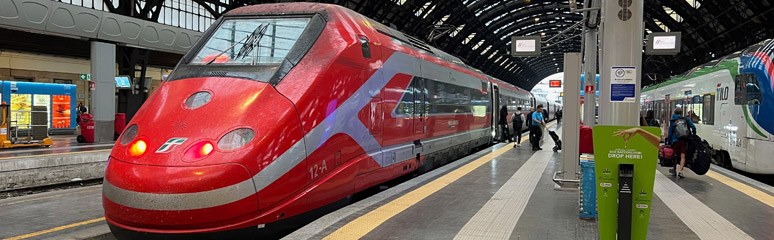
Trenitalia's top high-speed trains are the Frecciarossas (red arrows), mostly operated either by the original 300 km/h (186 mph) Frecciarossa 500 trains or the latest Frecciarossa 1000 trains introduced in 2015. Some are operated by 250 km/h (155 mph) Frecciarossa 700 & Frecciarossa 600 trains.
Frecciarossas have 3 or 4 classes of accommodation, a cafe-bar, power sockets at all seas & free WiFi, see the Frecciarossa page for more information.
Tickets for all Trenitalia's long-distance trains include a seat reservation and are only valid on the specific date & train you've booked.
Principal Frecciarossa routes: Turin-Milan-Bologna-Florence-Rome-Naples-Salerno (Frecciarossa 1000 & 500); Venice-Florence-Rome-Naples (Frecciarossa 1000 & 500); Turin-Milan-Verona-Venice (usually Frecciarossa 700); Milan-Ancona-Bari-Brindisi-Lecce (Frecciarossa 500). See seat maps.
Frecciargento: See the Frecciargento guide
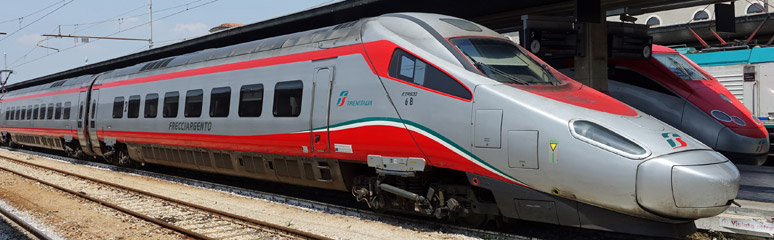
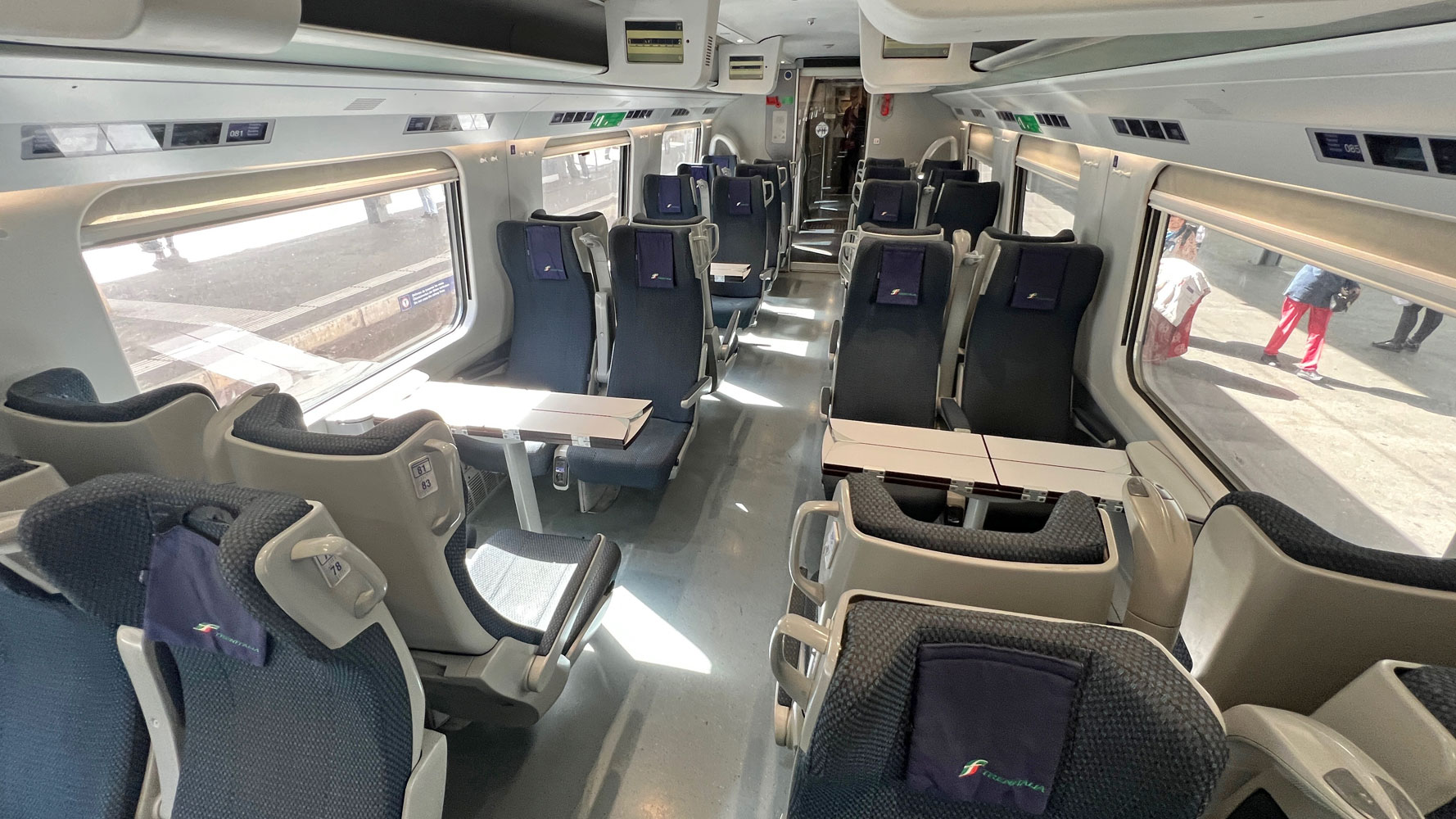
Next down the pecking order are Trenitalia's 250km/h (155mph) Frecciargento (silver arrow) tilting trains, although these are now rare as most are being rebranded as Frecciarossa. Frecciargento services are operated by pendolino tilting trains, air-conditioned with cafe-bar, power sockets at all seats & free WiFi. The trains reach 250 km/h on the high-speed lines and use their tilt to cut journey times through curves when running on classic lines.
Tickets for all Trenitalia's long-distance trains include a seat reservation and are only valid on the specific date & train you've booked.
Principal remaining Frecciargento routes: Rome-Bari, plus the odd Genoa-La Spezia-Pisa-Rome trains. See seat maps.
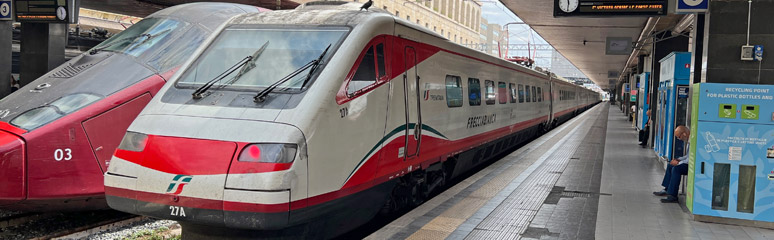
Frecciabianca
One step down from Frecciarossa and Frecciargento are the Frecciabianca (white arrow) services, now getting very rare. The remaining Frecciabianca services on the Rome-Pisa-La Spezia-Genoa route are operated by older ETR460 tilting trains bumped off Frecciargento service. They have 1st & 2nd class, power sockets at seats & free WiFi. Tickets include a seat reservation and are only valid on the specific date & train you've booked.
Principal remaining Frecciabianca route: Milan-Genoa-La Spezia-Pisa-Rome.
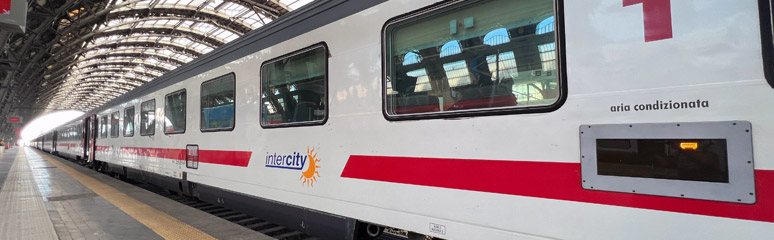
Intercity trains: See the IC guide
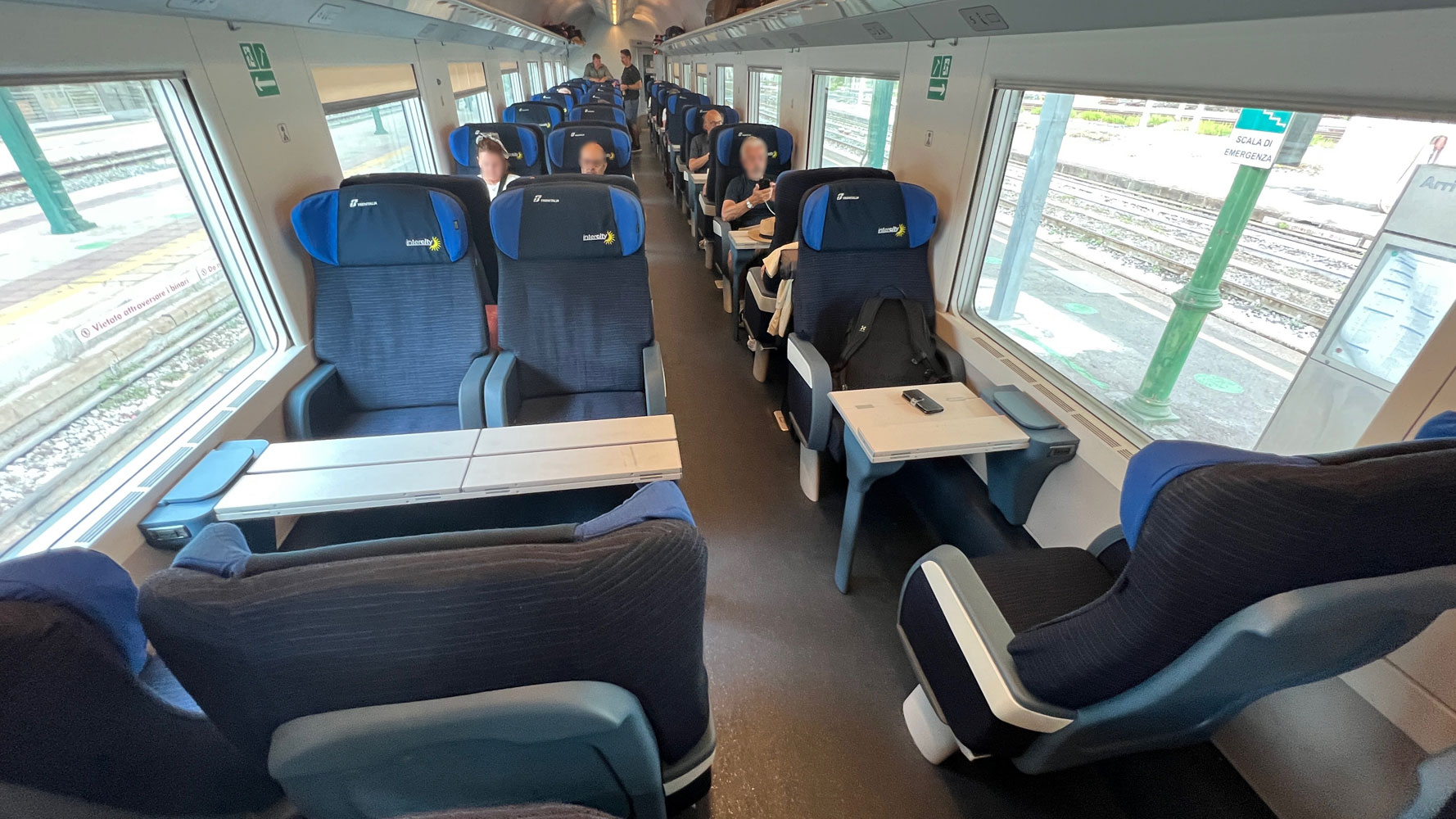
Next in the pecking order are the Intercity trains, fast trains hauled by locomotives at up to 160 km/h (100 mph), sometimes 200 km/h (125 mph). Most Intercity cars are open-plan with a centre aisle, a few are classic side-corridor-and-compartment cars with 6-seat compartments, though you don't always get both sorts in both classes on a given train. Some Intercity trains have a cafe counter, some just vending machines selling drinks and snacks. You're free to bring your own food & drink, even a bottle of wine if you like. See the Trenitalia Intercity page for more information.
Tickets for all Trenitalia's long-distance trains include a seat reservation and are only valid on the specific date & train you've booked.
Principal Intercity routes: Rome-Naples-Sicily; Rome-Livorno-Pisa-Cinque Terre-La Spezia-Genoa-Milan; Milan-Genoa-Savona-Ventimiglia (for Nice).
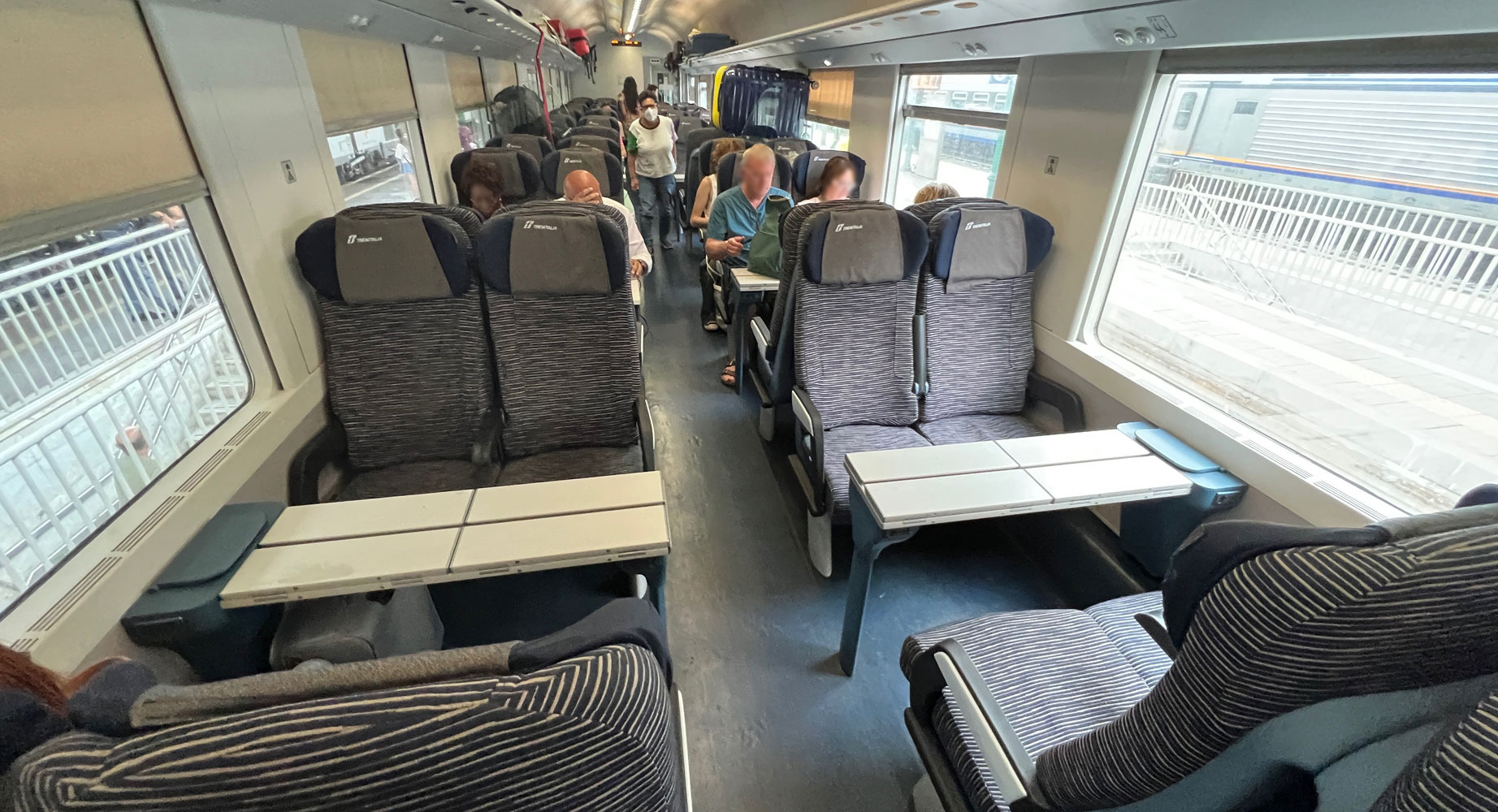
Intercity Notte sleeper trains: See the ICN guide
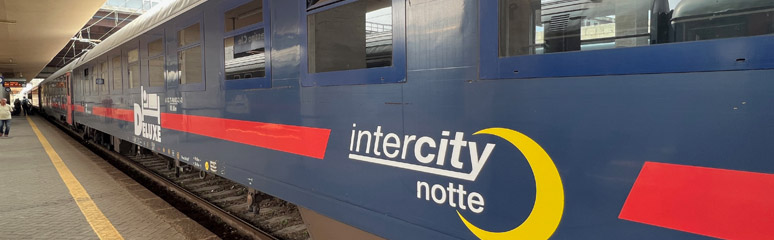
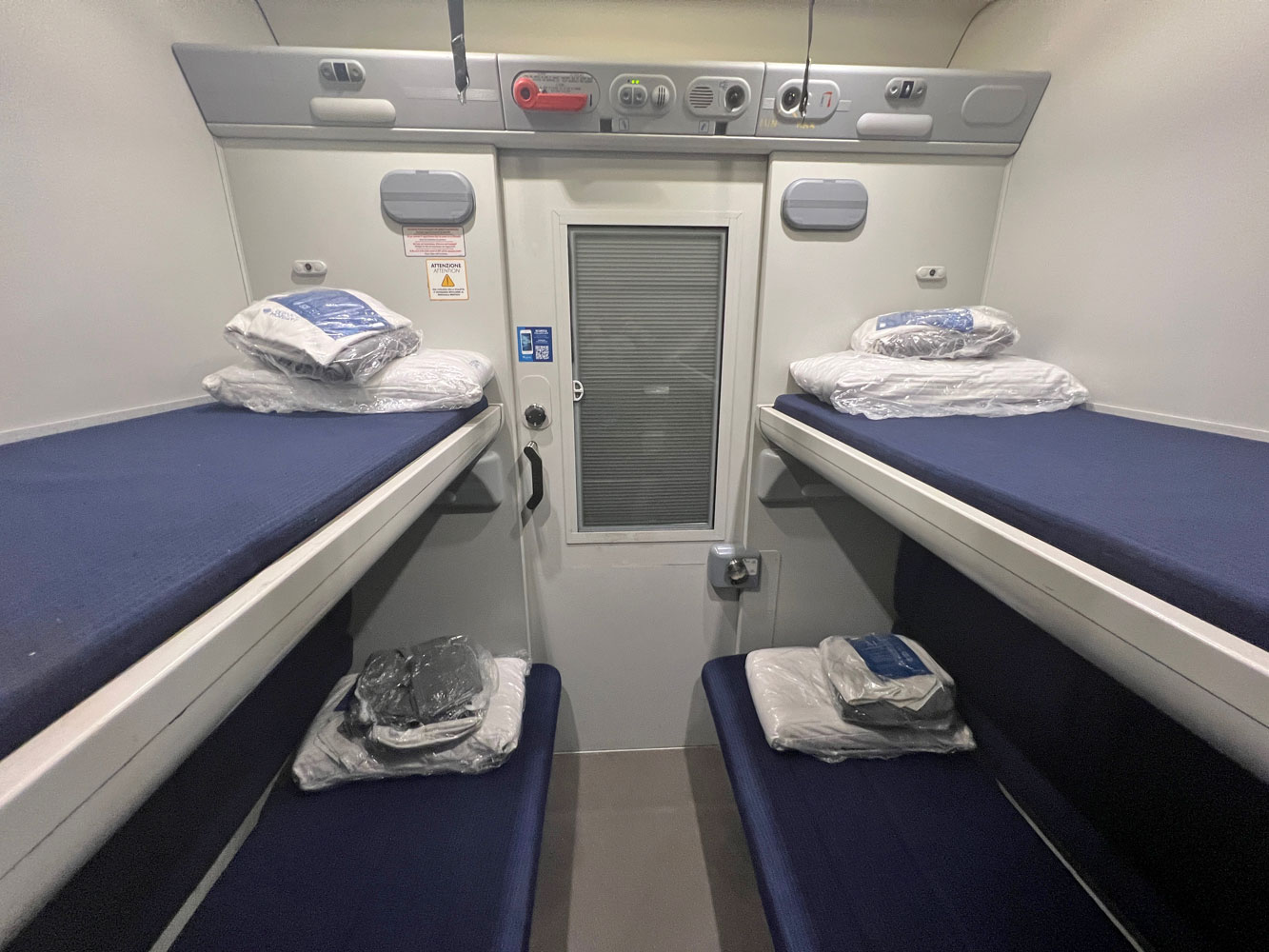
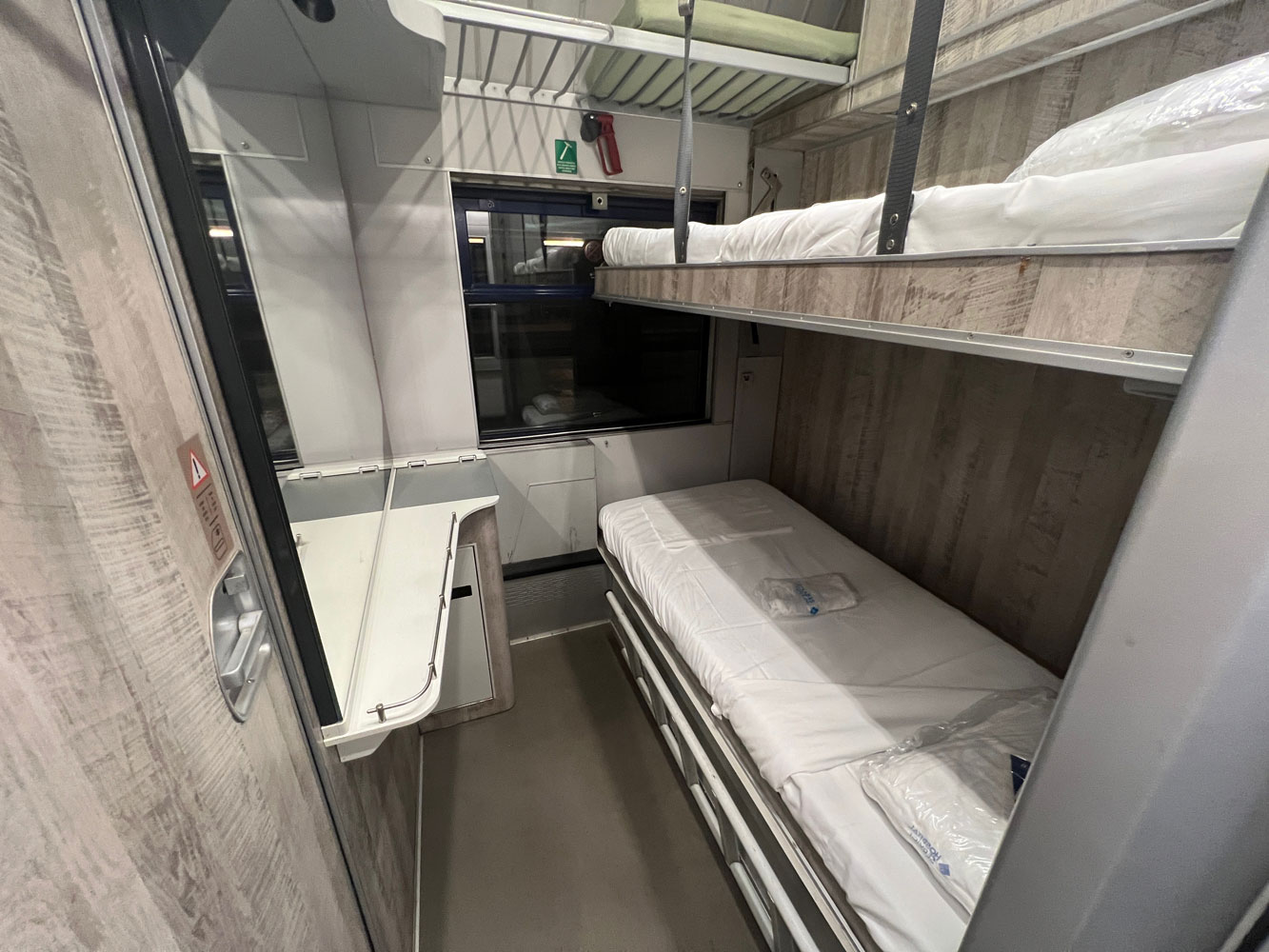
Comfortable Intercity Notte (ICN) overnight trains link Milan, Bologna, Rome, Naples with Messina, Palermo, Catania & Siracuse on Sicily, see the Trains to Sicily page.
Intercity Notte overnight trains also link Trieste/Venice with Rome, Turin/Milan with Naples, and Turin/Milan with Bari, Brindisi & Lecce, see the Intercity Notte page.
Regionale & Regionale Veloce (R, RV)
Regional trains come in many different shapes & sizes, they operate all over Italy including Florence-Pisa, Florence-Siena, Florence-Lucca, Venice-Trieste, Venice-Verona, Rome-Civitavecchia. On regional trains there are no assigned seats, you sit where you like. Luggage goes on the racks or simply on the floor. There's no catering, so bring your own food & drink. Many are 2nd class only.
There's little point in paying for regional trains in advance as there's just one cheap fixed-price Ordinaria fare which can be bought on the day. Buy a ticket from the ticket office or self-service machines or buy online or in the Trenitalia app. Interrail passholders can just hop on, nothing more to do or pay.
How online tickets for regional trains work:
In August 2023, Trenitalia made a simple thing unnecessarily complicated. For tickets bought online, the old system of having to stamp your ticket in a validator is gone, as is the system of tickets only being good for a 4-hour time slot.
Regional tickets bought online are now only good for the specific train you select, but you can change this free of charge as follows:
Until 23:59 on the day before departure, you can change the date and/or departure time free of charge using the Trenitalia app or website, as many times as you like. Tickets are 80% refundable.
From 00:00 on the day of travel, tickets become non-refundable, but you can change the departure time as many times as you like free of charge until 23:59 or the last train, whichever is sooner.
However, at the departure time of whatever train is currently selected, the ticket is considered 'used' and no further changes can be made. Obviously, this means that if you decide to take a later train you must change your departure time in the app before your original train leaves!
Online regional tickets bought from a retailer such as www.thetrainline.com or www.italiarail.com also work in this way, you'll get a link to make changes to the date & time. You show the QR code on your phone or can print the confirmation email with the codes on.
Can regional trains sell out?
Tickets are usually available in unlimited numbers so regional trains can't sell out, for example Milan-Tirano, Florence-Siena or Florence-Pisa. However, Trenitalia now have some regional routes such as Venice-Trieste where the number of tickets sold for each train is limited so they can in theory sell out and occasionally do - even though specific seats aren't assigned. This devious practice started during the pandemic and has continued.
To check, find the train on www.trenitalia.com and click the 'i' symbol for details. If it says non-prenotabile, you're fine, tickets are unlimited and can't sell out. If it says prenotabile ticket numbers are limited, so bear that in mind. If you use the Trenitalia app, you can see how many places are left on each train, usually many, which should reassure you.
Buying regional tickets at the station
You can buy regional tickets at the station on the day from a Trenitalia ticket machine or ticket office. The ticket may be for a specific departure. You must validate it by sticking the end of the ticket, blank side up, into one of the green validator machines at the entrance to (or on) the platform, see the validator photo below. Convalidare sul retro on the front means Validate other side!
Using a contactless card: Tap & Tap
On selected regional routes you don't even need to buy a ticket, you can just tap any contactless bank card against a green validator machine at your starting station (see the photo below), it beeps and you can board the train. When you reach your destination, tap the same card on another green validator machine and the full adult single fare will be deducted from your bank account. You can only buy one adult ticket for one person this way, only on specified routes, only for regional (R or RV) trains, only regular Ordinaria price. You cannot buy tickets for more than one person, or child tickets, or first class.
Routes with Tap & Tap include Florence-Pisa-Livorno and Venice Santa Lucia-Venice Mestre-Padua-Verona, for a list see www.trenitalia.com/en/purchase/tap-and-tap.html (please let me know if that link changes).

Ticket validator/Tap & Tap point: If you buy from the ticket office or a ticket machine, you must validate a regional (R or RV train) ticket by sticking it blank side up into the black slot. This is also the validator for tap & tap: Hold your contactless bank card against the contactless reader in the middle. Larger photo.

A modern double-deck 'Rock' regional train at Verona Porta Nuova, operating a Verona-Venice Regionale Veloce service.
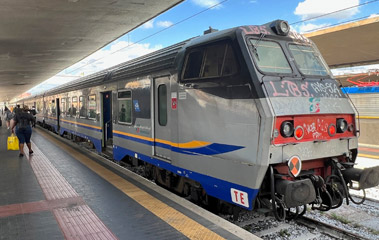
An older regional train of the sort that runs from Florence to Pisa, Livorno & Siena.
Italo high-speed trains: See the Italo guide
Private operator NTV (Nuovo Trasporto Viaggiatori) started operating its Italo high-speed trains on the Milan-Bologna-Florence-Rome-Naples route in 2012, and now competes with Trenitalia on the Turin-Milan-Verona-Venice and Venice-Florence-Rome-Naples routes as well. Competition between Trenitalia and Italo has driven up quality, increased capacity and driven down fares. It's well worth considering Italo for a journey between the main Italian cities.
See the Seat61 Italo information page for more information, an illustrated guide and the Italo video guide.
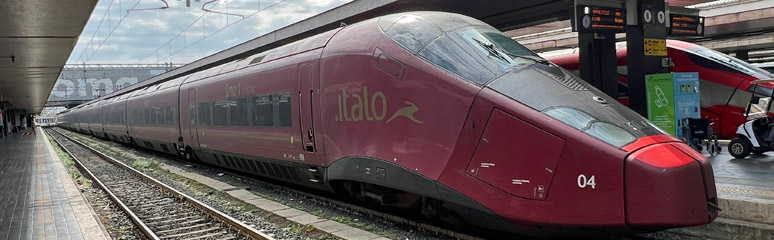
An Italo AGV train at Rome Termini.
-
1st or 2nd class?
2nd class (or standard class on Frecciarossas) is absolutely fine. It's very comfortable and there's plenty of luggage space, there's no need to pay for 1st class (or business class on Frecciarossas) if you are on a budget. There are very few peasants & chickens in 2nd class on European trains these days...
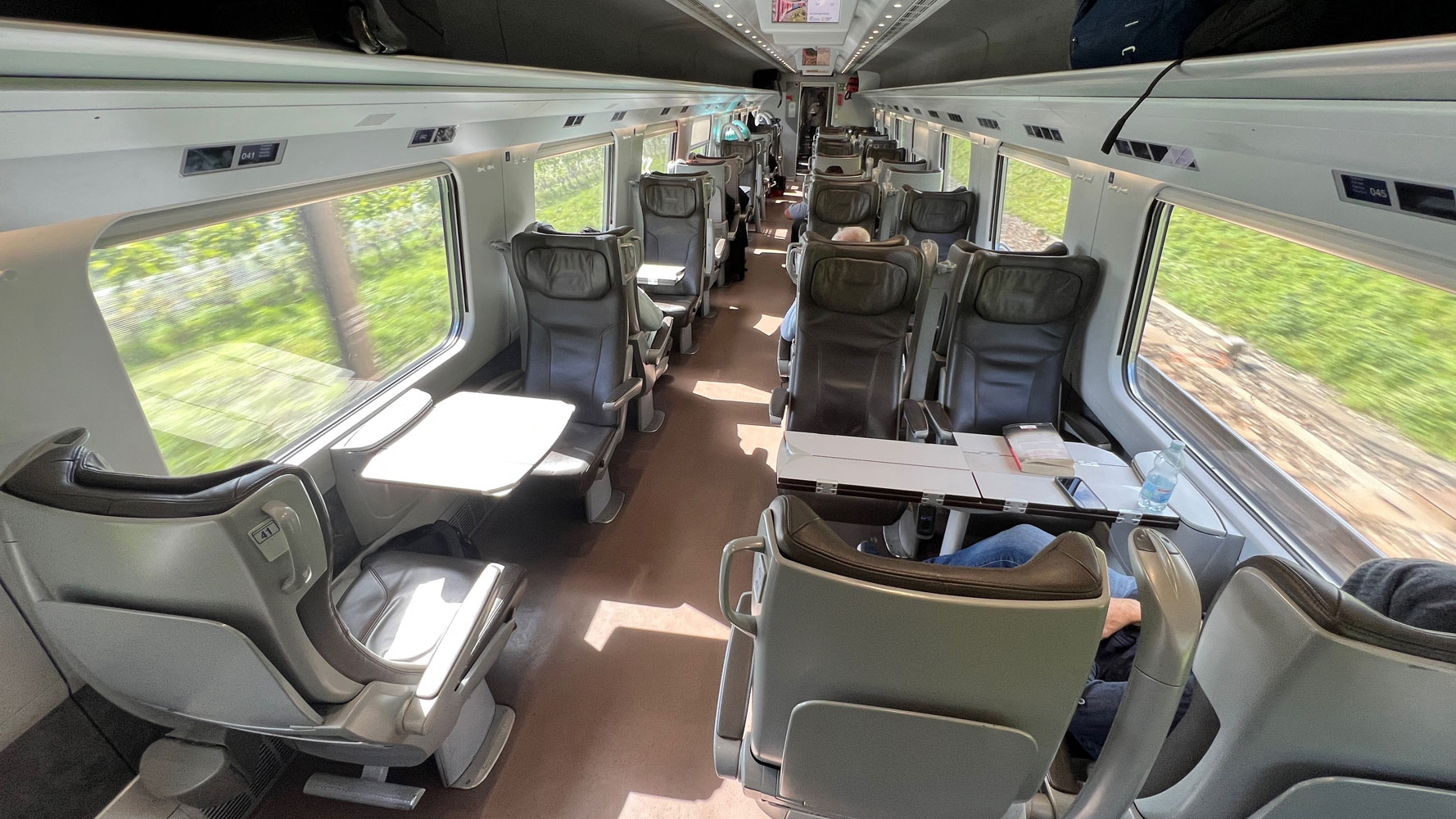
On the other hand, 1st (or business) class is nicer, with wider, plusher seats and a quieter environment with more laptops tapping and fewer noisy kids. And with long-distance trains dynamically priced, it often costs only a little more to go 1st class if you book ahead.
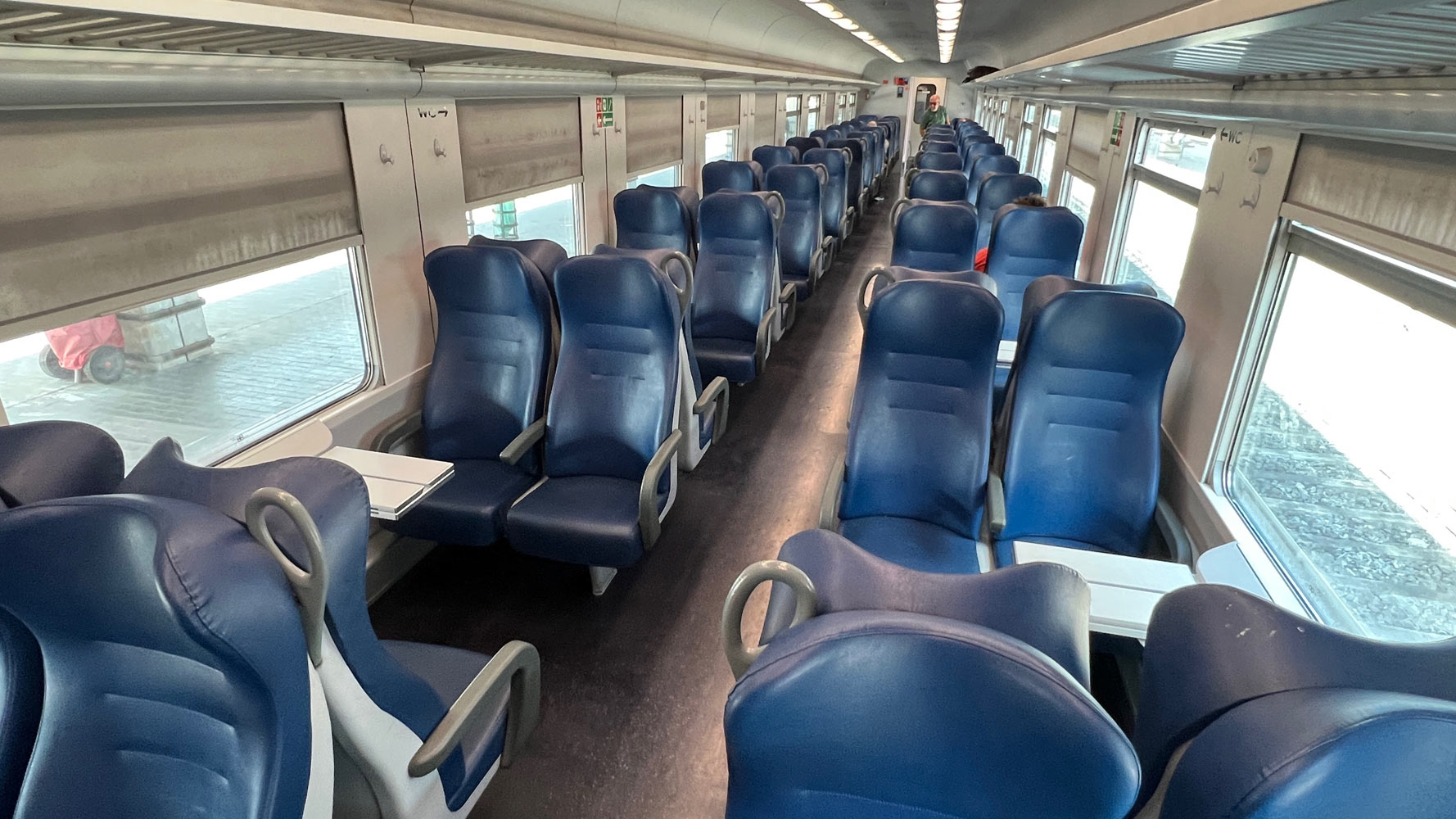
1st class seats are generally arranged 2+1 across the car width rather than 2+2, so you get solo seats (ideal for single travellers) and face-to-face tables for two on one side of the aisle, ideal for couples as you then face each other and both get a window seat that is also an aisle seat, the best of both worlds.
On Frecciarossa trains you also get a complimentary glass of prosecco and a small snack box in business class.
-
Luggage arrangements: See the luggage section.
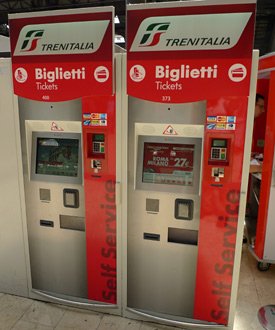 Multi-lingual self-service ticket machines are found at all main Italian stations. Click the UK flag on the touch screen for English. They can sell tickets for both regional & mainline trains, plus some international trains. They take cash & credit cards. Easier than going to the ticket office! |
|
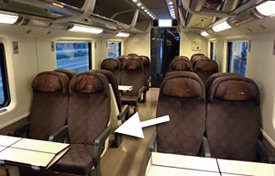 Medium-sized suitcases & backpacks fit between the seat backs on a Frecciarossa. There are also racks above your seat, and at the car ends. |
-
Do you need to validate your ticket?
Trenitalia's high-speed and intercity trains are ticketless, so no, as there's nothing to validate!
Since August 2023, regional tickets bought online are only good for a specific departure, you can change this as many times as you like before the departure of the selected train, see more about how regional tickets work. Again, there's nothing to validate.
However, tickets for regional trains (R, RV etc.) bought from a ticket office or ticket machine need to be validated before you board by sticking the end of the ticket, blank side up, into one of the green validator machines at the entrance to (or on) the platform. This prints the time & date on the ticket to show that it's used.
-
Language problems
First-time visitors often think this will be a problem, but it hardly ever is. At stations, finding your platform & train using the various departure screens is no different from finding your gate & plane at an airport. Signs are often in English as well as Italian, or pictograms are used. On high-speed trains, announcements are usually repeated in English.
At ticket offices clerks have a pretty shrewd idea you want a train ticket not a packet of washing powder, in fact clerks in popular tourist cities will be used to dealing with Brits, Americans & Australians and will usually know the relevant words in English about one-ways & round trips, first or second class. The ticket machines at every main station have a touch-screen with an English language facility.
The one thing that does help is knowing Italian place names: Rome = Roma, Florence = Firenze, Venice = Venezia, Naples = Napoli, Milan = Milano, Turin = Torino, Genoa = Genova.
-
Food & drink on trains in Italy
Most high-speed trains have a cafe-bar, although most Intercity trains (and Italo trains) only have vending machines. Feel free to bring your own food and drink with you, even a bottle of wine if you like, no rules against that on the rails!
-
Bicycles
You can take a bike with you on suburban, Regional & InterRegional trains if you buy a bike ticket costing about €4. You can also pay to reserve a bike space on most Intercity trains. However, on high-speed trains such as Frecciarossas you need to put your bike in a zip-up bike bag, front wheel & pedals removed and handlebars turned, see the bikes by train page.
-
Dogs & pets
Go to www.trenitalia.com and search under Services for Transport of pets. You can take pets on many trains, but the rules vary slightly by type of train. Very small dogs, cats & other pets in containers no bigger than 70cm x 30cm x 50cm are carried free on almost all trains & classes. Larger dogs on a lead & muzzled are allowed on almost all trains but must have a ticket bought for them at 50% of the adult 2nd class fare (whatever class the owner is using) and they are not permitted in Executive or Premium classes on Frecciarossa trains, or in catering cars. You can take a dog in sleepers or couchettes only if your party occupies the whole compartment. Guide dogs are always free.
-
First class lounges at Italian stations
Executive class passengers & holders of Trenitalia's frequent traveller card can use the FrecciaClub lounges at stations in major cities. You can also enter with a ticket for a business class Salottino seat (but not a regular business class seat).
Club class passengers on Italo, can use the Club Italo lounge at major city stations. Prima class passengers can also use the lounge if they pay a €12 add-on when booking - though this may not be offered at busy times or with the cheapest tickets.
-
A train planner app for your phone
Railplanner is a free offline train timetable app that you can download onto your phone to check train times, station departures & train calling points on the move without the need to be on WiFi or to use mobile data. It's blisteringly quick and covers not just Italy but most of Europe. It highlights the reservation-required high-speed & InterCity trains in red and the no-reservation-required regional trains in green. It's created with Interrail passholders in mind, but is useful for anyone. Download for iPhone or Android at www.interrail.com/en/plan-your-trip/rail-planner-app - please let me know if the link stops working.
-
Are the trains running on time?
You can check real-time arrivals and departures at any Trenitalia station or the running of any train by train number at www.viaggiatreno.it. Most regional trains run more or less on time, and so do most high-speed long-distance trains, with perhaps a 10 or 20 minute delay here and there. However, make allowances for a typical 30 to 90 minute delay when catching the overnight sleeper trains to/from Sicily, for example.
Choosing your seat
-
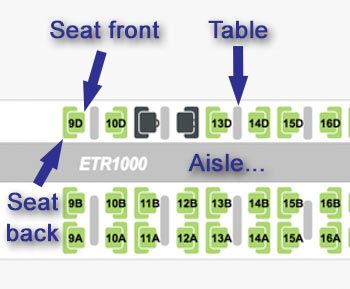
Trenitalia.com, Italiarail.com & Thetrainline.com allow you to choose your seats from a seat map on Frecciarossa, Frecciargento, Frecciabianca and Intercity trains within Italy.
-
It's pretty self-explanatory, but as I'm often asked, yes, the grey bars are tables, and no, you can't tell which way seats face. Indeed, most Naples-Rome-Venice and Naples-Rome-Milan trains change direction at both Rome Termini and Florence SMN station, both of which are dead-end terminus stations.
-
For a couple in 1st class I recommend a face-to-face table for two.
Luggage on trains in Italy
-
Luggage is no real problem on Italian trains, and it makes no real difference whether you go 1st or 2nd class, there's always room for bags. You don't check your bags in and there is no baggage car. You simply take whatever you like into the train with you, and stick your bags on the racks above your head or on the big luggage racks at the end of each car or between the seat backs. On regional trains, it just goes on the floor next to you if there aren't any racks.
-
There are no baggage fees or weight limits to worry about, for most practical purposes if you can carry it you can bring it. It's so simple, it hardly needs explaining, yet overseas visitors chase their tails worrying about it. Don't over-think it, but don't travel with more than you really need. Anything up to backpack-sized fits on the racks above your head, larger items such as bulky suitcases go on the racks at the end of the car, in the seating area, or between the seat backs.
-
Security is not a major problem, your bags full of clothing are no more likely to be stolen than airline checked baggage. There's no need to chain your bag to the rack, any more than you'd chain you bags to the luggage bin on a plane. Although I like to use a rack which I can see from my seat and I always keep cameras, passports and so on in my daypack at my seat. But I thought that was obvious?
-
Porters are pretty much a thing of the past along with butlers, valets and ladies' maids. However, Milan Centrale, Milan Porta Garibaldi, Venice Santa Lucia, Rome Termini, Florence SMN, Turin Porta Nuova are all termini with level access to and between all trains. You can just pull your bag on its wheels from street or taxi rank across the station concourse right up to the train door, lift it two steps up into the train, and wheel it to a convenient rack or space between the seats next to your seat. If you're elderly or pregnant, another passenger will almost always help you get your bags the two short steps into the train.
-
Luggage storage at stations
All main Italian stations including Turin Porta Nuova, Milan Centrale, Verona Porta Nuova, Venice Santa Lucia, Florence SMN, Rome Stazione Termini & Naples Centrale have left-luggage facilities, either lockers or a staffed facility. Information on left-luggage prices & opening times.
Which station in which city?
-
Rome
Roma Termini is the main station in Rome, in the city centre walking distance from all the sights, see the Roma Termini station guide.
Roma Ostiense and Roma Tiburtina are on the outskirts of the city, you'll need a local train or taxi (around €15) into the city centre. The Vatican has its own suburban station, Roma San Pietro, but it’s easy to reach St Peter’s from the Stazione Termini by bus or taxi.
-
Naples
Napoli Centrale is the main station in Naples city centre, co-located with the Circumvesuviana station for trains to Pompeii & Sorrento and 30 minutes walk from the ferry terminal for Capri & Ischia.
Do not book to Napoli Afragola by mistake as I've known a number of people do, Naples Afragola is a 'parkway' station for high-speed trains outside the city in the middle of nowhere, aimed at motorists from surrounding towns & villages.
-
Venice
Venezia Santa Lucia is the main station in Venice, in the city of Venice itself on the banks of the Grand Canal, 15-25 minutes walk from the Rialto Bridge & St Mark's Square. See the Venice Santa Lucia station guide.
Venezia Mestre is on the mainland in an industrial area outside Venice itself, always book to Venice Santa Lucia unless you have a hotel in Mestre.
-
Florence
Firenze Santa Maria Novella is the main station in Florence, often abbreviated to SMN, in the city centre easy walking distance from all the sights. See the Florence SMN station guide. A few trains use Campo Marte or Rifredi stations outside the city centre, linked to SMN by frequent local trains.
-
Milan
Milano Centrale is the main station in Milan, a magnificent terminus in the city centre, served by most mainline & international trains. It's a major Milan attraction in its own right, see if you can spot Mussolini. See the Milan Centrale station guide.
Milan Porta Garibaldi is rather less magnificent, but still central, used by the French Railways TGVs to Paris and by some Trenitalia trains. It's a 25 minute walk, 5 minute metro ride or 8 minute taxi ride from Centrale.
Some Malpensa airport trains arrive at Milan Cadorna, a small local terminus also located in the city centre, other Malpensa airport trains run to Milan Porta Garibaldi and Milan Centrale. Milan Lambrate is much less central, and Milan Rogoredo is 5 km from the city centre.
-
Turin
Torino Porta Nuova is the main station, a large and historic terminus, see the Turin stations guide.
However, trains to & from Paris use Turin's other main station, Turin Porta Susa, and most trains to or from Rome, Milan or Venice call at Porta Susa before or after Porta Nuova. Both stations are in Turin's city centre, walking distance from all the sights.
-
Siena
In Siena, the station is at the foot of the hill and used to be a steep trek up to the old town. However, there's now a series of modern escalators and moving walkways that ferry you almost painlessly to the top of the hill, from where it's just a minute or two's walk to the Porta Camollia at the entrance to the old town. From the Porta Camollia it's a pleasant 15 minute stroll to the famous Piazza del Campo.
-
Leaning Tower of Pisa
Map of Pisa showing tower & railway stations. Many people do Pisa as a day trip from Florence, using the frequent local trains. Pisa Centrale is 2km from the Tower, a 30 minute walk, but if you take a train to Pisa S. Rossore station it's only a 5-10 minute walk to the Tower. Some trains from Florence go direct to Pisa S. Rossore, 1 stop beyond Pisa Centrale, others require a change at Pisa Centrale. Check train times using www.trenitalia.com or www.italiarail.com.
 |
|
|
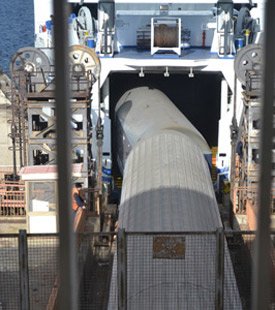
Sicily Express! The sleeper train from Milan to Palermo is shunted off the ferry at Messina. Yes, the trains to Sicily really are direct, they are put on a ferry to cross the straits from Villa San Giovanni to Messina. Photo courtesy of David Smith. Watch the video here. |
|
 |
|
|
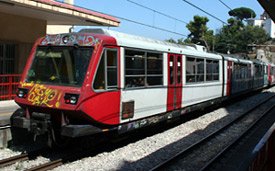
A Naples-Pompeii-Sorrento train on the Circumvesuviana Railway, every 30 minutes for just a few euros. |
How to travel to Sicily
-
The train is a wonderful way to reach Sicily, an experience in itself.
-
There are two daytime InterCity trains from Rome & Naples to Palermo, Catania, Siracuse and time-effective overnight sleeper trains from Milan, Rome & Naples direct to Palermo, Catania & Siracuse. See the timetable & information on the Trains to Sicily page.
-
If you use the daytime trains, bring a picnic and bottle of wine (as there's no catering car) and enjoy the ride, much of it along the Italian coast just a stone's throw from the sea towards the toe of Italy.
-
All these trains are shunted onto a ferry at Villa san Giovanni for the short crossing of the Straits of Messina to Sicily. It's the last remaining place in Europe where passenger trains go onto a ferry, a unique experience, watch the video. Once the train is secured in the ship's hold, steps are placed next to the train doors, and you can either remain on board the train or get off and walk upstairs to the deck to take some sea air, returning to the train as the ferry docks on the other side. Highly recommended! You can book all of these trains to Sicily as shown here.
-
Or use an overnight ferry from Naples: You can sail from Naples to Palermo by comfortable overnight ferry, with a or shared cabin with en suite shower & toilet, and there are restaurants and bars for an enjoyable evening on board. Ferries typically sail every day at around 20:00 and arrive around 06:30 in both directions. See www.tirrenia.it & www.snav.it for times, dates, fares & online booking.
How to reach Herculaneum, Pompeii & Sorrento
-
Naples to Herculaneum, Pompeii & Sorrento by Circumvesuviana train
The railway from Naples to Herculaneum, Pompeii & Sorrento isn't run by Trenitalia, it's the privately-run Circumvesuviana Railway, www.eavsrl.it. That's why you can't find trains to Sorrento on Trenitalia.com or Italiarail.com. Map of Naples showing stations.
Simply buy a mainline ticket from Venice, Florence, Rome or wherever to Naples Centrale at www.italiarail.com or www.trenitalia.com. On arrival at Naples Centrale, follow the signs to Circumvesuviana, these will take you downstairs to the Circumvesuviana station.
The Circumvesuviana station has its own ticket office, either buy a ticket to Ercolano, Pompeii Scavi or Sorrento there or use the ticket gate that allows you to touch in with a contactless bank card. Go through the automatic ticket gates onto the platform and hop on the next train.
Trains run to Herculaneum (Ercolano), Pompeii and Sorrento every 30 minutes throughout the day, no reservation is necessary or possible. Outside the weekday rush hours the trains are not crowded, there are plenty of seats and it's very easy to use. Luggage goes on the racks or just on the floor, no problem. This handy video shows you what to expect.
Naples to Pompeii costs around €3.20 one-way, journey around 40 minutes.
Naples to Sorrento costs around €4.50 one-way, journey 55-65 minutes.
-
Naples to Herculaneum, Pompeii & Sorrento by Campania Express
In addition to the regular Circumvesuviana trains, there are up to 4 daily air-conditioned all-reserved Campania Express trains from Naples Garibaldi station to Ercolano, Pompeii Scavi & Sorrento, aimed at tourists. These use exactly the same stations on the same line as the regular Circumvesuviana trains, but if you're happy paying a higher fare and restricting yourself to these 4 departures, you'll get a reserved seat, extra luggage space & air-con. The fare is €15. Check times & book tickets at seat61.transport-ticket.com (powered by Distribusion, which is who you're buying from).
Update 2026: The Campania Express will not run from 1 October 2026 until further notice, as EAV's new CEO apparently wants to concentrate on improving the Circumvesuviana Railway's normal service.
-
Naples to Sorrento by ferry
You can also travel from Naples Beverello ferry terminal to Sorrento by fast ferry with around 5 departures a day, journey time 45 minutes, fare around €13, bags €2.10, see www.alilauro.it. You can buy online or just buy at the ferry terminal on the day.
-
To the top of Vesuvius
To visit the summit of Vesuvius, two morning buses run from Naples or a more regular bus service runs from Pompeii, both run by EAVBUS, see www.eavbus.it (Italian only) or (more usefully) www.unicocampania.it, click English top right and look for 'Vesuvio Fares' under 'Tourist Info'.
-
Day trip to Pompeii? It's easy to arrange a trip to Pompeii yourself by train, see the guide here.
 |
|
|
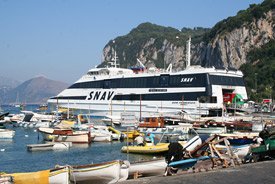
The SNAV fast ferry from Capri to Naples. |
How to reach Capri
-
Buy a mainline ticket from Venice, Florence, Rome or wherever to Naples Centrale at www.italiarail.com or www.trenitalia.com.
-
The island of Capri is just off Sorrento. You have two options: You can take a direct ferry from Naples to Capri, journey time around 45 minutes, fare €25, or you can take the Circumvesuviana Railway to Sorrento (55-65 minutes) then a shorter ferry crossing to Capri (around 25 minutes, fare around €20).
-
If you choose the ferry from Naples, take a taxi (5-10 minutes) or walk (25 minutes) from Naples Centrale to Naples Beverello ferry quay. Fast ferries link Naples Berevello with Capri every hour or two between 07:00 & 18:00 taking 45 minutes, see www.snav.it or Omio.com for times & fares. The ferry fare is around €25 plus a euro or two per item of large luggage. You don't need to pre-book, just turn up, buy a ticket and hop on. Map of Naples showing station & ferry terminals.
-
If you choose to take the local Circumvesuviana Railway to Sorrento, there are many ferries to Capri, no pre-booking necessary. Just be aware that it's a longish steep walk from Sorrento Circumvesuviana station down the hill to the ferry terminal.
-
Ferries from both Naples & Sorrento arrive at Capri's busy Marina Grande, there's a funicular railway up the steep hillside to Capri town itself. Bring plenty of money to Capri, even a small beer costs over €7!
How to reach Ischia
-
Ferries link Naples with Porto Ischia, see www.caremar.it (sailings every hour or two, crossing time 45 minutes fast ferry or 90 mins conventional ferry) or www.alilauro.it.
 |
|
|
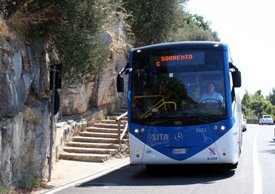
SITA bus on the narrow coast road between Amalfi and Sorrento. |
How to reach Amalfi, Positano, Praiano
-
Option 1, by bus from Salerno
There's no railway to these towns on the famous Amalfi Coast, but buses run from Salerno to Amalfi. So buy a train ticket for one of the many high-speed trains from Milan, Florence and Rome direct to Salerno, then hop on a bus to Amalfi. This Salerno bus option is the quickest way to Amalfi.
Buses link Salerno & Amalfi every hour or better between 06:00 & 22:30 on Mondays-Saturdays, slightly less frequently on Sundays, journey time 1h15, fare €2.80 one-way, buy a ticket at the tobacconists shop inside Salerno station.
The buses are operated by SITA, to check bus times see www.sitasudtrasporti.it (in Italian only, click Orari then 'Campania').
To check fares, use public transport site www.unicocampania.it, click English top right then Fares & Tickets.
-
Option 2, by ferry from Salerno
Alternatively, you can take a ferry from Salerno to Amalfi or Positano. See www.coopsantandrea.com for a timetable of small coastal ferries from Salerno (Concordia dock, 800m from Salerno railway station) to Amalfi and Positano. At the time of writing, they had departures from Salerno at 08:40, 09:40, 10:40, 11:40, 14:10 and 15:30, journey time to Amalfi just 35 minutes, but check their website for current timings. This is a good option in summer when the narrow coast road is clogged with traffic.
Option 3, by bus from Sorrento
You can also buy a train ticket to Naples, hop on the Circumvesuviana Railway to Sorrento as shown above then take a bus to Positano, Praiano & Amalfi. For buses linking Sorrento with Positano, Praiano & Amalfi, see www.sitasudtrasporti.it (in Italian only, click Orari then Campania). Sorrento-Amalfi takes 1 hour 40 minutes, buses run hourly or at certain times half-hourly 06:30 to 22:00, fare around €3. The journey along the coast road is dramatic, the bus hugging the cliff and it rear end swinging out precariously at every hairpin bend!
-
Option 4, a private transfer from Naples to Praiano, Positano or Amalfi hotels
If cost is no object, a private car transfer from Naples Centrale railway station to Positano or Praiano costs around €95 one-way for up to 3 people, or around €110 to Amalfi. Try www.amalfishuttle.com or www.positanoshuttle.com (same people - click 'transfer' at the top). I have not had any reports about them yet, so feedback would be appreciated. They will also do transfers from Sorrento Circumvesuviana station, which reduces the cost.
 |
|
|
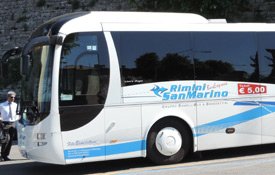
The bus from Rimini to San Marino. |
How to reach Elba
-
Travel by train to Piombino Marittima. Moby Lines (www.mobylines.com) sail every hour or so from Piombino to Portoferraio on Elba, crossing time 1 hour, foot passengers €7 one-way.
How to reach Lake Como
-
Como San Giovanni is the mainline station for Como, it's on the Zurich-Milan main line and linked to Milan Centrale by frequent regional train. Check times as above.
-
Lecco, Varenna & Bellanoare on the eastern side of Lake Como, there is a station at Lecco & Varenna-Esino (for the ferry to Bellagio) and Bellano on the Trenord local line linking Milan Centrale with Tirano (near the Swiss border, for the fabulous narrow-gauge Bernina route to Chur & Zurich). Check times as above
How to reach Lake Garda
-
There are two main stations for Lake Garda, Desenzano del Garda-Sirmione or Peschiera del Garda, both on the Milan-Verona-Venice main line. As well as regional trains, some Milan-Verona-Venice Frecciarossas call at Peschiera or Desenzano.
-
Alternatively, take a train to Verona Porta Nuova. Buses run frequently times an hour from outside the station to the eastern shores of Lake Garda including Lazise, Bardonlino & Garda, see the bus company website www.atv.verona.it.
-
You can also travel to Brescia, then take frequent buses to the western shore of Lake Garda, see the bus company website brescia.arriva.it.
How to reach San Marino
-
San Marino has no rail station, so first take a train to Rimini.
Buses to San Marino leave from outside Rimini railway station every hour or so between 08:10 & 19:25 in winter, between 06:45 & 20:30 in summer, less frequently on winter Sundays, journey time 50 minutes. Run by Bonelli Bus, the buses are air-conditioned with WiFi.
The fare is €7 one-way. Buses often leave full, so pre-book if you can.
To reach the bus stop, walk out of Rimini station main exit and turn right, walk 170m, then cross to the far side of the road, see walking map.
If you still need to buy a ticket when you get to Rimini, walk out of the station, cross the road and turn left. Two doors beyond Burger King there is a tobacconist shop which sells bus tickets.
-
Buy tickets from Bonelli Bus at www.bonellibus.it/en/shuttle-rimini-san-marino-2 (please let me know if that link changes).
How to reach Sardinia
-
Ferries to Sardinia
Ferries sail from Civitavecchia, Livorno, Naples & Palermo to various ports on Sardinia including Olbia & Golfo Aranci in the north and Cagliariin the south. Operators include Tirrenia, Grimaldi Lines, Corsica-Sardinia Ferries, use Direct Ferries to check and book all ferry routes & operators.
The shortest ferry crossing is Civitavecchia (just north of Rome) to Olbia where the daily daytime ferry takes 5h30, and an overnight ferry with cabins takes 7h. A daily ferry with cabins links Naples with Caligari overnight.
-
Trains on Sardinia
Regional trains run by a division of Trenitalia link the major centres and ports: Golfo Aranci, Olbia, Sassari, Porto Torres, Oristano, Cagliari. You can check train times at www.trenitalia.com although as trains are classed as regional you may as well just buy tickets at the station on the day.
In addition to the main Trenitalia routes, tourist services called the Little Green Trains run on two or three very rural routes, see www.treninoverde.com (in Italian only, use Google translate) or sardiniagreentrain.com (in English). These trains are run by transport authority ARST, a company formed by merging the urban transport authority with Sardinian Railways.
Airport train connections
Milan Malpensa airport
-
There are regional trains from Milan Malpensa airport to Milan Centrale every 30 minutes, journey time 52 minutes, fare around €12, no reservation necessary or possible, just buy a ticket at the station and hop on the next train.
Change at Milan Centrale for high-speed Frecciarossa & Frecciabianca trains to Venice, Florence, Rome, Naples or anywhere else in Italy. You can check times & fares at www.italiarail.com or www.trenitalia.com. Reservation is required for Italian long-distance & high-speed trains, make sure you read the tips below.
Rome Fiumicino airport
-
Leonardo Express trains run from Rome Fiumicino airport to Rome Termini in the city centre every 30 minutes, journey time 32 minutes, fare around €14, no reservation necessary or possible, just buy a ticket at the station and hop on the next train.
Change at Rome Termini for high-speed Frecciarossa & Frecciargento trains to Venice, Florence, Naples or anywhere else in Italy - indeed, there's even a very occasional direct high-speed train from Rome Fiumicino Airport to Florence & Venice. You can check times & fares at www.italiarail.com or www.trenitalia.com - Reservation is required for Italian long-distance & high-speed trains, make sure you read the tips below.
Pisa airport
-
A people-mover (driverless train) shuttles passengers from Pisa airport to Pisa Centrale in the city centre in just 8 minutes. Change at Pisa Centrale for hourly regional trains to Florence, and regular regional, Intercity or Frecciabianca trains to Rome, La Spezia and Monterosso in Cinque Terre. You can check times & fares at www.trenitalia.com selecting Pisa fermata Aeroporto for Pisa airport station - but read the tips below.
Bologna airport
-
A people mover links Bologna Centrale with Bologna airport, for more info see the Bologna Centrale station guide.
Tips for buying plane-to-train tickets
-
The regional trains from Malpensa into Milan, from Fiumicino into Rome or from Pisa to Florence are no problem - you can turn up, buy a ticket at the station & hop on the next train. No reservation is possible and no pre-booking necessary. They cannot sell out.
-
But if you intend to catch an onward high-speed train from Milan or Rome to (let's say) Florence, Naples or Venice, remember that Italian high-speed trains require reservation and tickets are only valid on the specific train you book.
-
Cheap advance-purchase economy or super-economy tickets become worthless if your flight is late and you miss your train. Even a flexible 'base' ticket becomes worthless one hour after departure if you can't get to a Trenitalia ticket counter to change the reservation to a later train.
-
So when arriving by air at Malpensa or Fiumicino and going to Florence, Naples, Venice and the like, you must choose one of two strategies:
Option 1, prioritise your budget: The money-saving option is to buy a cheap Super-Economy fare and commit to a specific train in advance at www.italiarail.com or www.trenitalia.com, but allowing a hefty 3-4 hours between flight arrival and train, to allow for any flight delays or long lines at immigration.
Option 2, prioritise your time: The time-saving option is to just buy a ticket at the base price when you get to the airport station. Then you can buy a ticket for the first train leaving after you have landed, collected your bags and are ready to go. I know this goes against the grain for overseas visitors desperate to reserve every Starbucks cappuccino 6 months ahead, but unless it's Christmas Eve or the like, you'll always find places available even right before departure as there are so many seats on so many trains, this shouldn't be a concern. Or
You can check what the base fare is by running an enquiry at www.trenitalia.com, that's what you'd pay at the station on the day.
Alternatively, book in advance at www.italiarail.com and select the Viva fare, this is 100% refundable and changeable before departure time, and can be cheaper than Trenitalia's Base fare.
A compromise option? You may find it cheaper to book cheap advance-purchase tickets on two trains - the train you should easily make if your flight is on time and a back-up train an hour or two later - than to pay the base fare for one train as in the time-saving option above. Or book one train that you should normally easily be able to make, then just accept that if the plane is significantly late, you'll have to buy another ticket at the base fare.
Troubleshooting: The usual mistakes with Trenitalia.com1. No trains appear in the search results or only 1 or 2 trains at odd times of day. Reason: Data isn't fully loaded yet for that date, either because you're looking at a date more than a few months ahead, or at a date after the twice-annual timetable change, on the 2nd Sunday in June and the 2nd Sunday in December, when they are always late loading the data and the 4 months often slips to 60 days or even less. Solution: Wait till bookings open! 2. My train is missing from the search results even though other trains are shown. Reason: Trenitalia loads trains in blocks, and data may be incomplete. Some trains - such as Intercity Notte sleepers or some EuroCity trains that go to/from Switzerland - may be loaded last. 3. Problem: It says my arrival and/or departure station is invalid. On Trenitalia.com you need to use Italian place names, such as 'Roma Termini' for Rome, 'Milano Centrale' for Milan, 'Venezia S. Lucia' for Venice, 'Firenze' for Florence. 4. Problem: I want a sleeper and it says 'Double seat compartment'. This is just a poor translation, this does in fact mean a 2-bed sleeper! 5. Problem: Pompeii or Sorrento not shown. That's because you need to travel to Naples Centrale with Trenitalia, then switch to a local private railway, the Circumvesuviana, www.eavsrl.it. |
How to use Trenitalia.com
-
The Italian Railways website www.trenitalia.com is well worth getting to know. It can sell:
Domestic Italian train tickets for any train journey within Italy, including couchettes & sleepers on overnight trains, at cheap prices with no booking fee.
International train tickets for most direct international trains starting in Italy heading for Paris, Switzerland, Austria, Germany and Slovenia, including couchettes & sleepers on overnight trains, again with cheap tickets if you pre-book. Remember that ticket collection for trains to Austria & Germany is only possible at stations in Italy!
-
Trenitalia have an app so you can can manage tickets on your phone.
Some overseas visitors find it Not available in your region. There's an easy workaround for this by using Settings to change your Apple ID region, just Google How to change iPhone app store region.
-
Or use Italiarail.com instead. You may find www.italiarail.com easier to use than trenitalia.com for sleeper trains, international trains and passholder reservations. ItaliaRail is a US-based agency who connects directly to the Trenitalia ticketing system to sell Trenitalia tickets, but in plain English using English-language place names. They charge no booking fee.
How to use www.trenitalia.com
-
Go to www.trenitalia.com and change it to English at top right.
Tip: I prefer using Trenitalia's advanced search page, www.lefrecce.it/Channels.Website.WEB. This is the one to bookmark! It offers more features than their home page journey planner and the input fields don't suddenly shift downwards while you're trying to type like they do when you first open the home page.
-
Booking usually opens 4 months before departure, though this can vary. Looking too far ahead is the most common mistake made by overseas visitors planning a big trip many months ahead. Europeans tend to book train travel only days or weeks ahead, not months, but of course the further ahead you can book the cheaper it can be.
-
Booking may open only 1-2 months ahead for travel immediately after the two annual timetable changes, on the 2nd Sunday in June and 2nd Sunday in December. Trenitalia is always late loading the data for a new timetable period, especially for regional, InterCity and international trains. For example, I'm often asked in early May why Trenitalia seems to have cancelled all Venice-Trieste trains in late June. Of course they haven't, they've simply not got around to loading all the data for dates after the mid-June timetable change so no trains are shown!
-
You need to use Italian-language place names. Firenze for Florence, Roma for Rome, Milano for Milan, Venezia for Venice, Torino for Turin, Napoli for Naples.
-
Tutti le Stazione means all the stations in that city, so simply select this if you don't know which station is best. But for the record you want Venezia Santa Lucia for central Venice, Firenze SMN for central Florence, Roma Termini is best for central Rome and Centrale (obviously) in most other cities. Remember that Sorrento isn't on the mainline network, you book to/from Naples.
-
Warning: Time zone glitch when setting search time
When you set your desired departure time in the search parameters, there's a glitch, it sets this in your device's own local time zone. I'm in the UK and Italy is 1 hour ahead, so if I set desired departure time to 07:00, I see trains from 08:00 onwards.
Only a minor annoyance for me, as train times in the search results are correctly shown in local Italian time. But if you were in California and set departure time to 17:00, Italy is 9 hours ahead and Trenitalia.com would interpret this as 02:00 Italian time and would show early trains the following morning. I have known people then scroll down to a train leaving at their desired 17:00 time and book it, failing to realise that they are booking a train on the day after the day they want. Be aware of this and always, always, always double and triple check the date before you confirm and pay. Trenitalia will not let you change a non-changeable ticket if you screw up, even though they set you up!
-
You can book up to 7 adults at a time. Up to 5 adults on the main page, click Advanced search and you can select up to 7. More than this, and you'll either need to split the booking and make creative use of the choose exact seat feature so you all sit together - or book at www.italiarail.com which can book up to 20 people at a time. Indeed, for any small group it's worth checking www.italiarail.com as it can be cheaper because of the way it handles multiple passengers.
-
Infants under 4 go free on all trains, no ticket required, just bring them along.
-
Children means anyone under 14 on national trains (= Frecciarossa, Frecciargento, Frecciabianca, InterCity, ICN), but only under-12s qualify for child fares on regional trains. If you are taking a 12 or 13-year-old on a part-Frecciarossa, part-regional journey, split the booking.
-
Choosing your fare
Base is the fully-flexible fare, it's what you'd pay at the station on the day. Refundable, only valid on the train booked but can be changed before departure, or at the station up to an hour after departure. The base fare was originally one fixed-price for a given journey, but as from late 2017 the base fare for Frecciarossa & Frecciargento trains can vary slightly by day of the week or the popularity of each particular train.
Economy & Super-Economy are Trenitalia's cheap advance-purchase fares, only valid on the train booked, limited refunds & changes, limited availability, these are the fares you want for cheap travel, if you are certain what time train you want.
Cartafreccia Special fares can only be bought if you have a Cartafreccia card, which you probably haven't.
Ordinaria is the regular fare for regional trains. It's fixed-price, you can buy at that price even on the day. In principle this fare is good for any train, but you now need to select a specific departure and check in online for it before boarding, see more about how regional tickets now work.
Smart & Smart2 are cheap advance-purchase fares for international journeys, feel free to select those. No refunds or changes, specific train only, limited availability, must be bought at least a week before departure.
-
It doesn't translate sleeper & couchette types into English
Vagone Letto Relax - Tripla Cabina Intera = 3-berth sleeper with washbasin, books the whole compartment (intera = whole).
Vagone Letto Relax - Doppia Cabina Intera = 2-berth sleeper with washbasin, books the whole compartment.
Vagone Letto Relax Uso Singolo - Cabina Intera = Single-berth sleeper with washbasin, books the whole compartment.
Superior Doppia - Cabina Intera = 2-berth sleeper with shower & toilet, 2-berth compartment, books the whole compartment.
Superior Uso Singolo - Cabina Intera = Single-berth sleeper with shower & toilet, books the whole compartment.
Cuccetta Comfort 4 Posti - Promiscuo = bunk in shared 4-berth Comfort couchettes, normal mixed sex compartment.
Cuccetta Comfort 4 Posti - Donna = bunk in shared 4-berth Comfort couchettes, in special ladies-only compartment.
Cuccetta Comfort Tripla - Uso exclusivo = whole couchette compartment booked for sole use by 3 people.
Cuccetta Comfort Quadrupla - Cabina intera = whole couchette compartment, booked for sole use by 4 people.
So if you want to book 2 people together in a 2-bed sleeper you should select Doppia Cabina Intera for both passengers.
On some international routes they use slightly different sleeper terminology:
Cabina A3 = 3-berth. Cabina A2 = 2-berth. Gran classe = deluxe with shower & toilet.
But again, Uomo means male, donna means female, intera means you want to book a whole compartment.
You'll see your berth numbers before payment stage, but before you panic that you're not together in the same compartment, remember berth numbers are not consecutive, so for example 21 & 25 are indeed together in the same compartment, with 22 & 26 next door, see how sleeper & couchette berths are numbered on the sleeper & couchettes page. See the description of Italian couchette and sleeper types above for more information.
-
I recommend using the Choose seats toggle. You'll see a Choose seats toggle at the bottom of the page when selecting a fare for Frecciarossa, Frecciargento, Frecciabianca or InterCity trains. You'll then be able to pick specific seats from a numbered seat map. It should be obvious, but the grey rectangles separating some seats are the tables between seats which face each other, see the screenshot here. You cannot tell which seats face forwards or backwards (indeed, some trains change direction en route, for example Rome-Venice trains usually reverse at Florence) but in any case if there are two or more of you I recommend seats facing each other across a table as the most natural and convivial way to travel, and you both then get a window seat.
-
Select Continue without logging in to buy without registering. You can register if you like - if you don't have an Italian address, tick the I don't have a tax code box and select your country (UK = Regno Unito, Unites States = Stati Uniti). You can still retrieve your booking later if you need to, even if you don't register.
-
Some people report an error message about incorrectly entered data if they fill in more than names in the 'Passengers' section. The error went away if they filled in just the names of the passengers, leaving email and phone number fields in the passengers section blank, but completing the name, email and contact number field in the 'Contact-Buyer-Required' section. I cannot replicate this error, so feedback would be appreciated!
-
How are tickets delivered? On most Italian domestic trains (but not international ones other than to/from Switzerland) you can select the ticketless option, which means you can simply print out your booking reference or show it on your phone. Easy! Alternatively, the 'self service' option means that tickets can easily be picked up from the self-service machines at all main Italian stations, you simply enter your name and booking reference and out come the tickets. Or they can be picked up from the ticket office at any main Italian station.
-
Don't buy international tickets starting in Germany or Austria using Trenitalia.com!!!! It's OK to book Switzerland-Italy trains and Paris or Lyon to Italy trains as these are ticketless. But most other international tickets booked at Trenitalia.com such as tickets from Germany or Austria to Italy need to be collected at an Italian station or posted to an Italian address, they cannot be collected at any station outside Italy!!! So even though Trenitalia will happily sell you a ticket from Vienna to Venice, you can't pick up the tickets in Vienna because (do I really have to spell it out?) Vienna is in Austria and has no Trenitalia staff or ticket machines. And no, they won't accept the booking printout as a ticket on the train, and no, Austrian Railways staff cannot access a Trenitalia booking and cannot help you! So you will have wasted you money and will need to buy another ticket. So don't use trenitalia.com for international journeys heading into Italy, unless it's one from Switzerland, or you'll be visiting Italy beforehand, or have an Italian address to which tickets can be sent.
-
You can book up to 4 journeys as one transaction. Even credit cards that work can fail to work if used for a second transaction, so book all your trips together (up to a maximum of 4 journeys), by adding each ticket to your basket and paying for them all together.
-
Time limit: You must complete your booking(s) within a rather annoying time limit, about 15 minutes, otherwise the reservations are dropped and you have to start again. Especially annoying if you are trying to book 4 journeys!
-
Passenger names: Don't worry, unlike airlines, Trenitalia doesn't need passenger names for anyone except the person booking, unless it specifically asks for every passengers' name. So if it didn't ask, and there's only one name on the booking, that's not a problem.
-
Don't worry if your seat numbers aren't consecutive! The system does normally book all of the passengers on one booking in seats next to each other! For example, seats 62 & 68 in a 2nd class car on a Frecciarossa are in fact side by side! And in a 2-bed sleeper, berths 21 & 25 are in the same compartment, with 22 & 26 in the compartment next door! For seat numbering plans for Italian trains, see the train seat maps page.
-
Payment problems? If your card doesn't work, it may be your bank blocking the transaction as possible fraud because it's a 'foreign' transaction. Call your bank and ask them to unblock Trenitalia.com for you. In fact, it can be a good idea to call you bank before using Trenitalia.com. If Trenitalia.com really won't accept any of your credit cards, buy your Italian train tickets from www.italiarail.com instead.
-
Other problems? If you get stuck, you can contact Trenitalia's web team at areaclienti@trenitalia.it to unfreeze frozen accounts and so forth. They can handle emails in English. Or you can call Trenitalia telesales on +11 39 06 6847 5475.
How to use Trenitalia ticket machines
It's easy to buy tickets at the station using the self-service ticket machines at all main Italian stations, as long as you have a credit card with a PIN (4-digit personal identification number). They have an English language facility, and it's faster and easier than using the ticket office. The machines are pretty self-explanatory, but to give you confidence and so you know what to expect, here's how to use them.
Incidentally, you'll sometimes find annoying types who hang around offering to 'help' foreigners, just be healthily suspicious of them and refuse all help, you don't need it as the machines are self-explanatory and you certainly don't need anyone near your wallet or pockets while you are distracted. Italian stations are perfectly safe (I've spent literally hours hanging round them out of professional interest, without any problem whatsoever), but it pays to be streetwise!
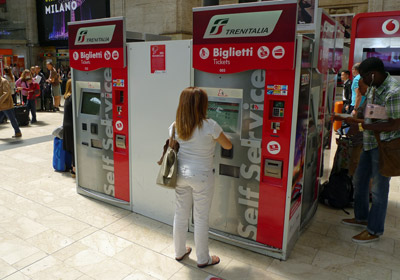
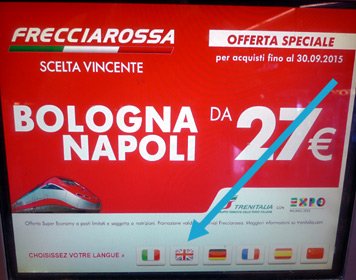
To buy a ticket
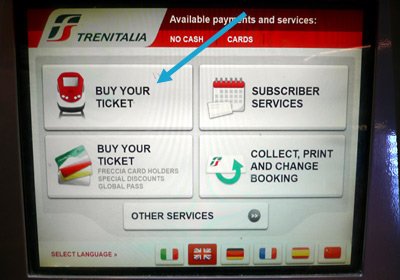
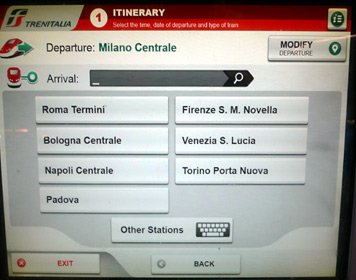
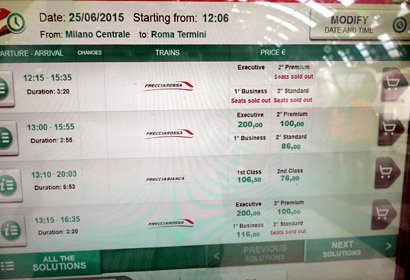
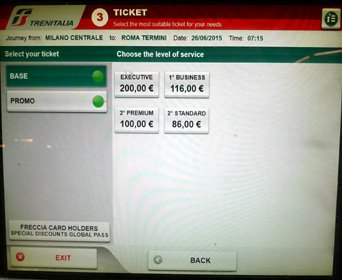
Children under 4 go free with no ticket needed, children under 12 can use a child rate ticket on regional trains, children under 14 can use a child ticket on Frecciarossa, Frecciargento, Frecciabianca, InterCity & InterCity Notte mainline trains.
Guidebooks
Paying for a guidebook may seem an unnecessary expense, but it's only a fraction of what you spend on the whole trip. If you have a decent guidebook, you see so much more and know so much more about what you're looking at. I think the Lonely Planets or Rough Guides are the best ones out there for the independent traveller.
 Click the images to buy at
Amazon.co.uk
Click the images to buy at
Amazon.co.uk
Or buy in the USA from Amazon.com
European Rail Timetable & maps

 The
European Rail Timetable
(formerly the Thomas Cook European Timetable)
has train & ferry times for every country in Europe plus
currency & climate information. It is essential
for regular European train travellers and an inspiration for armchair
travellers. Published since 1873, it had just celebrated 140 years of
publication when Thomas Cook decided to pull the plug on their entire publishing
department, but the dedicated ex-Thomas Cook team set up a private venture and
resumed publication of the famous European Rail Timetable in March 2014.
You can buy it online at
www.amazon.co.uk (UK addresses) or
www.europeanrailtimetable.eu (shipping worldwide).
More information
on what the European Rail Timetable contains.
The
European Rail Timetable
(formerly the Thomas Cook European Timetable)
has train & ferry times for every country in Europe plus
currency & climate information. It is essential
for regular European train travellers and an inspiration for armchair
travellers. Published since 1873, it had just celebrated 140 years of
publication when Thomas Cook decided to pull the plug on their entire publishing
department, but the dedicated ex-Thomas Cook team set up a private venture and
resumed publication of the famous European Rail Timetable in March 2014.
You can buy it online at
www.amazon.co.uk (UK addresses) or
www.europeanrailtimetable.eu (shipping worldwide).
More information
on what the European Rail Timetable contains.
Rail Map Europe is the map I recommend, covering all of Europe from Portugal in the west to Moscow & Istanbul in the east, Finland in the north to Sicily & Athens in the south. Scenic routes & high-speed lines are highlighted. See an extract from the map. Buy online at www.europeanrailtimetable.eu (shipping worldwide) or at www.amazon.co.uk (UK addresses).
Suggested hotels in Italy
Here are my suggested hotels in key Italian cities, conveniently located for arrival by train and all with good or great reviews. You are unlikely to be disappointed by any hotel scoring over 8.0 out of 10 on Booking.com.
Hotels in Turin
-
If you're only stopping overnight en route between London/Paris and Venice/Florence/Rome/Naples, the Paris-Milan trains serve Turin Porta Susa station so you want a hotel nearby.
Hotels near Porta Susa station with good or great reviews include the Hotel Torino Porta Susa, Hotel Diplomatic, Best Quality Hotel Dock Milano (across the road from the now-defunct original Porta Susa station building, immediately north of the new one), or the small but highly-recommended Al Porta Susa B&B.
-
If you're stopping for longer to visit Turin - and you should, it's one of Italy's most under-rated cities - I'd choose a hotel near Turin Porta Nuova as it's more central and most high-speed trains to Venice, Florence, Rome or Naples start here.
Look no further than the lovely Turin Palace Hotel, my favourite hotel in Turin, just across the road from Turin Porta Nuova and walking distance from all the sights. Friendly staff, lovely room, great breakfast, and it even has a roof terrace and bar - you won't be disappointed!
An excellent alternative is the Starhotels Majestic Hotel, 200m from Porta Nuova station.
Hotels in Milan
-
There are lots of hotels near Milan Centrale, used by the Frecciarossa to/from Paris, the EuroCity trains to/from Switzerland and the majority of Italian domestic trains.
Affordable hotels & guesthouses with good or great reviews just outside the station include the Hotel Bristol, Hotel Bernina, 43 Station Hotel, B&B Hotel Milano Central Station, Guesthouse Teodora.
More upmarket hotels include HD8 Hotel, Glam Hotel, Made to Measure Business, Starhotel Echo or Starhotel Anderson.
At the top end, the 5-star Excelsior Hotel Gallia is just across the road, you won't go wrong with that if your budget will stretch!
-
Near Milan Porta Garibaldi (used by the TGV to/from Paris), the AC Milano Hotel (a Marriott Lifestyle Hotel) is just 350m from the station and gets good reviews. Also try the Holiday Inn Porta Garibaldi, which offers family rooms.
Hotels in Verona
-
Hotels near Verona Porta Nuova station with good or great reviews include the Corte Merighi Rooms & Breakfast, Novo Hotel Rossi, Guesthouse Verona or (a little closer to the centre, but with fab reviews) the Relais Empire.
Hotels in Venice
-
Location, location, location! Some people try to save money by staying on the mainland at Mestre as hotels in Mestre are naturally cheaper. It's an option, but don't do it if you don't have to. You want to be a resident in Venice, not a serial day-tripper, so try to find an affordable place in the historic city of Venice itself.
-
Venice Santa Lucia station is walking distance from everywhere in central Venice including the Rialto Bridge and Piazza San Marco, so a hotel near the station which you can easily walk to with your bags makes a lot of sense.
Relatively inexpensive places with good reviews near Venice Santa Lucia include Albergo Marin, Hotel Marte, La Loggia della Luna, Albergo ai Tolentini. I personally recommend the quiet and friendly Albergo Marin, a short walk from Venice Santa Lucia, I hadn't expected such an inexpensive hotel to offer egg & bacon for breakfast with a glass of Prosecco!
For an upmarket place to stay I can personally recommend the luxurious and intimate Hotel Canal Grande, just 5 minutes walk from Venice Santa Lucia, I've stayed here with my son. Also try the Abazzia De Luxe.
For the least expensive accommodation in central Venice check www.hostelworld.com. Use the map view to see places in Venice itself.
Of course, if you have the financial backing for a water taxi, then fine, stay near San Marco or wherever you like. My son nagged me continually until I caved in and splurged €70 on a water taxi from Santa Lucia station to St Marks. I have to say that it was the best thing I have ever done in Venice, and that includes a gondola ride!
-
If you do decide to stay in Mestre to save money and travel in & out of Venice by train every day, try the Hotel Cris which has great reviews 200m from Venezia Mestre station, and the Best Western Plus Hotel Bologna.
Hotels in Florence
-
For something fancy, try the Hotel Santa Maria Novella with a 9/10 review score and rooftop terrace overlooking the Basilica of Santa Maria Novella. It's a mere 5-minute 400m walk from Florence Santa Maria Novella station.
-
For something more affordable but also an easy walk from the station, try the Hotel Art Atelier.
-
Other hotels nearby with good reviews include C-hotels Club, 7Florence B&B, Hotel Lombardia.
Hotels in Rome
-
There are many hotels near Rome Termini. However, an affordable top choice with a 9/10 review rating is the Hotel Diocleziano, a 5-minute 400m walk from Roma Termini's main entrance, set in a 19th century building next to the Terme di Diocleziano ancient Roman baths.
-
An upmarket option near the station is Hotel Le Petit, an 8-minute 700m walk from the station, also with great reviews.
-
Other hotels near the station with good or great reviews include The Hive Hotel, Dream Station, The Republic Hotel.
Hotels in Naples
-
There are lots of hotels near Naples Centrale.
-
The Starhotel Terminus is just across the road from the station, gets great reviews and has a roof terrace with views over the Bay of Naples.
-
The Hotel Potenza is only a little further into the Piazza Garibaldi, cheaper, also with good reviews.
-
The Unahotel Napoli is highly recommended, on Piazza Mancini overlooking Piazza Garibaldi, on the far side facing the station.
-
Also consider the Pit Stop Napoli Centrale.
 Booking.com
for hotels
Booking.com
for hotels
I generally use Booking.com for hotels for 3 reasons:
(1) It keeps all my hotel bookings together in one place;
(2) I've come to trust Booking.com's review scores;
(3) Booking.com usually offers a clearly-marked Free cancellation option.
Free cancellation means you can secure hotels risk-free even before trains open for booking, and if necessary change those bookings if your plans evolve.
If I'm only staying a night or two, I look for a hotel near the station to make arrival & departure easy. You can enter the station name (e.g. Berlin Hbf) as search location. If staying longer, I look for a hotel close to the sights, entering the name of a city attraction as the search location, then using map view.
I then look for a hotel with a review score of 8.0 or over, any hotel scoring over that won't disappoint.
AirBnB: Airbnb.com
www.airbnb.com began in 2008 when two designers who had space to share hosted three travellers looking for a place to stay. AirBnB is a platform which connects hosts with guests, so you can now book a room in people's homes, or an apartment, flat or house which people want to rent out. It can be nicer than a hostel, cheaper than many hotels.
 Backpacker hostels:
Hostelworld.com
Backpacker hostels:
Hostelworld.com
www.hostelworld.com offers online booking of dorm beds or cheap private rooms in backpacker hostels most European cities at rock-bottom prices. It's one way to cut costs significantly compared to using a hotel every night.
Travel insurance & other tips
|
|
|
|
|

Always take out travel insurance
You should have travel insurance with at least £1m or preferably £5m medical cover from a reliable insurer. It should cover trip cancellation and loss of cash & belongings up to a reasonable limit. An annual policy is usually cheapest even for just 2 or 3 trips a year, I have an annual policy with Staysure.co.uk myself. Just don't expect travel insurance to bail you out of every missed connection, see the advice on missed connections here. Here are some suggested insurers, I get a little commission if you buy through these links, feedback always welcome.
www.staysure.co.uk
offers enhanced Covid-19 protection and gets 4.7 out of 5 on
Trustpilot.
www.columbusdirect.com is also a well-know brand.
 www.staysure.com/ie if you live in Ireland.
If you live in the USA try
Travel Guard USA.
|
|

Get an eSIM with mobile data package
Don't rely on WiFi, download an eSIM with a European mobile data package and stay connected. Most newer mobile phones can download a virtual SIM including iPhone 11 & later, see device compatibility list. There's no need to buy a physical SIM card! Maya.net is a reliable eSIM data retailer with a 4.5 out of 5 Trustpilot rating and a range of packages including unlimited data.
|
|

Get a VPN for safe browsing. Why you need a VPN
When travelling you may use free public WiFi which is often insecure. A VPN encrypts your connection so it's always secure, even on unsecured WiFi. It also means you can select the geographic location of the IP address you browse with, to get around geoblocking which a surprising number of websites apply. See VPNs & why you need one explained. ExpressVPN is a best buy with a 4.7 out of 5 Trustpilot ranking which I use myself - I've signed up as an ExpressVPN affiliate, and if you go with expressvpn.com using this link you should see a special deal, 3 months free with an annual subscription. I also get some commission to help support this site.
|
|

Get a Curve card for foreign travel
Most banks give you a poor exchange rate then add a foreign transaction fee on top. A Curve MasterCard means no foreign transaction fees and gives you the mid-market exchange rate, at least up to a certain limit, £500 per month as I write this. The money you spend on your Curve card goes straight onto one of your existing debit or credit cards. And you can get a Curve card for free.
How it works: 1. Download the Curve app for iPhone or Android. 2. Enter your details & they'll send you a Curve MasterCard - they send to the UK and most European addresses. 3. Link your existing credit & debit cards to the app, you can link up to two cards with the free version of Curve, I link my normal debit card and my normal credit card. 4. Now use the Curve MasterCard to buy things online or in person or take cash from ATMs, exactly like a normal MasterCard. Curve does the currency conversion and puts the balance in your own currency onto whichever debit or credit card is currently selected in the Curve app. You can even change your mind about which card it goes onto, within 14 days of the transaction.
I have a Curve Blue card myself, it means I can buy a coffee on a foreign station on a card without being stung by fees and lousy exchange rates, just by tapping the Curve card on their card reader. The money goes through Curve to my normal debit card and is taken directly from my account (in fact I have the Curve card set up as payment card on Apple Pay on my iPhone, so can double-click my phone, let it do Face ID then tap the reader with the phone - even easier than getting a card out). I get a little commission if you sign up to Curve, but I recommend it here because I think it's great. See details, download the app and get a Curve card, they'll give you £5 cashback through that link.
|
|

Carry an Anker powerbank
Tickets, reservations, hotel bookings and Interrail or Eurail passes are often now held on your mobile phone. You daren't let it run out of power, and you can't always rely on the phone's internal battery or on being near a power outlet. I always carry an Anker powerbank which can recharge my phone several times over. Buy from Amazon.co.uk or buy from Amazon.com.
Touring cities? Use hill walking shoes!
One of the best things I've done is swap my normal shoes for hill-walking shoes, in my case from Scarpa. They're intended for hiking across the Pennines not wandering around Florence, but the support and cushioning for hiking works equally well when you're on your feet all day exploring foreign cities. My feet used to give out first and limit my day, now the rest of me gives up before they do!