


|
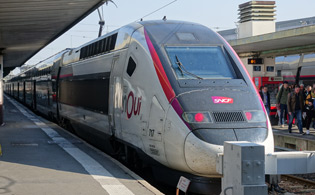
France by TGV: Just walk into the station, glance at the departures screen to find your train & hop on, up to 2 minutes before departure. Buy French train ticketswww.sncf-connect.com (SNCF's own website, no booking fee) www.raileurope.com (can be used by anyone, small fee) www.thetrainline.com (can be used by anyone) Omio.com (can be used by anyone, small fee) |
|
|
|
|
|
|
Times, fares & how to buy tickets
The best way to travel between French town & cities is in comfort by train. France's world-famous TGV travels at up to 320 km/h (199 mph), city centre to city centre, with cheap fares if you pre-book. This page explains how French trains work and how best to buy tickets.
 How to
check train
schedules & fares
How to
check train
schedules & fares
Maps of the French rail network
Carte Avantage, SNCF's discount card
TGV,
Intercités, overnight trains,
TER
Travel tips:
Luggage, ticket validation, food...
Places off the network: Corsica, Mont St
Michel...
Charles de Gaulle Airport trains
Custom-made tours of France by train
International trains to/from France
Train travel from the UK to France
Trains from Paris to
other European cities
Trains from Nice to
other European cities
Trains from
Marseille to
other European cities
Trains from
Toulouse to
other European cities
Trains from
Bordeaux to
other European cities
Trains from
Strasbourg to
other European cities
Trains to Paris from other European cities
Station guides
Paris Gare du Nord station
guide
Paris Gare de l'Est station
guide
Paris Gare de Lyon station
guide
Paris Gare d'Austerlitz station
guide
Paris Gare Montparnasse station
guide
Paris Gare de Bercy station
guide
Paris Gare St Lazare
station guide
Lyon Part Dieu & St
Exupéry station guide
General train travel information
How to use the
French Railways website
Luggage on trains &
Left
luggage at stations
Interrail passes - the
European railpass
General European train travel
information
Child age limits & travel with
kids
Travel insurance,
mobile data, VPN & other
tips
Useful country information
How to check schedules & fares
-
You can check train times & fares for any journey in France at the French Railways website www.sncf-connect.com, called voyages-sncf.com until 2017. There's no booking fee and if booking 1st class on a TGV you can choose your seat from a seat map. It can be a little fiddly and has occasionally been known to struggle with non-European credit cards.
-
You can also use either www.raileurope.com (formerly Loco2.com, prices in €, £ or $) or www.thetrainline.com (formerly Captaintrain.com, in €, £ or $). These are easy to use, in plain English, international cards no problem and they sell tickets for other European operators too, not just for French Railways. Both sites charge a small booking fee.
-
To understand the different types of train such as TGV, TER & Intercité, see What are French trains like?
-
As well as regular trains including their full-service TGV InOui high-speed trains, French Railways have a subsidiary company called Ouigo which runs lo-cost no-frills TGVs between Paris and Bordeaux, Lyon, Aix, Avignon, Marseille, Nimes, Montpelier, Cannes & Nice. Ouigo is a budget airline on rails, with check-ins, luggage restrictions, no first class, no catering, and on some routes an out-of town Paris station. Don't book one unless you understand their limitations! See the Ouigo page for more information.
Maps of the French rail network
-
Map of the French railway network (please let me know if the link stops working, they change it so often!)
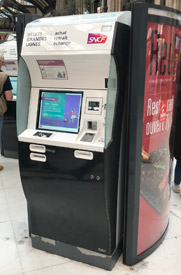 You can buy tickets at these self-service machines. Just click the UK flag on the touch screen for English! Tickets bought online at Raileurope.com, Thetrainline.com, Rail Europe or sncf-connect.com can be collected from these machines, although many tickets are now print-at-home e-tickets so don't need to be collected. Do you need a credit card to ride this train... or at least to collect the tickets? If you bought your tickets from raileurope.com, Thetrainline.com or Rail Europe you don't need a credit card to collect tickets from these machines, just enter the reference number & your name. But if you bought from sncf-connect.com you'll need to insert the original card you used to buy the tickets. If this isn't a Chip n PIN credit card you'll need to collect tickets from the staffed ticket office instead. |
Do you need to buy in advance?
-
TER regional, local & suburban trains, no.
This includes all TER (Trains Express Régionaux), Paris suburban trains and all other local trains. For example, Lyon-Grenoble or Dijon-Lyon TERs, Cannes-Nice-Monte Carlo TERs, Paris to Versailles or CDG airport by RER.
Simply buy a ticket at the station ticket office or from the self-service machines, you may still need to validate it (composter) in the little machines on the platform (although this requirement is being phased out), hop on the next train and sit where you like. Or buy one online, just to save time, online TER tickets don't need to be validated.
No reservation is necessary or even possible, the train can't sell out and the fare is fixed so there's usually no price advantage in pre-booking. There are a few exceptions to this, read more about TER ticketing.
Tip: SNCF sometimes shows a busy TER as fully-booked when trying to book online. In fact it can't be full as TERs don't have reservations and a tarif normal ticket is good for any TER train that day. If you go to the station, ticket machines or ticket office will still sell you a ticket for that train. The workaround for online booking is to buy a tarif normal ticket for a previous or later train and use it on the one that's showing as full.
-
Intercités, probably.
A few shorter-distance Intercité trains don't have compulsory seat reservation, so they can never sell out, you can always buy a full-price ticket at the station and hop on, sitting wherever you like. Routes include Nantes-Bordeaux, Nantes-Lyon, Toulouse-Hendaye, Béziers-Clermont. But you can still save some money by booking a cheap train-specific non-refundable prems fare in advance, so it's worth checking online.
However, most Intercités such as Paris-Limoges-Brive-Toulouse, Paris-Vichy-Clermont, Bordeaux-Toulouse-Montpellier-Marseille and Intercités de nuit require compulsory reservation, just like the TGVs explained below.
-
TGV high-speed trains, yes.
TGV high-speed trains are all-reserved. All tickets for these trains come with a seat reservation automatically included and the price varies like air fares, so pre-book for the cheapest prices. In practice there are almost always places available on most trains even just before departure, the issue is price. On the day of departure you'd have to pay the expensive full-flex fare, for example Paris-Nice €140, but if you pre-book you can buy a cheap Prems fare, Paris-Nice from €25 upwards. So it pays to book ahead! Booking now opens up to 4 months ahead.
Fares explained
-
SNCF simplified TGV & Intercité fares in 2019 and there's now just one type of fare in 2nd class, although they call the higher prices Seconde and the cheaper prices Prems, which is SNCF's long-established brand name for cheap fares.
So you'll now see only one 2nd class price against each train, in contrast to the flexible, inflexible and semi-flexible fares they used to have. In 1st class there are two fare types, Première & Business Première.
Prices are dynamic like air fares, cheaper in advance, more expensive closer to departure, cheaper on quiet trains, days & dates, more expensive on popular trains, days & dates. All tickets commit you to a specific train.
All 1st & 2nd class fares are now changeable & refundable. Refunds or changes of date/time are free of charge until 7 days before travel, then there's a fee of up to €19 until 30 minutes before departure. To change your date or time you have to pay any difference in fare.
From 30 minutes before the train departs, tickets can be changed up to two times for the same day and the same journey, but they become non-refundable once exchanged. Tickets are non-refundable and non-exchangeable after departure.
Business première fares are totally flexible, changeable without any fee until 30 minutes after departure. From 30 minutes before the train departs, tickets can be changed up to two times for the same day and the same journey, but they are non-refundable once exchanged. These fares are expensive, aimed at business travellers as their name suggests.
-
Local and regional (TER) trains just have one fixed price fare, usually termed Tariff normal. These tickets are valid for one journey on any train leaving until midnight on the day they're booked for or (in some cases) after you validate it in a little composter machine on the platform. Sometimes there are cheaper tariffs at off-peak times, but that depends on the region.
How to buy tickets at the station
-
It's easy to buy tickets at the station even if you don't speak French. For local journeys such as Paris-Versailles or Nice-Cannes, you just turn up, buy a ticket and hop on, no reservation necessary. You can buy tickets from the multi-lingual self-service machines at main stations. Just touch the UK flag for English.
-
For long-distance trains including all TGV, Intercités & Intercités de Nuit overnight trains, reservation is compulsory, but there are usually seats available even on the day of travel and you can buy a ticket immediately before the train departs. But there are much cheaper fares if you pre-book.
-
In some cases you need to validate your tickets by putting them into the little yellow machines marked Compostez votre billet at the entrance to every platform - there's a fine if you don't! Print-at-home tickets don't need to be validated, and SNCF are steadily phasing out the need to validate tickets. You already don't need to in some regions.
How to buy train tickets online
-
Bookings open 4 months ahead for TGV & Intercités, 3-5 months for TER regional trains.
Over the summer, booking horizons get longer: In 2024 sales opened on 24 January for travel until 22 May, on 7 March until 5 July, on 13 March until 11 September.
Google SNCF ticket sales opening to find the page on www.sncf-connect.com where they give current sales opening dates.
For Christmas & New Year horizons get shorter: Dates after the mid-December timetable change usually open in mid-October.
-
Buy at www.sncf-connect.com
This is French Railways' own website selling tickets in €. You print your own ticket or can show it on your phone.
It's a little fiddly, it's almost as if they made it that way deliberately. The language selector is out of sight towards the bottom of the page and their home page has just one mysterious all-purpose entry field which confuses a lot of people, instead of having from and to fields like a normal site. However, I've set up all links to www.sncf-connect.com to go to a page in English with conventional from and to fields, at least I can help you with that!
When booking a 1st class ticket on a TGV or Intercité you can usually select your seat from a seat map.
It can sell all SNCF products including Billets Bambin (which gives infants under 4 their own reserved seat) and Espace Privatif (sole occupancy of a couchette compartment on French overnight trains). It can sell tickets with the Carte Avantage discount applied (SNCF's discount card) and can sell tickets for Ouigo lo-cost trains as well as full-service TGV InOui.
The vast majority of tickets can be printed or shown on your phone. In rare cases where www.sncf-connect.com only offers you a collect-at-station ticket you'll need a chip & PIN credit card to collect from the machines (without chip & PIN you'll need to use the busy staffed ticket counter) but if you buy at Raileurope.com or Thetrainline.com no credit card is necessary to collect tickets, just the booking reference.
www.sncf-connect.com normally works for anyone from any country, so give it a try. In the past I've occasionally known it to reject some overseas credit cards, but if you have any problems you can simply switch to www.thetrainline.com.
-
Buy at www.thetrainline.com
Three young French entrepreneurs thought they could sell SNCF tickets better than SNCF themselves, and they were right. They started a website called Capitainetrain which was later acquired by well-known UK ticket retailer The Trainline and absorbed into www.thetrainline.com. It connects to SNCF's ticketing system and sells the same tickets at the same prices, with a small booking fee. You can pay in €, £ or $. About Thetrainline.com.
It's easier to use than www.sncf-connect.com, anyone of any nationality can buy tickets at www.thetrainline.com, international credit cards are welcome. You print your ticket or show it on your phone. They ask you to print in A4 size, but if you're American printing tickets on Letter size paper is absolutely fine.
When booking a 1st class ticket on a TGV or Intercité you can usually select seats from a seat map, a big plus.
Thetrainline.com can sell Billets Bambin, Espace Privatif and tickets for Ouigo lo-cost trains, and can apply the Carte Avantage discount.
-
Buy at www.raileurope.com
Two young British entrepreneurs started Loco2.com, aiming to make buying train tickets easier. Loco2 was acquired by SNCF in 2018, rebranded Raileurope.com in 2019 and sold on again in 2020. It links to SNCF's ticketing system and sells the same tickets as SNCF at the same prices, with a small booking fee. You can pay in €, £ or $. Who are Raileurope.com?
It can sell Billets Bambin to give your infant under 4 their own reserved seat.
However, it can't sell tickets for Ouigo lo-cost trains or Espace Privatif on overnight trains, nor can it sell tickets with a Carte Avantage discount. It offers a wide range of seating options including upper and lower deck on a TGV Duplex, but unlike SNCF-connect and Thetrainline it doesn't offer seat selection from a seat map.
It's easier to use than www.sncf-connect.com, international credit cards welcome. You print your ticket or show it on your phone. They ask you to print in A4 size, but if you're American printing tickets on Letter size paper is absolutely fine.
Which website for French train tickets?
Here's a summary of the features of each website, you can draw your own conclusions. As far as price is concerned, all the sites below charge the same basic fare (give or take exchange rates).
Type = does it offer basic choice of aisle, window, table-for-four or (in 1st class) a table-for-two or solo seat?
Deck = does it offer a choice of upper or lower deck on a double-decker TGV Duplex?
Map = can you select your seat from a seat map when booking 1st class on a TGV or Intercité?
Show = does it show you car & seat number before you pay? This allows you to check against a seat map, and if not to your liking, re-run the enquiry.
Ouigo = can it book the special lo-cost budget-airline-on-rails TGV trains branded Ouigo (see the Ouigo page)?
FB = Billet Bambin, allows you to pay a few euros to reserve a seat for your infant aged 0-3, more information here.
EP = Espace Privatif, allows you to book sole occupancy of a 4-berth couchette on a French night train, more information here.
CA = Carte Avantage, can this website sell tickets if you have SNCF's Carte Avantage discount card?
* www.sncf-connect.com usually works with any credit card, very occasionally I receive an It's rejected my credit card email from overseas users such as Americans or Australians, but give it a go, with one of the other sites as a fall-back if it doesn't.
How to contact SNCF
You can call SNCF telesales & customer service on 00 33 184943635, listen out for option 85 for English. Lines open 08:00-20:00 French time, 7 days a week.
SNCF's discount card: Carte Avantage
What is a Carte Avantage?
-
Carte Avantage is SNCF's discount card for leisure travel. You buy it for a year and it gives discounts on travel. It may justify the price even for one or two long trips, especially if you're booking close to your departure date when fares would normally be expensive.
-
Man in Seat 61's top tip
You can read the small print until you're blue in the face, but the only way you'll know for certain what benefit a Carte Avantage gives is by running an enquiry with and without a Carte Avantage added and seeing what effect the card has.
So before buying a Carte Avantage, run an enquiry for the specific journeys you plan to make, on the same days of the week, using either www.thetrainline.com or www.sncf-connect.com (a) without any Carte Avantage and (b) with a Carte Avantage discount added.
You can add a Carte Avantage reduction to the passenger details without entering a card number. See what that does to prices. If you see no difference, the discount may not apply to your particular route/train/day. If you see a difference, do savings justify the cost of the card?
Types of Carte Avantage
-
Carte Avantage Adulte costs €49 at the time I write this and lasts one year, see details & buy online at sncf-connect.com.
It can be bought by anyone regardless of nationality or country of residence.
It gives 30% discount on French domestic TGV & Intercité journeys and 25%-50% on some TER regional trains if your journey is:
(a) one-way on a Saturday or Sunday; or
(b) a return journey on any day of the week which includes a Friday, Saturday or Sunday night away; or
(c) one-way or return on any day of the week if accompanied by at least one child under 12.
One accompanying adult also gets the same discount - in other words, if there are 2 of you, you only need one Carte Avantage.
Up to 3 accompanying children under 12 years old get 60% off TGV & Intercité fares, and a varying amount off TER fares.
In addition, fares are capped if you have a Carte Avantage so they remain affordable even close to travel date where they'd otherwise be high.
The 30% discount also applies to some international journeys, notably the Paris-Luxembourg TGVs, Paris-Milan TGVs, Paris-Barcelona TGVs; TGVs & ICEs between Paris & Frankfurt, Stuttgart, Munich; and TGV-Lyria between Paris & Switzerland.
However, there is no discount on Eurostar or Eurostar (formerly Thalys), and no discount on TER trains in some French regions.
There is no discount on one-way journeys on weekdays (unless you're travelling with a child), or on some international journeys, so see my top tip above to check whether a Carte Avantage will work for your own specific journeys.
-
Carte Avantage Jeune is for anyone aged 12 but under 28 years old, see details & buy online. This costs the same as the adult version, but the discounts apply one-way or round trip on any day of the week, without the weekend or accompanying child restriction. However, there's no discount for a second adult. You can buy wherever you live and whatever your nationality.
-
Carte Avantage Senior for anyone over 60, see details & buy online. This costs the same as the adult version, but the discounts apply one-way or round trip on any day of the week, without the weekend or accompanying child restriction. However, there's no discount for a second adult. You can buy wherever you live and whatever your nationality.
How to buy a Carte Avantage
-
The card is digital, you can either print it out and carry it as a .pdf document or load it into the SNCF-Connect app to show on your phone. Either way, there's a QR code which conductors can scan.
-
In theory, you can upload a photo of yourself to make the card fully digital with no separate ID needed (your photo will appear on the conductor's device the moment he scans your ticket). However, SNCF's photo upload system doesn't work and will repeatedly reject any photo you try to upload. So don't waste your time on it, if you can't upload a photo (which you can't), you simply need to carry some alternative form of photo ID, such as a passport or driving licence.
How to buy tickets with Carte Avantage discount
-
As soon as you've bought your Carte Avantage, you can buy tickets with the relevant discount at either www.thetrainline.com (small booking fee) or www.sncf-connect.com (a little more fiddly, no fee).
When using www.thetrainline.com, don't click Add railcard as you'll only see UK railcards, first set up a journey with a French origin and/or destination, then click Add loyalty and railcards, then click SNCF - Discount cards.
You can also use your Carte Avantage if buying French train tickets at Omio.com. Unfortunately, you can't use a Carte Avantage at www.raileurope.com.
Should you buy a railpass?
-
If you just want to make one, two or perhaps three journeys from A to B, book point-to-point tickets in advance online, it's the cheapest & easiest option. But for a more extensive itinerary, consider an Interrail pass. This allows you to stay flexible.
Interrail passes
-
You can buy an Interrail pass, either a one-country pass just for France or a global pass covering most of Europe including France. These give unlimited travel on trains run by SNCF (French Railways) for various periods of time, check prices at www.thetrainline.com/passes.
Passholder reservations
-
French long-distance trains usually require a reservation, including TGV & Intercités. For high-speed TGV trains it costs either €10 or €20 depending on availability. Passholder reservations can be made online on your laptop or phone, see how to make reservations here.
Is a rail pass worth it?
-
People struggle with this, perhaps because they think point-to-point fares have one fixed price that can be compared with a pass. But point-to-point fares vary like air fares so you have to check actual fares for your specific trains & dates. And it's not just about price, it's about how you value the flexibility of a pass versus cheap but inflexible no-refunds no-changes tickets. Here's how to make a decision:
-
First go to www.thetrainline.com/passes and check the current price for a single-country Interrail pass for France for however many days you want. Divide the cost by the number of days. That's the cost-per-day. Now factor in the €10 reservation fee for a TGV.
At the time I write this, a 4-day France pass works out at €49 per day + €10 = €59 assuming you make one journey per day.
-
Now go to www.thetrainline.com and check actual prices for journeys you plan to make, on the trains and dates you want. Compare these with the pass cost. Then remember that the cheapest point-to-point prices usually mean specified train only, no refunds, no changes whereas a pass gives unlimited flexible travel, give or take the need to make a reservation. It depends how you value the flexibility of a pass!
-
Of course, I'm assuming one trip per day here. Passes give you unlimited trips and mileage, with complete flexibility. As soon as you want to make multiple trips the same day (Paris to Lyon and back, for example) a pass makes sense.
Also, children under 12 qualify for a free Interrail pass (but still have to pay for reservations), so if you have kids, that can swing it towards a pass.
What are French trains like?
Trains à Grande Vitesse (TGV)
-
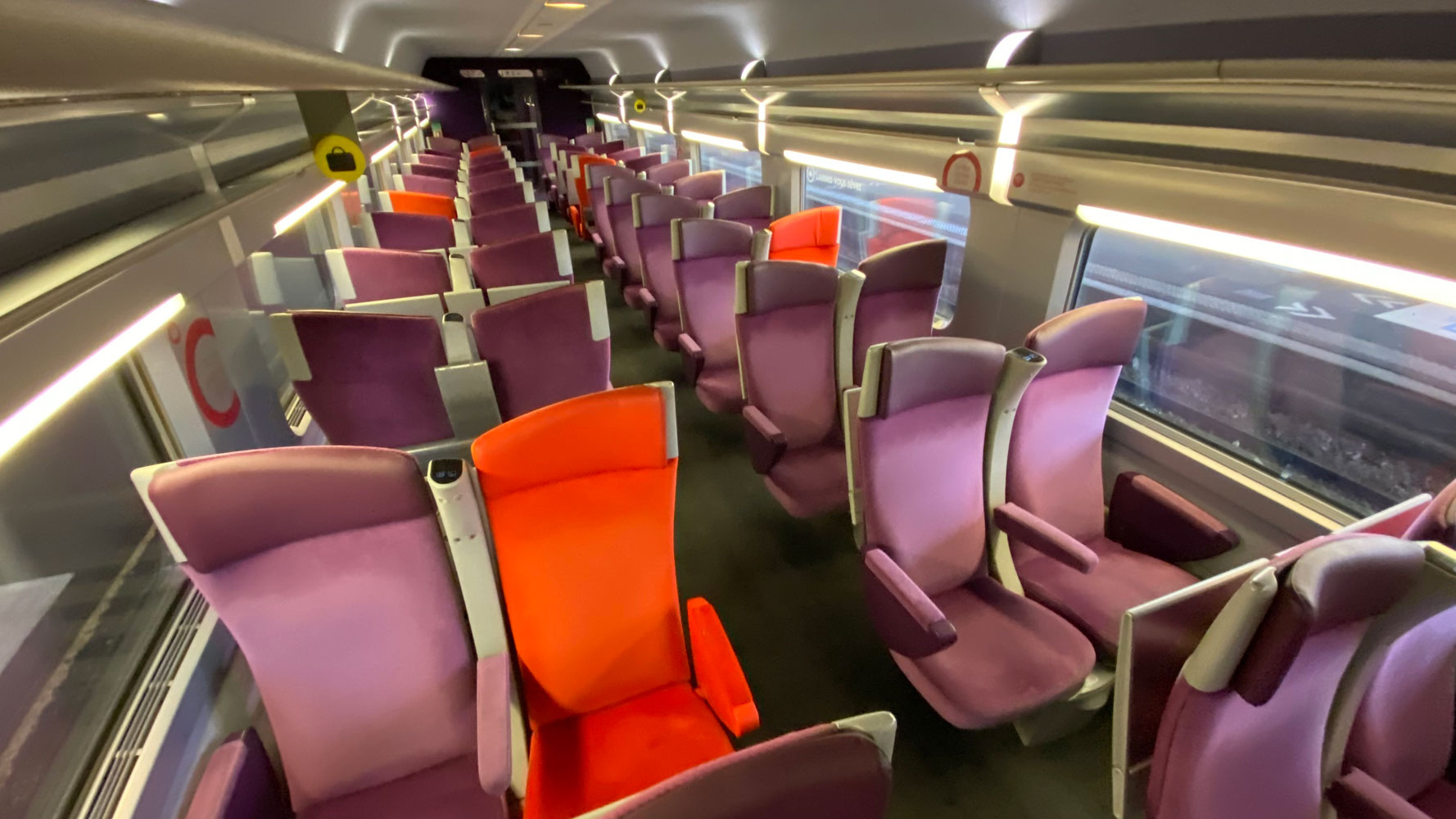
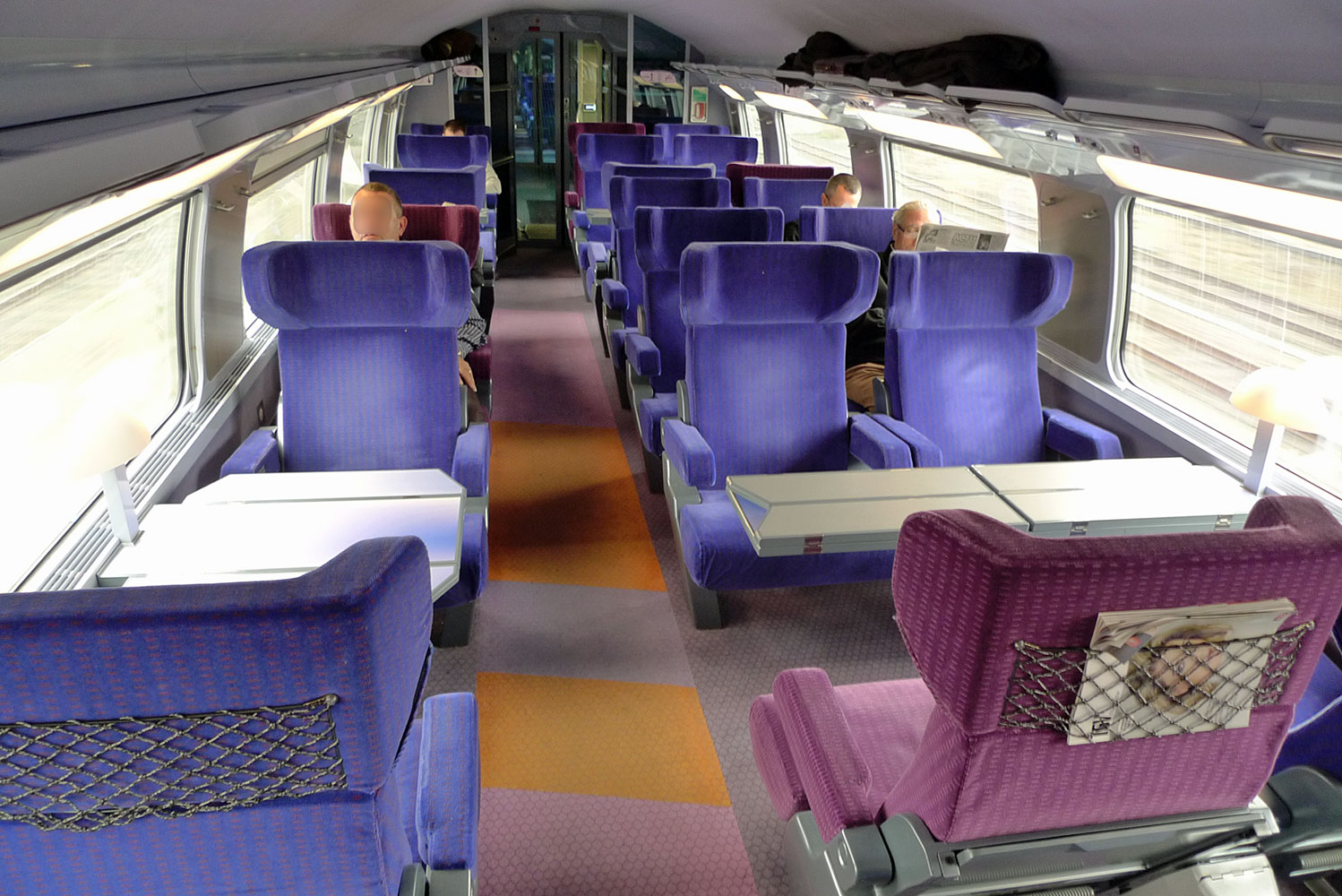
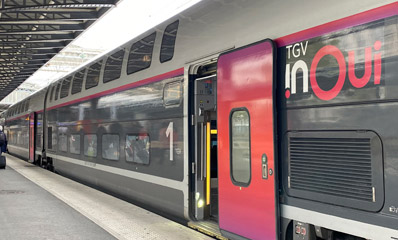
TGVs or Trains à Grande Vitesse are SNCF's premier high-speed trains. They run on major routes covering most of France at up to 300 km/h (186 mph). In fact, they run at up to 320 km/h (198 mph) on the new TGV-Est route from Paris to Reims, Strasbourg, Metz, Luxembourg & Basel, opened in 2007. Smooth & quiet even at high speed, it's a very relaxing way to travel. All but a handful of shorter-distance TGVs have a cafe-bar, and all have power outlets, free WiFi, toilets, wheelchair accessible spaces and luggage space.
Seat reservation is compulsory on TGV services, and all tickets come with a seat reservation automatically included.
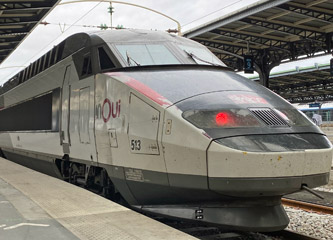
SNCF's full-service TGVs are branded TGV InOui, to distinguish them from the no-frills lo-cost Ouigo trains.
There are various types of TGV including double-deck TGV Duplex, for TGV seat maps see the seat map page.
Ouigo
-
In 2013, French Railways launched a lo-cost no-frills TGV service, a budget-airline-on-rails called Ouigo. For more information see the Ouigo page.
-
SNCF used to have a subsidiary company called iDTGV to run special cheap TGVs, but iDTGV was discontinued in December 2017.
Intercités
-
Intercités is the name given to SNCF's remaining non-high-speed long-distance express trains. They come in two varieties, Intercités with compulsory reservation and Intercités without compulsory reservation.
-
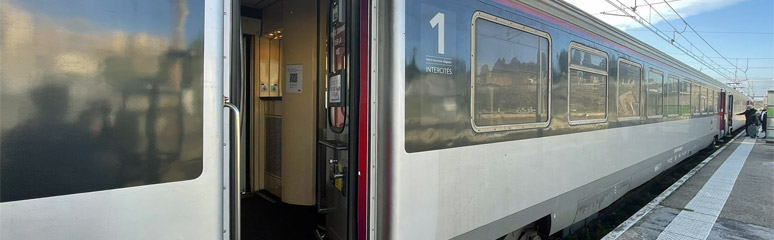
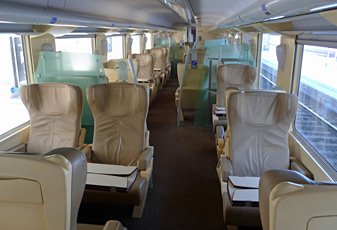
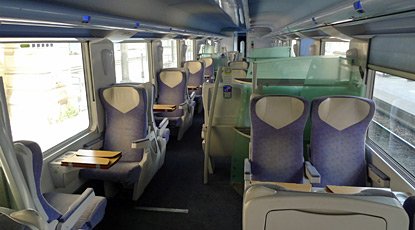
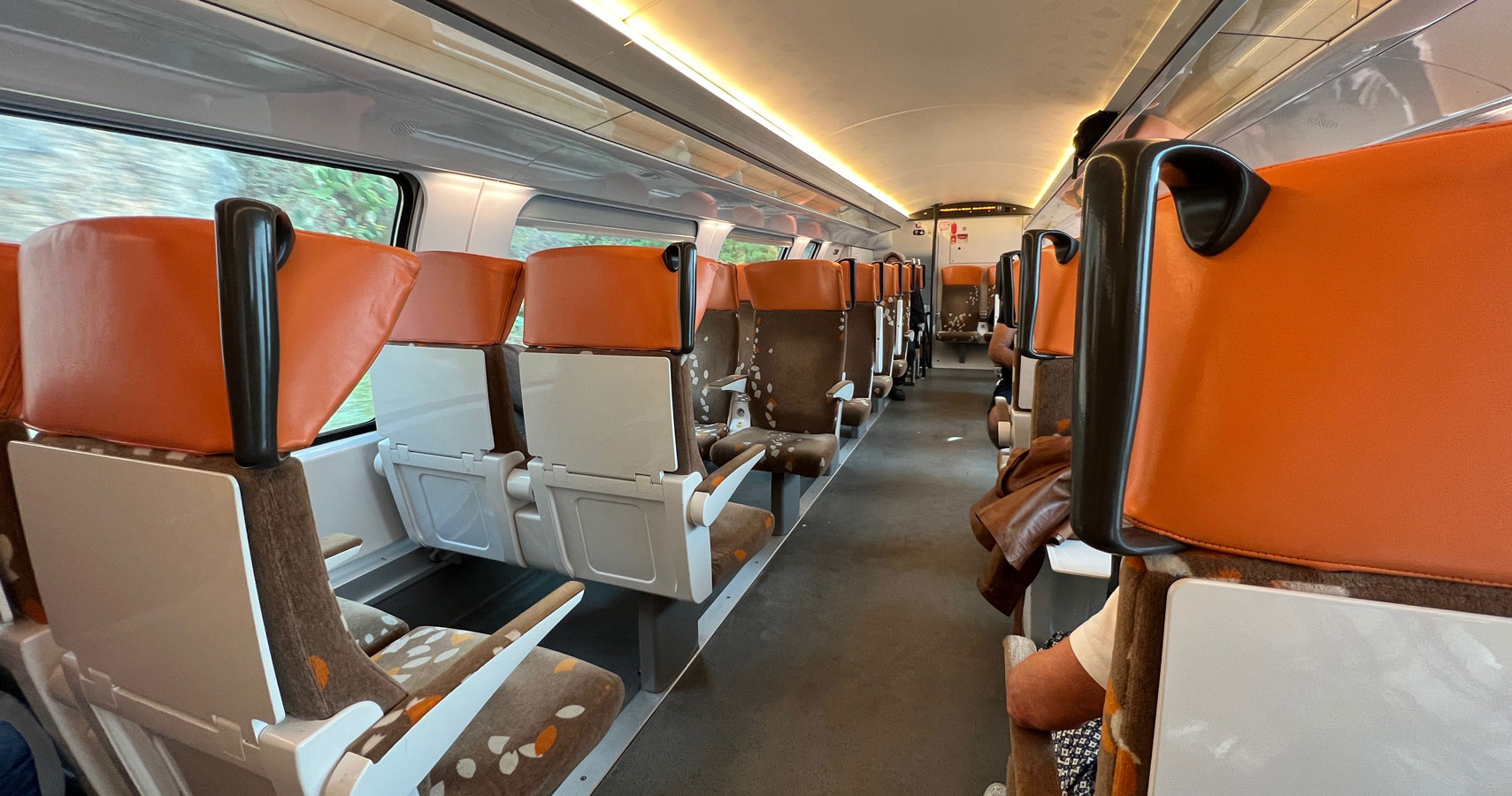
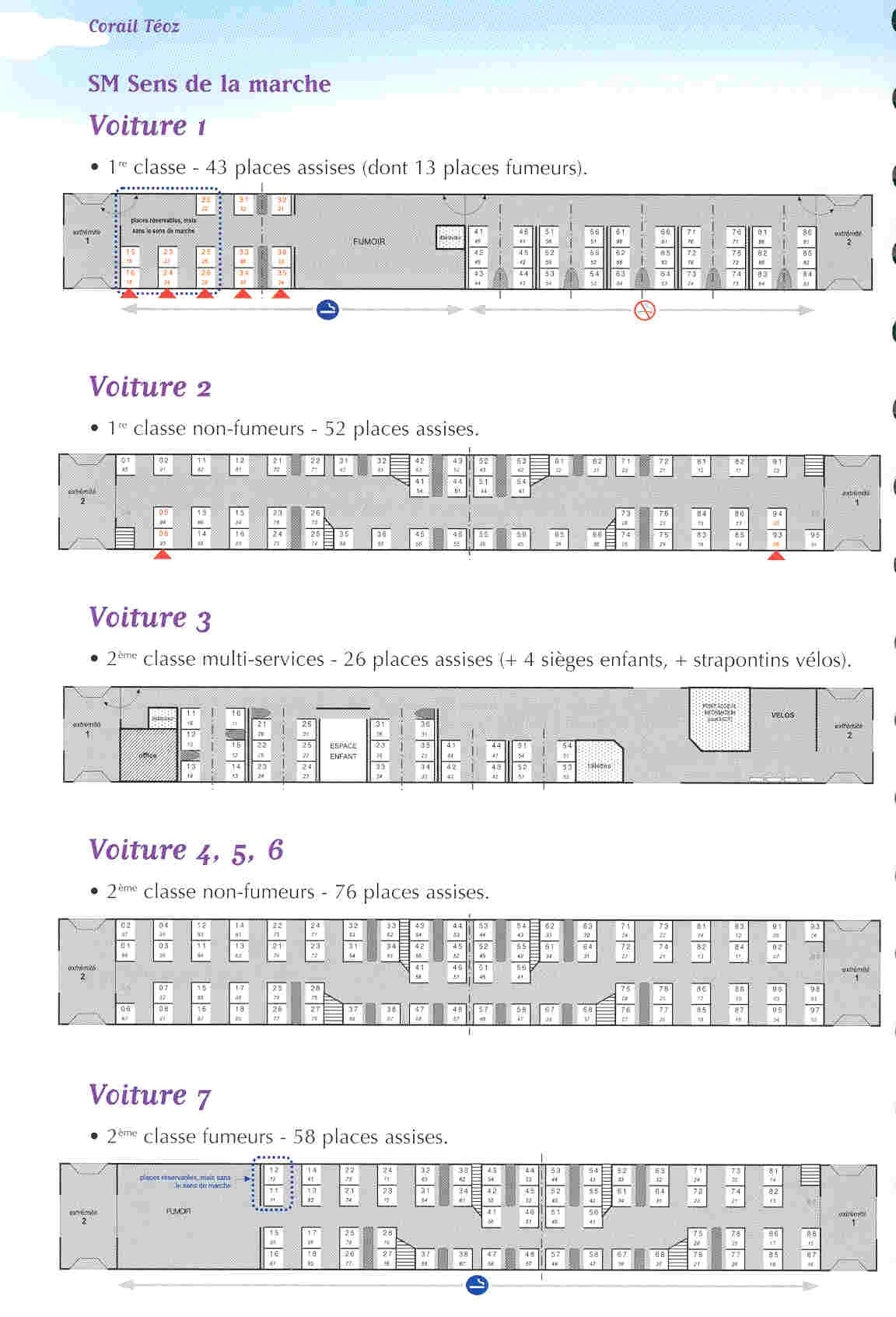
Intercités with compulsory reservation are mostly smart locomotive-hauled trains running at up to 125mph, many using stylish air-conditioned cars formerly branded Téoz like the ones shown below, although SNCF has ceased using the Téoz branding. New electric units are slowly coming on stream for Intercité services to replace the locomotive-hauled cars. All seats have access to power sockets. Intercité routes include the Paris-Limoges-Brive-Toulouse (POLT) route and Nantes-Bordeaux-Toulouse-Perpignan-Marseille. All tickets for these trains come with a seat reservation for a specific train automatically included. See seating plan.
-
Intercités without compulsory reservation usually use similar locomotive-hauled coaches with a plainer interior. There are only a few routes left now, Nantes-Bordeaux, Nantes-Lyon, Toulouse-Hendaye, Béziers-Clermont. Most other routes in this category have now been handed over to the French regions and have become TER, notably Paris-Boulogne-Calais & Paris-Normandy. As the name suggests, you don't need a reservation for these trains, you can just turn up, buy an open ticket which can never sell out, get on and sit where you like. Seat reservation is an optional extra if you want it. Although these trains don't need to be pre-booked, if you book in advance you can often find cheaper train-specific prems fares which save money over the on-the-day full-flex price.
-
All Intercités have plenty of room for luggage, toilets, and often some form of catering - either a trolley service or a cafe-bar.
-
Some routes formerly branded Intercité have become TER (for example, Paris-Amiens-Boulogne-Calais), whilst Paris-Normandy Intercités have been rebranded Train Nomad with modern unit trains replacing or about to replace the old locomotive-hauled carriages.
-
Tip: It's possible to pre-order drinks & snacks for delivery to your seat on most Intercités. Go to www.sncf-connect.com/train/services-train/restauration-intercites (please let me know if that link stops working), order what you want (the cut-off seems to be just hours before departure), enter your train number, you car & seat number, your name & email, and pay.
Intercités de Nuit
-
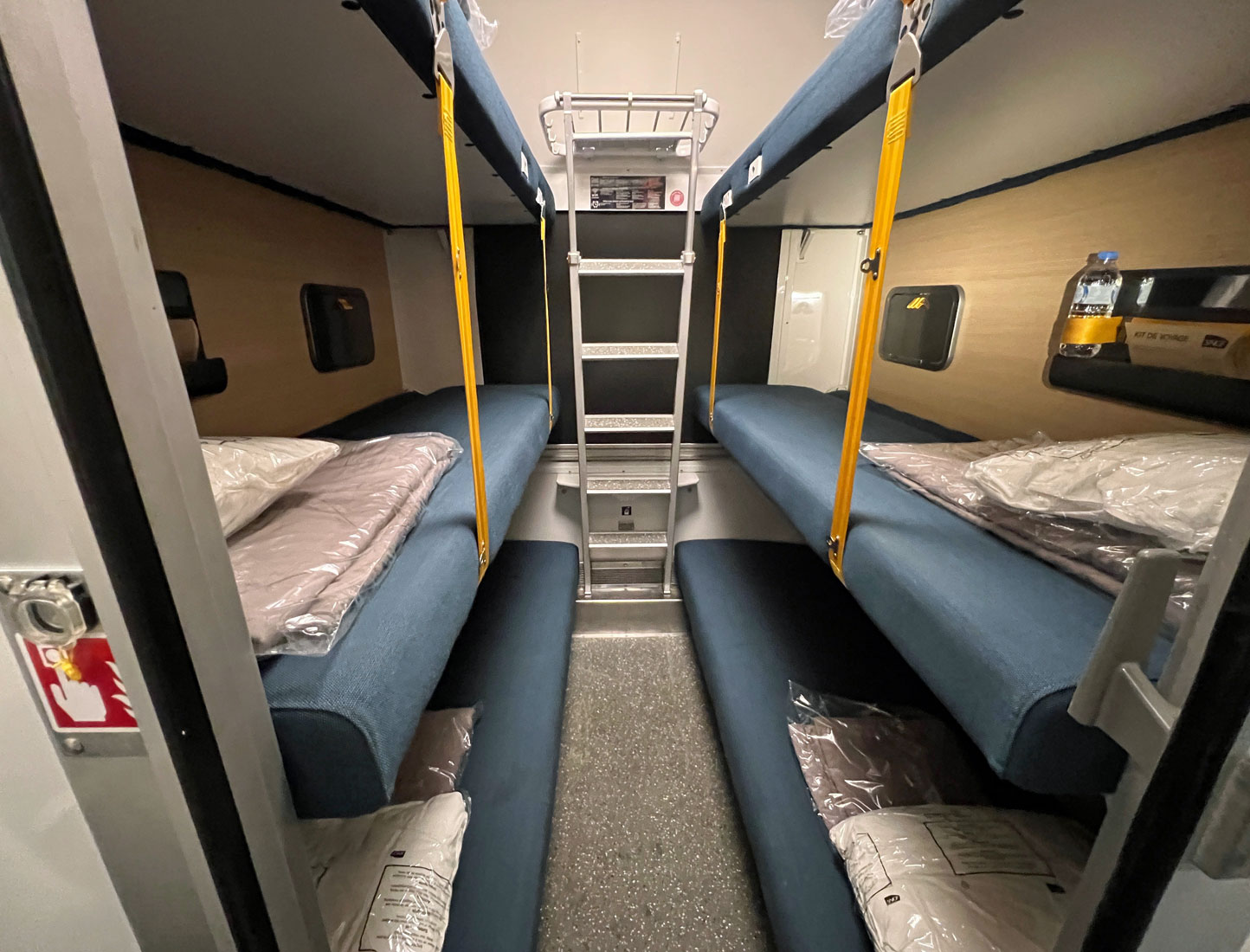
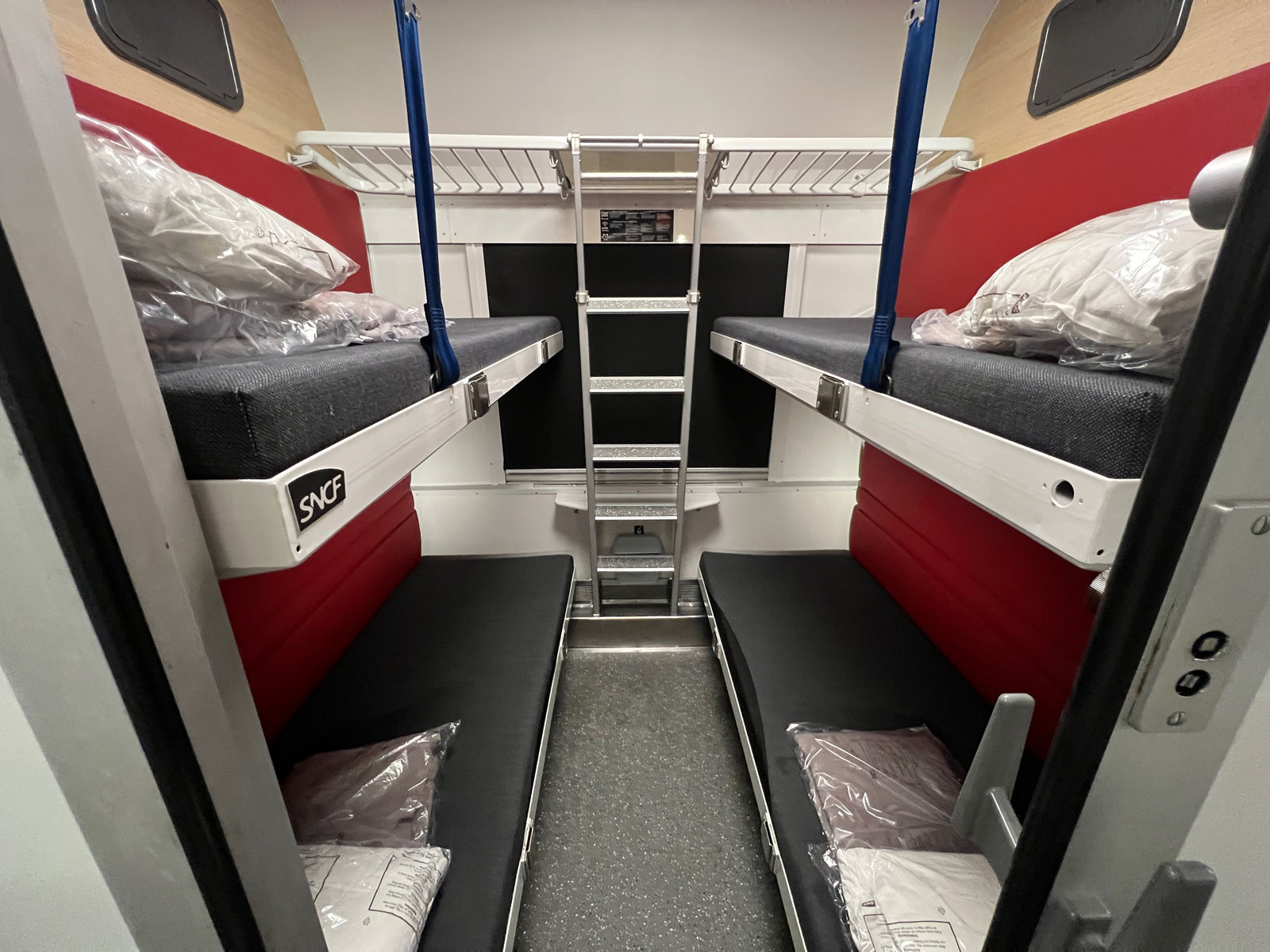
SNCF's overnight sleeper trains are called Intercités de Nuit. Taking an overnight train with couchettes can be great fun and the most time-effective way to travel, in effect faster than flying. Sleep your way to the south of France in a comfy couchette, from Paris to Cannes, Nice, Narbonne, Perpignan, Toulouse, Rodez, Briancon or Latour de Carol for as little as €29 each way booked at www.raileurope.com or www.thetrainline.com. You can book sole or dual occupancy of a couchette compartment as explained here.
-
For more information, photos & a video guide see the Intercités de Nuit page.
Trains Express Régionaux (TER)
-
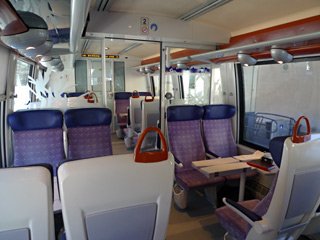
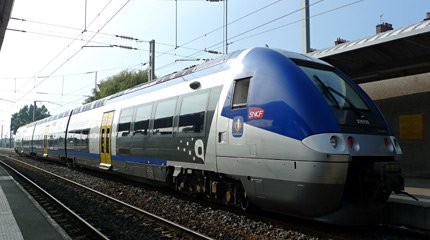
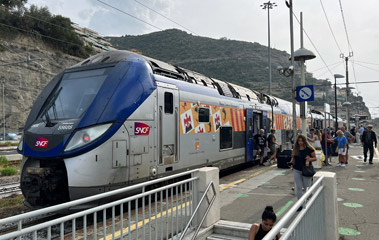
Trains Express Régionaux (TER) come in all shapes and sizes, typical single-deck & double-deck TERs are shown below. TERs are local regional trains, there are no seat reservations, you just sit where you like. Some TERs are double-deck such as the Cannes-Nice-Monaco-Ventimiglia TERs and a few use locomotive-hauled mainline carriages including the Paris-Dijon-Lyon and Marseille-Nice TER trains. All TER trains have space for luggage on various racks (or it simply sits on the floor) and many carry bikes too. They generally have toilets.
-
TER ticketing
TER trains have affordable fixed-price open tickets, so you may as well just buy at the station on the day - although you may now find some cheap train-specific tickets if you book a few days or weeks in advance and commit to a specific departure. Most TER trains can never 'sell out' as Tarif normal tickets should always be available, but see the next paragraph!
-
Can TERs sell out?
On 95% of TER routes there are no reservations, Tarif normal tickets have unlimited availability and can be used on any TER train that day. But since the pandemic, SNCF sometimes plays a dirty trick: Some TER departures can be shown as 'fully-booked' (complet in French) on trains they think will be very busy. This has often backfired, by making it difficult to buy tickets it has lead to photos of half-empty 'complet' trains posted on social media!
The easy workaround:
Buy a full-price Tarif normal TER ticket for any TER train before or after the 'full' train on the same day, a Tarif normal ticket is good for any train that day, so you can use it on the train that was shown as Complet. Simples.
I'm told that ticket machines at the station will also happily sell you a ticket for these TERs falsely shown as 'fully-booked'. So remember, it's just a dirty trick from a management that wants to make life difficult for rail travellers. You can get around it!
-
TERs with compulsory reservation
There are exceptions to every rule. TERs between Paris and Normandy have compulsory reservation, such as Paris-Caen-Cherbourg. Some longer TER routes in the east such as Paris-Nancy-Strasbourg are also now reservation compulsory. These TERs can indeed sell out.
-
Maps of the French rail network: See the maps section on the Train travel in Europe page.
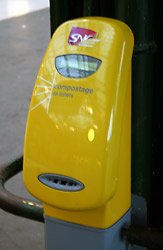
Compostez votre billet!
Before boarding your train, you may need to validate your ticket in one of these yellow compostez validation machines near the entrance to each platform - although this process and these machines are gradually being phased out.
-
Printing your ticket
These days you usually get a print-at-home ticket for a French train journey. You should print it out full-size on normal A4 paper, but it's OK to print on US Letter Size paper if necessary.
-
Collecting your ticket
Some tickets can't be self-printed so need to be collected from the self-service ticket machines at any French station. If you bought your tickets online at www.raileurope.com or www.thetrainline.com or any Rail Europe site, all you need is the booking reference and lead passenger name, you don't need the credit card you used. However, if you bought online at www.sncf-connect.com (any version) you'll need to insert the original credit card, which will need to be chip n PIN for the machine to work. If your credit card isn't chip n PIN and you bought from www.sncf-connect.com you'll need to collect from the staffed counter, rather than from the machines. See photos showing how to collect tickets.
-
Ticket validation (compostage)
Originally, all French train tickets had to be validated just before you boarded your train, by putting them into the small yellow machines marked Compostez votre billet at the entrance to each platform. There was a fine if you didn't! This process is being phased out and machines removed, it's already unnecessary for TER tickets in some regions of France, and unnecessary if you have a train-specific ticket for a TGV or Intercité. And of course you can't validate an e-ticket on your phone! But the need to validate still exists with some tickets in some regions, so be aware of it and if in doubt where there's a machine, validate your ticket.
-
Language problems?
First-time visitors often think this will be a problem, but it hardly ever is. At stations, signs are usually in English as well as French, or easy-to-understand pictograms are used.
-
Food & drink on French trains
Most long-distance trains have a cafe-bar, serving tea, coffee, wine, beer & snacks. French domestic trains no longer have restaurant cars, though a few key Monday-Friday business services offer pre-bookable at-seat meals in first class. However, feel free to bring your own food and drink (even a bottle of wine, if you like) onto the train, there's no rules against that on the rails!
-
A meal at the Gare de Lyon?
If you're passing through Paris via the Gare de Lyon, consider dining at the famous Train Bleu restaurant inside the station. It was originally the Gare de Lyon's grand buffet, opened in 1903 and decorated in a sumptuous art nouveau style. It's not the cheapest restaurant around, but the food is superb and the surroundings are perhaps the most spectacular you will ever eat a meal in. It's an experience in itself, and well worth it! The restaurant's website is www.le-train-bleu.com, just email them to book a table. You can also use their bar section to wait for your train while you have a coffee or beer, far better than waiting for your train at one of the draughty cafe tables downstairs on the concourse!
-
You don't check your bags in, you simply take them with you onto the train, placing them on the racks at the end of each car, or above your head. More about luggage on trains.
-
Luggage limits
Since February 2024 SNCF has had a more formal luggage limit for TGV InOui: There are no weight limits, but you must be able to carry it yourself in one go. If you exceed these limits there's a €50 fee, although it's not yet clear how tough staff will be.
You can carry either 1 hand luggage + 2 suitcases or 1 hand luggage + 1 suitcase + 1 specific item.
Your hand luggage can measure up to 40 cm x 30 cm x 15 cm. Your suitcase(s) can measure up to 90 cm x 70 cm x 50 cm.
Your specific item (musical instrument, pushchair, bike in cover, folded bike, scooter) can measure up to 130 cm x 90 cm. Bikes, musical instruments, snowboards & skis must be under a labelled cover. You can travel with your pair of skis, without a maximum size, one pair per person.
-
Left luggage at stations
Major French stations including Paris Gare du Nord, Paris Gare d'Austerlitz Est & Paris Gare de Lyon have left-luggage lockers in various sizes, up to suitcase-sized. Expect to have your bags X-rayed before entry to the locker area. More information on left luggage lockers including current prices.
|
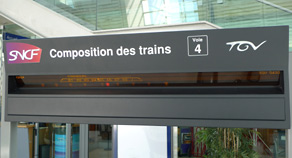
Train formation display, showing where along the platform each car of a train will stop, so you can be waiting in the right place when your train comes in! |
-
Bicycles
You can take a bike with you free of charge on suburban & regional trains. On Intercités de Nuit overnight trains & TGVs on a few routes, you can take them for a small fee, about €10. On other TGVs, you'll need to place you bike in a zip-up 'bike bag' & they then travel free. For more information, see the bicycles by train page.
-
Dogs & pets
Dogs can be taken on all French trains, sometimes free, sometimes for a small fee. For more information, see the dogs & pets page.
-
Can I book a seat facing direction of travel?
Only on some routes, and then only if you book through the right website! You can book a seat facing the direction of travel on a handful of TGV routes where the trains have been equipped with a special seat numbering system. On these trains, each seat has two possible numbers and the relevant one lights up depending on the direction of the train. Routes equipped with this system where you can choose a seat facing direction of travel include TGV-Atlantique Paris-Brittany, Paris-Bordeaux/Biarritz/Lourdes/Spanish border and most TGV-Est trains Paris-Reims-Nancy-Strasbourg, Paris-Luxembourg and also the Paris-Italy TGVs Paris-Turin-Milan. Choosing a facing seat is not possible on TGV Duplex, or on routes such as Lille-Lyon-Avignon/Marseille/Bordeaux/Montpelier, Paris-Avignon-Marseille-Nice, Paris-Lyon, Paris-Nimes-Montpelier. But if there are two of you and you choose dual face to face in 1st class, or a table for 4 (family or facing) in 2nd class, you'll know you always have at least one seat facing. See this comparison table to see which websites can book a forward-facing seat where it is an option, and which sites can't.
-
Can I book a seat for my baby or infant?
Infants under 4 go free on French trains, no ticket necessary, just buy tickets for yourself and bring your infant along without a ticket. However, they don't get their own seat if they go free, so they'll have to sit on your lap. You may want a seat for your baby carrier or wriggly 2 or 3 year old, I know I would! No problem, on French domestic TGV and Intercité trains you can pay an extra flat €9 for a Billet Bambin and get a reserved seat for your infant next to yours, in either class. You can only buy Billet Bambin at www.raileurope.com, www.thetrainline.com or at www.sncf-connect.com. If you want a Billet Bambin, simply add a passenger with age 0-3 and it will be added automatically.
How to change trains & stations in Paris
Which station in Paris?
-
The Gare du Nord serves trains to the north: Lille, Amiens, Boulogne, Calais, Dunquerque, London, Brussels, Antwerp, Rotterdam, Amsterdam, Cologne.
-
The Gare de l'Est serves trains to the east: Nancy, Strasbourg, Reims, Frankfurt, Munich, Stuttgart, sleepers to Berlin, Hamburg, Munich, Moscow
-
The Gare de Lyon serves TGV trains to the south-east: Lyon, Avignon, Marseille, Cannes, Nice, Monte Carlo, Nîmes, Montpellier, Narbonne, Perpignan, Turin, Milan, Geneva, Bern, Lausanne, Basel, Zurich.
-
The Gare d'Austerlitz serves Téoz trains to Limoges, Toulouse, & overnight couchette trains to Cannes, Nice, Monte Carlo, Toulouse, Perpignan, Narbonne, Lourdes, Biarritz, Madrid & Barcelona.
-
The Gare Montparnasse serves TGV trains to the southwest: Toulouse, Bordeaux, Nantes, Biarritz, Lourdes, Brest, Rennes.
-
The Gare St Lazare serves Dieppe and the immediate north.
-
The Gare de Bercy, a little known station down the road from the Gare de Lyon, now handles most trains to Clermont Ferrand.
-
Charles de Gaulle airport has its own station, served by TGV high-speed trains on the Paris by-pass line and by RER express metro trains into central Paris, see the section below.
-
Disneyland Paris is right next to Marne La Vallée station. This is linked to central Paris by frequent turn-up-and-go RER express metro trains, just buy tickets at the station on the day. Marne la Vallée is also served by mainline TGV high-speed trains on the Paris by-pass line, carrying trains from Brussels & Lille in the North to Lyon, Avignon, Marseille, Nimes & Montpellier in the south, for times & tickets use www.thetrainline.com. For park information & tickets see www.disneylandparis.com.
Places not served by the main rail network
-
Mont St Michel has no station, but can be reached by train+bus, see the Mont-Saint-Michel page.
-
St Tropez: Take a train to St Raphael. Bus 876 links St Raphael bus station (next to the railway station) with St Tropez bus station every hour or so, journey time 1h25, fare around €3, check times and buy tickets using the Zou regional transport phone app at zou.maregionsud.fr.
-
The Nice-Digne railway is a private and very scenic line linking Nice (CFP station) with Digne. Highly recommended, see www.trainprovence.com.
-
Corsica: Corsica can easily be reached by comfortable ferry from a variety of ports in Southern France, including Marseille, Toulon or Nice. The principal ferry operators are www.corsicalinea.com (formerly SNCM and Corsica Ferries (www.corsicaferries.com). For train service on Corsica see cf-corse.corsica.
Charles de Gaulle (CDG) Airport station
-
For journeys between CDG Airport and central Paris, simply use the frequent RER express metro - RER Line B has stations at both Terminal 1 & Terminal 2. RER trains run every 6 to 15 minutes, journey time into Paris around 50 minutes, fare around €10 valid to any RER or metro station in central Paris. No reservation is necessary or possible for the RER, just buy a ticket at the station on the day. For more info see http://easycdg.com.
-
Charles de Gaulle Airport also has its own TGV station, which is on the high-speed line that by-passes Paris. It's served by TGVs to Lille & Brussels in the north and to Lyon, Avignon, Marseille, Perpignan, Cannes, Nice, Rennes, Nantes, Le Mans, Poitiers, Bordeaux, Toulouse to the south. You can check TGV times & prices and buy tickets from CDG to destinations across France at either www.raileurope.com or www.thetrainline.com.
-
Remember that TGV tickets are only valid on the specific TGV you book. Cheap tickets become worthless if your flight is late and you miss your train, so I recommend allowing at least 3 hours between your flight's scheduled landing time and any TGV leaving CDG station.
-
You'll find more frequent trains to these destinations from the relevant station in central Paris, often with greater availability of cheaper tickets, so if you don't see a convenient departure with an attractive price leaving direct from CDG, use www.raileurope.com or www.thetrainline.com to check train times & prices from central Paris to your destination, leaving Paris at least 4 hours after your flight lands, and simply hop on the RER express metro to the relevant central Paris station as explained above.
-
You can't reach every French destination from CDG TGV station - If you're bound for Normandy, Limoges, Brive, Cahors or Clermont Ferrand for example you'll have to take the RER into central Paris as explained above and then take a train from the relevant station in central Paris.
Guidebooks
 Paying
for a guidebook may seem an unnecessary expense, but it's a
tiny fraction of what you're spending on your whole trip.
You will see so much more, and know so much more about what
you're looking at, if you have a decent guidebook. I recommend the Lonely
Planet or Rough Guides as the best ones out
there for independent travellers. Click the
images to buy the books - if you buy anything
at Amazon
through these links, Seat61.com gets a small
commission (at no extra cost to you) to help support the site.
My own book is an essential handbook for train travel to Europe
based on this website called "The
Man in Seat 61".
Paying
for a guidebook may seem an unnecessary expense, but it's a
tiny fraction of what you're spending on your whole trip.
You will see so much more, and know so much more about what
you're looking at, if you have a decent guidebook. I recommend the Lonely
Planet or Rough Guides as the best ones out
there for independent travellers. Click the
images to buy the books - if you buy anything
at Amazon
through these links, Seat61.com gets a small
commission (at no extra cost to you) to help support the site.
My own book is an essential handbook for train travel to Europe
based on this website called "The
Man in Seat 61".
Click the images to buy at Amazon.co.uk
Or buy in the USA from Amazon.com




European Rail Timetable & maps

 The
European Rail Timetable
(formerly the Thomas Cook European Timetable)
has train & ferry times for every country in Europe plus
currency & climate information. It is essential
for regular European train travellers and an inspiration for armchair
travellers. Published since 1873, it had just celebrated 140 years of
publication when Thomas Cook decided to pull the plug on their entire publishing
department, but the dedicated ex-Thomas Cook team set up a private venture and
resumed publication of the famous European Rail Timetable in March 2014.
You can buy it online at
www.amazon.co.uk (UK addresses) or
www.europeanrailtimetable.eu (shipping worldwide).
More information
on what the European Rail Timetable contains.
The
European Rail Timetable
(formerly the Thomas Cook European Timetable)
has train & ferry times for every country in Europe plus
currency & climate information. It is essential
for regular European train travellers and an inspiration for armchair
travellers. Published since 1873, it had just celebrated 140 years of
publication when Thomas Cook decided to pull the plug on their entire publishing
department, but the dedicated ex-Thomas Cook team set up a private venture and
resumed publication of the famous European Rail Timetable in March 2014.
You can buy it online at
www.amazon.co.uk (UK addresses) or
www.europeanrailtimetable.eu (shipping worldwide).
More information
on what the European Rail Timetable contains.
Rail Map Europe is the map I recommend, covering all of Europe from Portugal in the west to Moscow & Istanbul in the east, Finland in the north to Sicily & Athens in the south. Scenic routes & high-speed lines are highlighted. See an extract from the map. Buy online at www.europeanrailtimetable.eu (shipping worldwide) or at www.amazon.co.uk (UK addresses).
Custom-made tours of France
 Railbookers,
railbookers.co.uk
Railbookers,
railbookers.co.uk
Railbookers are a train travel specialist who can put together a tour or short break for you as a package, including rail travel, hotels & transfers. On their website you'll find a range of suggested tours & holidays which can be varied or customised to your own requirements. And as you're booking a package, they'll take care of you if anything happens to one part of the itinerary such as a strike or delay. They now have offices in the UK, USA & Australia.
 UK call 0207 864 4600,
www.railbookers.co.uk
- please quote 'Seat 61'.
UK call 0207 864 4600,
www.railbookers.co.uk
- please quote 'Seat 61'.
 US call free 1-888-829-4775,
see website.
US call free 1-888-829-4775,
see website.
 Canada call free 1-855-882-2910,
see website.
Canada call free 1-855-882-2910,
see website.
 Australia call toll-free 1300 971 526,
see website.
Australia call toll-free 1300 971 526,
see website.
 New Zealand call toll-free 0800 000 554 or
see website.
New Zealand call toll-free 0800 000 554 or
see website.
 Tailor
Made Rail,
tailormaderail.com
Tailor
Made Rail,
tailormaderail.com
Tailor Made Rail can arrange tours of France by train based on your own requirements, they welcome complex itineraries. As it's a package, they'll take care of you if anything happens on one part of the trip, for example, a national strike. They're TTA-protected, which is similar to ATOL's protection for air travel.
Call their dedicated seat61 phone line 020 3778 1461 and quote seat 61 when booking. From outside the UK call +44 20 3778 1461. Lines open 09:00-17:30 Monday-Friday. Their website is www.tailormaderail.com/destinations/france.
Suggested hotels in Paris
Something special
There are the obvious luxury choices such as the famous (and expensive) Paris Ritz in the Place Vendôme, founded by the Swiss hotelier César Ritz & French chef Auguste Escoffier in 1898. Anyone who's anyone has stayed here, from Hemingway to Princess Diana - even I've stayed there, once!
And the equally famous, luxurious & expensive Le Meurice, which Von Choltitz made his headquarters during the occupation of Paris in WW2 where he took the call from his Führer demanding to know "Is Paris burning?"
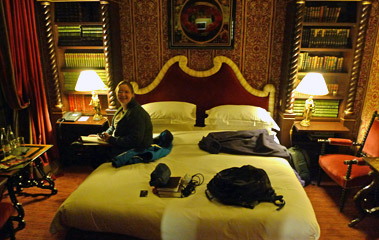
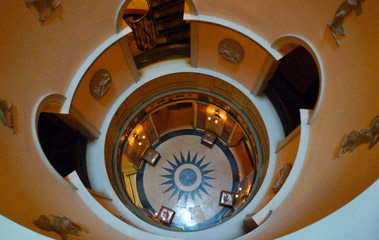
But if for a special hotel for a luxury break or romantic weekend, I'd recommend the small, sumptuous, intimate l'Hôtel, on the bohemian left bank, walking distance from the Seine, the Ile de la Cité & Notre Dame. Price-wise it requires a modest splurge, but nothing like the other two.
Playwright Oscar Wilde spent the last days of his life here in room 16 when it was known as l'Hôtel d'Alsace, famously quipping, "My wallpaper and I are fighting a duel to the death. One or the other of us has to go.". Fortunately the wallpaper is now fine (Mrs 61 & I had the room next to Oscar's). The hotel has welcomed many famous guests, from Sinatra to Mick Jagger. Rooms are on the cosy side, but they are beautifully decorated and have character that bigger and flashier hotels lack. Check prices & book a stay at l'Hôtel.

Hotels near Paris stations
Here are some hotel suggestions that are close to the major Paris rail stations and which get good reviews:
Hotels near the Gare du Nord
The top choice here is the 4-star 25 Hours Terminus Nord, built in 1870 directly across the road from Gare du Nord's main exit. It was refurbished in 2019 in a decidedly quirky style to become part of the avant-garde 25 Hours hotel brand. The funky decor and weird lighting grew on me, staff were friendly, breakfast excellent, and our large double room with balcony (the two second-floor windows to the left of the '2' in '25 Hours' sign) was well soundproofed with effective air-conditioning in spite of a heatwave. A top choice that gets great reports from other seat61 travellers, too! The tale of and Marshal Pétain & the Hotel Terminus Nord.
Alternatively, the 2-star Libertel Gare du Nord Suede is a 3-minute 250m walk from the Gare du Nord, or try the Art Hotel (3-star) or Avalon Hotel (2-star).
For somewhere relatively cheap, try the Hotel Altona, a 9-minute 650m walk from the station or Grand Hotel Magenta, a 4-minute 230m walk from the station - although in this popular area the review score suffers when you reduce the price.

The 25 Hours Hotel Terminus Nord. Below left, a large double room with balcony. Below right, a single room.


Hotels near the Gare de l'Est
The 3-star Libertel Gare de l'Est Français is opposite the station and gets great reviews, as does the cheaper 2-star Hotel Little Regina, just a 2-minute 110m walk across the road from the station. Also consider the Midnight Hôtel Paris, a 4-minute 250m walk from the station, and the 2-star OKKO Hotels Paris Gare de l'Est.
Hotels near the Gare de Lyon
If I'm catching an early train (or arriving late at night), my favourite hotel here is the 4-star Mercure Paris Gare de Lyon, perfectly located on the station itself next to the Gare de Lyon's iconic clock tower. Friendly staff and lovely rooms, I highly recommend it.
In a similar category, consider the Citizen M Hotel, an easy 2-minute 160m walk from the station, although I've yet to stay here myself, multiple Seat 61 travellers have raved about it. Alternatively, the 3-star Hotel Terminus Lyon is directly in front of the station; The 4-star Novotel Paris Gare de Lyon is opposite the station, and the 2-star Hotel 26 Faubourg is a 6-minute 450m walk away.
Hotels near the Gare Montparnasse
The 3-star Hôtel Montparnasse Saint Germain is a top choice here with excellent reviews, a 4-minute 260m walk from the Gare Montparnasse or 120m walk from Montparnasse Bienvenue metro station. Equally highly-rated, the 3-star Maison Gaîté is a 5-minute 290m walk from the station. Or try the 4-star Mercure Paris Gare Montparnasse, a 7-minute 450m walk from the station.
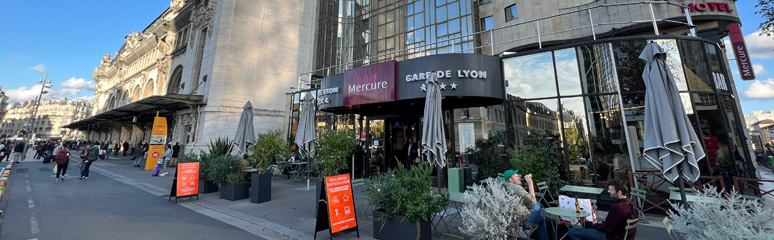

Entrance to the Mercure Hotel at the Gare De Lyon, right next to the station's famous clock tower. Handy for early trains!
Backpacker hostels: www.hostelworld.com
www.hostelworld.com: If you're on a tight budget, don't forget about backpacker hostels. Hostelworld offers online booking of cheap private rooms or dorm beds in backpacker hostels in Paris and most other European cities at rock-bottom prices.
Travel insurance & other tips
|
|
|
|
|


Always take out travel insurance
You should have travel insurance with at least £1m or preferably £5m medical cover from a reliable insurer. It should cover trip cancellation and loss of cash & belongings up to a reasonable limit. An annual policy is usually cheapest even for just 2 or 3 trips a year, I have an annual policy with Staysure.co.uk myself. Just don't expect travel insurance to bail you out of every missed connection, see the advice on missed connections here. Here are some suggested insurers, I get a little commission if you buy through these links, feedback always welcome.
www.staysure.co.uk
offers enhanced Covid-19 protection and gets 4.7 out of 5 on
Trustpilot.
www.columbusdirect.com is also a well-know brand.
 www.staysure.com/ie if you live in Ireland.
If you live in the USA try
Travel Guard USA.
|
|

Get an eSIM with mobile data package
Don't rely on WiFi, download an eSIM with a European mobile data package and stay connected. Most newer mobile phones can download a virtual SIM including iPhone 11 & later, see device compatibility list. There's no need to buy a physical SIM card! Maya.net is a reliable eSIM data retailer with a 4.5 out of 5 Trustpilot rating and a range of packages including unlimited data.
|
|

Get a VPN for safe browsing. Why you need a VPN
When travelling you may use free public WiFi which is often insecure. A VPN encrypts your connection so it's always secure, even on unsecured WiFi. It also means you can select the geographic location of the IP address you browse with, to get around geoblocking which a surprising number of websites apply. See VPNs & why you need one explained. ExpressVPN is a best buy with a 4.7 out of 5 Trustpilot ranking which I use myself - I've signed up as an ExpressVPN affiliate, and if you go with expressvpn.com using this link you should see a special deal, 3 months free with an annual subscription. I also get some commission to help support this site.
|
|


Get a Curve card for foreign travel
Most banks give you a poor exchange rate then add a foreign transaction fee on top. A Curve MasterCard means no foreign transaction fees and gives you the mid-market exchange rate, at least up to a certain limit, £500 per month as I write this. The money you spend on your Curve card goes straight onto one of your existing debit or credit cards. And you can get a Curve card for free.
How it works: 1. Download the Curve app for iPhone or Android. 2. Enter your details & they'll send you a Curve MasterCard - they send to the UK and most European addresses. 3. Link your existing credit & debit cards to the app, you can link up to two cards with the free version of Curve, I link my normal debit card and my normal credit card. 4. Now use the Curve MasterCard to buy things online or in person or take cash from ATMs, exactly like a normal MasterCard. Curve does the currency conversion and puts the balance in your own currency onto whichever debit or credit card is currently selected in the Curve app. You can even change your mind about which card it goes onto, within 14 days of the transaction.
I have a Curve Blue card myself, it means I can buy a coffee on a foreign station on a card without being stung by fees and lousy exchange rates, just by tapping the Curve card on their card reader. The money goes through Curve to my normal debit card and is taken directly from my account (in fact I have the Curve card set up as payment card on Apple Pay on my iPhone, so can double-click my phone, let it do Face ID then tap the reader with the phone - even easier than getting a card out). I get a little commission if you sign up to Curve, but I recommend it here because I think it's great. See details, download the app and get a Curve card, they'll give you £5 cashback through that link.
|
|

Carry an Anker powerbank
Tickets, reservations, hotel bookings and Interrail or Eurail passes are often now held on your mobile phone. You daren't let it run out of power, and you can't always rely on the phone's internal battery or on being near a power outlet. I always carry an Anker powerbank which can recharge my phone several times over. Buy from Amazon.co.uk or buy from Amazon.com.
Touring cities? Use hill walking shoes!
One of the best things I've done is swap my normal shoes for hill-walking shoes, in my case from Scarpa. They're intended for hiking across the Pennines not wandering around Florence, but the support and cushioning for hiking works equally well when you're on your feet all day exploring foreign cities. My feet used to give out first and limit my day, now the rest of me gives up before they do!