


 Algeria thanks you for your visit! Courtesy Philip Dyer-Perry |
Visiting Algeria
A former French colony, Algeria has been badly affected by terrorism until recently and for much of the previous few decades it has been a no-go zone for tourists. However, the UK Foreign & Commonwealth travel advice has changed and no longer advises against all but essential travel to Algiers and most of Algeria, other than the border regions and south. If you plan to visit Algeria, you should read the travel advice for Algeria at www.gov.uk/foreign-travel-advice.
 Getting to Algeria from Europe, Morocco or Tunisia
Traveller Philip Dyer-Perry comments on visiting Algeria in 2026: "I felt, for the most part, like the only tourist in the country. Tourist infrastructure is not really developed, which makes it a very real experience, but it also means that things like proper restaurants (as opposed to fast food takeaways) are a rarity. I only visited three of the main cities, but in each of them I felt safe and I was safe. But Algerians were more than just safe - they were friendly, hospitable, curious, gentle and honest. I experienced zero hassle, and even officials including border officials were friendly, courteous, and good humoured."
Useful country information
Getting to Algeria
London or Paris to Algiers
It's fairly easy to reach Algeria from London, Paris or anywhere in mainland Europe, taking a train to Marseille then a comfortable ferry to Algiers.
-
Step 1, take Eurostar & TGV from London St Pancras to Marseille St Charles, either changing in Paris or changing in Lille, or at certain times of year by direct Eurostar, as explained on the UK to France page.
-
Stay overnight in Marseille. Inexpensive hotels with good reviews just outside Marseille St Charles station: Ibis Marseille Centre Gare St Charles, Holiday Inn Express Marseille St Charles.
-
Step 2, sail across the Mediterranean from Marseille to Algiers on a comfortable and civilised cruise ferry operated by Corsica Linea ferries. Sailings operate at least weekly, more frequently in summer. Ships typically sail at 11:00, arriving at 09:00 the following day. A full range of en suite cabins, restaurants, bars, sun-decks is offered. Check sailing dates, times, prices & book online at www.corsicalinea.com or try Algerie Ferries at algerieferries.dz. If you have any feedback or photos, please let me know.
-
Remember that you will need an Algerian visa, which requires visa support in the form of confirmed hotel bookings or a letter from a tour company. Read up on this first, information at www.lonelyplanet.com/algeria may help.
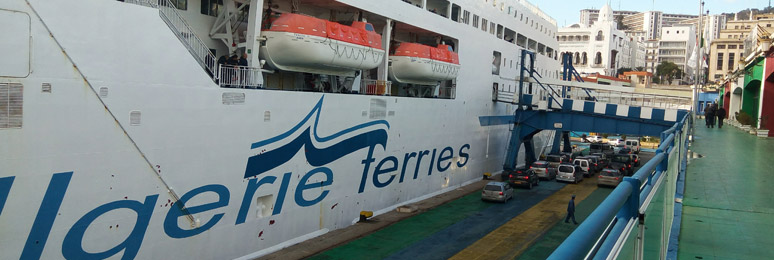
Algerie Ferries ship boarding in Algiers port. Courtesy of Andrew Gaskill.
Morocco - Algeria
The Morocco-Algeria border has been closed for some years and travel between these countries along the North African coast is not possible.
Tunisia - Algeria
The Tunisia-Algeria border is open, see the travel advice at www.gov.uk/foreign-travel-advice. The Algerian and Tunisian rail networks are connected and since August 2024 a train links Annaba with Tunis 3 times a week, restoring a link that last operated in 1995, give or take an abortive attempt in 2003:
Westbound Tunis to Annaba: Leaves Tunis at 08:25 on Mondays, Wednesdays & Fridays, arriving Annaba at 18:25.
Eastbound Annaba to Tunis: Leaves Annaba at 09:00 on Tuesdays, Thursdays, Sundays, arriving Tunis 18:27.
The train has two 1st class cars and two 2nd class cars, cafe car & baggage van.
Fare: 1st class 1,900 DZD (about €13), 2nd class 1,640 DZD (€11). Buy at the station.
Distance 357 km. If you travel this way, feedback & photos would be appreciated!
Traveller Philip Dyer-Perry took this train in 2026: "Annaba station is another stunning place – with the trainshed, concourse and frontage being beautiful. The city is also rather nice, but I just nipped up to see the Basilica of St. Augustine and then came back again. Taxis cannot be found outside the station, but a block south of the station, on the west of the tracks, opposite the station garden. Around 07.00 I was one of the first to buy a ticket for the thrice-weekly Annaba – Tunis train, due to depart at 09.10. Around €10 got me a first-class ticket. It was necessary to show a passport to buy the ticket. Boarding was controlled with a ticket and passport check, followed by the manual bag search. The train itself was in top condition with everything working, power sockets, reading lights, toilets, aircon, the lot. The onboard buffet was again the usual selection."
Traveller report (2025): "Very similar experience to Alex Schindler. We bought the tickets 2 days before, they said you can buy up to 6 days before. Not many people in the train. Tickets and passports checked before boarding. The train is old but it's renovated and quite comfortable inside. 1 class ticket 44 tnd. There was a restaurant with limited selection of drinks & snacks, you could also buy something at Tunisia Ghardimiau but better to have also some food with you. Customs on both sides were rather slow, might take a long time if the train was full. We arrived a little late 19.15, it's very slow but the landscape is nice especially the Algerian side."
Traveller Alex Schindler reports (2024): "I bought a ticket one day before in the evening, price 2nd class 38 TZD. Designated seating is irrelevant, you sit where you like, padded soft seats are comfy, plug available at the seat. Departure was punctual 8:25, the train was relatively empty. Cleanliness and amenities very good by Tunisian standards, toilet was somehow working. Your passport must be registered at the cashier desk just before departure. Left Ghardimaou (Tunesia) border post with 1 hour delay (no problems with customs), very welcoming officers in Souk Ahras (Algeria) no problems at all. Train arrived in Annaba very slowly with several stops 3 hours delayed at 21:30.
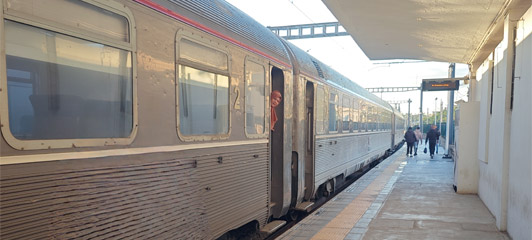
The Tunis-Annaba train, near the border. Photo courtesy of Ramon Arland.


2nd & 1st class seats on the Tunis-Annaba train. Photos courtesy of Tuomo Janatuinen.

Above left, ready to leave Annaba station. Above right, at the border at Souk Ahras, 'Algeria thanks you for your visit'. Courtesy Philip Dyer-Perry.
Train travel in Algeria
A train network runs along the Mediterranean coast, linking Oran, Algiers, Constantine and Annaba amongst other towns. Trains are operated by SNTF, for times and fares see www.sntf.dz (which may or may not successfully produce train times!). The most important trains have 1st & 2nd class and air-conditioning. If you have any feedback or photos, please let me know.
Algiers to Oran, 421 km, 4 trains every day typically leaving Algiers Agha station at 05:50, 08:00, 14:00 & 17:00, journey time 4h to 5h.
Algiers to Constantine, 464 km, 2 daytime trains per day from Algiers Agha station (direct at 07:25 and at 12:30 with a change at Setif), plus a sleeper train at 21:30.
Algiers to Annaba, 631 km, one overnight train every day leaving Algiers Agha station at 21:30. It has 1st class 4-berth couchettes, 2nd class 6-berth couchettes, 2nd class seats & catering car. 1270 dinars for a 1st class couchette. You can book a 4-berth for sole occupancy if you buy 4 tickets.
Algiers station
The original Algiers main station is now only used by suburban trains. See location map.
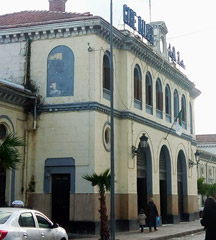
Algiers station, exterior. Courtesy of Philip Dyer-Perry.
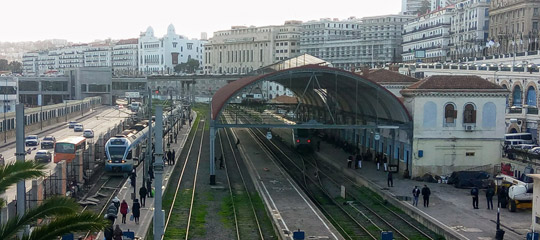
Algiers station, overview. Courtesy of Andrew Gaskill.
Algiers Agha station
Long-distance trains are mostly relegated to the charmless Algiers Agha station, see location map. It's still central, but a 22-minute 1.5 km walk south of Algiers station.


Agha station, outside and in. Courtesy of Philip Dyer-Perry.
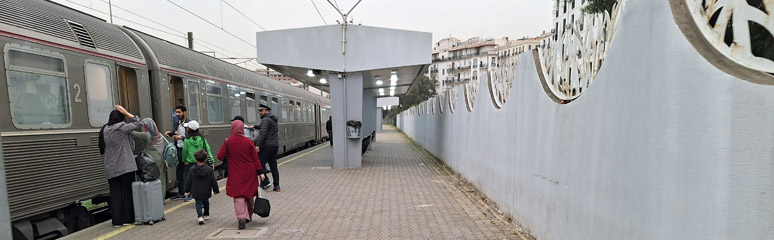
The night train to Annaba, boarding at Algiers Agha station. Courtesy of Philip Dyer-Perry.
On board the trains
Long distance trains have air-conditioned 1st & 2nd class. Overnight trains have 6-berth couchettes (basic padded bunks in lockable compartments with upper, middle and lower bunks each side), but no proper sleepers.


2nd & 1st class seats on the Algiers-Annaba train. Photos courtesy of Philip Dyer-Perry.

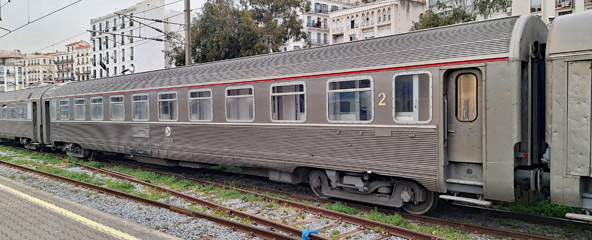
Above left, 6-berth couchettes on the Algiers-Annaba train. Above right, couchette car. Photos courtesy of Philip Dyer-Perry.